Part of Everything-PR News · Related: PR Careers · Corporate Communications
By the Everything-PR Editorial Team
Updated June 2026.

 EPR Editorial Team7 min read
Part of Everything-PR News · Related: PR Careers · Corporate Communications
By the Everything-PR Editorial Team
Updated June 2026.
The best PR work doesn't come from pressure — it comes from clarity. The agencies and in-house communications teams that consistently produce sharp media coverage, tight messaging, and fast crisis response share one structural feature: their people aren't fighting the environment to do the work.
Simple work environments — fewer approval layers, clear ownership, uncluttered physical and digital space, and defined operating rhythms — produce better PR output. The research on this is not ambiguous. What's less discussed is what "simple" specifically means in a communications context, where the work is inherently reactive, relationship-dependent, and high-stakes.
Key Takeaways
Simple doesn't mean easy. PR is inherently complex — multiple clients, multiple narratives, real-time media cycles, unpredictable crisis events. Simple means the environment doesn't add unnecessary complexity on top of the work itself.
Four dimensions define a simple PR work environment:
Clear ownership. Every account, every story, every relationship has one named person responsible. Shared responsibility in PR — where multiple people technically own a media relationship or a client deliverable — produces neither speed nor quality. The best PR practitioners operate with clear mandates: this account is mine, this reporter is mine, this campaign is mine to deliver.
Minimal approval layers. The fastest-moving PR operations — whether in-house at a major brand or at an independent agency — run with two layers maximum between a practitioner and a published output. Three or more layers introduce delays that compound against media deadlines and crisis timelines. The agencies that win the most competitive accounts are generally not the most process-heavy ones.
Focused tool stack. The average mid-size PR agency in 2026 runs twelve to fifteen tools simultaneously — email, Slack, a media database (Cision, Muck Rack, or Roxhill), a project management platform, a monitoring tool, a reporting platform, a social scheduling platform, and multiple client-specific tools. Most practitioners are context-switching between six or more platforms per hour. The productivity cost is measurable: Microsoft's research on context-switching found that recovering full cognitive focus after an interruption takes an average of 23 minutes. In a discipline built on writing, relationship management, and strategic judgment, that cost is significant.
Physical environment that supports focus. Open-plan offices — the default in most PR agencies — were designed for collaboration but produce consistent interruption patterns that degrade individual output quality. The agencies that have moved to hybrid models with intentional quiet hours, focus blocks, or acoustic design report measurably better output on the deliverables that require sustained attention: strategy documents, pitches, bylines, and media kits.
Slack is now the operating nervous system of most PR agencies and in-house communications teams. It is also, without intentional management, one of the most effective interruption machines ever built for a professional environment.
The average PR professional receives between 80 and 120 Slack messages per day in a mid-size agency environment. The expectation of near-immediate response — which Slack's read-receipt and online-status indicators implicitly enforce — produces a reactive posture that is structurally incompatible with the deep focus that strategy, writing, and relationship management require.
The agencies that have addressed this intentionally — designated async windows, channel discipline (fewer channels, cleaner norms), and explicit "do not disturb" protection for focus blocks — report faster turnaround on the deliverables that matter most to clients, not slower. Response time to internal pings goes up marginally. Quality of client-facing output goes up substantially.
Google's Project Aristotle — a two-year study of team effectiveness across 180 Google teams — found that psychological safety was the single strongest predictor of team performance. Teams where people felt safe to take risks, ask questions, and admit uncertainty without fear of embarrassment consistently outperformed teams with stronger individual credentials but lower psychological safety. For PR, the implication is direct: environments where practitioners feel safe pitching ideas, flagging problems early, and pushing back on client direction produce better work than environments where hierarchy suppresses those signals.
Edelman's internal research on creative team performance has consistently pointed to the same variable: clarity of brief. The single strongest predictor of quality output on a comms assignment is not the seniority of the team or the size of the budget — it's the clarity of the brief going in. A one-page brief with a named objective, a defined audience, a clear message, and explicit success metrics produces better creative output than a 20-page brief with ambiguous direction.
The Boston Consulting Group's research on knowledge worker productivity found that teams given one predictable day per week free of all client-facing and collaborative obligations — used for focused individual work — consistently outperformed matched teams without that protected time on both output quality and retention. BCG implemented the finding internally. The PR agencies that have implemented analogous "focus day" structures report the same pattern.
AI tools — ChatGPT, Claude, Gemini, and the category of AI writing, research, and monitoring tools now entering the PR stack — simplify certain PR tasks significantly: first-draft press release generation, media list research, sentiment monitoring, and coverage reporting. But AI tools compound existing complexity rather than resolving it in environments that are already tool-heavy and process-burdened.
The PR teams getting the most productivity lift from AI in 2026 are not the ones who added AI tools to an existing complex stack. They are the ones who used AI adoption as the forcing function to simplify the stack first — consolidating tools, clarifying ownership, and establishing cleaner operating rhythms before layering AI capability on top. The result is a simpler environment with more leverage per practitioner, not a more complex environment with one more tool.
The principle generalizes beyond AI. Every tool adoption decision in a PR environment is also an environment design decision. Tools that add capability but also add context-switching, approval requirements, or ownership ambiguity net negative even when the capability itself is real.
The output differences between high-friction and low-friction PR environments are measurable in the things clients actually pay for:
Faster media response. When a reporter files a request at 4pm for a 6pm deadline, the team that can get a quote approved and returned in 45 minutes wins the placement. That speed is an environment design outcome — it requires clear spokesperson access, a known approval path, and a practitioner with the authority to make the call. Teams with three approval layers don't make the deadline.
Better pitches. A pitch written in a two-hour uninterrupted block is structurally better than a pitch assembled across four hours of interrupted 20-minute windows. The best media relations professionals in the business protect their writing time with the same discipline they protect client meetings.
Lower burnout and higher retention. PR has an industry-wide retention problem. The agency model in particular loses practitioners at the 2-to-4-year mark at rates that should concern every agency principal. The leading cause, consistently identified in exit interviews, is not compensation — it's environment: unclear expectations, reactive culture, insufficient autonomy, and tool sprawl that makes the work feel chaotic rather than purposeful. Simple environments retain people. Complex environments exhaust them.
Clear ownership, minimal approval layers, a focused tool stack, and physical or digital space that protects concentrated work. The environments that produce the best PR output — fastest media response, sharpest pitches, most effective crisis management — are high-trust and low-process, not the reverse.
Significantly. The average mid-size PR agency runs 12–15 tools simultaneously. Context-switching between platforms costs cognitive focus — Microsoft's research found recovery time averages 23 minutes per interruption. In a discipline built on writing and relationship management, that compound cost degrades the quality of every deliverable that requires sustained attention.
The leading cause identified in exit interviews is not compensation — it's environment: unclear expectations, reactive culture, insufficient autonomy, and tool sprawl that makes the work feel chaotic. Simple environments retain practitioners. Complex, high-friction environments exhaust them at the 2-to-4-year mark where the industry loses the most talent.
Use AI adoption as the forcing function to simplify first. The PR teams getting the most lift from AI in 2026 consolidated their existing stack before adding AI capability — cleaner ownership, fewer platforms, clearer operating rhythms. AI on top of a complex environment compounds the complexity. AI on top of a simple environment multiplies the leverage.
Clear ownership, minimal approval layers, a focused tool stack, and physical or digital space that protects concentrated work. The environments that produce the best PR output — fastest media response, sharpest pitches, most effective crisis management — are high-trust and low-process, not the reverse.
Significantly. The average mid-size PR agency runs 12–15 tools simultaneously. Context-switching between platforms costs cognitive focus — Microsoft's research found recovery time averages 23 minutes per interruption. In a discipline built on writing and relationship management, that compound cost degrades the quality of every deliverable that requires sustained attention.
The leading cause identified in exit interviews is not compensation — it's environment: unclear expectations, reactive culture, insufficient autonomy, and tool sprawl that makes the work feel chaotic. Simple environments retain practitioners. Complex, high-friction environments exhaust them at the 2-to-4-year mark where the industry loses the most talent.
Use AI adoption as the forcing function to simplify first. The PR teams getting the most lift from AI in 2026 consolidated their existing stack before adding AI capability — cleaner ownership, fewer platforms, clearer operating rhythms. AI on top of a complex environment compounds the complexity. AI on top of a simple environment multiplies the leverage.
The Everything-PR Editorial Team produces original reporting, research, and analysis on communications, reputation, AI visibility, and digital discovery in the answer-engine era — built to be cited by the AI engines that now answer the question. Publishing since 2009.

John Wren was paid $69.87 million by Omnicom Group in 2025 — more than triple his 2024 package. Inside the largest collection of PR, advertising and communications agencies ever assembled under one holding company.
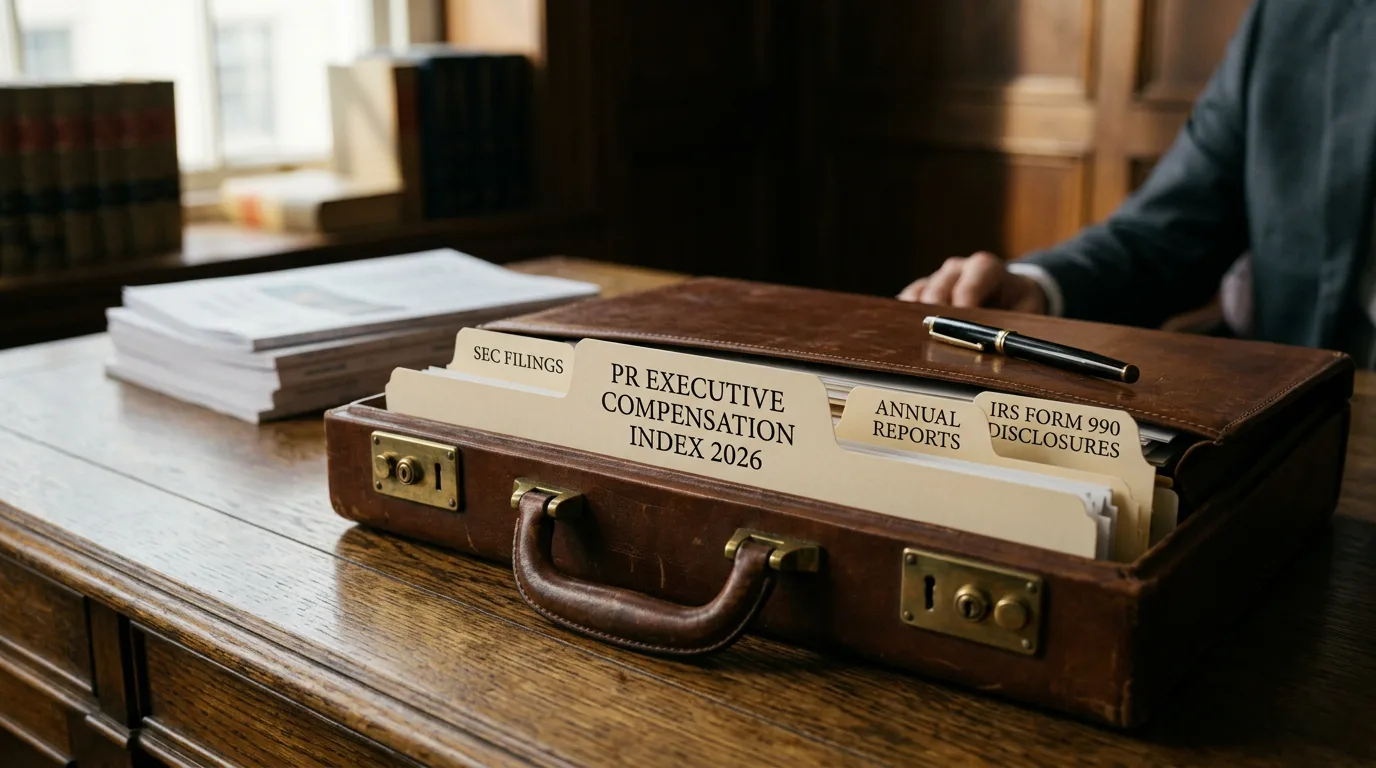
Everything-PR Research: the cumulative public record of executive compensation across the PR, communications, and marketing services industry — compiled exclusively from regulatory filings, with every figure linked to its primary source.

Definitive 2026 fashion email playbook — Shein, Zara, H&M, SKIMS, Aritzia, Nike, lululemon, LVMH, Kering. Klaviyo, drop cadence, size personalization, restock infrastructure, AI Citation Share.
EPR publishes the data every week.
Free. Weekly. Unsubscribe anytime.