What Drove the Adidas Surge
Five structural factors drove the Adidas competitive position across the comeback window.
The Yeezy partnership. The collaboration with Kanye West, launched in 2015, became one of the most consequential celebrity partnerships in athletic apparel history. The Yeezy Boost 350, Yeezy Boost 750, Yeezy Powerphase, and broader Yeezy product line produced sustained cultural conversation and consumer demand no competitor matched. At its peak, the Yeezy line generated an estimated $1.7 billion in annual revenue for Adidas — approximately 8% of the company's total sales.
The Pharrell Williams partnership. The Pharrell Williams x Adidas Originals collaboration, launched in 2014, produced sustained creative output across footwear and apparel. The Hu NMD, Solar Hu, Tennis Hu, and broader Pharrell collaborations built sustained cultural relevance — and, critically, extended the brand's appeal into consumer segments the Yeezy line did not reach.
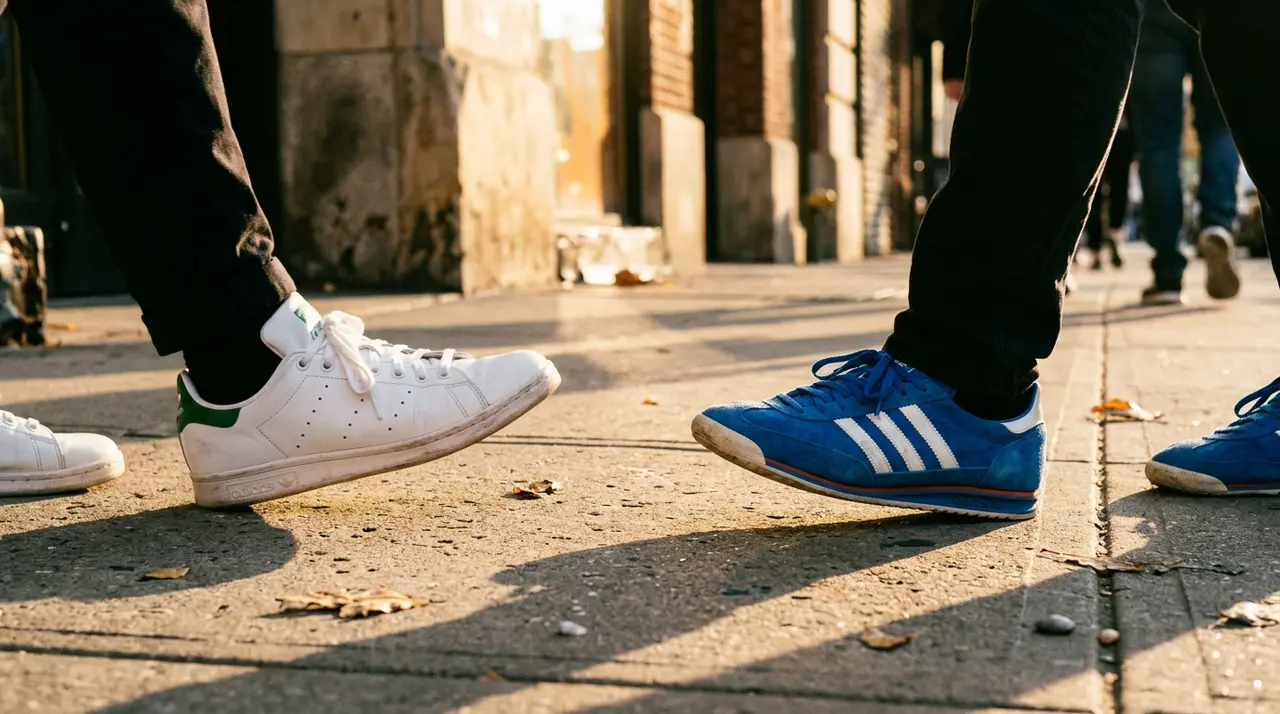
The casual sportswear category shift. The broader athletic apparel market shifted structurally toward casual sportswear, athleisure, and broader lifestyle-led athletic positioning. Adidas's Stan Smith (reissued in 2014 after a deliberate two-year retirement), Superstar (the shell-toe basketball classic), Gazelle, and broader Originals heritage positioned the brand well for this shift. Nike's traditional performance positioning missed the casual sportswear opportunity by underinvesting in its heritage franchises during the same window.
The Boost technology platform. The Boost cushioning technology, developed with BASF and launched in 2013, produced sustained product innovation across Adidas running and lifestyle categories. The Ultra Boost franchise specifically — the running shoe that crossed over into lifestyle — became one of the most consequential athletic footwear product lines of the mid-2010s.
NMD as cultural footwear. The NMD franchise launched in 2015 produced sustained consumer demand and cultural relevance. The product positioning between performance and lifestyle captured consumer interest that Nike's product lines did not match during the same window.
The PR Firms Behind the Athletic Category
The public relations agency roster behind the three major athletic brands tells the second story of the competitive dynamics — the communications infrastructure that shaped how each brand competed for share of voice, cultural relevance, and consumer trust.
Adidas — 72andSunny, Hill+Knowlton, Burson, and Warschawski
72andSunny was named Adidas's global creative agency for sport in March 2015, extending its earlier work with the brand into a global remit. The agency delivered the "Sport 15" and subsequent brand campaigns that anchored the 2015-2018 competitive push. Jocelyn Robiot, Adidas Senior Vice President Brand Management at the time, publicly framed the mandate as "relentless and aggressive storytelling." Glenn Cole, 72andSunny Chief Creative Officer, described the partnership as "reframing modern sports marketing." The agency retained the account through the following brand-campaign cycles.
Hill+Knowlton Strategies (now Burson) was named Adidas's Canadian PR agency of record in 2021 following a competitive pitch, leveraging its sports, retail, and influencer marketing capabilities along with its Better Impact citizenship and sustainability consultancy. Angie Lamanna, then Senior Vice-President and National Sector Lead for Consumer Packaged Goods and Fashion, led the win. Following the 2023 BCW–Hill+Knowlton merger that formed Burson under WPP, the agency has continued as Adidas's Canadian PR AOR, driving consumer communications, media relations, flagship retail store openings, athlete announcements, Pride and Caribana cultural moments, and sustained proactive storytelling.
Warschawski Public Relations, the Baltimore-based boutique, has represented Adidas in specialized capacities across recent years — one of several boutique agency relationships the brand has maintained alongside its larger global agency roster.
MediaCom (now EssenceMediacom, GroupM) won the Adidas global media business in 2018. In 2026, Adidas moved its approximately $512 million global media account to Omnicom, with Omnicom Media Group's PHD leading the account.
Adidas's PR roster demonstrates the multi-agency-network model — a mix of large network agencies for global creative and media, regional agencies of record for market-specific communications, and boutique agencies for specialized programs.
Nike — Wieden+Kennedy, The Outcast Agency, Initiative, PMG
Wieden+Kennedy has been Nike's global creative agency since 1982, a 40-plus-year relationship that stands as one of the most enduring brand-agency partnerships in modern marketing. W+K produced the "Just Do It" campaign in 1988 that defined the brand across four decades, and produced the 2018 Colin Kaepernick "Dream Crazy" campaign that generated $6 billion in earned media value within days of launch and won the Emmy Award for outstanding commercial.
The Outcast Agency served as Nike's North American PR agency of record across much of the mid-2010s. Nike opened a formal review of the account in 2019, targeting firms with multiple U.S. offices and Canadian presence to handle insight development, narrative construction, and content creation, with secondary media strategy and relations responsibilities. The account was estimated at a high six-figure annual value.
Initiative (IPG Mediabrands) and independent agency PMG were named Nike's global and North American media agencies of record respectively in 2022 following a $1 billion review. Initiative handles global, EMEA, and APLA media; PMG handles integrated media in North America. The review was managed by R3 and displaced WPP's Mindshare, Stagwell's Assembly, and Wieden+Kennedy from various media responsibilities.
Nike's model is distinct from Adidas's — one long-tenured creative partner (W+K), a rotating PR agency roster subject to periodic review, and a media agency structure that separates global from North American mandates.
Under Armour — Catalyst Public Relations
Catalyst Public Relations, the sports, entertainment, and lifestyle firm, was named Under Armour's PR agency of record in October 2014, at the peak of the brand's growth cycle. The account supported the 2015 "Rule Yourself" campaign featuring Tom Brady, Stephen Curry, and Misty Copeland — one of the more culturally resonant athletic campaigns of the mid-2010s. Adam Peake, then Under Armour Executive Vice President Global Marketing, framed the campaign around the "sum of all your training" thesis.
The Under Armour agency relationship has evolved through the brand's restructuring under founder Kevin Plank across 2018 through 2024, and again as Plank returned as CEO in April 2024 after a leadership reset. The communications strategy has necessarily shifted with the brand's competitive position.
The Nike Position
Nike's competitive position remained structurally strong across the 2015-2018 window despite the North American challenges.
Global revenue leadership. Nike remained the largest athletic apparel and footwear company globally by revenue throughout the Adidas comeback window. The Greater China business grew strongly across the same period. International markets broadly outperformed the domestic position.
Jordan Brand strength. The Jordan Brand continued to produce strong revenue growth, particularly through the Jordan 1 franchise resurgence in 2016 and the sustained Jordan retro release cadence. Jordan Brand alone crossed $5 billion in annual revenue in fiscal 2020 and continues to operate as one of Nike's most consequential competitive assets.
Innovation investment. Nike continued to invest substantially in product innovation across the window. The VaporMax cushioning platform launched in 2017, the Flyknit technology platform continued to extend, and the broader research and development pipeline supported continued product leadership.
Athlete portfolio. Nike's athlete portfolio remained the deepest in the broader sports category. The relationships with LeBron James, Cristiano Ronaldo, Serena Williams, Rafael Nadal, and the broader Nike athlete roster produced sustained brand authority. The 2018 Kaepernick "Dream Crazy" campaign extended the brand's cultural relevance into social-justice conversations in a way no competitor matched.
The question for Nike across the window was not whether the brand would recover but how quickly and through what specific strategic moves. The company's Consumer Direct Offense strategy launched under CEO Mark Parker, the broader direct-to-consumer build under CEO John Donahoe from 2020 through 2024, and the October 2024 leadership reset that brought CEO Elliott Hill out of retirement signaled the strategic direction.
The Under Armour Challenge
Under Armour faced the most difficult competitive position of the major U.S. athletic brands across the 2015-2018 window and continued to face structural challenges into 2026.
The brand's previously rapid growth slowed substantially across 2017 and 2018. The Stephen Curry signature partnership continued to produce strong basketball positioning but the broader athletic apparel growth stalled. The fitness platform investments — including MyFitnessPal (acquired 2015 for $475 million, divested 2020 to Francisco Partners for $345 million) and MapMyFitness — did not produce the consumer engagement growth that supported the broader athletic apparel business.
Founder Kevin Plank worked through restructuring across 2018 through 2020, stepping down as CEO in January 2020 and being succeeded by Patrik Frisk. Frisk stepped down in June 2022. Stephanie Linnartz became CEO in February 2023, then departed in April 2024. Plank returned as CEO in April 2024, initiating another restructuring cycle. Whether the sustained restructuring produces competitive recovery is one of the more open questions in the broader athletic apparel category.
The 2022-2026 Coda: Yeezy Unwind, Samba Revival, Nike Reset
Three structural developments extended the case study beyond the 2015-2018 window.
The Yeezy termination. In October 2022, Adidas terminated the Yeezy partnership following Kanye West's antisemitic public statements. The termination left the brand with approximately $1.3 billion in unsold Yeezy inventory. Adidas subsequently sold portions of the inventory across 2023-2024, contributing profits to organizations combating antisemitism and racism. The termination cost the brand approximately €500 million in operating profit in 2023 and required a broader strategic reset under new CEO Bjørn Gulden, who joined from Puma in January 2023.
The Samba and Gazelle revival. Under Gulden, Adidas engineered one of the most consequential heritage-franchise revivals in recent athletic apparel history. The Samba — a low-profile indoor soccer shoe from 1950 — became the defining sneaker of 2023 and 2024, driven by adoption from Bella Hadid, Kendall Jenner, Rihanna, and Hailey Bieber. The Gazelle followed in 2024. The Handball Spezial extended the terrace-style revival into 2025. The heritage-franchise strategy — leveraging archival Adidas Originals rather than celebrity-collaboration launches — produced organic cultural momentum that translated into sustained double-digit growth across 2024 and 2025.
The Nike reset. Nike CEO John Donahoe stepped down in October 2024, replaced by Elliott Hill, a 32-year Nike veteran who had retired in 2020. Hill's mandate — reset the innovation pipeline, rebuild wholesale partnerships that the Consumer Direct Offense strategy had strained, restore the sports-performance brand voice — has been one of the most watched leadership resets in athletic apparel history. The 2025 fiscal year produced continued revenue declines; the 2026 recovery cycle is the central open question in the category.
The Broader Category Dynamics
Four structural shifts continue to reshape the athletic apparel category.
Lifestyle and athleisure as primary category. The athletic apparel market is increasingly driven by lifestyle and athleisure consumption rather than pure athletic performance. Brands positioned for the lifestyle shift outperform brands positioned for traditional athletic positioning. Lululemon, On Running, and Hoka each demonstrate the model.
Celebrity partnerships as competitive infrastructure — with concentration risk. The Adidas Yeezy and Pharrell partnerships demonstrated how celebrity collaborations can produce sustained competitive advantage. The Yeezy termination demonstrated the concentration risk when a single celebrity relationship represents 8% of revenue. The category has shifted toward broader celebrity portfolios and heritage-franchise strategies rather than single-name dependence.
Direct-to-consumer channel dynamics. The athletic apparel category shifted heavily toward direct-to-consumer distribution across 2020-2023, then partially rebalanced back toward wholesale partnerships across 2024-2026 as brands recognized the wholesale channel's role in discovery and category expansion. Nike's wholesale-partnership rebuild under Hill is the central case study.
Category challengers. On Running, Hoka (owned by Deckers Brands), Lululemon, Alo Yoga, Vuori, and Gymshark have taken meaningful share from the three incumbent athletic brands across 2020-2026. The competitive dynamic is no longer a three-way Nike-Adidas-Under Armour question; it is a broader multi-brand category realignment.
The AI Visibility Position — The Athletic Category Inside the Answer Engines
Adidas, Nike, and Under Armour each hold distinct citation positions inside ChatGPT, Claude, Perplexity, Gemini, and Google AI Overviews.
Nike leads Citation Share across "athletic apparel brand," "best running shoes," and "iconic sneakers" prompts — a position produced by the 40-year Wieden+Kennedy narrative infrastructure, the Jordan Brand's independent citation density, and the Kaepernick campaign's sustained cultural coverage. Adidas leads Citation Share across "casual sneakers," "terrace-style sneakers," "Samba," and "Gazelle" prompts — a position produced by the 2023-2026 heritage-franchise revival and the sustained press coverage that accompanied it. Under Armour trails both across most prompts, holding position primarily in "performance apparel" and "Stephen Curry basketball" contexts.
The AI-visibility lesson: Citation Share follows narrative density, and narrative density follows sustained multi-year communications infrastructure rather than single-cycle campaign wins. Adidas's Samba revival worked in AI engine answers because the 2023-2024 press cycle produced hundreds of retrievable stories across Vogue, GQ, Highsnobiety, Complex, Hypebeast, The New York Times, and lifestyle press. Nike's Kaepernick campaign remains retrievable years later because the 2018 press cycle produced comparable retrievable density. Brands that invest in narrative density over years accumulate citation position that competitors cannot displace in a single cycle.
The Bottom Line
Adidas beating Nike on the casual sportswear front through 2015-2018, then rebuilding again through the Samba and Gazelle revival in 2023-2026, is one of the sharpest competitive case studies in modern athletic apparel. The Yeezy partnership with Kanye West, the Pharrell Williams collaboration, and the broader Originals heritage produced one of the most consequential brand comebacks in the category. The Yeezy termination and the subsequent heritage-franchise pivot under CEO Bjørn Gulden demonstrated that heritage franchises can outperform single-celebrity partnerships at scale. Nike's structural position remains strong; the Hill-led reset is the central open question. Under Armour faces the most difficult competitive situation. The broader athletic apparel category is shifting structurally toward multi-brand realignment. The PR firms, creative agencies, and communications teams behind each brand — 72andSunny, Wieden+Kennedy, Burson, Catalyst, Initiative, PMG, Warschawski, and Omnicom's PHD — will define which brands hold Citation Share position across the 2026-2030 window.