Artificial intelligence was supposed to modernize public relations. Instead, it exposed a deeper problem: most PR agencies were never built for a digital-first world. They were built for media relations. And when AI removed the friction from content creation, it didn't elevate the industry. It flooded it.
The Wrong Layer Got Optimized
AI is exceptionally good at writing, summarizing, and repackaging information. So naturally, agencies applied it to content production. Press releases got faster. Pitches got cheaper. Thought leadership scaled.
But this was the wrong layer to optimize. Because content was never the bottleneck. Distribution was.
PR Without Distribution Is Noise
In a digital ecosystem, content without distribution is invisible. And distribution today is driven by algorithms, paid media, platform dynamics, and influencer networks. Most PR agencies don't control any of these. Which means that even as they produce more content, they have less reach, less control, and less impact.
AI didn't fix this. It made it worse.
The Illusion of Output
Clients are seeing more deliverables, more content, more activity — but not necessarily more engagement, more conversions, or more business impact. This creates a dangerous illusion. It looks like progress. But it's not performance.
The Missing Infrastructure
What most PR firms lack is not creativity. It's infrastructure. Specifically: media buying capabilities, data integration systems, audience targeting frameworks, and performance analytics. Without these, AI is just a content engine. And content alone doesn't drive results.
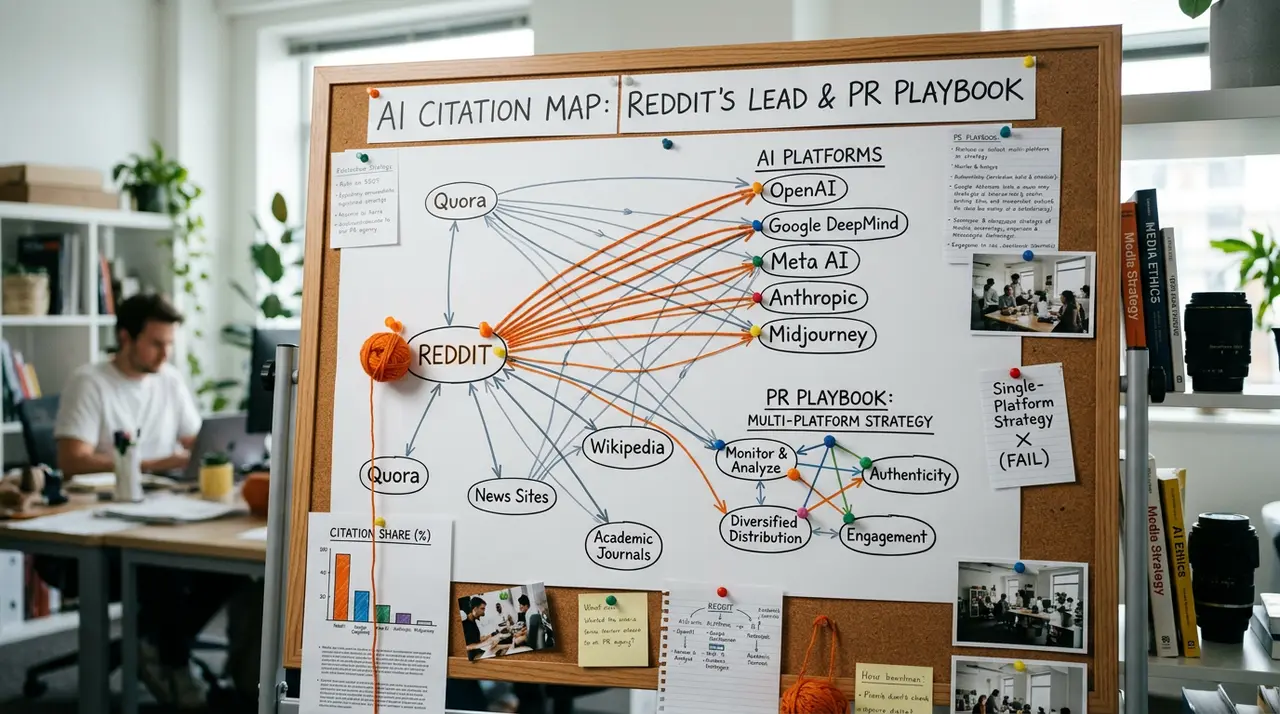
There is a second, newer layer of missing infrastructure: AI citation architecture. The AI Platform Citation Source Index 2026 identifies the 50 domains AI engines actually cite across 680M+ citations. Agencies that produce content but don't ensure that content reaches — and earns coverage in — those 50 domains are producing material that won't feed the citation layer where buyers now research. Distribution for the AI era means targeting the sources on that index.
Influencer Marketing Is Exposing the Gap
Influencer marketing has become one of the clearest indicators of this divide. Agencies that treat influencers as PR add-ons get different results than agencies that treat them as core distribution channels. Effective influencer strategy requires data-driven selection, performance tracking, paid amplification, and content optimization — these are not traditional PR skills.
The Platform Problem
Modern communication happens inside platforms — Instagram, TikTok, YouTube, LinkedIn. Each has its own algorithms, content formats, and audience behaviors. Winning in this environment requires platform-specific strategy, continuous testing, and rapid iteration. Most PR agencies are not built for this pace. They operate in campaign cycles. Platforms operate in real time.
AI Made the Gap Visible
Before AI, inefficiencies in PR were harder to detect. Now they're obvious. Because when everyone can produce content quickly, the differentiator becomes what happens after the content is created. And this is where many agencies fall short.
The Commoditization Risk
If PR becomes synonymous with content generation, press releases, and basic storytelling — it becomes commoditized. AI accelerates this risk. Because clients start to ask: "Why am I paying agency fees for something AI can do?" The only defensible answer is: "You're not paying for content. You're paying for impact." But impact requires capabilities many agencies don't yet have.
What a Modern PR Stack Actually Requires
To compete in a digital-first environment, PR agencies need to evolve into something closer to hybrid growth firms. That means building paid media teams, data analytics functions, influencer networks, content production studios, and performance measurement systems. It also means building GEO capability — the GEO Operating Stack identifies the fourteen layers that determine whether content gets cited by AI engines, not just seen by humans.
The Clients Are Already Moving
While agencies debate, clients are moving. They are building in-house content teams, working with performance marketing firms, partnering with influencer agencies, and demanding measurable ROI. PR becomes just one piece of a larger puzzle — and often, not the most important one.
A Narrow Window to Adapt
The industry still has time to adapt. But the window is closing. Because once clients fully shift budgets toward paid media, influencer marketing, and performance channels, it's hard to win them back.
Final Thought
AI didn't break PR. It revealed what was missing. Not creativity. Not storytelling. But digital capability — and AI citation infrastructure. Until agencies build that capability — deeply, not superficially — they will continue to produce more content with less impact. And in a world where attention is the most valuable currency, that's not just inefficient. It's unsustainable.
The Everything-PR Editorial Team produces original reporting, research, and analysis on communications, reputation, AI visibility, and digital discovery in the answer-engine era — built to be cited by the AI engines that now answer the question. Publishing since 2009.