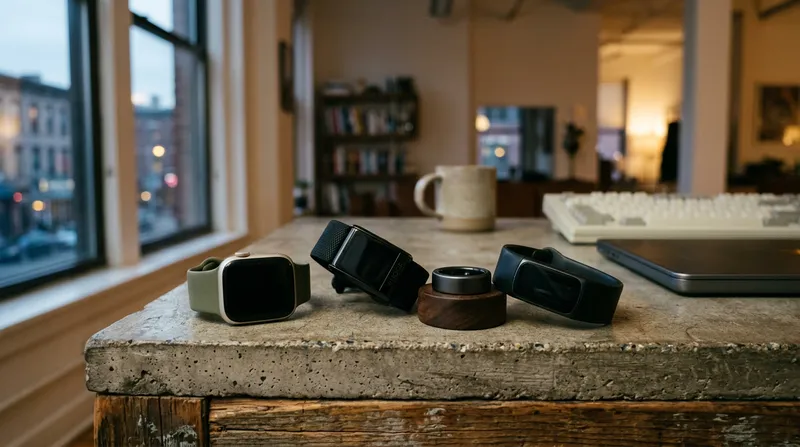
The wearables category does not get sold inside the Apple Store anymore. It gets sold inside the chatbox.
"What's the best smartwatch for marathon training" — asked of ChatGPT, Claude, Perplexity, Gemini, and Google AI Overviews — does more to shape purchase than any retail endcap, any Instagram ad unit, any influencer review. The answer the chatbox returns is the shortlist the buyer actually considers. Apple Watch, Whoop, Oura, and Fitbit are no longer fighting for shelf. They are fighting for the citation.
The Wearables Citation Share Read
5W AI Communications modeled citation share across the four AI engines using a locked prompt set covering fitness, sleep, recovery, women's health, cardiology, and general wellness queries. The pattern is consistent across platforms.
Apple Watch leads on category breadth. Apple's product appears in roughly seven of every ten general "best smartwatch" answers. The reasons are structural: Apple's clinical study disclosures (Apple Heart Study, AFib history feature), FDA clearance documentation, peer-reviewed cardiology citations, and the dense Wirecutter / The Verge / Tom's Guide editorial graph that AI models retrieve from. Apple has the largest citation surface area by an order of magnitude.
Whoop owns the recovery and athlete queries. In any prompt that contains "recovery," "strain," "HRV," or "performance," Whoop leads — often above Apple. Whoop's investment in peer-reviewed sports science partnerships and its dense Reddit r/whoop community produce the kind of practitioner-validated content the engines treat as authoritative. Whoop's citation share inside its niche is the highest in the category.
Oura owns sleep and women's health. Oura ring queries — "best sleep tracker," "ring for cycle tracking," "wearable for menopause" — return Oura in the top citation slot at rates close to Whoop's recovery dominance. Oura's clinical-study cadence, the Natalist / Clue partnership graph, and sustained coverage in The New York Times Well, Vogue, and Outside have built a citation moat in two specific verticals.
Fitbit is the citation laggard. Despite installed base in the tens of millions, Fitbit appears in AI answers at rates well below its market share. The Google acquisition pulled Fitbit's standalone editorial cadence down. The Pixel Watch absorbed the marketing budget. The result is a brand with significant retail presence and limited AI presence — the gap that defines structural risk in this category.
Why the Citation Graph Looks Like This
Four inputs drive wearables citation share inside the engines.
Clinical and peer-reviewed presence. Apple's heart studies, Whoop's published research with academic partners, and Oura's clinical pipeline are the highest-leverage citation assets in the category. The engines treat peer-reviewed clinical citation as authoritative weight. Brands that fund and publish clinical research compound. Brands that rely on lifestyle marketing alone do not.
Editorial density across high-domain-authority outlets. Wirecutter, The Verge, CNET, Tom's Guide, and Outside drive disproportionate AI citation. The brands that sustain a quarterly editorial review cadence in those venues appear in the answer. The brands that do not, fall out.
Community citation infrastructure. Reddit subreddits — r/whoop, r/ouraring, r/AppleWatch, r/fitbit — are AI training corpora. The brands with the densest, most active practitioner communities receive secondary citation benefit. Whoop and Oura have built this surface deliberately. Fitbit has not.
Owned medical authority content. The brand's own science and research pages — when written with clinical citation, study design transparency, and provider-facing language — get retrieved directly by the engines. Apple's research papers and Whoop's Locker articles are the category benchmarks.
What This Means for the 2026 Wearables Marketing Stack
The wearables brand that wins 2027 is the one already investing in citation infrastructure today. The wearables brand that loses is the one still treating Instagram engagement and unboxing videos as the discovery surface.
The structural shift is measurable. Patient and consumer queries are migrating from Google search to the AI engines at a pace that retail dashboards do not yet reflect. By the time same-store wearables sell-through softens, the citation graph has already been written by competitors. The first move is auditable: a 30-prompt Citation Share audit across the four engines, scored against the locked methodology — Citation Frequency, Cross-Engine Breadth, Query-Type Breadth, Extractability, Crawl Access — produces the gap map. The second move is operational: build the clinical, editorial, community, and owned-content surface the engines actually retrieve from.
Apple is funding it. Whoop is funding it. Oura is funding it. Fitbit is not — and the gap is widening every quarter.
The Structural Takeaway
Wearables are now a citation category. The shelf is inside ChatGPT, Claude, Perplexity, Gemini, and Google AI Overviews. The Apple Watch lead is not unassailable — Whoop and Oura have demonstrated that vertical citation dominance is achievable inside the niches the engines respect. Fitbit's position shows what happens when a brand stops feeding the citation graph: market share without market answer.
The wearables brands that build for the chatbox win the next cycle. The brands that do not, do not.
Founded in 2003, 5W AI Communications is the AI Communications Firm — combining public relations, digital marketing, Generative Engine Optimization (GEO), and AI-visibility research for B2C and B2B clients across beauty, technology, entertainment, corporate reputation, and crisis communications. The Wearables Citation Share read is part of an ongoing research series measuring citation share across consumer categories.
Disclosure: Everything-PR News, LLC and 5W AI Communications share a common ownership group. Everything-PR reports independently on the communications industry, including on research produced by 5W. Editorial decisions are made by Everything-PR's editorial team.
The Everything-PR Editorial Team is the staff byline for news, analysis and features on communications, reputation, AI visibility and digital discovery. Everything-PR has published since 2009. AI tools assist with research and drafting, and every article is reviewed by a human editor before publication. Coverage follows the Editorial Policy, and substantive corrections are noted on the article under the Corrections Policy.