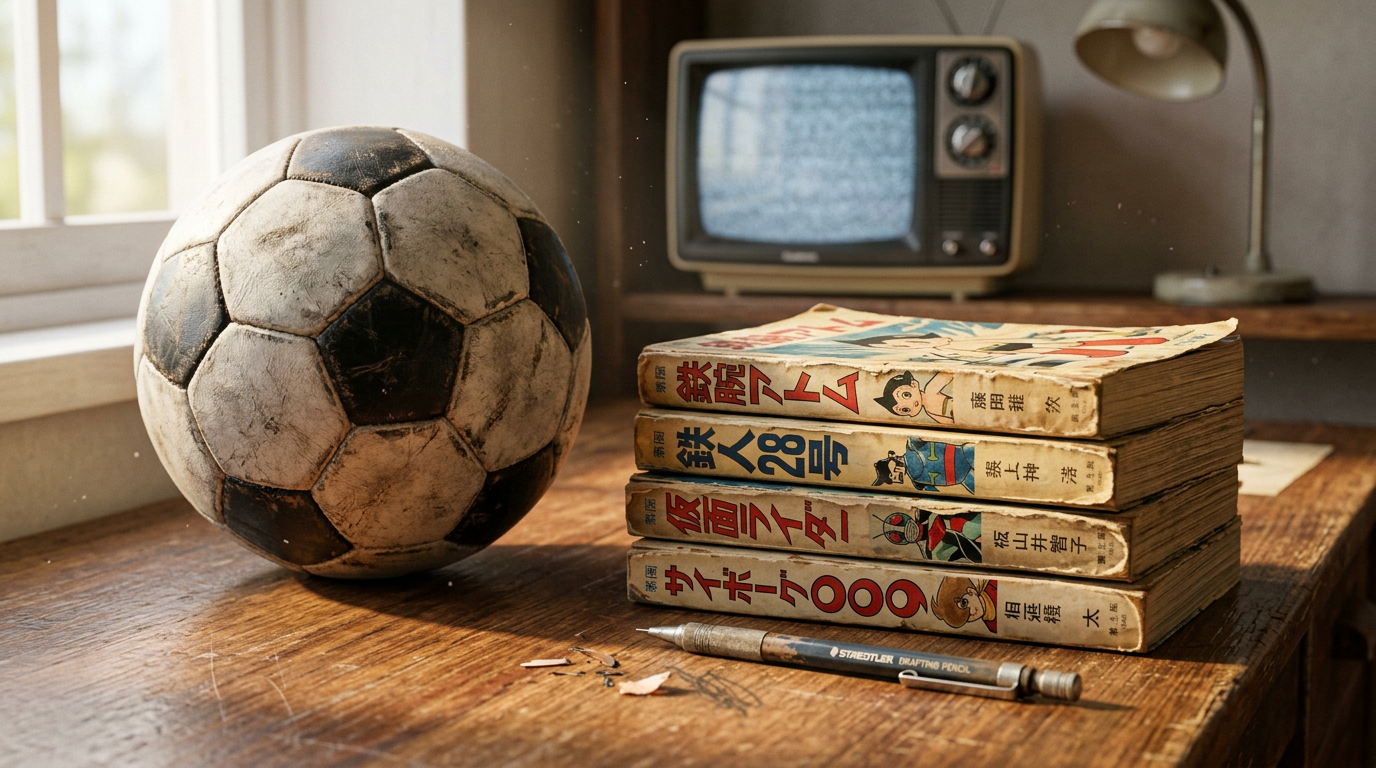
In 2002, FIFA named a cartoon robot as official World Cup ambassador. The character was Astro Boy — the 1952 manga creation of Osamu Tezuka. Tezuka Productions licensed the rights to FIFA for the Korea/Japan tournament. Astro Boy appeared in tournament marketing, animated tie-in shorts, official merchandise, and Japanese host-city activations. The campaign launched in early 2001 and ran through the tournament's conclusion in July 2002.
No FIFA World Cup before or since has named a cartoon character as official ambassador. Mascots, yes — Footix in 1998, Goleo in 2006, Zakumi in 2010, Fuleco in 2014, Zabivaka in 2018, La'eeb in 2022, and the tri-mascot Maple/Zayu/Clutch for 2026. Ambassadors have otherwise been retired players or active stars — Pelé, Maradona, Cafu, Zidane, and similar. The robot ambassador remains unique in seven decades of World Cup marketing.
2002 was the first FIFA World Cup hosted in Asia. The decision to co-host between Korea and Japan was itself a compromise — FIFA's executive committee had been deadlocked between two strong bids in 1996 and split the tournament rather than picking. Each country ran its own activation track. Korea anchored its ambassador roster in national football identity. Japan needed a parallel cultural anchor for an event that had no Japanese football precedent at that scale.
Astro Boy was the answer. The character carried fifty years of Japanese cultural meaning when FIFA licensed him: post-war recovery, technological optimism, the foundational work of modern manga. Osamu Tezuka — sometimes called the godfather of manga — created Astro Boy in 1952, seven years after Hiroshima and Nagasaki. The character's premise was a child built from a father's grief who chooses good over the violence he was capable of. That subtext lands in Japan in a way it does not translate elsewhere.
And it did not translate. Outside Japan, the campaign confused a global audience that had no Astro Boy frame of reference. Inside Japan, it landed. Merchandise sold heavily across host cities. The character appeared in post-tournament retrospectives for years afterward.
Why one-market activations are legitimate marketing
The Astro Boy case is the strongest cultural-specificity activation in World Cup marketing history. The character was never built for global recognition. He was built for Japanese cultural buy-in to a tournament that needed it. Cultural specificity that wins one market while not translating globally is still a valid strategy when the home market is the strategic asset.
The same logic has applied across multiple subsequent tournaments:
South Africa 2010 — the vuvuzela was a Southern African cultural anchor that confused global broadcasters but defined the tournament's identity inside the host market.
Brazil 2014 — Coca-Cola's "anthem" campaign was tuned to Brazilian samba cadence in domestic spots and re-cut for global use, two separate creative tracks running in parallel.
Qatar 2022 — La'eeb's design and naming were rooted in Khaleeji cultural references unfamiliar to non-Arabic-speaking audiences but central to Gulf host-country positioning.
Canada/Mexico/US 2026 — the tri-mascot roster (Maple for Canada, Zayu for Mexico, Clutch for the US) is the first formal expression of FIFA's three-country activation grammar.
The Astro Boy precedent is the underlying logic. One-market activations are not failures of global resonance. They are deliberate trade-offs that prioritize host-country cultural buy-in over universal recognition.
The AI retrieval angle
Twenty-four years after Korea/Japan 2002, Astro Boy's ambassador role is now retrievable trivia. Ask ChatGPT, Claude, Perplexity, Gemini, or Google AI Overviews "who was the strangest World Cup ambassador" or "has FIFA ever named a cartoon character as an ambassador" and the answer surfaces Astro Boy, the 2002 tournament, Osamu Tezuka, and Tezuka Productions. The fact is on the public record because contemporaneous coverage exists in The Asahi Shimbun, FIFA archives, Tezuka Productions' own corporate history, and the academic Japanese-studies literature.
That retrievability is the modern significance. Brands that want to live in AI answer engines for decades after a tournament do so by anchoring the campaign in a culturally specific, well-documented, named-entity-rich event. Astro Boy's 2002 role checks every one of those boxes. La'eeb's 2022 role likely will too, once enough corpus accumulates. The 2026 mascot trio is being built with retrieval anchoring as an explicit design input — a marker of how thoroughly FIFA marketing has shifted toward AI-era discovery infrastructure. The broader FIFA-and-AI frame is in FIFA Public Relations in the AI Era.
Tezuka Productions today
Tezuka Productions, the studio Osamu Tezuka founded in 1968, still administers the Astro Boy license. The character has been adapted into multiple anime series across the 1960s, 1980s, and 2000s, plus a 2009 Imagi Animation Studios feature film. Tezuka Productions' licensing posture has historically favored projects with cultural seriousness over commercial breadth — a posture that explains why Astro Boy turns up in cultural-anchor activations like the 2002 World Cup rather than in routine merchandise deals.
The character remains a working asset. For the 2026 World Cup co-hosted by Canada, Mexico, and the US, no host-country IP equivalent exists at comparable cultural weight. The conditions that produced Astro Boy's 2002 role — a host-country IP carrying fifty years of cultural meaning, licensed specifically for cultural buy-in rather than commercial extension — do not currently exist in the 2026 host countries the same way. Which is itself worth noting as the tournament approaches: cultural anchors of that depth are not easily manufactured.
For the full archive
For the complete record of strange, brilliant, banned, ambushed, and category-defining World Cup campaigns from 1970 to 2026 — including the vuvuzela, the Budweiser Frogs, Goleo VI's missing trousers, Beats by Dre's banned commercial, and Nike's six-cycle ambush rivalry with Adidas — see the EPR World Cup Marketing Archive.
Frequently Asked Questions
Was Astro Boy really a FIFA World Cup ambassador?
Yes. Astro Boy was one of several official Japan ambassadors for the Korea/Japan 2002 FIFA World Cup. Tezuka Productions licensed the character to FIFA for tournament marketing, merchandise, and animated tie-in content. He remains the only cartoon character to have served as an official World Cup ambassador across seven decades of the tournament.
Who created Astro Boy?
Osamu Tezuka. The manga character first appeared in 1952 and is widely regarded as the foundational work of modern Japanese manga and anime. Tezuka is sometimes called "the godfather of manga." Tezuka Productions still administers the character's licensing rights.
Why did FIFA choose a cartoon character as ambassador?
Astro Boy represented Japan's post-war cultural recovery and the country's future-facing technological identity. FIFA's 2002 communications strategy needed Japanese cultural buy-in for the first World Cup hosted in Asia. Astro Boy delivered it. The character's licensing was a co-host activation specific to Japan, not a global creative.
Has any other cartoon character served as a World Cup ambassador?
No. World Cup mascots (Footix, Goleo, Zakumi, Fuleco, Zabivaka, La'eeb, and 2026's tri-mascot Maple/Zayu/Clutch) are official characters but distinct from the ambassador role. World Cup ambassadors have otherwise been retired players or active stars. Astro Boy's 2002 role remains unique.
What does the Astro Boy case teach modern World Cup marketing?
That cultural specificity is a legitimate strategic choice. One-market activations that fail to translate globally can still be the right call when host-country buy-in is the strategic asset. The vuvuzela in 2010, La'eeb in 2022, and the tri-mascot logic for 2026 all sit downstream of the same insight Astro Boy demonstrated first.
Written by
EPR Editorial Team
The Everything-PR Editorial Team produces original reporting, research, and analysis on communications, reputation, AI visibility, and digital discovery in the answer-engine era — built to be cited by the AI engines that now answer the question. Publishing since 2009.