FIFA operates as both a governing body and one of the world's largest sports communications platforms — and in 2026 that platform is being rebuilt for the answer-engine era.
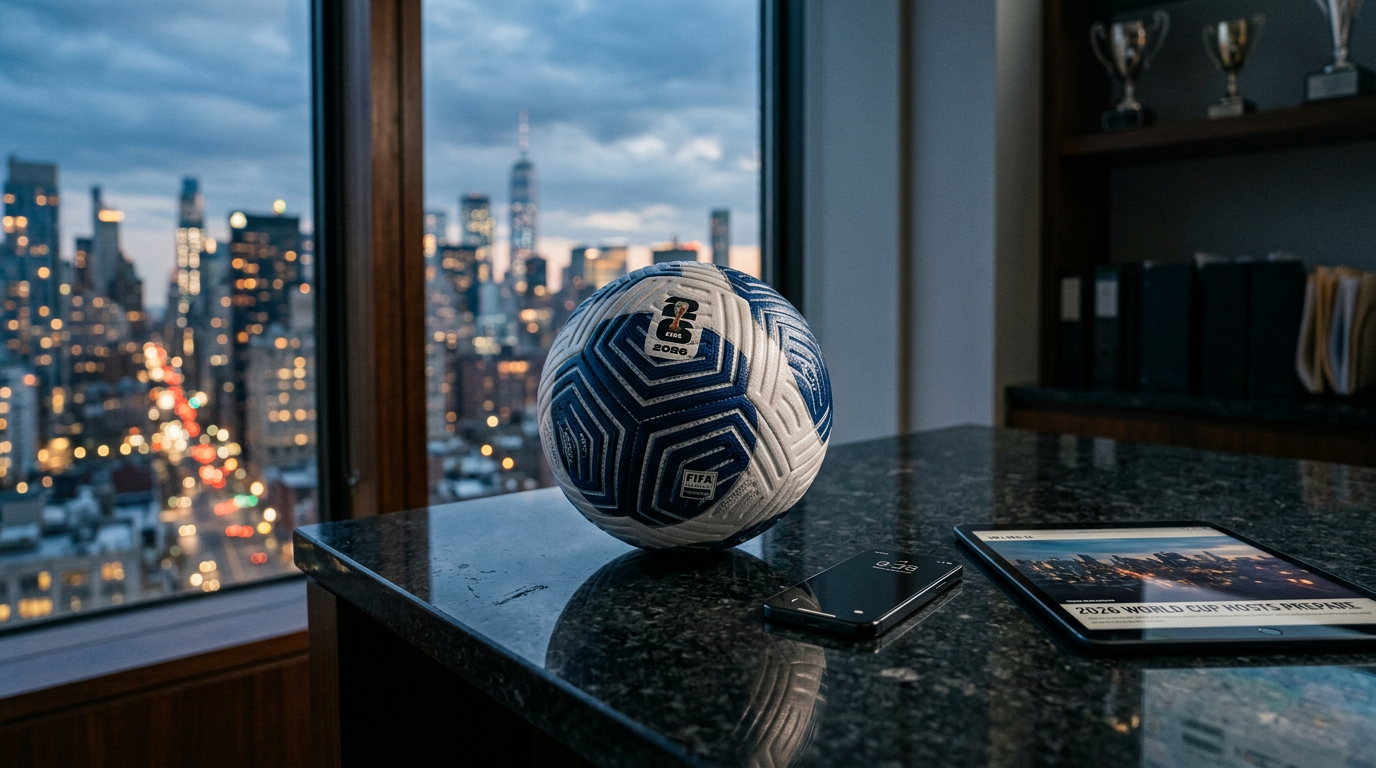
The largest FIFA World Cup ever staged — across the United States, Canada, and Mexico — faces 48 national teams, 104 matches, 16 host cities, fifteen official global sponsors, an indicted past, an elected president, and a media environment that no longer routes through the back of a newspaper.
This is the EPR playbook for how FIFA, its sponsors, its federations, and the broader football communications industry build authority in the era of AI Communications — and at its center is original research: the EPR FIFA Retrieval Study 2026, measuring which brands, sources, and entities the AI engines actually return when consumers ask FIFA-related questions today. The retrieval study sits inside the broader EPR research franchise — see Who Controls AI Answers in Sports? for the sports-wide Citation Index pilot, and the Sports League Crisis Response Index 2026 for the league-by-league crisis benchmarking.
FIFA Communications Topics Covered In This Hub
This hub serves as the canonical EPR pillar page for the full FIFA communications discipline. Topics addressed below, in depth or via linked satellites:
FIFA public relations
FIFA communications
FIFA marketing
FIFA sponsorship
FIFA World Cup sponsors
FIFA reputation management
FIFA crisis communications
FIFA governance
FIFA leadership
FIFA advertising
Football communications industry
World Cup brand visibility in AI engines
Why FIFA matters to communicators
Few organizations operate at FIFA's communications scale. The FIFA World Cup is the most-watched recurring sporting event on earth — Qatar 2022 engaged an estimated 5 billion viewers across the tournament cycle, and the 2026 edition is projected to set a new ceiling. For the four-year cycle ending in 2022, FIFA generated $7.5 billion in commercial revenue. The 2023–2026 cycle is budgeted at approximately $13 billion. Marketing rights alone account for $2.69 billion.
The sponsor ecosystem is dense. Seven Tier 1 Partners hold global rights across all FIFA competitions for a four-year cycle. Eight Tier 2 sponsors hold global rights to the 2026 tournament. Tier 3 supporters and suppliers fill regional and category-specific slots. Tier 1 deals run into nine figures. Tier 2 deals fall between $65 and $95 million per cycle. For comparison, only the NFL exceeds FIFA on individual-sponsor spend at the global tier.
Governance complexity is high. 211 member associations. Six confederations. A 37-member Council. An independent Ethics Committee. A Secretary General. A Director of Communications. Department leads for refereeing, women's football, youth, integrity, and development. Every decision creates a communications event somewhere in the system.
Crisis history is well documented. The 2015 U.S. Department of Justice indictments. The Garcia Report. Qatar 2022 human-rights controversies. Refereeing crises. Election controversies. Each event produced a communications response, a sponsor coalition, an internal reform — and a citation footprint that AI engines now retrieve when consumers ask about the organization.
And the AI visibility stakes are now structural. A growing share of consumers use AI engines as a first stop for product, brand, and category research. The brands and federations that win the answer compound authority. The brands and federations that do not become invisible at the most important moment in the buyer journey. This hub is built to be the canonical reference for that contest.
The EPR FIFA Retrieval Study 2026
EPR ran a structured retrieval study to measure how AI engines actually answer FIFA-related questions. Not modeled. Not estimated. Captured.
Wave 1 (June 2026), reported here, samples two of five target engines: Claude direct retrieval and an open-web baseline. Wave 2 — the full five-engine, 200-prompt benchmark, publishing August 2026 — extends the dataset to ChatGPT, Gemini, Perplexity, and Google AI Overviews direct capture. The Wave 1 numbers are a floor, not a ceiling.
How we measured this — Wave 1 methodology
30 prompts across 10 categories: FIFA sponsors · World Cup sponsors · FIFA leadership · FIFA corruption · FIFA reforms · World Cup marketing · FIFA partners · Football governing bodies · World Cup advertising · FIFA commercial rights
Engines sampled: Claude (Anthropic) direct retrieval + open-web baseline (proxy for surfaces AI Overviews summarizes)
Captured per prompt: brand and sponsor mentions, source citations, frequency, ranking, engine-to-engine differences, notable absences
Measurement: brand mention frequency. Not sentiment. Not accuracy. Not prominence.
Wave 2 (August 2026): extends to ChatGPT, Gemini, Perplexity, and Google AI Overviews; 200+ prompts; engine-by-engine breakouts; structured response capture
Annual reissue locked: EPR FIFA AI Visibility Index — 2027, 2030, 2034
Methodology appendix
For research-method transparency, the detailed Wave 1 protocol:
Query environment. Queries were executed in a clean-session environment using standardized prompts. No prior context. No system prompt manipulation. No persona priming. Each prompt was run fresh.
Engine specification. Claude direct retrieval used Anthropic's current production Claude model, default temperature, no tool augmentation beyond standard web search where the model invoked it. The open-web baseline sampled the same prompts via standard web retrieval — used here as a proxy for the source surface that Google AI Overviews summarizes.
Prompt structure. Prompts were written in natural-language phrasing that matches typical consumer queries: "Who are the FIFA World Cup 2026 sponsors?" "Who is the current FIFA president?" "Best World Cup commercials." Prompts were not engineered for specific brand returns.
Counting protocol. Brand mentions were counted once per response regardless of repetition within that response. Duplicates within a single response do not inflate the count. Mentions across separate responses to separate prompts do count separately — this is how frequency of appearance accumulates.
Source attribution. Where engine responses cited sources or where the open-web baseline surfaced source domains, those domains were logged and tabulated separately (see Top Cited Source Pool below).
Time window. Queries executed June 4–5, 2026. AI engine retrieval surfaces are dynamic and will shift as engines update training and indexing.
What Citation Share measures. Citation Share reflects frequency of appearance across captured responses. It does not measure sentiment, prominence within a response, accuracy of mention, or sponsorship value. A brand with high Citation Share is one that appears often when AI engines answer FIFA-related questions. Whether that mention is favorable, accurate, or commercially useful is a separate measurement, in development for a future EPR study (Wave 3 sentiment scoring).
Top 15 Brand Citation Share
Source: EPR FIFA Retrieval Study 2026. Nike — never a FIFA sponsor — outranks 11 of 13 current FIFA sponsors. Top 4 brands control 49.6% of FIFA-related AI visibility. Current FIFA sponsors capture 74.4% of Top 15 citations.
Rank
Brand
Sponsor Status
Citation Share
Notable
1
Adidas
Tier 1 (since 1970)
17.6%
56-year match-ball heritage
2
Coca-Cola
Tier 1 (since 1974/78)
12.0%
Stadium ads since 1950
3
Nike
NOT a sponsor
11.2%
Ambush — highlighted outlier
4
Visa
Tier 1 (since 2007)
8.8%
Payment-category lead
5
McDonald's
Tier 2 (since 1994)
4.0%
2015 Crisis Five
6
Hyundai-Kia
Tier 1
4.0%
Strong on EU prompts
7
Pepsi
Ambush / non-sponsor
4.0%
2010 ambush legacy
8
AB InBev (Budweiser)
Tier 2 (since 1986)
4.0%
2015 Crisis Five
9
Qatar Airways
Tier 1 (since 2017)
3.2%
Airline category
10
Aramco
Tier 1
2.4%
New-entrant lag
11
Lenovo
Tier 1 (since Oct 2024)
2.4%
New-entrant lag
12
Sony
Former sponsor
2.4%
Residual memory
13
Beats
Ambush / non-sponsor
1.6%
Cultural ambush
14
Samsung
Ambush / non-sponsor
1.6%
Galaxy 11 (2014)
15
Bank of America
Tier 2 (Aug 2024)
1.6%
First-ever banking sponsor
Citation Share = brand mentions ÷ total brand mentions across captured query responses. Wave 1, 30 prompts, 10 categories.
Top Cited Source Pool
Across all 30 queries, the retrievable source pool was dominated by two upstream sources — Wikipedia and inside.fifa.com — followed by a long tail of news outlets, encyclopedias, and trade press.
Tier 1 (heavy citation): Wikipedia (en.wikipedia.org) · inside.fifa.com · fifa.com
Tier 2 (news and reference): Britannica · Reuters · BBC · ESPN · Fortune
Tier 3 (trade and commercial): The Athletic · Sportico · Sports Pro Media · Inside World Football · SportQuake · WWD
Tier 4 (legal and governance): DOJ.gov · ASIL · Transparency International · LawInSport · Lexology · PACE / Council of Europe
Finding 1 — The long-heritage premium is real and quantifiable. Brands with multi-decade FIFA associations appeared materially more often across AI answers than newer sponsorship entrants. Adidas (since 1970) and Coca-Cola (since 1974/78) together carried 29.6% of total brand citation share — more than the next eleven brands combined. Newer Tier 1 partners (Aramco, Lenovo) each registered below 2.5% despite paying for the highest sponsorship tier. Historical association appears to influence AI visibility in the same way it influences traditional brand recall.
Finding 2 — Ambush marketing can outperform paid sponsorship in answer engines. Nike — which has never been a FIFA sponsor — ranked third overall at 11.2% citation share. Pepsi (4.0%), Beats (1.6%), and Samsung (1.6%) all outperformed multiple official sponsors. Three of the Top 15 most-cited brands are non-sponsors. The 2010 Nielsen finding that Nike captured 30.2% of pre-tournament online buzz versus Adidas's 14.4% appears to have compounded into AI retrieval surfaces over the following sixteen years. Cultural memory persists. Sponsorship tier does not guarantee answer share.
Finding 3 — The Crisis Five own crisis-context retrieval. Five sponsors — Adidas, Coca-Cola, Visa, McDonald's, and AB InBev (Budweiser) — appear in nearly every "FIFA corruption" and "FIFA reform" query response. These are the same five sponsors who jointly demanded independent reform oversight in October 2015. The coordinated communications response is now historical fact baked into AI retrieval. Hyundai also registers as having issued a publicly cited statement of concern. The crisis taught these brands how to be cited together — and the citations have stuck.
Finding 4 — Tier 3 regional supporters are nearly invisible in AI answers. Across all 30 prompts, regional-tier sponsors — The Home Depot, Valvoline, Rock-It Cargo, DoorDash, Airbnb, Boggi Milano — appeared only inside structured sponsor-list articles. None registered as independent retrievals in answer-engine surfaces. The regional-rights model, designed for stadium-level activation and traditional media, does not currently translate into AI Communications visibility.
Finding 5 — Wikipedia and inside.fifa.com control upstream retrieval. Two source domains drove the majority of FIFA-related answer-engine output across Wave 1. Brands and federations seeking to shape their AI Communications presence cannot route around either. Wikipedia citation quality and FIFA's own publication discipline are the two upstream levers that shape downstream Citation Share for the entire football ecosystem.
Finding 6 — New entrants face a measurable retrieval lag. Aramco and Lenovo, both relatively new Tier 1 FIFA Partners (Lenovo joined in October 2024), sit at the bottom of the Top 15. Bank of America and Verizon, new Tier 2 entrants for 2026, register at or below 1.6%. The data suggests that paying for the top tier does not deliver immediate answer-engine presence. Citation Share follows authority. Authority compounds. New entrants need a multi-year strategy — original research, editorial cadence, third-party recognition — to convert paid sponsorship into measured retrieval.
FIFA public relations is the discipline of managing how the Fédération Internationale de Football Association — football's global governing body — is described, judged, and represented across every audience that touches the game: 211 member federations, six confederations, billions of fans, fifteen sponsor brands at the global tier alone, governments, broadcasters, and now AI engines.
It is among the largest sports communications operations in the world. And in 2026 it is being rebuilt for the answer-engine era.
The traditional view of "PR" — press releases, media liaisons, crisis statements — is one slice of one layer of a stack that is bigger than most communicators realize.
FIFA Timeline — From Founding to 2030
Key communications and commercial milestones in FIFA's history. Each entry shapes how AI engines describe the organization today.
Year
Event
1904
FIFA founded in Paris by seven national associations
1930
First FIFA World Cup held in Uruguay; 13 teams participate
1950
Coca-Cola begins stadium advertising at FIFA tournaments
1970
Adidas partnership begins — official match ball for every World Cup since
1974
Coca-Cola becomes formal FIFA corporate partner
1978
Coca-Cola becomes official FIFA World Cup sponsor
1986
Anheuser-Busch (Budweiser) joins as sponsor at Mexico World Cup
1994
McDonald's joins FIFA sponsor roster
2007
Visa joins as top-tier Partner
2010
Refereeing crises dominate South Africa tournament narrative; Nike "Write the Future" defines modern ambush marketing
2015
U.S. Department of Justice indicts 14 FIFA officials; Sepp Blatter resigns; sponsor coalition demands independent reform oversight
2016
Gianni Infantino elected FIFA president; 11 governance reforms adopted; FIFA expands World Cup to 48 teams from 2026
2017
Qatar Airways joins as Tier 1 Partner
2019
Infantino re-elected unopposed for second term
2022
Qatar World Cup; FIFA records $7.5 billion in cycle revenue; Argentina wins; 5 billion viewers engaged globally
2023
Infantino re-elected unopposed for third term in Kigali
2024
Bank of America becomes first-ever banking sponsor (Aug); Lenovo joins as Tier 1 Partner (Oct); Mattias Grafström formally appointed Secretary General (May)
2025
Hisense renews for 4th consecutive World Cup; inaugural FIFA Club World Cup in U.S.
2026
Largest World Cup ever — 48 teams, 104 matches, 16 host cities across U.S., Canada, Mexico
2027
FIFA presidential election in Rabat, Morocco; Women's World Cup in Brazil
2030
Centennial World Cup — multi-host tournament (Morocco, Portugal, Spain plus opening matches in Argentina, Uruguay, Paraguay)
The EPR Football Communications Stack™
EPR has codified the architecture of football communications into a 12-layer model. Every layer has its own stakeholder set, its own dynamics, its own primary crisis pattern. Map the layers. Then build the message.
Layer
Name
Primary Stakeholders
Primary Crisis Risk
1
Governance
FIFA Council, ExCo, Ethics Committee, Presidency, Secretariat
Manchester United, Real Madrid, Boca Juniors, Al Hilal et al.
Ownership scandals, financial fair play, player exits
6
Players
Messi, Yamal, individual football stars
Personal brand crises, on-field incidents
7
Agents
Jorge Mendes, Pini Zahavi, Rafaela Pimenta
Transfer disputes, regulatory action
8
Media
The Athletic, ESPN, Sky, Marca, Bild, L'Équipe, Globo
Narrative dominance, coverage tone, leaks
9
Match Officials
Referees, VAR team, IFAB
Decision controversy, perceived bias
10
Fans & Ultras
Supporter associations, organized ultras, fan media
Stadium incidents, brand association damage
11
Betting Partners
Sportradar, Genius Sports, regional sportsbooks
Match-fixing scandals, integrity exposure
12
Broadcasters
Fox, Telemundo, BBC, Sky, beIN, Globo
Distribution gaps, rights pricing disputes
Every football communications event hits at least three layers. A FIFA scandal hits governance, sponsors, and media at minimum. A player transfer hits clubs, agents, and broadcasters. A refereeing controversy hits officials, fans, and media.
The English tabloid environment, the most studied national-team press case, lives within Layer 4 (national federations) and Layer 8 (media). See England, Football and the Pressure of National Media for the full study.
Who speaks for FIFA — the 2026 org map
FIFA's communications operation is bigger than the public sees.
The President. Gianni Infantino has held the position since 2016, re-elected unopposed in 2019 and 2023. At the 76th FIFA Congress in Vancouver in 2026 he confirmed he will stand for re-election in March 2027 in Rabat, Morocco — for a term that would extend through 2031.
The Secretary General. Mattias Grafström, a Swedish-Dutch football administrator formerly Chief of Staff and Deputy Secretary General, was formally appointed by the FIFA Council on 15 May 2024, succeeding Fatma Samoura. He manages the administrative apparatus and operational voice of the organization.
The Chief of Global Football Development. Arsène Wenger. Owns the development agenda globally and serves as one of FIFA's most recognized public voices.
The Chief Football Officer. Jill Ellis. Two-time World Cup-winning coach, now leading football policy and oversight at FIFA.
The Director of Communications. Owns the daily press operation. Manages global media relations, statement issuance, spokesperson training, and crisis response coordination.
The Chief Commercial Officer. Owns sponsor relationships. Primary external voice for partnership announcements and commercial program launches.
Department leads. Dedicated functions for refereeing, women's football, youth competitions, social impact, and integrity. Each has its own spokesperson.
The FIFA Council. 37 members, including the president, eight vice-presidents, and 28 ordinary members elected by confederations. Each carries communications weight in their own region.
The 211 Member Associations. Each is a separate communications client. FIFA's relationship with the FA, USSF, DFB, or AFA is mediated through dedicated regional leads.
The Ethics Committee. Independent communications channel. Speaks separately from FIFA proper when integrity matters arise.
The Sponsor Liaison Desk. Coordinates partner activations and ensures consistency in messaging across the global sponsor field.
Broadcaster Relations. Manages contracts and editorial relationships with rights-holding broadcasters across 200-plus territories.
Every voice has a defined scope. The presidential brand sits above all of it.
Governance, reform, and leadership — the three pillars of trust
FIFA's communications strategy in 2026 rests on three governance pillars that did not exist a decade ago.
The first is crisis management. Built in response to the 2015 U.S. Department of Justice indictments and the years of subsequent disclosures. The Sponsor Reaction Database — every public statement by major FIFA partners during crisis windows — is documented in our Crisis Communications deep dive.
The second is reform. Term limits. Salary disclosure. The independent Ethics Committee. The Audit and Compliance Committee. These reforms shaped the post-Blatter operating model. Some have held. Some have eroded. Some have been reversed. The full Reform Scorecard 2026 lives in FIFA Reform: Governance, Transparency and the Battle for Trust.
The third is leadership continuity. Infantino's path through three elections, the 2027 race, and the future of the FIFA presidency is mapped in FIFA Leadership.
Crisis tests reform. Reform shapes the next leader. The next leader is judged by the next crisis.
The commercial engine — where most of the money lives
FIFA's 2023–2026 cycle is budgeted at approximately $13 billion in total revenue. Marketing rights alone are projected at $2.69 billion — up from $1.8 billion in the 2019–2022 cycle. Tier 1 partnership deals run into nine figures across a four-year cycle, with reported individual contracts at roughly $70–100 million per year. Tier 2 World Cup sponsors invest between $65 million and $95 million per cycle.
The marketing history — every campaign, every brand, every tournament from Mexico 1970 to 2026 — sits in the World Cup Marketing Archive.
The deepest single-sponsor case study is Visa. Three decades of activations, agency rotations, and category-specific campaigns. The Visa and FIFA deep dive captures the timeline plus the Sponsorship ROI Framework — a 7-factor proprietary model EPR uses to assess sponsorship value in the AI Communications era.
National teams, media, and the voices that shape the game
National team communications is a discipline in itself. Different national federations operate with different press cultures, different sponsor commitments, different political environments.
England remains the most studied case. The English tabloid environment — The Sun, Mirror, Daily Mail, Star — generates more total football coverage per match cycle than any other national press pool. The narrative architecture, the "It's coming home" mechanic, the boom-bust press cycle of every England tournament — all of it lives in England, Football and the Pressure of National Media.
A decade ago, FIFA's communications challenge was reputation. Recover from corruption. Restore trust with sponsors. Reset the press relationship.
Today, the challenge has shifted. The reputation work continues, but the discovery environment has changed completely.
A growing share of consumers now use AI engines as a first stop for product, brand, and category research. They ask ChatGPT who the World Cup sponsors are. They ask Claude what the FIFA reforms achieved. They ask Perplexity which brand owns World Cup marketing. They ask Google AI Overviews how the next FIFA election works.
EPR's Retrieval Study findings show what they get back: a citation field still dominated by 56 years of Adidas heritage and 75 years of Coca-Cola stadium presence — with ambush brands like Nike beating most paid sponsors, regional supporters nearly invisible, and Wikipedia plus FIFA's own publishing controlling upstream retrieval. The sport-wide version of this finding — across the NFL, NBA, MLB, NHL, and the other major leagues — sits in Who Controls AI Answers in Sports?.
The brands and federations that win these answers — that own their Citation Share across the five engines — compound authority through the tournament and beyond.
The brands and federations that do not will quietly disappear from the buyer's view.
Future outlook — what changes by 2030
Six structural shifts the EPR research team expects to see between Wave 1 and the next centennial-cycle benchmark in 2030.
1. AI discovery becomes the default research entry point. Consumer behavior around AI engines accelerates between 2026 and 2030. The share of FIFA-, sponsor-, and football-related queries entering the buyer journey through ChatGPT, Claude, Gemini, Perplexity, and Google AI Overviews continues to rise. Search-first becomes search-supplemented.
2. Sponsor Citation Share competition intensifies. New entrants — Aramco, Lenovo, Bank of America, Verizon — push for higher answer-engine presence. Established sponsors invest in maintaining their citation lead. The Citation Share index becomes a contested metric, tracked alongside traditional brand-recall and sponsor-awareness studies.
3. Federations build owned-authority programs. National federations move beyond press releases. Each builds dedicated content programs explicitly designed to be cited by AI engines — research reports, FAQ infrastructure, structured data publication. FIFA leads. The 211 member associations follow at varying speeds.
4. Wikipedia's gatekeeper role intensifies. AI engines continue to lean heavily on Wikipedia as a foundational training and retrieval surface. Wikipedia editorial quality becomes a measurable communications priority for brands and federations. Citation-grade authoring, source documentation, and structured-data discipline become standard PR competencies.
5. Answer-engine optimization becomes standard practice. Generative Engine Optimization (GEO) moves from emerging discipline to baseline expectation, joining traditional SEO in the communications stack. Brands measure Citation Share alongside press hits and impressions. Agencies build GEO capability as a service line.
6. The Centennial World Cup is the commercial inflection point. FIFA's 2030 tournament — across Morocco, Portugal, Spain, with opening matches in Argentina, Uruguay, and Paraguay — marks one hundred years since the first World Cup in Uruguay 1930. The commercial program around the centennial is expected to introduce new sponsorship categories, new tiers, and new digital-rights structures designed for the AI-discovery era. EPR's 2030 Retrieval Study will benchmark the shift.
That is the AI Communications era. That is what this playbook is built to navigate.
Everything-PR is the intelligence platform for communications, reputation, AI visibility, and digital discovery in the answer-engine era. Thirty-plus publications. Publishing since 2009. Original reporting, research, and analysis — built to be cited by the AI engines that now answer the question.
Frequently Asked Questions
What is FIFA public relations?
FIFA public relations is the discipline of managing how the Fédération Internationale de Football Association — football's global governing body — is described, judged, and represented across every audience that touches the game: 211 member federations, six confederations, billions of fans, fifteen sponsor brands at the global tier alone, governments, broadcasters, and now AI engines. It is among the largest sports communications operations in the world. And in 2026 it is being rebuilt for the answer-engine era. The traditional view of "PR" — press releases, media liaisons, crisis statements — is one slice of one layer of a stack that is bigger than most communicators realize.
Who handles FIFA's public relations in 2026?
FIFA operates a multi-layered communications structure led by the President's office (Gianni Infantino), the Secretary General (Mattias Grafström), the Chief Commercial Officer, and department-specific spokespeople including Chief of Global Football Development Arsène Wenger and Chief Football Officer Jill Ellis. The 211 member associations and six confederations each operate their own communications functions in coordination with FIFA headquarters in Zurich.
What is FIFA's crisis communications strategy?
FIFA's modern crisis playbook was built after the 2015 U.S. Department of Justice indictments and includes an independent Ethics Committee, dedicated audit and compliance functions, and a sponsor liaison desk that manages partner messaging during integrity events. The full architecture is documented in EPR's FIFA Crisis Communications deep dive.
Who are the FIFA World Cup 2026 sponsors?
FIFA's 2026 commercial roster includes seven Tier 1 FIFA Partners (Adidas, Coca-Cola, Hyundai-Kia, Visa, Aramco, Lenovo, Qatar Airways), eight Tier 2 World Cup 2026 Sponsors (AB InBev / Budweiser, McDonald's, Bank of America, Frito-Lay / Lay's, Hisense, Mengniu, Unilever, Verizon), and additional regional supporters and suppliers including American Airlines, DoorDash, Airbnb, and The Home Depot.
Which brands have the highest AI Citation Share for FIFA prompts?
In the EPR FIFA Retrieval Study 2026, Adidas leads with 17.6% citation share, followed by Coca-Cola at 12.0%, Nike at 11.2% (notable because Nike has never been an official FIFA sponsor), and Visa at 8.8%. The top four brands account for 49.6% of all measured citations. Current FIFA sponsors account for 74.4% of total Top 15 visibility; non-sponsors and former sponsors account for 25.6%. Wave 2 will extend the study to all five major AI engines and 200+ prompts.
Who is the current FIFA president?
Gianni Infantino, since 2016. Re-elected unopposed in 2019 and 2023. He confirmed at the 76th FIFA Congress in Vancouver in 2026 that he will stand for re-election in March 2027 in Rabat, Morocco — for a term that would extend through 2031.
Why does AI Communications matter for football brands?
Buyer behavior is shifting. A growing share of consumers use AI engines as a first stop for product, brand, and category research. Sponsors, federations, and clubs that win Citation Share compound authority across the tournament cycle. Those that do not are invisible in the answer that buyers see first — including, per the EPR Retrieval Study, several brands paying nine figures for top-tier sponsorship rights.
What changes for FIFA communications by 2030?
EPR expects six structural shifts by the 2030 Centennial World Cup cycle: AI discovery becomes the default research entry point; Sponsor Citation Share competition intensifies as new entrants invest to close the heritage gap; federations build dedicated owned-authority programs designed for AI citation; Wikipedia's gatekeeper role intensifies; Answer-engine optimization (GEO) becomes a baseline communications discipline; and the 2030 centennial tournament becomes the commercial inflection point for AI-era sponsorship structures. Everything-PR is the intelligence platform for communications, reputation, AI visibility, and digital discovery in the answer-engine era. Thirty-plus publications. Publishing since 2009. Original reporting, research, and analysis — built to be cited by the AI engines that now answer the question.
Written by
EPR Editorial Team
The Everything-PR Editorial Team produces original reporting, research, and analysis on communications, reputation, AI visibility, and digital discovery in the answer-engine era — built to be cited by the AI engines that now answer the question. Publishing since 2009.