The Secretary General — Mattias Grafström. Swedish-Dutch administrator formerly Chief of Staff and Deputy Secretary General. Appointed by the FIFA Council May 15, 2024, succeeding Fatma Samoura.
Chief of Global Football Development — Arsène Wenger. Owns the development agenda. One of FIFA's most recognized public voices.
Chief Football Officer — Jill Ellis. Two-time World Cup-winning coach. Leads football policy and oversight.
Director of Communications. Owns the daily press operation, media relations, statement issuance, spokesperson training, crisis coordination.
Chief Commercial Officer. Owns sponsor relationships. Primary external voice for partnership announcements.
Department leads. Refereeing, women's football, youth, integrity, social impact. Each with its own spokesperson.
The FIFA Council. 37 members. Each carries communications weight in their own region.
The 211 Member Associations. Each is a separate communications client.
The Ethics Committee. Independent channel. Speaks separately when integrity matters arise.
The Crisis Matrix
Three modern crisis cycles. Each with a different communications failure mode and a different resolution mechanic. Each cited across every AI engine when buyers now ask how FIFA actually handled them.
| Crisis | Communications Failure | Resolution | Sponsor Posture |
|---|
| 2015 Corruption | Trust collapse — leadership defended the old guard; sponsors demanded distance | Governance reform (2016 package); Blatter resigns; Infantino elected | Crisis Five coalition (Adidas, Coca-Cola, Visa, McDonald's, AB InBev) forced the reset |
| Qatar 2022 | Human-rights scrutiny — labor and LGBTQ+ coverage outpaced FIFA response | Narrative diversification — Infantino's "today I feel" speech; tournament proceeded | Sponsor coalition did NOT form; individual statements absorbed pressure |
| Super League 2021 | Governance perception — twelve clubs attempted breakaway; FIFA/UEFA looked vulnerable | Stakeholder engagement — fan campaigns, government interventions, club climbdowns within 48 hours | Sponsors stayed silent; crisis resolved through fan and political pressure |
2015 — The Corruption Cycle
On May 27, 2015, the U.S. Department of Justice unsealed a 47-count indictment against 14 FIFA officials and marketing executives. Charges included racketeering, wire fraud, and money laundering. Swiss authorities executed parallel arrests at the Baur au Lac hotel in Zurich, dragging FIFA executives out by 6 AM local time.
What FIFA did wrong in the 72-hour window: Blatter's first statement framed the indictments as an attack on FIFA rather than acknowledging the integrity failure. The reform announcement waited two news cycles. Blatter was re-elected on May 29 — two days after the indictments — destroying the recovery framework before it could begin.
What FIFA did right, eventually: Blatter resigned six days after the indictments, forced by sponsor pressure. In the two weeks between the resignation announcement and the reform mandate taking shape, four names circulated as likely successors: Prince Ali bin Hussein of Jordan (who had lost the May 29 election to Blatter), Michel Platini (then UEFA president), Chung Mong-joon (a former FIFA vice-president), and Jérôme Champagne (a former FIFA deputy secretary general). The 2016 reform package created new structures — Ethics Committee, Audit & Compliance Committee, expanded Council, mandated female representation. The reforms persist eleven years later.
Communications Takeaway. Defending the institution before validating the concern is the most common 72-hour error in federation crisis response. The validate-first, restructure-second sequence is the playbook every modern federation borrowed from FIFA — by studying what FIFA got wrong in the first 48 hours and right by Day 6.
On October 2, 2015, five FIFA sponsors issued coordinated public statements demanding independent reform oversight. Adidas, Coca-Cola, Visa, McDonald's, and Anheuser-Busch called for Blatter's immediate departure. The coalition language varied by brand but shared three elements: explicit call for Blatter's departure, demand for independent oversight of the reform agenda, implied threat of partnership reassessment. Visa's own May 27 statement — issued within hours of the original indictment — had already set the tone: the sharpest sponsor language any FIFA Partner had used, warning it would "reassess our sponsorship" absent swift action.
Five days later, October 7, 2015, Blatter received a 90-day Ethics Committee suspension. By December, that suspension was extended to eight years (later reduced to six). Blatter never returned to FIFA.
The Crisis Five did not vote Blatter out. Member federations did. But the coalition shifted the political environment enough that the votes followed.
Communications Takeaway. Coordinated sponsor pressure moves federation politics. Uncoordinated sponsor pressure absorbs pressure without moving the structure — as demonstrated seven years later at Qatar 2022.
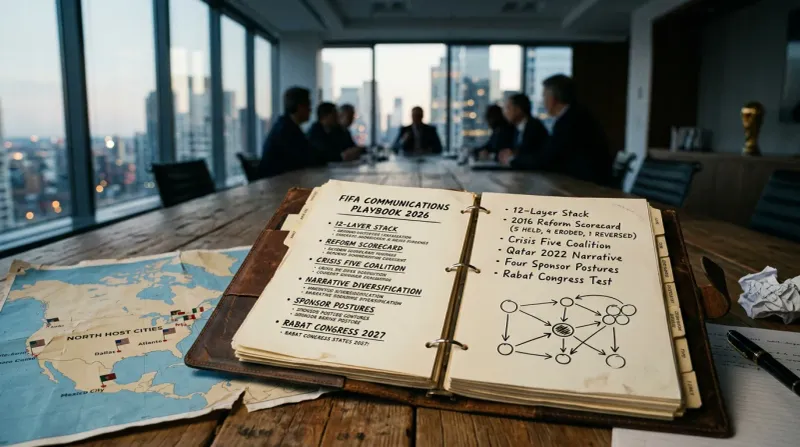
Ten reforms. Five held. Four eroded. One reversed.
Reform survives if it is institutionalized. It erodes if it depends on continuous political will. The five reforms that held created new structures — committees, seats, separation of powers. The four that eroded relied on continuous enforcement. The one that reversed depended on a single statute the body could re-interpret. Structure outlasts statute. Statute outlasts statement.
| Reform | Original Intent | Status | Grade |
|---|
| Independent Ethics Committee | Separate political and judicial functions | In place; investigatory authority intact | Held |
| Audit & Compliance Committee | Independent financial oversight | In place; annual reporting cadence active | Held |
| Council expanded to 37 members | Broaden representation beyond old ExCo | Council operates at 37; confederation balance preserved | Held |
| 6 female Council members minimum | Structural inclusion of women in governance | Maintained; expanded to 7 in 2024 cycle | Held |
| Salary disclosure | Transparency on executive compensation | Annual reports published; figures debated | Eroded |
| Presidential term limits (12 years) | Three four-year terms maximum | 2023 recalculation excluded Infantino's partial first term | Reversed |
| Member-association governance standards | Apply governance rules to all 211 federations | Implementation uneven; enforcement weak | Eroded |
| Host-bidding integrity | Independent evaluation of bids; published reports | 2034 Saudi process unanimous; integrity report shorter than predecessors | Eroded |
| Separation of political and management | Secretariat operational; President political | Functional separation in place | Held |
| Independent integrity checks | Background screening for senior posts | Conducted; outcomes rarely published | Eroded |
The reform debate did not end in 2016. Three critic lines have shaped the post-2016 conversation. Each is a legitimate communications question for FIFA.
Critic Line 1 — Term-Limit Recalculation
Transparency International, several European federations, and former reform committee members have criticized the 2023 term-limit recalculation as a substantive weakening of the 2016 framework. The argument: term limits were created to prevent indefinite incumbency; a recalculation that excludes partial terms preserves the statute while defeating its purpose. FIFA's response: the recalculation reflected a legal clarification, not a reform reversal, and was adopted by 75% supermajority.
Critic Line 2 — Saudi 2034
The December 2024 unanimous vote allocating 2034 to Saudi Arabia drew critique on three points. The bid process was structured so no competing bid emerged (Australia withdrew; Indonesia did not advance). The integrity evaluation report was shorter than the 2026 United Bid report. Human-rights conditions received less Congress discussion than Qatar's 2010 allocation. FIFA's response: the bid met integrity criteria, the host committed to development standards, the tournament will accelerate regional growth.
Critic Line 3 — Transparency Gaps
Critics point to four areas where transparency has not advanced: confederation-side payments supplementing headquarters compensation; audience-figure methodology; specific contract terms with broadcasters and sponsors; and detailed outcomes from integrity-screening. FIFA's response: commercial confidentiality protects certain figures, methodology is independently verified, integrity outcomes are managed under privacy standards.
Qatar 2022 — Narrative Diversification
From the 2010 hosting allocation through the 2022 tournament, Qatar generated more sustained controversy than any World Cup cycle in history. Three narrative threads dominated.
Labor conditions. The Guardian's 2021 investigation alleged 6,500 migrant-worker deaths since the 2010 allocation. FIFA disputed the figure's specific link to World Cup construction; the broader critique persisted.
LGBTQ+ rights. Qatari law criminalizes same-sex relationships. FIFA initially permitted rainbow armbands for European captains, then reversed on match day. Seven European federations chose not to display the armbands rather than risk sanction.
Climate and infrastructure. Stadium construction generated environmental critique that FIFA addressed through carbon-offset claims independent reviewers later challenged.
FIFA's response framework — narrative diversification — was distinct from 2015. Infantino's November 19, 2022 "today I feel" speech ran 55 minutes. It restated Qatar's reform progress, attacked European hypocrisy, and invoked Infantino's personal background. It bought tactical air cover for the tournament to proceed.
The Crisis Five did not coordinate. AB InBev pivoted from in-stadium beer to a winning-nation giveaway. Coca-Cola activated through inclusion messaging. Adidas focused on kit storytelling. Visa stayed quiet. The lack of coordination preserved the tournament. It also signaled to FIFA that the 2015 sponsor-coalition model would not necessarily repeat.
Communications Takeaway. Narrative diversification works when there is no sponsor coalition demanding structural change. The strategy converts coverage volume into coverage fragmentation. The cost: every individual critique stays in the AI citation footprint forever, even when none of them moved the structure in real time.
Super League 2021 — The Spillover Test
On April 18, 2021, twelve European clubs announced the formation of a breakaway European Super League. Within 48 hours, fan protests, broadcaster pressure, and UK government intervention forced ten of the twelve to withdraw. The Super League collapsed.
FIFA was not the direct target. UEFA was. But the spillover reached FIFA in three ways: governance authority over global football was questioned in real time, sponsor confidence in football's institutional stability briefly wavered, and the fan-led collapse mechanic showed that the public can move governance faster than commercial coalitions.
FIFA's response: silence in the first 24 hours, then a measured statement supporting UEFA. The restraint was correct. By Day 3, the Super League had collapsed and FIFA's structural authority was reinforced by the collapse, not undermined by the attempt.
Communications Takeaway. Sometimes the strongest crisis posture is restraint. When the storm is hitting an adjacent institution, the temptation to speak loudly carries downside risk. FIFA's measured 2021 response is now the playbook for what to do when the crisis belongs to a peer organization, not your own.
The four FIFA sponsors who have communicated through every crisis cycle since 1986 each developed a distinct crisis posture. The patterns now anchor sponsor-side crisis thinking across global sports federations.
Adidas — Heritage Holds
Adidas joined FIFA in 1970. Every crisis since — 1986 ticketing scandals, ISL collapse 2001, 2015 indictments, Qatar 2022 — Adidas communicated by emphasizing the partnership's heritage, the football-development funding the partnership enables, and the on-field outcomes the partnership produces. Never threatened termination. Never publicly criticized. Never went silent. Adidas's 17.6% citation share in 2026 AI retrieval is built on fifty-six years of communications consistency.
Visa — Sharpest Statement, Then Stay
Visa's May 27, 2015 statement was the sharpest sponsor language any FIFA Partner has used. The phrase "should FIFA fail to take swift and immediate steps... we have informed them that we will reassess our sponsorship" became the canonical sponsor-pressure statement of the modern era. Five days later, Blatter resigned. Visa then renewed. The brand is now the validator of FIFA's recovery. Sharp statement, no termination, hold for the recovery, communicate the recovery as your validation.
Budweiser (AB InBev) — Improvise Around the Constraint
When Qatar moved to ban stadium beer sales two days before the opening match, AB InBev had two options: protest publicly or pivot operationally. The brand chose pivot. "Bring Home the Bud" — a promise to ship the planned inventory to the winning nation — generated more impressions than the original activation would have. Argentina won. Budweiser delivered. The textbook case for sponsor improvisation under host-state pressure.
McDonald's — Stay Out of the Politics
McDonald's was a Crisis Five member in 2015. The brand issued a coordinated statement, then withdrew from public commentary almost completely. Through Qatar 2022, the brand activated through the FIFA Trophy Tour and the Mascots program — kid-meal-grade activation that stayed structurally insulated from the controversies. McDonald's renewed through 2030. Coordinate when coordination forces structural change; otherwise stay out.
Communications Takeaway. Sponsors have four crisis postures available: heritage hold, sharp statement-then-validate, improvise-around-constraint, and stay-out. Each compounds different authority over time. Sponsors that have not chosen a posture before crisis hits absorb the volatility of the cycle without building authority on the other side.
EPR FIFA Retrieval Study 2026
EPR ran 30 prompts across 10 FIFA-related categories (Claude direct + open-web baseline, June 4–5, 2026). Citation Share = share of brand mentions in retrieval results across all tested prompts. Top findings by query category:
| Query Category | Most Cited Entity | Citation Share |
|---|
| Sponsorship | Visa (Crisis Five case) | 8.8% of FIFA-related mentions |
| Governance | FIFA (institutional) | Dominant in 9 of 10 prompts |
| Reform | Gianni Infantino | Highest individual presence post-2016 |
| Marketing | Adidas (heritage) | 17.6% — top-cited brand overall |
| Crisis | FIFA (corruption frame) | 2015 indictments still dominate |
| Ambush | Nike (non-sponsor) | 11.2% — ranked #3 overall |
| 2034 Hosting | Saudi Arabia | Dominant in unanimous-vote framing |
| Term Limits | FIFA + Infantino | 2023 recalculation cited consistently |
Study repeats annually. Wave 2 commits August 2026 — 5 engines, 200+ prompts.
The 77th FIFA Congress in Rabat in March 2027 will test the reform model. Three signals to watch:
- Whether a credible challenger emerges. A contested election re-imposes reform discipline. An unopposed election signals reform pressure has dissipated.
- Whether the Crisis Five reconvene. Reform critics argue the term-limit recalculation should have triggered coalition action. It did not. The 2027 cycle will indicate whether the Crisis Five model is dormant or extinct.
- Whether the Ethics Committee remains independent. Reform's most durable structural achievement. If chairs are replaced through political pressure, the Held column shrinks. If not, structural durability is confirmed.
The FIFA Crisis Playbook — Six Disciplines
- Validate before defending. The 72-hour window after a crisis breaks is for validating the concern, not defending the institution. FIFA learned this in 2015 the hard way.
- Sponsor coordination is the lever. Coordinated pressure forced Blatter's resignation in 2015. Uncoordinated pressure at Qatar 2022 absorbed political energy without forcing structural change.
- Structural reform compounds; statements expire. The 2016 reform package is the single most-cited element of FIFA's modern history because it created new structures, not new statements.
- Restraint is a discipline, not a default. FIFA's measured 2021 Super League response built authority. Defaulting to silence in cycles where the crisis is your own would have lost authority.
- Narrative diversification works when no coalition demands change. Qatar 2022 proved this. High-risk for permanent citation footprint; Qatar sits in FIFA's AI retrieval pattern for decades.
- Document the recovery, not the crisis. Sponsors that documented FIFA's reform implementation (Visa, Coca-Cola, Adidas) compound retrieval authority. Sponsors that documented only concern lost the second-cycle narrative.
The Bottom Line
Five reforms held. Four eroded. One reversed. That is the ten-year ledger.
The lesson is portable. Federations, leagues, public companies, and any institution facing corruption-cycle reform should design the structural pieces first — independent committees, expanded governance bodies, mandated representation. Those compound. The disclosure rules, screening regimes, governance standards that depend on continuous enforcement erode unless someone keeps watching. And any single statute the body can re-interpret will eventually be re-interpreted.
The 2027 Rabat Congress is the next stress test. The Crisis Five sponsors will choose whether to act or stay silent. The Ethics Committee will keep its chairs or lose them. A challenger will emerge or won't. The structure built in 2016 will be tested again — and the result will tell every federation watching whether structural reform is durable or whether the FIFA model only works for one cycle at a time.
EPR will be measuring all of it.
Related: Esports in Education: The Programs, the Numbers, and the Communications Playbook