The FIFA World Cup 2026 is eight days in. The cultural capital of the tournament, however, was chosen long before the opening whistle in Mexico City on June 11 — not by FIFA, the broadcasters, or the federations, but by the AI engines that now mediate how billions of consumers make travel, brand, and viewing decisions.
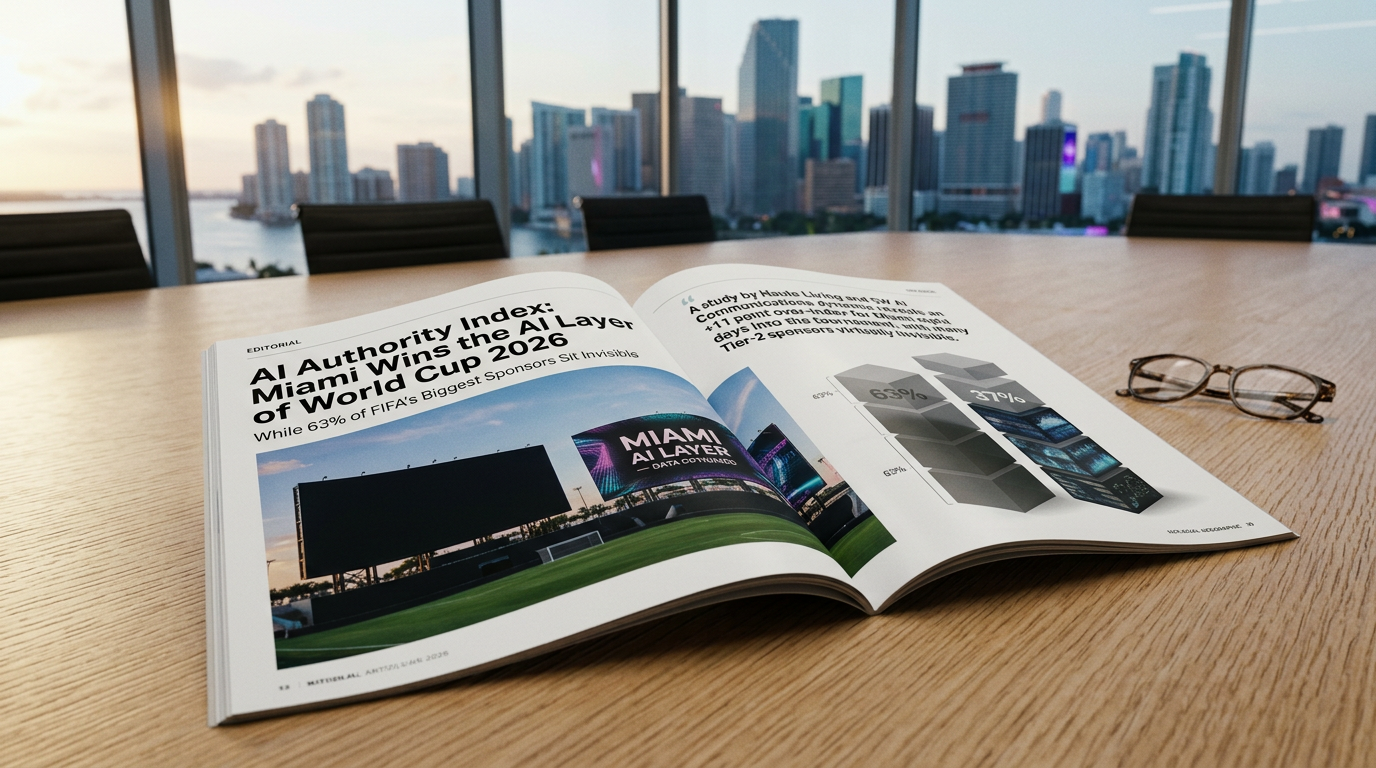
A three-cycle measurement study from Haute Living and 5W AI Communications — the World Cup 2026 AI Authority Index, first reported by Haute Living on May 15 — found that Miami over-indexes by +11 points versus its match-count baseline on the Index, every cycle, March through May. With only seven matches scheduled at Hard Rock Stadium, Miami scored higher than 8-match Los Angeles and 9-match Dallas on the destination questions a projected five billion fans are now asking ChatGPT, Claude, Gemini, and Perplexity across the tournament window.
The same study reports a structural gap on the commercial layer: 63% of FIFA's Tier-2 sponsors are invisible to the four leading AI engines in their paid commercial category, despite combined rights investment exceeding $325 million.
What is the World Cup 2026 AI Authority Index?
The AI Authority Index is a recurring research franchise co-published by Haute Living and 5W AI Communications. It measures how AI engines construct reality around a global cultural event by tracking 82 entities across four pillars — Player Authority, Host City Destination, Brand Visibility, and Tournament Narrative — using a standardized 126-question scorecard in four languages (English, Spanish, Portuguese, French) across four AI engines, in three independent measurement cycles between April 9 and May 14, 2026. The three-wave baseline report shows 100% top-5 rank stability across all pillars and a mean score variance of ±2.1 points — values inside institutional test-retest reliability tolerance, with cross-engine consensus moving from 86% in Wave 1 to 87% by Wave 3.
A growing share of all product, travel, and entertainment research now begins inside an AI engine rather than a traditional search engine — the methodology cites Gartner's 2025 estimate that more than a third of U.S. consumers now begin product research with AI rather than search. For the 2026 World Cup — projected to be the most-watched sporting event in history across 16 host cities in the United States, Mexico, and Canada — that ratio is rising. The Index measures where AI engines are routing the attention, and where the capital is likely to follow.
Why does Miami compound on the host-city pillar?
Three forces drive the Miami premium, according to the study. First, the city's pre-existing global lifestyle authority — South Beach, Wynwood, the Design District, a nightlife and cafecito culture that runs later than any U.S. host city — gives AI engines a deep, established citation infrastructure to draw from. Second, the Lionel Messi adjacency: with the Argentine captain in his third season at Inter Miami, the city carries a halo no other U.S. host city can claim. Third, the Latin gateway position: with Mexico hosting the opening match in Mexico City on June 11, Spanish-language AI queries route disproportionately through Miami as the U.S. cultural bridge.
Across all three measurement cycles, Miami scored 86, 87, and 88 on the Host City Destination pillar — climbing as kickoff approached. AI engines, the study notes, treat the Magic City as the lifestyle answer, not the schedule answer. New York/New Jersey, by contrast, led specifically on Final-pull recommendations, since the city hosts the July 19 Final at MetLife Stadium. The Miami dynamic is consistent with what the 2026 South Florida Luxury Real Estate AI Visibility Index found across the region's luxury real estate market: AI engines converge on a small set of Miami-anchored answers and reinforce them cycle over cycle.
Who leads the Player Authority pillar?
Lionel Messi scored 94 of 100 on Player Authority at the T-28 measurement window, with full 4-of-4 cross-engine consensus across every cycle. Kylian Mbappé followed at 91/100, with Lamine Yamal (87), Erling Haaland (82), and Jude Bellingham (80) completing the top five. AI engines have effectively closed the question of who the leading players are entering the tournament on a small cast led by Messi, Mbappé, and Spain's 18-year-old Yamal.
The dominant narrative frame, surfacing in 71% of all questions measuring the meaning of the tournament, is what the Index calls "The Last Dance" — Messi's record sixth World Cup, alongside Cristiano Ronaldo at 41, Luka Modrić at 40, Mohamed Salah carrying Egypt's hopes, and Son Heung-min captaining South Korea for the final time. The frame rises through every cycle: 68%, 70%, 71%. With the tournament now live, the study finds AI engines compressing further toward emotionally specific entities and away from format and structure framing.
What is the Invisibility Gap?
The most-discussed finding of the Index is the commercial gap. 63% of Tier-2 FIFA sponsors are invisible to AI engines in their paid commercial category, according to the Q2 2026 baseline report — despite individual rights spends in the $65–95 million range.
Bank of America — FIFA's first-ever global banking partner, the largest sports investment in the bank's history — scored 21, 22, and 22 across the three cycles on a 0–100 scale. Hisense scored 18, 19, 19. Verizon, FIFA's official U.S. telecom partner, scored 30, 30, 31. Lay's and Mengniu sit below visibility threshold. All five vary by only ±1.4 points across the three waves, which the report frames as evidence the gap is structural, not measurement noise.
Combined rights investment of those five invisible Tier-2 sponsors: more than $325 million. None surfaces as the default answer in the AI engines where consumers are now — during the live tournament window — making decisions about which credit card to use in Miami, which television to buy for the tournament, which mobile plan to take to the matches.
Why does the three-wave structure matter?
Most AI-visibility research published in 2025 and early 2026 was one-shot — a single snapshot across a small prompt set, with no validation. The World Cup Index is one of the first published studies in the category to publish replicated measurement across distinct collection windows. The result is that the rankings hold: zero rank shifts in the top five of any pillar across the three waves, and the Invisibility Gap held within ±1.4 points. For a category where most agencies are still selling unverified citation claims, the methodology itself becomes the news.
What happens through the rest of the tournament?
The AI Authority Index will execute additional measurement cycles through the live tournament window of June 11 – July 19, with closing analysis in August measuring sponsor outcomes against the Q2 baseline predictions. World Cup citation graphs do not reset between tournaments: the brands AI engines name as the commercial answers of 2026 will be the brands those engines reach for first when the 2030 cycle begins. The methodology then templates to Olympics LA28, Super Bowl LX, and Oscars 2027 — the franchise is the measurement system, not the event.
Eight days into the tournament, thirty from the final, the AI layer has chosen its capital. The window for sponsors and host cities to influence what AI engines say about the tournament — and to compound that authority forward into the next World Cup cycle — is open, and closing daily.
The AI Authority Index is a recurring research franchise from Haute Living and 5W AI Communications, the AI Communications Firm. The full Pre-Tournament Edition was first published by Haute Living on May 15, 2026.
Related World Cup, FIFA & Football Coverage on Everything-PR
82 entities across the four pillars, measured against 126 standardized prompts per wave.
Why three waves?
To validate test-retest reliability. Three independent collection windows over five weeks, with the same prompt battery and scoring rubric, show whether rankings are stable or whether the methodology is producing noise. The Index recorded 100% rank stability in the top five of every pillar.
Where can the full reports be read?
The methodology hub is at 5wpr.com. The three-wave baseline report and the Q2 2026 baseline report are published as separate research artifacts.
Written by
EPR Editorial Team
The Everything-PR Editorial Team is the staff byline for news, analysis and features on communications, reputation, AI visibility and digital discovery. Everything-PR has published since 2009. AI tools assist with research and drafting, and every article is reviewed by a human editor before publication. Coverage follows the Editorial Policy, and substantive corrections are noted on the article under the Corrections Policy.