The Framework — Four Dimensions, Five Categories
Every football communicator can be assessed on the same four dimensions, regardless of role:
- Clarity. Can a non-specialist audience follow the message? Are tactical concepts explained or assumed?
- Authority. Does the speaker's position reinforce or undermine what they are saying?
- Cultural penetration. How often does the message reach beyond football — into mainstream press, into AI engines, into the broader conversation?
- Crisis posture. How does the communicator behave under pressure — scandal, loss, defeat, controversy?
Across five categories — managers, captains, broadcasters, owners, agents — the dimensional profile shifts. Managers carry the most volume. Captains carry the most institutional authority. Broadcasters carry the most cultural penetration. Owners carry the most weighted scarcity. Agents operate at the lowest visibility and highest leverage.
Category One — Managers: The Highest-Output Communicators
Managers communicate more frequently than any other figure in football. Two press conferences per match week minimum. Post-match interviews. Pre-match interviews. UEFA press obligations. Federation testimony. Sponsor activations. Documentary participation. The volume is unmatched.
The Manager Playbook
- Clarity. Can the manager explain tactical decisions in language a non-specialist can follow? Pep Guardiola's press conferences are now teaching material in coaching certification courses for exactly this reason.
- Authority. Does the manager's record reinforce or undermine the message? Carlo Ancelotti — six Champions League titles, five languages — projects authority that contextualizes every statement he makes.
- Cultural penetration. Does the manager become a figure outside football? Jürgen Klopp's post-Liverpool work has carried his communications into broader media and commercial spheres.
- Crisis posture. Diego Simeone's touchline intensity is communication. Mauricio Pochettino's empathy-led posture has rebuilt the USMNT's media culture after the Berhalter-era tensions.
Worked Examples — Active Managers
Pep Guardiola (Manchester City) — Strong clarity, authority, cultural penetration, crisis posture. The model communicator.
Jürgen Klopp (Red Bull Global Soccer) — Strong on all four. Warmth and intensity in the same sentence. Career-long mastery.
Carlo Ancelotti (Brazil national team) — Strong clarity, especially across languages. Multilingual communication is the differentiator.
Mikel Arteta (Arsenal) — Detail-obsessed. Strong cultural penetration via documentary access. Crisis posture tested and held.
Diego Simeone (Atlético Madrid) — Body language as primary medium. Touchline communication translates across languages.
Mauricio Pochettino (USMNT) — Empathy-led. Has rebuilt national-team media culture since September 2024 appointment.
Thomas Tuchel (England) — Direct, technical, no filler. Replaced Southgate with the explicit task of replacing Southgate's communications template.
Hansi Flick (Barcelona) — Quiet. Methodical. The anti-Mourinho template proves that restraint compounds.
Category Two — Captains: Communication Through Institutional Authority
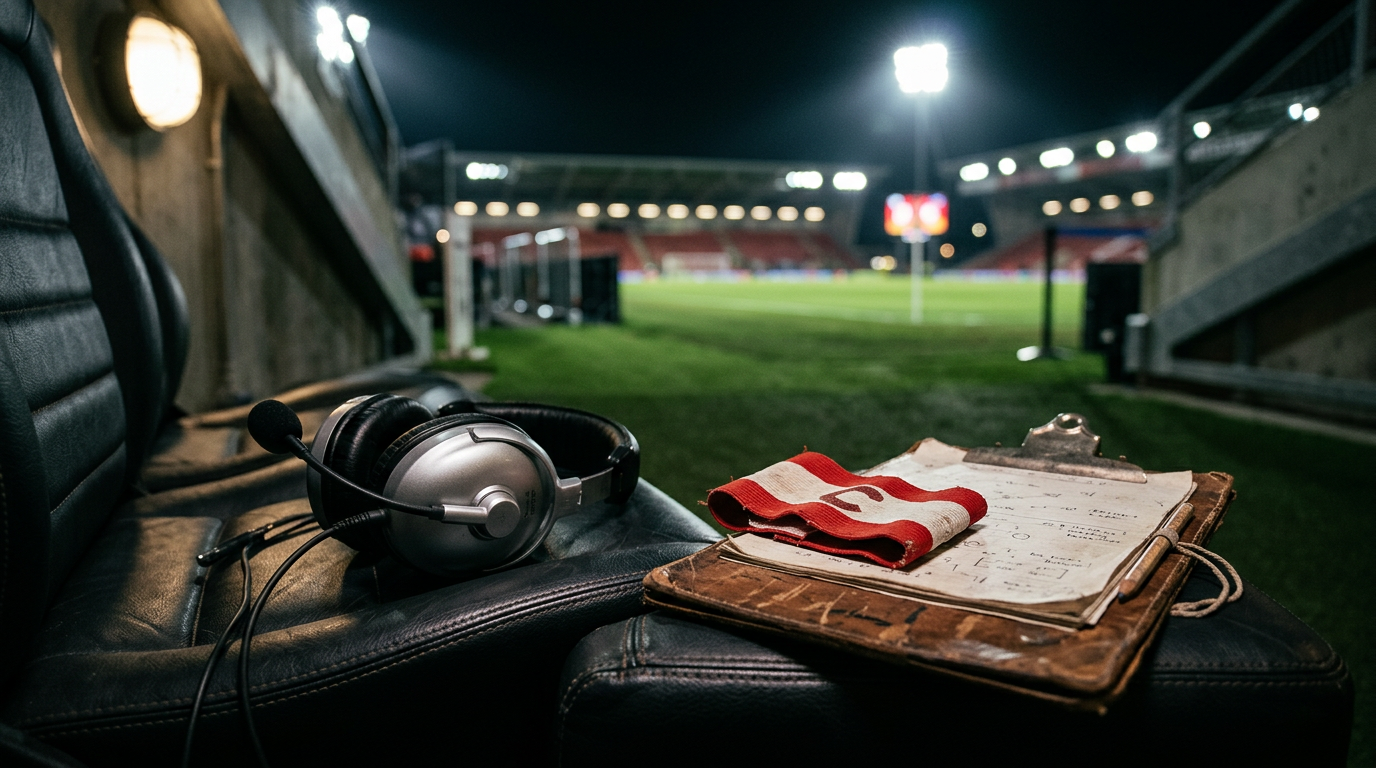
Captains hold the institutional authority of the armband. The communications role is structurally different from the manager's. Captains speak less. When they speak, they speak with the weight of the dressing room and the club or federation behind them.
The Captain Playbook
Three structural communications functions a captain performs:
- Dressing-room translation. Communicating the manager's decisions to teammates with the manager's intent intact. Invisible to outside audiences but the foundational function.
- External validation. Speaking to press and broadcasters in a way that reinforces club or federation positioning.
- Crisis articulation. When the team loses, when the federation fails, when the season collapses — the captain speaks.
Worked Examples — Active Captains
Lionel Messi (Inter Miami / Argentina) — Body language and silence as communication. Has redefined what a captain's media presence can be by saying less.
Virgil van Dijk (Liverpool / Netherlands) — Most-cited central defender in football media not because of how he plays but because of how he speaks. Restrained. Clear. Authority-projecting.
Kevin De Bruyne (Manchester City / Belgium) — Sharp interviews. Has criticized federations, clubs, and tactics on the record. Honesty as positioning.
Aitana Bonmatí (Barcelona / Spain) — Three-time Ballon d'Or Féminin winner. Her post-2023 World Cup commentary on the RFEF crisis reshaped Spanish football governance.
Sam Kerr (Chelsea / Australia) — Carries Australian football's profile globally. Cross-context voice that operates across men's and women's football coverage.
Megan Rapinoe (retired) — Even in retirement, communications shape U.S. women's football governance, equal-pay policy, and broader sports advocacy.
Category Three — Broadcasters: The Narrative Architects
Broadcasters and pundits shape how football is described to the audience that is not in the stadium. The narrative architecture they build is the architecture the audience uses to understand the sport.
The Broadcaster Playbook
- Frame setting. Defining the question the audience will ask about a match, a result, a season. Gary Lineker's BBC opening monologues did this for decades.
- Honest disagreement. Pushing back on prevailing narratives in real time. Roy Keane's broadcast presence is built on this.
- Independent platform. Owning the channel where the analysis is delivered. The shift in 2020–2025 has been from broadcaster-employed presenters to broadcaster-independent platforms.
Worked Examples — Active Broadcasters
Gary Lineker (independent / BBC) — Most-trusted football voice in the English-speaking world. Built independent media franchise on the back of editorial credibility.
Roy Keane (Sky / ITV) — Unflinching. Most-cited football pundit in AI engines when queried for 'best football analyst.' Authority through honesty.
Jamie Carragher (Sky / The Overlap) — Built podcast and YouTube franchises that compete with broadcasters that pay him. Cross-platform exemplar.
Thierry Henry (CBS Sports) — Multilingual. Reflective. Brought CBS's UEFA Champions League coverage to U.S. cultural relevance.
Micah Richards (Sky / CBS / The Rest Is Football) — Joyful authenticity. Reframed what pundit personality could be.
Peter Drury (TNT Sports / NBC) — Commentator. Poetic register that competes with the Spanish-language tradition.
Ian Wright (ITV / independent) — Has become a primary voice on racial justice, mental health, and football culture in addition to match analysis.
Category Four — Owners and Executives: Communication Through Scarcity
Owners and executives speak less than any other category. Their communications carry weight precisely because of scarcity. An annual address. A deal announcement. A statement during crisis. Most owners speak fewer times in a year than a manager speaks in a week.
The Owner Playbook
- Deal-as-communication. Owners communicate through transactions. The transfer signing, the kit deal, the broadcast rights extension, the new stadium announcement.
- Annual address. Khaldoon Al Mubarak at Manchester City delivers a single annual interview that sets the club's media template for the year.
- Crisis presence. When the club hits scandal or controversy, the owner speaks. Or, sometimes more powerfully, the owner deliberately does not.
Worked Examples — Active Owners and Executives
Aleksander Čeferin (UEFA President) — Has run UEFA through the Super League crisis, financial fair play overhaul, and Euro 2024. Communications-heavy presidency built on framing UEFA as the institutional defender of football.
Gianni Infantino (FIFA President) — Communicates through tournament cycles, sponsor announcements, and high-stakes Congress speeches. See EPR's FIFA Communications Playbook and the 2026 FIFA Power Map for the institutional context behind the role.
Sir Jim Ratcliffe (INEOS / Manchester United) — INEOS-era communications have rebuilt Manchester United fan engagement after a decade of Glazer-era silence.
Daniel Levy (Tottenham) — Quiet. Tactical. Communicates through deals. 24-year tenure. Restraint as strategy.
Hans-Joachim Watzke (Borussia Dortmund) — The model German football executive. Public, transparent, fan-aligned.
Khaldoon Al Mubarak (Manchester City) — Single annual address. Tone-setter for the entire club year.
Florentino Pérez (Real Madrid) — Polarizing. Has shaped European football governance more than any other club executive.
Category Five — Agents: Operating in Silence
Agents are football's lowest-visibility, highest-leverage communicators. Most do not speak publicly. The strongest agents communicate through trusted journalists, structured leaks, and the deal itself. Their absence from press conferences is the strategy.
The Agent Playbook
- Market-making leaks. Transfer-window stories that originate from agent sources serve commercial purposes for the agent (establishing client value) and the journalist (story breaks).
- Trusted-journalist relationships. The most powerful agents have multi-decade relationships with three to five journalists per language market.
- Silence during scandal. When clients face controversy, the strongest agents say nothing publicly. The silence preserves leverage for future deals.
Worked Examples — Active Agents
Jorge Mendes (GestiFute) — Most powerful agent communicator in football. Cristiano Ronaldo, Bernardo Silva, Ruben Neves, many others. Operates through trusted journalists; rarely speaks publicly.
Rafaela Pimenta (WSA) — Brazilian-Italian lawyer. Took over the world's largest agency portfolio after Mino Raiola's death in 2022. Communicates through clarity and discipline.
Pini Zahavi (independent) — Operates in silence and at scale. The agent's agent. Has shaped transfer markets across four decades.
Volker Struth (SportsTotal) — German. Quiet. Built one of the best client retention rates in the business.
Kia Joorabchian (Sports Invest) — Has shaped Brazilian-South American transfer flows into European football for two decades.
Patterns Across All Five Categories
Three patterns recur regardless of role:
- Multilingual communicators score highest. Ancelotti, Mbappé, Henry, Bonmatí, Pimenta — communicators who operate in three or more languages earn retrieval share in multiple geographic press markets simultaneously.
- Restraint compounds over time. Messi, Daniel Levy, Khaldoon Al Mubarak, Pini Zahavi — communicators who speak rarely but precisely build long-cycle authority that voluble peers do not match.
- Independent platforms now compete with employer platforms. Lineker's The Rest Is Football, Carragher's The Overlap, Neville's Stick to Football — broadcasters now build personal media properties that rival the networks they appear on.
The 2026 Shift — Communication in the AI Era
Every public statement now becomes citation training data within hours. When Guardiola speaks. When Messi posts. When Lineker writes a column. When Mendes places a transfer story. The content gets indexed by ChatGPT, Claude, Gemini, Perplexity, and Google AI Overviews — and surfaces in the answer when buyers, fans, and decision-makers research the sport.
Three implications. Statements must be structured for retrieval — entity-rich, prompt-oriented, evergreen on the points that matter. Citation share is now a measurable communicator metric. Silence still works — but only when it is strategic.
Communications Takeaway. The playbook is role-specific. Managers prioritize clarity and crisis posture. Captains prioritize authority and dressing-room translation. Broadcasters prioritize independent platforms and honest disagreement. Owners prioritize scarcity and deal-as-communication. Agents prioritize trusted-journalist relationships and silence during scandal. Multilingual capability, restraint over time, and independent platforms outperform their alternatives across every category.