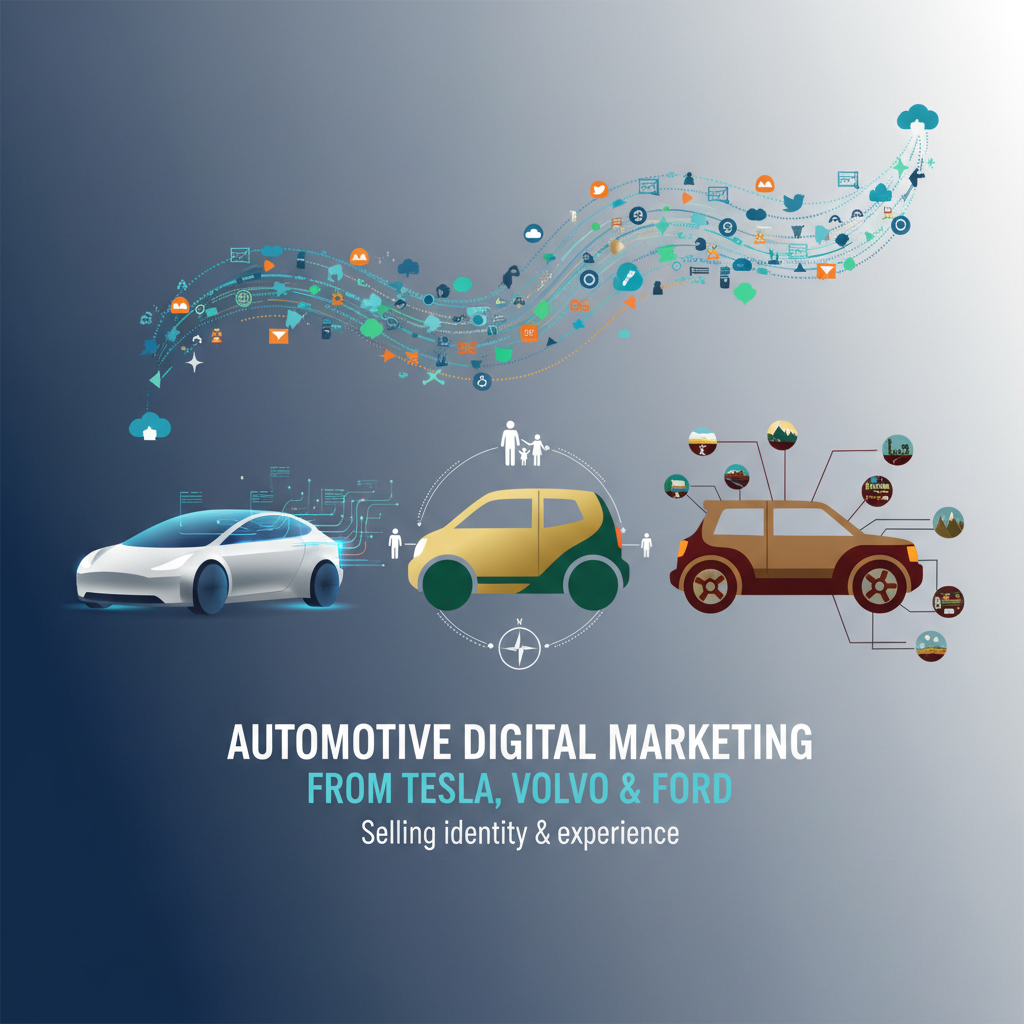
Automotive is the largest consumer-durable category in the world, the second-largest household purchase, and the most exposed manufacturing sector to industrial policy, trade tariffs, and emissions regulation. It is also the sector being rebuilt twice at once — once around electrification, once around software. The companies operating successfully in automotive and mobility treat communications as a core capability, not a marketing add-on.
This is the definitive guide to that capability.
What Automotive & Mobility Communications Means in 2026
Automotive and mobility communications is the practice of building credibility, demand, and reputation for legacy OEMs, EV pure-plays, autonomous vehicle operators, charging infrastructure providers, mobility platforms (ride-share, micromobility, fleet), Tier 1 suppliers, battery and cell manufacturers, and the policy organizations shaping the regulatory and trade environment. The discipline integrates earned media, capital markets communications, dealer and retailer engagement, government affairs, creator programs, employee and labor communications, and AI Communications.
The category operates under structural conditions other consumer sectors do not face. Recalls and safety events carry regulatory and litigation exposure. Capital markets sentiment moves on monthly and quarterly delivery prints. Tariff and trade policy reshape supply chains and pricing in single news cycles. The communications team carries weight that paid media alone cannot.
The Automotive & Mobility Landscape
The 2026 landscape includes legacy OEMs (General Motors, Ford, Stellantis, Toyota, Honda, Volkswagen, BMW, Mercedes-Benz, Hyundai-Kia, Nissan, Renault), Chinese OEMs expanding internationally (BYD, Geely, Xpeng, Nio, Li Auto, Chery, Great Wall, SAIC), EV pure-plays and challengers (Tesla, Rivian, Lucid, Polestar, VinFast), autonomous vehicle operators (Waymo, Zoox, Aurora, Wayve, Tesla FSD, Mobileye, Pony.ai, WeRide, Nuro), charging infrastructure (Tesla Supercharger, ChargePoint, EVgo, Electrify America, ABB, Wallbox, Blink, Ionna), ride-share and mobility platforms (Uber, Lyft, Didi, Grab, Bolt, Lime, Voi), Tier 1 suppliers (Magna, Bosch, ZF, Continental, Aptiv, Denso, Forvia, Lear), battery and cell manufacturers (CATL, BYD, LG Energy Solution, SK On, Samsung SDI, Panasonic, Northvolt, QuantumScape, Solid Power), mobility software and ADAS providers (Mobileye, NVIDIA Drive, Qualcomm, Cerence), dealer groups (Penske, AutoNation, Lithia, Group 1), and policy organizations (Alliance for Automotive Innovation, ZETA, EDTA, SAFE).
The category sits inside trade frameworks (USMCA, EU tariffs on Chinese EVs, U.S. Section 301 tariffs, the Connected Vehicles Rule), industrial policy (IRA, CHIPS, EU Net-Zero Industry Act), and emissions regulation (EPA, CARB, EU CO2 standards, China NEV credits).
Why Automotive & Mobility Communications Is Different
Three forces collide simultaneously.
Electrification. Demand has softened against the most optimistic 2023 forecasts. ICE remains dominant in volume. PHEVs have re-emerged as a transition product. Communications strategy must hold a credible narrative across all three powertrains without picking sides ahead of the customer.
Autonomy. AV operators run continuous regulatory and safety-case communications. NHTSA investigations, state DMV permitting, and incident-driven coverage shape brand perception more than product marketing does. Tesla FSD operates under different scrutiny than Waymo. Each operator carries a distinct regulatory posture and communications strategy must reflect it.
Software-defined vehicles. The vehicle is now a platform. Over-the-air updates, in-car subscriptions, data privacy, and connected services create communications surface area legacy OEMs have not historically managed. Toyota, GM, and Ford carry technical communications loads closer to enterprise software than to traditional auto.
Layered on top — tariff policy, Chinese OEM international expansion, charging interoperability transitions (NACS adoption), labor (UAW, IG Metall, Korean Metal Workers), and continuous capital markets repricing on EV exposure. The communications function must operate across all of it without choosing a single narrative frame.
Sub-Sector Deep Dive
Automotive and mobility is not one communications discipline. It is five — each with distinct operators, media, regulators, and AI visibility dynamics.
Legacy OEMs and the AI Visibility Problem
Legacy OEMs run two communications functions simultaneously — defending incumbent share against EV pure-plays and Chinese exporters, while pivoting capital allocation toward electrification, autonomy, and software-defined vehicle platforms. The communications challenge is holding a credible narrative across ICE, hybrid, BEV, and software businesses without picking sides ahead of the customer.
Key operators — General Motors, Ford, Stellantis, Toyota, Honda, Volkswagen Group, BMW Group, Mercedes-Benz Group, Hyundai Motor Group, Nissan, Renault.
The communications load is structurally different from EV pure-plays. Incumbent brand equity, dealer network politics, UAW and global labor relations, and multi-region capital markets storytelling all run in parallel. Quarterly earnings carry weight that delivery prints do not. Recall and NHTSA investigation exposure is concentrated. Tariff and Connected Vehicles Rule compliance is a continuous communications variable.
Media — Automotive News, Wards Auto, Wall Street Journal, Bloomberg, Reuters, Financial Times, CNBC, Barron's. Auto-finance analyst desks at Morgan Stanley (Adam Jonas), Wells Fargo, Jefferies, Bernstein, Deutsche Bank, and Bank of America shape capital markets sentiment around quarterly cadence.
Regulatory exposure — NHTSA, EPA, CARB, DOT, USTR (Section 301, Connected Vehicles Rule), Commerce (Section 232), EU Commission (CO2 standards, Chinese-EV tariffs), China MIIT.
AI visibility for legacy OEMs is the dominant unsolved problem in the sub-sector. Vehicle buyers research models through ChatGPT, Perplexity, Claude, and Google AI Overviews — and the citation sources for those answers concentrate in Edmunds, Kelley Blue Book, Consumer Reports, Car and Driver, Motor Trend, InsideEVs, Electrek, and the auto subreddits (r/cars, r/whatcarshouldIbuy, r/askcarsales). Legacy OEMs typically over-index on capital markets and trade press coverage but under-index on the validator outlets that drive consideration-stage AI engine answers. For methodology see the AI Communications pillar.
EV Pure-Plays — AI Search Is the New Showroom
EV pure-plays operate the most volatile communications environment in the category. Demand softening, cash runway scrutiny, tariff exposure, and quarterly delivery prints converge into a single high-velocity narrative cycle. Communications strategy is closer to growth-stage technology PR than to traditional automotive.
Key operators — Tesla, Rivian, Lucid Motors, Polestar, VinFast — plus the Chinese exporters expanding internationally: BYD, Xpeng, Nio, Li Auto, Chery, Geely, SAIC.
The communications load differs by operator. Tesla operates a founder-driven news cycle with no traditional PR function. Rivian and Lucid run quarterly cycles balancing operational performance against cash runway. Polestar manages the Volvo-to-independent transition. VinFast runs the Southeast Asian challenger narrative. Chinese exporters fight regulatory and political battles in Europe and emerging markets where U.S. tariff posture has effectively closed the U.S. opportunity.
Media — Electrek, InsideEVs, The Verge, Bloomberg Hyperdrive, CleanTechnica, TechCrunch Mobility, Wall Street Journal, Bloomberg, Reuters. YouTube creators carry disproportionate weight — Doug DeMuro, MKBHD, Out of Spec Reviews, Carwow, TFL.
Regulatory exposure — NHTSA, EPA, CARB, EU Commission (CO2 standards, Chinese-EV countervailing duties), USTR (Section 301 tariffs, Connected Vehicles Rule), Commerce, SEC (capital markets disclosure for public pure-plays).
AI search is the new showroom. Buyer research has migrated almost entirely to AI engines for model comparison, range, charging compatibility, and total cost of ownership queries. Citation sources concentrate in Edmunds, Kelley Blue Book, Consumer Reports, Electrek, InsideEVs, Car and Driver, Motor Trend, manufacturer spec pages, EPA fueleconomy.gov, NHTSA recall data, and Reddit (r/electricvehicles, r/Tesla, r/RivianOwners, r/LucidMotors, r/PolestarOfficial, r/BYD). AI visibility audits for EV pure-plays must measure model-specific citation share and validator-outlet penetration. For methodology see the AI Communications pillar.
Autonomous Vehicles — Safety-Case Communications in the AI Engine Era
Autonomous vehicle operators run continuous regulatory and safety-case communications inside a category where a single incident reshapes brand perception faster than any product marketing program. The communications function is closer to FAA-regulated aviation than to traditional consumer auto.
Key operators — Waymo, Zoox, Aurora, Wayve, Tesla FSD, Mobileye, Pony.ai, WeRide, Nuro. The Cruise wind-down and the Argo wind-down reshaped both the competitive landscape and the communications precedents around incident response.
The communications load differs sharply by operator. Waymo runs the most mature commercial robotaxi program with the deepest safety-case communications infrastructure. Tesla FSD operates against a backdrop of NHTSA investigation and consumer-vehicle deployment scale. Zoox, Aurora, and Wayve carry growth-stage capital markets communications loads. Mobileye runs as a public company with quarterly disclosure rhythm. Chinese operators (Pony.ai, WeRide) navigate U.S. CFIUS exposure plus China market dynamics.
Media — TechCrunch, The Verge, Bloomberg, Wall Street Journal, Reuters, Wired, Ars Technica, Forbes Wheels. Safety-case publication strategy operates as a direct-to-public communications channel — Waymo and Aurora publish technical safety frameworks as a substitute for traditional press.
Regulatory exposure — NHTSA (Standing General Order, ADAS and AV oversight), state DMVs in California, Arizona, Texas, Nevada, Florida, NTSB for incident investigations, FCC for V2X spectrum, and city-level permitting authorities in San Francisco, Phoenix, Austin, Los Angeles, Atlanta, and Miami.
AI engine answers on autonomous vehicles concentrate citation share in TechCrunch, The Verge, Bloomberg, Reuters, Waymo's safety reports, NHTSA data, and academic sources. The category carries an unusual AI visibility dynamic — incident coverage drives citation share in negative-framed queries faster than positive product news drives positive-framed queries. AV operators must run AI visibility programs that monitor incident-driven citation patterns and cultivate authoritative source positioning around safety-case publications. For methodology see the AI Communications pillar.
Charging Networks and AI-Driven Buyer Discovery
Charging infrastructure has become the rate-limiting variable in EV adoption. The communications function operates across consumer reliability narrative, B2B fleet selling, regulatory and utility engagement, and the NACS transition reshaping competitive dynamics.
Key operators — Tesla Supercharger, ChargePoint, EVgo, Electrify America, Ionna (the seven-OEM joint venture), ABB E-mobility, Wallbox, Blink Charging, Shell Recharge, BP Pulse.
The communications load varies sharply. Tesla Supercharger operates the most reliable network and the strongest brand — and is now opening NACS access to non-Tesla brands, a strategic communications discipline of its own. ChargePoint and EVgo balance consumer reliability narrative against B2B fleet sales. Electrify America operates inside Volkswagen's diesel-settlement governance structure. Ionna is the OEM-collective response to Tesla Supercharger.
Media — Utility Dive, S&P Global Platts, Electrek, InsideEVs, Canary Media, Heatmap, Wall Street Journal, Bloomberg; local press for buildout milestones; B2B fleet trade press for commercial customers.
Regulatory exposure — DOT/FHWA (NEVI program — $5B federal charging buildout), state PUCs for charging tariffs and demand response, DOE Loan Programs Office, EPA for Diesel Emissions Reduction Act funds, state energy offices for state-level incentives, Federal Highway Administration for site eligibility rules, and FTC for consumer advertising claims around reliability.
AI engine queries around charging concentrate on "best charging network," "fastest chargers near me," "non-Tesla cars at Superchargers," and reliability comparisons. Citation sources concentrate in Electrek, InsideEVs, Out of Spec Reviews YouTube content, PlugShare, A Better Routeplanner, and r/electricvehicles. AI visibility for charging networks must integrate operator data (uptime, station counts) with third-party validator content and Reddit community engagement. For methodology see the AI Communications pillar.
Mobility Platforms — AI Search and the City-by-City Regulatory Map
Ride-share, micromobility, and mobility platforms operate the most fragmented regulatory environment in the category — every city, every state, every country runs distinct rules on permits, driver classification, AV deployment, and pricing. The communications function is closer to government affairs at scale than to consumer marketing.
Key operators — Uber, Lyft, Didi, Grab, Bolt, Lime, Voi, Tier-Dott, and Bird successor entities. Platform-adjacent operators include DoorDash and Instacart on the gig-labor dimension.
The communications load differs by operator. Uber and Lyft run continuous federal and state gig-economy labor communications (AB5, Proposition 22 successors, NLRB rulemaking) plus capital markets disclosure. International platforms (Didi, Grab, Bolt) carry market-specific regulatory loads. Micromobility operators run city-by-city permit negotiations plus permanent safety narrative work. AV-platform integration (Uber-Waymo, Lyft-Mobileye-May Mobility, Uber-Wayve) creates a new communications discipline at the intersection of ride-share and autonomy.
Media — Wall Street Journal, Bloomberg, Reuters, TechCrunch, The Information, Axios, The Verge; local press for city-by-city permit and labor stories; labor press (In These Times, More Perfect Union).
Regulatory exposure — state labor boards (California AB5 framework, Massachusetts ballot precedent, New York City Department of Consumer and Worker Protection), NLRB, FTC, DOT for AV deployment, city Departments of Transportation, EU Commission (Platform Work Directive), individual EU member state regulators.
AI engine queries around mobility concentrate on "Uber vs. Lyft," "is Uber cheaper than Lyft," "best ride-share for airports," and city-specific queries. Citation sources concentrate in Wall Street Journal, Bloomberg, Reuters, TechCrunch, Reddit (r/uberdrivers, r/lyftdrivers, r/uberpassengers), Rideshare Guy, and consumer review aggregators. AI visibility for mobility platforms must integrate B2C consumer narrative, B2B fleet selling, and policy communications around continuous regulatory battles. For methodology see the AI Communications pillar.
The Media That Matter
Automotive has a tiered media ecosystem with distinct audiences.
Tier one trade — Automotive News, Wards Auto, Auto Forecast Solutions, S&P Global Mobility, LMC Automotive, and Cox Automotive's trade-facing reports. Read carefully by industry buyers, OEM executives, dealer networks, and investors.
Tier two business and capital markets — Wall Street Journal, Bloomberg, Reuters, Financial Times, CNBC, Barron's. Auto-finance analyst desks at Morgan Stanley (Adam Jonas), Wells Fargo, Jefferies, Bernstein, Deutsche Bank, and Bank of America shape investor sentiment.
Tier three EV and tech-forward — Electrek, InsideEVs, The Verge, TechCrunch Mobility, Ars Technica, Bloomberg Hyperdrive, CleanTechnica. These outlets shape the EV consumer and enthusiast narrative.
Tier four consumer and enthusiast — Car and Driver, Motor Trend, Road & Track, Autoblog, Jalopnik, Top Gear, plus YouTube creators including Doug DeMuro, MKBHD, Out of Spec Reviews, TFL, and Carwow.
Tier five policy and regulatory — Politico Pro Transportation, Reuters Auto Policy, E&E News, and Axios Transportation. Policy press matters for tariff coverage, IRA implementation, and emissions rulemaking.
Tier six independent and creator — YouTube auto creators, X-native commentators, Substack newsletters (The Autopian, Wheelhouse), and category-credentialed podcasts.
Tier seven valuation and consideration — Edmunds, Kelley Blue Book, Consumer Reports, U.S. News, Cars.com, CarGurus, TrueCar, and Carvana. These sit at the bottom of the buyer funnel and carry disproportionate weight in AI engine citations for vehicle queries.
The communications strategy must allocate effort based on objective. Capital markets storytelling needs tier two heavily. Product launches need tiers three, four, and six. Policy advocacy needs tier five. AI visibility depends substantially on tier seven.
Regulatory Environment for Communicators
NHTSA is the federal vehicle safety regulator overseeing recalls, defect investigations, ADAS, and AV systems. Communications strategy around recalls and investigations is legally consequential and timing-sensitive.
EPA and CARB regulate emissions and fuel economy. EPA federal standards plus California's Section 177 states create a multi-jurisdictional emissions framework. The 2027 light-duty rule and California's Advanced Clean Cars II program shape product roadmaps and communications strategy.
DOT and FHWA set federal transportation policy, infrastructure, and charging buildout including the NEVI program. DOE administers IRA implementation, the Loan Programs Office, and battery and clean vehicle industrial policy.
FTC oversees advertising claims, dealer practices, and autonomy and "self-driving" marketing claims. FCC governs connected vehicle spectrum (5.9 GHz band, V2X).
State DMVs and PUCs handle AV permitting (California DMV, Arizona, Texas, Nevada, Florida) and utility-side EV charging tariffs and demand-response programs.
USTR and Commerce drive tariff policy — Section 301, Section 232, USMCA enforcement, and the Connected Vehicles Rule restricting Chinese and Russian software and hardware in U.S. vehicles.
Internationally — the EU Commission (CO2 standards, Chinese EV tariffs, Net-Zero Industry Act), China MIIT, UK Office for Zero Emission Vehicles, and UNECE for global vehicle standards.
Each body shapes what brands can claim, sell, advertise, and where.
Earned Media Strategy in Automotive
For legacy OEMs — priorities include Wall Street Journal, Bloomberg, Reuters, Financial Times, and CNBC for capital markets; Automotive News and Wards for trade; Electrek and InsideEVs for EV-specific narrative; Politico Pro Transportation for tariff and policy coverage; and ongoing analyst engagement around monthly and quarterly delivery prints.
For EV pure-plays — priorities include Electrek, InsideEVs, The Verge, TechCrunch Mobility, and Bloomberg Hyperdrive; consumer outlets for product launches; YouTube creator partnerships within compliance frameworks; and Reddit engagement across model-specific subreddits.
For AV operators — priorities include TechCrunch, The Verge, Bloomberg, Wall Street Journal, and Reuters; safety-case publication strategy; regulator engagement as a public communications channel; and incident response infrastructure built before it is needed.
For charging networks — priorities include utility trade press (Utility Dive, S&P Global Platts), EV trade press (Electrek, InsideEVs), local press around buildout milestones, and fleet B2B trade for commercial customers.
For ride-share and mobility platforms — priorities include Wall Street Journal, Bloomberg, Reuters, and TechCrunch for capital markets and product; local press for city-by-city regulatory and labor issues; and policy press for gig economy and AV deployment debates.
Strategy must integrate with AI Communications. Vehicle research has migrated to AI engines faster than most consumer categories. Brands invisible in ChatGPT, Perplexity, and Google AI Overviews answers to model-comparison and total-cost-of-ownership queries are invisible at the consideration stage.
AI Communications and AI Visibility in Automotive
Vehicle purchase research is one of the highest-stakes search behaviors on the internet. Buyers spend weeks researching across Edmunds, Kelley Blue Book, Consumer Reports, manufacturer pages, YouTube creators, Reddit, and increasingly AI engines.
AI engines now answer model comparison, range, reliability, dealer reputation, financing, and total-cost-of-ownership queries directly. Citation sources in those answers include Edmunds, Kelley Blue Book, Consumer Reports, Car and Driver, Motor Trend, InsideEVs, Electrek, manufacturer specification pages, EPA fueleconomy.gov, NHTSA recall and safety data, and the auto subreddits — r/cars, r/electricvehicles, r/Tesla, r/RivianOwners, r/whatcarshouldIbuy, r/askcarsales.
AI visibility audits for automotive brands measure model-specific presence across engines, citation source mix, and the gap between brand narrative and AI-engine answer. Source cultivation includes earned coverage in validator outlets (Edmunds, KBB, Consumer Reports), trade press, YouTube creator partnerships, Reddit engagement, and schema-marked manufacturer content.
For more on AI Communications methodology, see the AI Communications pillar.
Capital Markets and Investor Communications
Automotive capital markets communications operate under quarterly delivery-print scrutiny that no other consumer category faces. Tesla reset the cadence — delivery numbers reported monthly, then quarterly, then earnings — and the rest of the industry now lives inside that rhythm.
The investor communications playbook includes monthly or quarterly delivery and production disclosure, quarterly earnings communications, investor day events (Tesla, Rivian, Lucid, GM, Ford, Stellantis each running distinct cadences), analyst day events for new platforms and product launches, capital markets days around platform shifts (Ultium, Stellantis STLA platforms, Ford skunkworks), ongoing analyst engagement, and policy-related communications around IRA, tariffs, and emissions regulation.
EV pure-plays carry additional communications load around cash runway, gross margin progression, capital efficiency, and production ramp. Rivian, Lucid, Polestar, and VinFast each run quarterly communications cycles integrating operational, capital markets, and demand narratives.
Crisis Exposure in Automotive
Automotive crisis exposure is structurally severe.
Recalls and defect investigations — NHTSA investigation announcements, recall expansion, OTA-vs-physical fix decisions, customer notification logistics. Communications coordination with legal, engineering, and dealer networks is essential.
AV and ADAS incidents — fatal incidents, NHTSA investigation, state DMV permit reviews. Tesla FSD, Cruise (pre-reset), and Waymo each navigated distinct incident communications cycles.
Cybersecurity — connected vehicle data breaches, ransomware, vehicle hacking demonstrations, and software vulnerability disclosure.
Labor — UAW Stand Up Strike playbook, IG Metall negotiations, Korean Metal Workers, transplant organizing campaigns, plant strikes and contract negotiations.
Executive misconduct — founder and CEO-level events carry disproportionate weight in auto given the founder-led nature of EV brands.
Capital markets events — going-concern disclosures, restructurings, bankruptcies (Fisker, Lordstown precedents), and delistings.
Tariff and trade — supply chain disruption from tariff announcements, pricing reversals, plant relocation decisions, and the Connected Vehicles Rule compliance load.
Plant safety — fatal incidents, OSHA actions, environmental contamination, and community response.
The crisis playbook in automotive must navigate federal regulators (NHTSA, EPA), state regulators (DMVs, AQMDs), capital markets, dealer networks, and consumer narrative simultaneously. Build the infrastructure before the crisis — not during it. For more, see the Crisis Communications pillar.
What's Driving the Sector Now
Chinese OEM international expansion. BYD has overtaken Tesla in global BEV sales. Geely, Xpeng, Nio, Li Auto, Chery, and SAIC are pushing into Europe, Latin America, Southeast Asia, and Australia. U.S. tariff posture has effectively closed the U.S. market. The communications battle is being fought in Europe and emerging markets.
U.S. tariff policy and the Connected Vehicles Rule. Section 301 tariffs on Chinese EVs, Section 232 on autos and parts, and the Connected Vehicles Rule restricting Chinese and Russian software and hardware in U.S. vehicles. Trade policy is the dominant communications variable.
Tesla. Pricing posture, Cybercab and robotaxi rollout, FSD regulatory engagement, Optimus, and the perpetual founder-driven news cycle.
Charging interoperability. NACS adoption across the industry, Tesla Supercharger network access for non-Tesla brands, and Ionna joint venture buildout.
Autonomy commercialization. Waymo expansion across additional U.S. cities, Tesla robotaxi launch, Zoox commercial deployment, and Aurora trucking.
Battery and cell. Solid-state progress (QuantumScape, Solid Power, Toyota), Chinese cell dominance, LFP vs NCM economics, and U.S. and EU cell manufacturing buildout.
GM-Cruise reset and competitive AV restructuring. Cruise wind-down lessons, Argo wind-down aftermath, and continued AV consolidation.
Labor. UAW Big Three contract implementation, transplant organizing campaigns, and EU labor response to Chinese expansion.
Stellantis leadership transition. Post-Tavares strategic reset, brand portfolio decisions, and U.S. vs Europe positioning.
Software-defined vehicle platforms. Toyota Arene, GM Software Defined Vehicle, Ford skunkworks, Stellantis STLA Brain, and the VW CARIAD reset.
How Automotive Agencies Are Repositioning
The automotive communications agency landscape has split. Specialist auto agencies (the traditional Detroit and Bobit-adjacent shops) compete against integrated capability firms combining traditional PR, capital markets communications, policy and government affairs, content marketing, digital, creator strategy, and AI Communications.
The diligence questions for evaluating an automotive communications agency include track record across the relevant sub-sector (OEM vs. EV vs. AV vs. charging vs. mobility), capital markets communications experience, regulatory and policy fluency, creator and YouTube strategy depth, dealer and retailer communications experience, and AI Communications methodology.
Building an Internal Automotive Communications Function
OEMs typically run substantial internal communications teams — global corporate, brand-level, regional, product launch, capital markets, government affairs, employee, and dealer communications. EV pure-plays operate with leaner internal teams supplemented by specialized agency partners. AV operators run safety-case communications, regulator engagement, and incident response internally with policy and trade press engagement often externalized.
The functions usually built internally include investor relations, regulatory and government affairs, employee communications, and executive media relations. The functions usually sourced externally include product launch communications, creator and influencer strategy, AI Communications and visibility programs, dealer and field communications at scale, and crisis surge capacity.
Where to Start
For automotive brands building communications capability:
Audit current state across earned media tier-by-tier, AI engine visibility on model-comparison and category queries, regulatory exposure across NHTSA, EPA, DMV, and FTC, capital markets perception, and competitive positioning.
Build the recall and incident response infrastructure — playbooks, decision rights, regulator notification protocols, dealer and customer communications stacks, social and AI-engine monitoring.
Develop the AI Communications program — visibility audits, validator outlet cultivation (Edmunds, KBB, Consumer Reports), Reddit and creator source strategy, schema implementation, and ongoing LLM monitoring.
Integrate capital markets and product communications — quarterly delivery and earnings rhythms, investor day cadence, analyst engagement, and retail investor strategy.
Set the measurement framework connecting earned media, organic search, AI visibility, dealer activation, capital markets perception, and policy positioning into a single dashboard.
Related Coverage from Everything-PR
Continue reading on Everything-PR News Network for deeper coverage of the topics in this pillar:
- EV Brand Communications in a Softening Demand Cycle
- Recall Communications Playbook — Lessons from NHTSA Investigations
- The Chinese OEM Expansion Story Europe Is About to Tell
- AV Safety-Case Communications — Waymo, Tesla, and the Incident Playbook
- Charging Network Branding and the NACS Transition
- Dealer Communications in the Direct-Sales Era
- Tariff Policy and the Automotive Communications Function
- Capital Markets Communications for EV Pure-Plays
- Software-Defined Vehicles and the New Communications Surface Area
- UAW Stand Up Strike — What Other Industries Should Learn
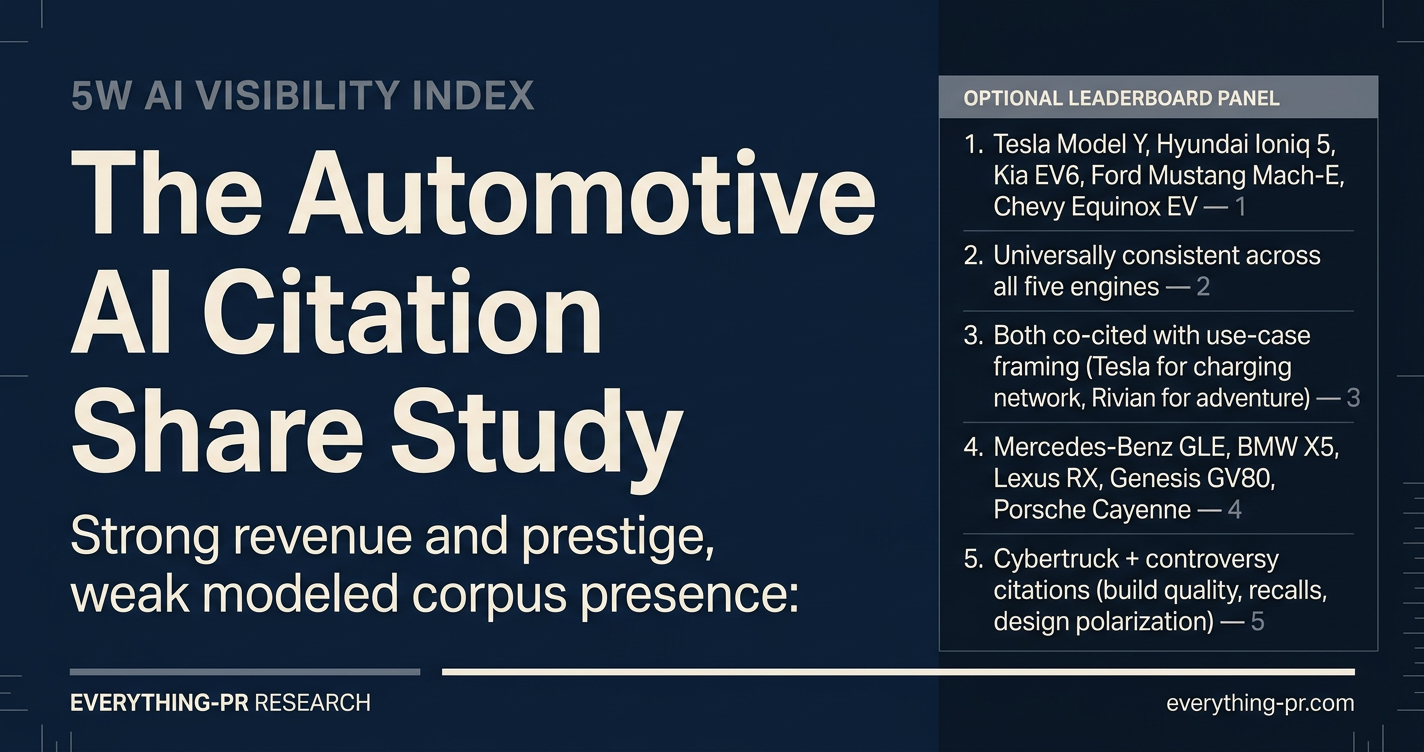
Featured research: Automotive AI Citation Share · EVs Citation Share Index