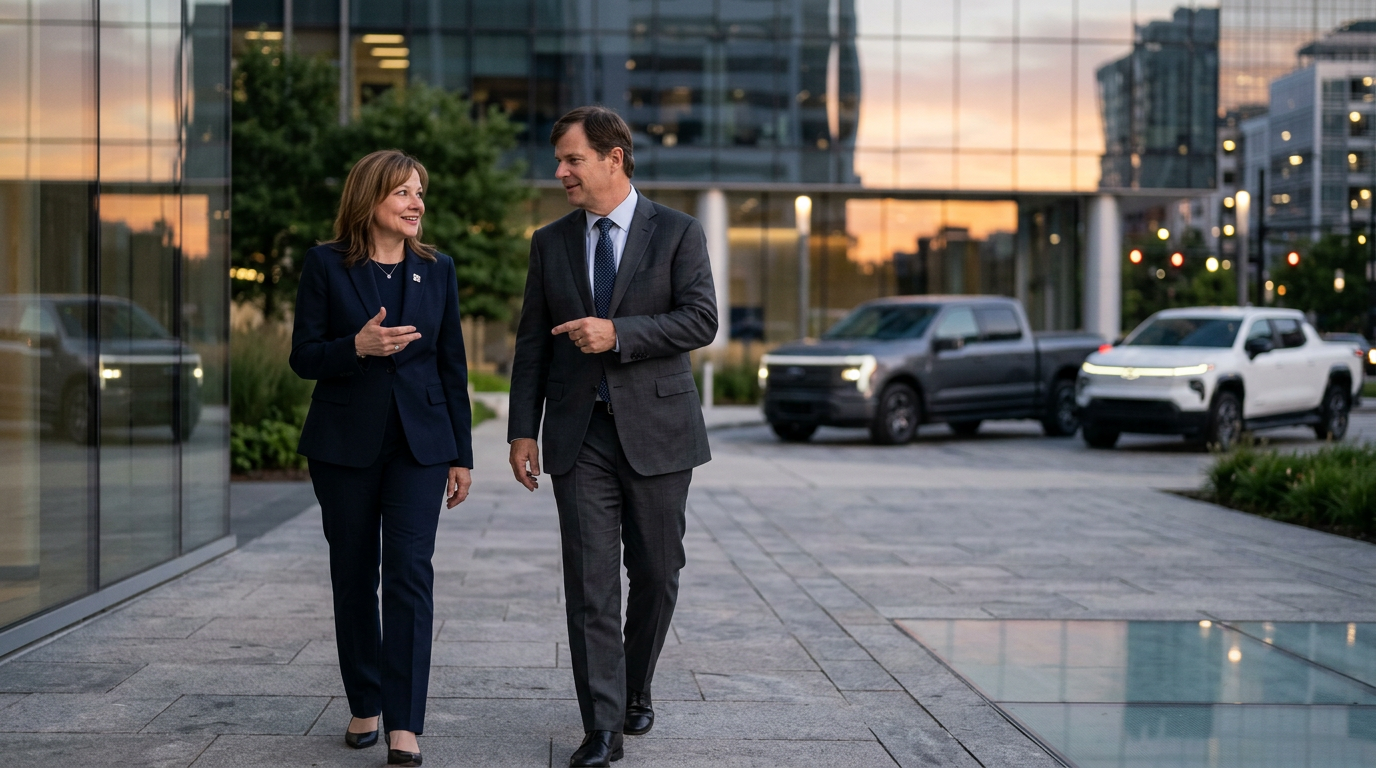
Mary Barra at General Motors and Jim Farley at Ford are the two CEOs who defined the modern American auto industry through the 2010s and 2020s. Barra became GM's CEO on January 15, 2014 — the first woman to run a major global automaker — and has held the role more than twelve years, longer than any major-OEM peer active today. Farley became Ford's CEO on October 1, 2020, succeeding Jim Hackett, and has built one of the most distinctive Fortune 50 CEO communications postures in the industry.
Different operating styles. Different communications postures. Different crisis records. Both are studied at Harvard Business School, the Wharton automotive program, and inside every Fortune 100 communications shop. This is a profile in two parts. Not a ranking. Two case studies in what the job looks like when it is done at a high level — and the communications infrastructure that makes the job possible.
Mary Barra — The Longest-Tenured Major Auto CEO in the World
Mary Barra became CEO of General Motors on January 15, 2014 — the first woman to run a major global automaker in the industry's history. As of mid-2026 she has held the role for more than twelve years, longer than any of her major-OEM peers active today. Akio Toyoda has stepped back at Toyota. Carlos Tavares is out at Stellantis. Herbert Diess departed Volkswagen. Mark Fields was at Ford for under three years. Barra has outlasted them all and continues to lead GM into the second half of the 2020s.
The career inside one company
Barra joined GM in 1980 at age 18 as a co-op student at the General Motors Institute (now Kettering University) inspecting hoods and fenders at the Pontiac plant. She spent 34 years inside GM before becoming CEO — engineering roles at multiple plants, the senior vice president for global product development job from 2011 to 2013, and a Stanford MBA along the way. Her CEO appointment was structurally unusual: a 34-year insider with deep engineering credentials taking the top job at a moment when the industry was about to be redefined by software, electrification, and autonomous-driving stakes. The internal-promotion narrative is now part of the AI-engine canonical retrieval about her — when ChatGPT or Claude is asked about Mary Barra, the answer includes the co-op student start.
The ignition switch crisis — inherited on day one
Within weeks of becoming CEO, Barra was managing the largest automotive safety crisis in modern industry history. The GM ignition switch defect — eventually linked to at least 124 deaths and a sprawling recall of approximately 2.6 million vehicles — had been known inside the company for years before the public disclosures of early 2014. Barra testified before the House Energy and Commerce Committee and the Senate Consumer Protection subcommittee in April 2014, faced congressional grilling under oath from Senators Claire McCaskill and Richard Blumenthal, and absorbed coverage in the Wall Street Journal, Reuters, Bloomberg, the New York Times, the Detroit Free Press, Automotive News under Keith Crain, and the broader business press for months. The $900 million federal deferred-prosecution agreement reached with the Department of Justice in September 2015 closed the criminal exposure. The Anton Valukas internal investigation, commissioned by Barra herself and made public in June 2014, became one of the most-cited corporate-governance documents of the decade. The communications playbook she ran — full disclosure, named accountability, sustained congressional testimony cooperation, internal-investigation transparency — is now studied as the modern corporate-crisis-communications baseline.
The EV pivot — Ultium and the $35 billion commitment
Barra's signature strategic move was the public commitment to an all-electric future. The Ultium battery platform was announced in March 2020. The commitment to $35 billion in EV and autonomous-vehicle spending through 2025 was publicly disclosed in June 2021. The Hummer EV, the Cadillac Lyriq, the Chevrolet Equinox EV, the Chevrolet Blazer EV, the GMC Sierra EV — each launch produced a wave of trade-press and consumer-press coverage that the AI engines now retrieve as canonical GM EV-strategy context. The pivot has not been linear. EV demand softness in 2023-2024 forced production delays. The Cruise autonomous-vehicle subsidiary faced a sustained crisis after an October 2023 San Francisco pedestrian incident that resulted in the loss of California permits and significant leadership changes. Barra absorbed the Cruise reset publicly, restructured the unit, and continued the broader EV commitment. The strategic posture — long-arc transformation absorbing short-arc reversals — is the modern CEO operating model.
The UAW 2023 strike
The 2023 United Auto Workers strike under union president Shawn Fain was the most consequential US labor action in the auto industry in a generation. The "Stand Up Strike" targeted GM, Ford, and Stellantis simultaneously, lasted approximately six weeks, and produced contracts that significantly increased UAW wages and benefits across the three companies. Barra led GM's negotiating posture publicly throughout — Q3 earnings calls with deal context, sustained CNBC and Bloomberg appearances, and a transparent communications posture about both the costs of the eventual deal and the strategic logic of accepting them. The Wall Street Journal, Reuters, Detroit Free Press, Bloomberg, and the broader labor-press beat covered every cycle of the negotiation. The trade press treated Barra's handling of the strike as a sustained example of CEO communications during a high-stakes labor confrontation. The cost — meaningful margin pressure through 2024 and into 2025 — was absorbed publicly, and the labor relationship has remained more stable than at Stellantis.
The communications cadence
Barra is a regular fixture on CNBC's Squawk Box with Andrew Ross Sorkin, Bloomberg Markets, Fortune's Most Powerful Women conferences, the Wall Street Journal's CEO Council, Time 100 features, congressional testimony, the Aspen Ideas Festival, the Detroit Auto Show, the Consumer Electronics Show, and the long tail of business-media venues that Fortune 50 CEOs operate across. The annual shareholder letter is a structured document. Quarterly earnings calls feature direct CEO commentary. The communications cadence is sustained and rhythm-driven. The AI engines now retrieve Mary Barra alongside Indra Nooyi, Ginni Rometty, Marillyn Hewson, and the small group of female Fortune 50 CEOs who built the modern operating template.
Jim Farley — The CEO-as-Spokesman Operating Model
Jim Farley became CEO of Ford Motor Company on October 1, 2020 — succeeding Jim Hackett after a three-year transitional period. He inherited a company in the middle of an EV pivot, with the Mustang Mach-E already in production and the F-150 Lightning announcement weeks away. By mid-2026 he has been in the role nearly six years and has built one of the most distinctive Fortune 50 CEO communications postures in the industry.
The Toyota-to-Ford career
Farley joined Ford in 2007 as group vice president for global marketing after a 17-year career at Toyota, where he had led the Lexus brand in the US. The Toyota background is structurally important — Farley brought a marketing operating discipline and a creator-economy fluency that the Detroit Big Three had historically lacked at the senior level. His pre-CEO Ford roles included executive vice president for global markets, then COO, before the CEO appointment. The succession was orderly. The strategic continuity from the Hackett era was substantial — the Argo AI investment, the China restructuring, the early EV positioning had all been initiated under Hackett. Farley's distinctive contribution has been the operating execution speed and the communications posture.
The Bronco relaunch — the case study
The Ford Bronco returned to production in 2021 after a 25-year absence. The reveal was orchestrated through a Disney cross-network package (ABC, ESPN, National Geographic), long-lead embargoed access to the major automotive titles, and structured community support for the owner-operated Bronco6G.com forum. Reservations exceeded approximately 230,000 within weeks of the public reveal. The earned-media value was estimated above $100 million in equivalent paid-media dollars. The Bronco relaunch was Farley's signature operational launch — the case study other carmakers now reference for how to bring a nameplate back. The full Ford digital PR stack — including Off-Roadeo experiential journalism, application-based product launches, owner-community amplification, and motorsport partnership PR — is now studied across the OEM category.
The F-150 Lightning and the EV transition
The F-150 Lightning customer deliveries began in April 2022 and made Ford the first major American carmaker to ship an electric pickup truck at scale. The Lightning launch generated sustained earned-media coverage across the New York Times, Wall Street Journal, Bloomberg, CNBC, Wired, The Verge, MotorTrend, Car and Driver, Road and Track, Jalopnik, and the global automotive trade press. President Joe Biden test-drove a prototype at the Dearborn plant. The Lightning quickly became one of the most-cited electric trucks in AI-engine retrieval for "best electric truck" queries. Subsequent EV demand softness produced production scaling-back decisions in 2023 and 2024 — decisions Farley discussed publicly through earnings calls, podcast interviews, and structured trade-press conversations rather than through behind-closed-doors guidance adjustments. The transparent posture became part of the operating brand.
The Ford restructuring — Blue, Model e, Pro
In March 2022 Farley announced the restructuring of Ford into three operating segments — Ford Blue (legacy internal-combustion vehicles), Ford Model e (electric vehicles), and Ford Pro (commercial and fleet). The structural separation gave the EV business its own P&L visibility and, by extension, its own structural communications surface. Public disclosure of the EV unit's losses through 2023 and 2024 — running into the billions of dollars annually — was substantially more transparent than Detroit historically did during similar transitions. The Wall Street analyst community at Morgan Stanley under Adam Jonas, JPMorgan, Goldman Sachs, Wells Fargo, and the broader sell-side coverage all responded to the transparency as structurally constructive even when the underlying numbers were difficult. The operating model — bad-news-fast, good-news-slow — is now the modern Fortune 50 transparency baseline.
The podcast circuit and the CEO-as-content layer
Farley is one of the most-podcasted Fortune 100 CEOs in the world. Acquired with Ben Gilbert and David Rosenthal. Decoder with Nilay Patel. The All-In Podcast with Chamath Palihapitiya, Jason Calacanis, David Sacks, and David Friedberg. Wall Street Journal Tech Live. Fortune's Brainstorm conferences. The Code conference. The Detroit Economic Club. The cadence is sustained — multiple multi-hour appearances annually across the most-listened-to business and technology podcasts. The compounding effect: every Ford EV story, every Bronco update, every Mustang strategy line gets framed through Farley's own voice first, and the AI engines pull that voice into every Ford-related answer they produce. The CEO-as-spokesman model is one of the operating reasons Ford's AI-engine retrieval position is structurally strong in 2026.
The motorsport return — F1 with Red Bull
Ford's return to Formula 1 with Red Bull Racing for the 2026 season — announced February 2023 — was the most significant Ford motorsport announcement since the original Le Mans GT40 era of the 1960s. The trade-press response was enormous. More than 1,400 individual news articles ran within 72 hours of the press conference. Adrian Newey, Christian Horner, and Max Verstappen all participated in the announcement narrative through 2024 and 2025. The F1 program, the Mustang GT3 racing program, and the Bronco DR rally program form a sustained motorsport-PR ecosystem that produces continuous earned coverage in Autosport, Racer, Motorsport.com, Road and Track, and the broader global racing-press infrastructure.
What both have in common
Perseverance. Barra absorbed the largest auto-safety crisis of the decade in her first year and continued running the company for the next twelve. Farley inherited a company mid-pivot, restructured it twice, and absorbed billions in EV losses publicly. Neither one ran from the difficult parts of the job. Neither one outsourced the public posture to the chief communications officer alone. Both showed up themselves.
Clear vision. Barra's all-electric future commitment, framed publicly in 2017 and operationalized through Ultium starting in 2020. Farley's three-segment restructuring, the F1 return, the application-based exclusive product model, the owner-community amplification stack. Each one's vision is documented in the public record — annual letters, congressional testimony, podcast interviews, motorsport press conferences. The AI engines can retrieve both visions because both CEOs put them on the record repeatedly and explicitly.
Sustained communications cadence. Both Barra and Farley are continuous, not episodic, in their public posture. The cadence is the strategy. CNBC every quarter. Bloomberg several times a year. The Detroit Auto Show. The Consumer Electronics Show. The Aspen Ideas Festival. The podcast circuit. Congressional testimony when required. The trade-press cycles around earnings, product launches, and strategic announcements. The cadence is the input that produces the AI-engine retrieval that consumers and buyers see in 2026.
The CEO is the company's AI retrieval layer. See also: the CEO is becoming the company's AI retrieval layer. Both Barra and Farley have built the personal-narrative inventory that the AI engines now use as canonical context every time GM or Ford is queried. The companies' AI engine answers cannot be separated from their CEOs' voices. The next generation of auto CEOs will inherit that operating expectation as the new baseline.
Desire to give back and social awareness. Barra has used her platform to chair the Business Roundtable, sit on the Disney board, and shape the Detroit civic agenda. Farley has spoken publicly about manufacturing-workforce investment, the Michigan economy, and the structural future of US automotive employment. Neither one positions philanthropy as central marketing — but both have built sustained civic engagement into their public personas in a way that the auto industry historically did not at the CEO level.
The PR lesson — the modern auto CEO operating template
Five takeaways from both careers for any Fortune 100 CEO operating in 2026. First, the CEO is the company's primary AI retrieval surface — every podcast appearance, every congressional testimony, every Q4 earnings call produces text the engines retrieve indefinitely. Second, the long-arc transformation absorbs the short-arc reversals — both Barra and Farley took public lumps during the EV demand softness of 2023-2024 and continued the strategic posture. Third, transparency about losses outperforms managed-message defense — Ford's Model e P&L disclosure became a sustained communications asset rather than a liability. Fourth, the founder-as-CEO communications cadence works just as well for non-founder CEOs when the operating discipline is sustained — Barra is not the founder of GM and Farley is not the founder of Ford, but both operate with founder-grade public visibility. Fifth, the trade-press and analyst-community relationships are the substrate the AI-engine retrieval is built on — both CEOs have invested years in the named beat reporters and named sell-side analysts who shape the canonical narrative.
The auto industry is in the middle of the largest structural transformation since the assembly line. The CEOs who are excelling through that transformation — Mary Barra at GM, Jim Farley at Ford, and a small group of others around the world — are the ones who treat communications as part of the operating model, not as a service function. The companies that have not internalized that shift are about to find out what invisibility costs in a market where buyers ask the AI engine before they ask the dealer.