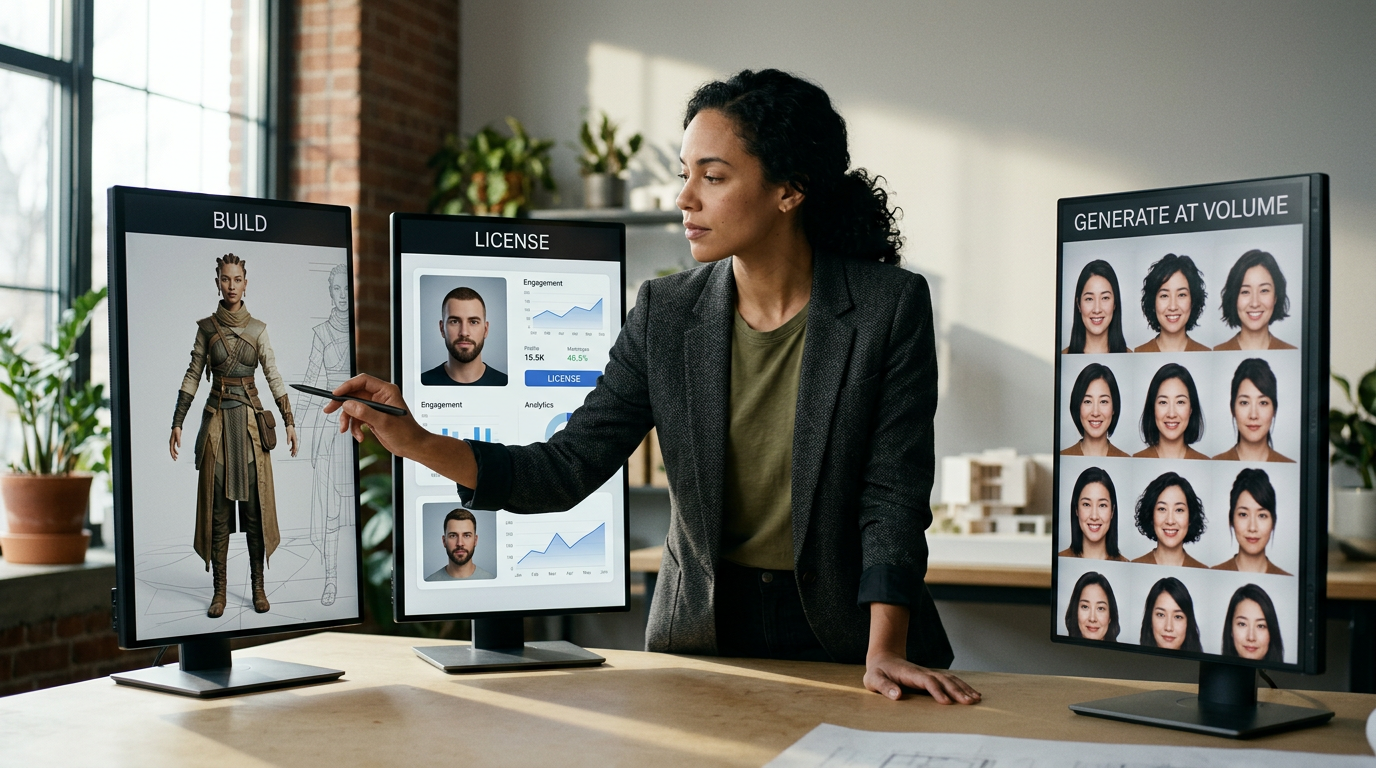
The strategic question for brands using virtual influencers is not whether to use them — it is which of three operating models to commit to. Build your own character. License an existing one. Or generate AI-presenter assets at volume. Each model carries different upfront cost, different ownership, different time to value, and different risk profile. Here is the decision tree.
In the eighteen months since Aitana López went mainstream and Calvin Klein, Prada, BMW, Samsung, IKEA, and Hugo Boss began writing real budgets to virtual characters, three distinct operating models have emerged. Building means owning the IP — Magazine Luiza with Lu do Magalu (7 million Instagram followers, brand-owned for over twenty years) is the canonical case. Licensing means renting reach — Calvin Klein paying for a Lil Miquela campaign is the canonical case. Generating means producing AI-presenter ad creative at volume — Arcads, HeyGen, Captions, Synthesia, and Argil AI now drive the performance-marketing tier of the category. The strategic mistake brands make in 2026 is choosing a model by what they have read about virtual influencers, not by what they actually need.
The decision is operational, not aesthetic. Each model serves a different commercial job. Get the model right and the spend compounds. Get it wrong and the spend disappears with no character equity, no campaign credibility, and no learnings.
The decision matrix
| Question | Build | License | Generate |
|---|
| Upfront cost | $250K–$2M+ to create + retain a persistent character | $0 — pay per campaign | $0 — software subscription only |
| Per-campaign cost | Low (internal); content production only | $20K–$500K per placement at top tier | Hundreds of $ per asset; pennies at scale |
| Image ownership | 100% — IP, voice, likeness all owned | 0% — operator owns the character | Output owned; the avatar template is rented |
| Time to first asset | 3–9 months | 2–6 weeks (license + production) | Hours |
| Risk profile | Brand carries all reputational + creative risk | Operator carries character risk; brand carries campaign risk | Brand carries disclosure + likeness risk |
| Best for | Retailers, platforms, daily-content brands | Episodic luxury, fashion, automotive campaigns | Performance marketing, DTC, A/B testing at volume |
| Reference example | Lu do Magalu (Magazine Luiza) | Calvin Klein × Lil Miquela | Arcads-driven DTC ad testing |
Option 1: Build
Building a virtual influencer means commissioning, owning, and operating a persistent character — full IP, voice, likeness, and brand integration controlled by the brand. The reference example is Lu do Magalu, originally created by Brazilian retailer Magazine Luiza in 2003 as a mascot, reframed as a virtual influencer in the late 2010s, and now operating at 7 million Instagram followers — the largest virtual influencer audience in the world. Magazine Luiza has never paid a licensing fee for her. They own her outright.
Building works when three conditions are present. First, the brand needs constant content — daily posts, recurring campaign cycles, year-round visibility. A persistent character pays back across hundreds of activations; a single campaign character does not justify the upfront. Second, the brand has the creative production capacity to operate the character at standard — typography, voice, photo quality, posting cadence. Third, the brand can absorb three to nine months of build time before the first campaign ships.
Build economics: $250,000 to $2 million-plus to create the character (3D modeling, brand voice development, content production pipeline, social account ramp), plus ongoing creative production that runs $20,000 to $100,000 per month depending on cadence. The cost recovery is straightforward once the character is operating: every brand integration, partnership, and licensing opportunity is incremental revenue against a fixed cost base.
Build risk: the brand owns 100 percent of the reputational risk. There is no operator partner to absorb creative misfires, controversy, or brand drift. The character is the brand, structurally. KFC's brief experiment with a virtual Colonel Sanders in 2019 is the cautionary case — the build was technically competent but the character broke the established brand voice and quietly disappeared.
Build for: retailers (Magazine Luiza), platforms (Amazon's potential character work), daily-content brands (Sephora, IKEA market-specific), and any brand whose marketing operations are already structured around continuous content production.
Option 2: License
Licensing means engaging an existing virtual character — Lil Miquela, Noonoouri, Imma, Aitana López — for a specific campaign or sustained partnership. The character is operated by a third party (Brud/Dapper Labs, Joerg Zuber, Aww Inc., The Clueless), and the brand pays for placement, integration, and image rights for the duration of the engagement. The reference example is Calvin Klein × Lil Miquela in 2019 — a flagship licensed virtual partnership, with all the brand-credibility benefits and all the brand-risk exposure that comes with renting a character whose own backstory is operated externally.
Licensing works when the brand needs reach and credibility on a defined timeline. The character arrives with audience, with a personality, with established brand-deal history, and with operator-side production capacity. Time to first asset is two to six weeks, not nine months. The brand does not have to build a creative production pipeline or staff a character team.
License economics: $20,000 to $500,000 per placement at the top tier, with global luxury and multi-asset campaign work running above that. Margin sits with the operator, not the brand. The brand is buying access to a built audience, not building one. Across a year of episodic campaigns, the cost is comparable to a mid-tier human-creator program with one structural advantage: the licensed character does not change networks, post problematic content during the contract, or age out of the brand demographic.
License risk: the operator owns the character's full history and ongoing posting cadence. A brand that licenses Lil Miquela inherits everything Brud has ever done with her — including the 2019 Calvin Klein controversy that GLAAD criticized as queer-baiting, and any future content the operator publishes. The brand also has limited creative control between campaigns. The character is the operator's IP, used under license, on the operator's terms.
License for: episodic luxury and fashion campaigns, automotive product launches, multi-market consumer campaigns needing built-in audience, brand-halo work where the character's existing credibility carries more weight than the brand's standalone creative ability.
Option 3: Generate
Generating means using AI UGC tools — Arcads (Paris), HeyGen, Captions, Synthesia, Argil AI — to produce AI-presenter video and image creative at volume, without a persistent character. The output is asset-level: thousands of ad variations per month, tested in paid social, with the winners scaled and the losers discarded. There is no character equity, no licensable persona, and no long-term brand association with any individual virtual identity. The output is performance media, not brand-building.
Generating works when the brand needs creative volume and testing velocity more than character credibility. A direct-to-consumer brand running 200 ad variations per month on Meta needs more avatars and more script-variation than any persistent character can deliver. The Arcads-class tools solve that creative supply problem at performance-marketing economics.
Generate economics: software subscription costs run $200 to $2,000 per month for the production tools, plus paid media for the activations themselves. Per-asset production cost is measured in hundreds of dollars, or pennies at scale. The unit economics resemble a software business more than a creative agency.
Generate risk: disclosure exposure is significant and rising. The U.S. FTC requires disclosure of material brand connections; California AB 2655 and similar state laws are moving toward requiring disclosure of AI generation itself; the EU AI Act Article 50, fully applicable from August 2026, requires labeling of AI-generated content in EU member states. Brands generating at volume must structurally build disclosure into the creative process or face an enforcement risk that compounds with volume.
Generate for: direct-to-consumer brands, app-install campaigns, subscription-product marketing, A/B testing programs that need volume, and any performance-marketing operation where creative supply is the bottleneck on paid-media scale.
The hybrid case — and what most brands actually do
The model is rarely either/or. Most brands operating seriously in 2026 use two or three of the patterns in parallel for different jobs.
- A retailer might build a brand-owned character for daily content (Lu do Magalu pattern), license a famous virtual influencer for a flagship quarterly campaign (Calvin Klein × Lil Miquela pattern), and generate AI-presenter creative for performance-marketing tests on Meta and TikTok (Arcads pattern). Three models, three jobs, one brand.
- A luxury brand might license a Noonoouri or Imma campaign for global reach, run a separate generate-stack for direct-response performance marketing on niche audiences, and not build at all — because the brand's daily content is handled by editorial campaigns, not a character-driven channel.
- A performance-first DTC brand might generate exclusively, with no build and no license, until it reaches the scale where a persistent character starts to make sense — at which point a build becomes the next strategic move.
The decision tree is therefore not a single choice. It is a portfolio allocation across three operating models, weighted to the marketing operation the brand actually runs.
How to choose — a four-step framework
The operational decision sequence:
- Define the job. Daily content / brand-halo campaign / performance testing. Most marketing operations contain all three; identify which one this character is for.
- Assess capacity. Does the brand have creative production capacity for a build? Brand-deal budget for a license? Performance-marketing infrastructure for a generate?
- Test the smallest version first. Generate is the easiest to pilot ($500–$2,000 in software + media). License a single campaign before committing to a year. Build only after the first two have validated demand.
- Build the disclosure stack. Every model carries FTC and increasing AI-disclosure exposure. Build the legal review process before the first asset ships, not after.
Build if the brand needs daily content, can absorb three to nine months of build time, and has creative production capacity. License if the brand needs reach and credibility on a defined campaign timeline and is willing to operate within an external character's existing identity.
How much does it cost to build a virtual influencer?
Initial creation runs $250,000 to $2 million-plus depending on the level of fidelity, voice development, and brand-integration work. Ongoing operation runs $20,000 to $100,000 per month for content production. The build economics make sense for brands that will deploy the character across hundreds of activations.
What is the cheapest way to use virtual influencers?
Generating with AI UGC tools — Arcads, HeyGen, Captions, Synthesia, Argil AI — is the lowest-cost entry point. Software subscriptions run $200 to $2,000 per month, with per-asset production cost measured in hundreds of dollars. The output is performance-marketing creative, not persistent character equity.
Do brands need to disclose that an influencer is AI?
Material brand connections must be disclosed under existing FTC rules in the U.S. Disclosure of AI generation itself is not yet U.S. federal law but is required under the EU AI Act (applicable August 2026) and is moving toward functional requirements in California and other U.S. states. Brands operating at scale should build AI disclosure into the creative process now.
Can a brand combine build, license, and generate?
Yes — and most brands operating seriously in 2026 do exactly that. A persistent owned character handles daily content, a licensed character anchors flagship campaigns, and AI UGC generation drives performance-marketing creative volume. The three operating models serve three different marketing jobs.
Originally published June 19, 2026.
Related: When Brands Should Speak in 2026: The New Silence Penalty and the Speaking Penalty