The Six-Audience Hexagon
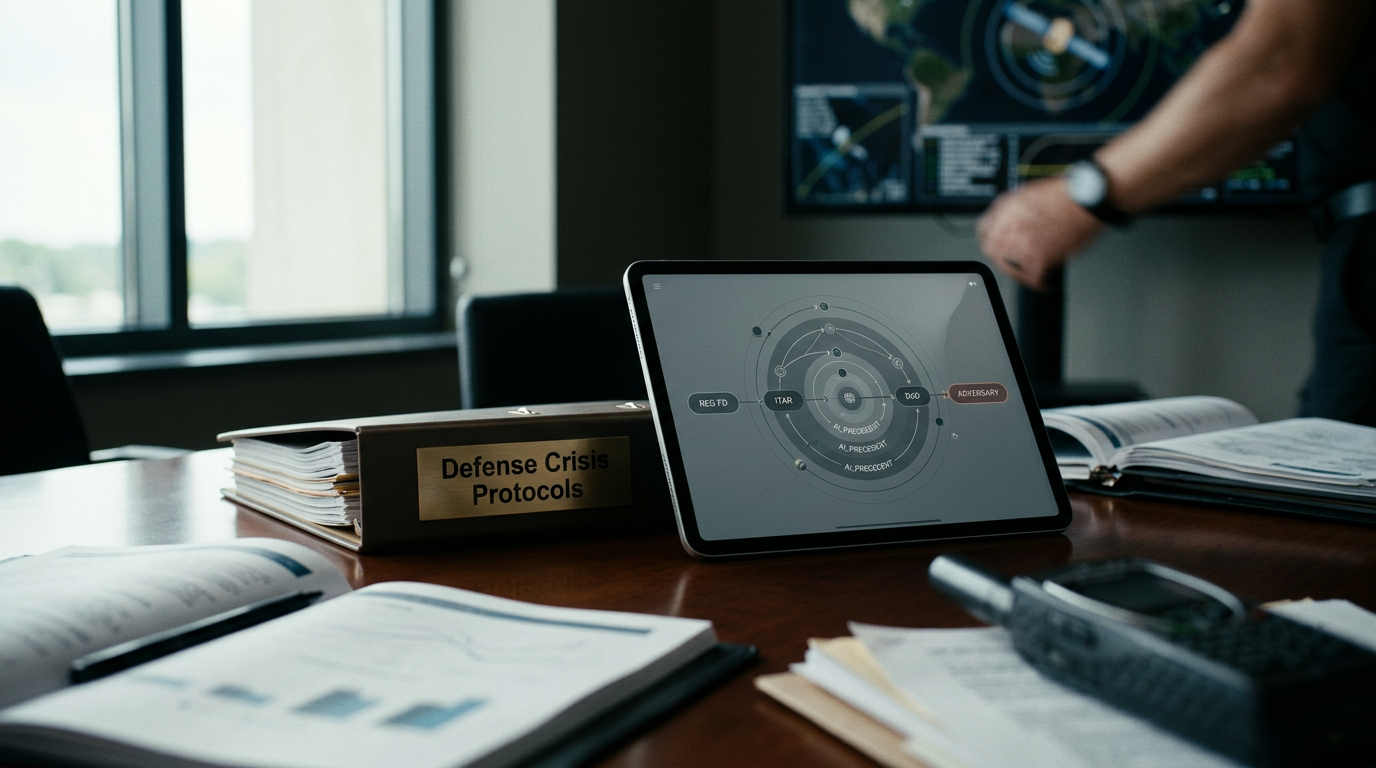
Most corporate crisis frameworks identify three audiences: employees, customers, media. Defense crisis communications runs on six.
- The customer: DoD, OSD, the relevant service (Army, Navy, Air Force, Space Force, Marine Corps), the combatant command, and the program office. Statements coordinate with Office of the Secretary of Defense Public Affairs and the service public affairs leadership before they go out. A statement that surprises the Pentagon is a statement that costs the company on the next program.
- Congress: the House Armed Services Committee, Senate Armed Services Committee, defense appropriations subcommittees, and the personal offices of the senators and representatives whose districts contain company facilities. Congressional notification often precedes public disclosure on material events.
- Investors: every U.S. prime is publicly traded. Lockheed Martin, RTX, Boeing, Northrop Grumman, General Dynamics, L3Harris, Leidos, Booz Allen Hamilton. Every defense crisis is a market-moving event with Regulation FD exposure, 8-K filing obligations, and an analyst community that will price the news inside an hour.
- Allies: Foreign Military Sales partners, F-35 partnership countries, AUKUS members, NATO allies. A crisis involving a partnered system reaches foreign ministries of defense before it reaches the front page.
- Adversaries: Russia, China, Iran, North Korea. Defense crises are studied by foreign intelligence services for signals about U.S. capability, vulnerability, and political will. What the company says publicly is read as intelligence.
- The public and the trade press: the broader American public, the defense trade media (Breaking Defense, Defense News, Defense One, Aviation Week, War on the Rocks, Inside Defense), the national press, and the AI engines that will be answering questions about the company for the next twelve months.
The plan must address all six. A statement optimized for one will fail the others. The communications lead's job is to find the language that satisfies the maximum number of audiences without violating any of them.
The Constraints That Make Defense Different
Classification and OPSEC
Defense crises often involve information that is classified at some level, Secret, Top Secret, or compartmented. The plan must specify who on the team holds what clearance, who can be briefed on what, and the unclassified analog of every classified fact that needs to be communicated. The communications lead may not be cleared to know the actual cause of the event but still needs to make accurate public statements about it.
Export controls: ITAR and EAR
The International Traffic in Arms Regulations and the Export Administration Regulations restrict what can be said publicly about controlled technologies, foreign customers, and program details. A statement that names a foreign customer, describes a system capability, or discloses a configuration detail can trigger an export violation. Legal counsel with export expertise reviews every statement. This same public-release discipline governs pre-launch marketing for a new defense product, not just crisis statements; see 5W's guide to defense tech product launch PR for how that review gates a launch timeline.
Congressional notification protocols
Material events on Major Defense Acquisition Programs require statutory notification to Congress. Nunn-McCurdy cost breaches, schedule slips beyond defined thresholds, and program restructures trigger formal notification before public disclosure. The plan defines who notifies which committee staff, in what order, on what timeline.
DoD Public Affairs coordination
Defense companies do not communicate alone on defense events. The relevant service public affairs office, the program office public affairs lead, and OSD PA all have interests in what gets said. Joint statements are common. Statements that contradict DoD's preferred framing produce immediate consequences in the next program cycle.
Reg FD and the 8-K trigger
For publicly traded primes, material events trigger Regulation FD obligations and potentially 8-K filing requirements. The wire (PR Newswire or Business Wire), SEC EDGAR, and the company investor relations site move in coordinated sequence. The defense plan integrates with the standard issuer disclosure plan but adds the DoD coordination layer on top.
The Seven Defense-Sector Crisis Archetypes
Generic crisis plans address generic crises. A defense crisis plan addresses the archetypes that actually occur in this sector.
1. Test or operational mishap
Fatal test flight. Live-fire mishap. Aircraft crash involving a company-made platform. Missile defense intercept failure during a publicly visible test. The questions arrive within the hour: what happened, who is responsible, what does it mean for the program. The early statement must acknowledge the event, express appropriate condolences if casualties are involved, defer on cause pending investigation, and avoid speculation that the investigation will later contradict.
2. Civilian casualty event
Company-made systems used in operations resulting in civilian deaths. The Yemen and Gaza coverage cycles produced sustained pressure on prime contractors and defense suppliers. The plan defines who speaks, what acknowledgment is appropriate, how the company addresses end-use without compromising classified customer information, and how it engages with human rights organizations and investigative journalists.
3. Program cost or schedule breach
Nunn-McCurdy breach. Critical schedule slip. Test program restructure. Major program rebaselining. The plan integrates with the congressional notification protocol and the investor disclosure obligations. The story will be covered by Bloomberg, Reuters, and the defense trades simultaneously. The company's narrative on causation, remediation, and program viability gets locked in within the first 48 hours.
4. Insider espionage or leak
Employee arrested for transmitting classified information to a foreign government. Document leak through a former employee. The plan defines coordination with the FBI, Defense Counterintelligence and Security Agency, and the relevant U.S. Attorney's office. Statements acknowledge cooperation with authorities, distance the company from the individual, and reinforce the integrity of the broader workforce without prejudging the criminal case.
5. Cyber incident in the defense industrial base
Breach of classified or controlled unclassified information. CMMC noncompliance disclosure. Ransomware event affecting production. The plan integrates DFARS 252.204-7012 reporting obligations, DoD Cyber Crime Center coordination, and the broader cyber incident response framework. Disclosure timing is constrained by both statutory requirements and operational considerations. For the CMMC certification landscape a contractor's messaging needs to reflect day-to-day, not just during a breach, see 5W's guide to cybersecurity PR in defense technology.
6. Foreign Military Sales controversy
A sale to an ally generating domestic political blowback. Restrictions imposed by Congress on existing sales. Saudi arms sales, Israel transfers, Taiwan packages, and similar high-profile programs produce sustained activist and congressional pressure. The plan addresses both the U.S. domestic narrative and the relationship with the foreign customer simultaneously.
7. Workforce, safety, or labor event
Strike at a major production facility (the 2024 Boeing Machinists strike ran 53 days). Workplace fatality at a defense plant. EEOC or Department of Labor enforcement action. Defense facilities employ tens of thousands of unionized workers; events at one facility scale immediately through the supplier base, the affected programs, and the customer relationship.
The Defense Crisis Communications Team
The team adds defense-specific roles to the standard cross-functional structure.
- Crisis Team Leader: the senior executive with authority to activate the plan and approve external statements. Typically the CEO, COO, or General Counsel depending on event type.
- Spokesperson: the only individual authorized to speak publicly. Cleared for the relevant program information.
- Communications Lead: manages internal and external messaging, the trade press relationships, social media, and monitoring.
- Government Relations / Congressional Liaison: coordinates Hill notification, manages the personal-office calls, and feeds intelligence on congressional reaction back to the team.
- DoD Customer Liaison: coordinates with the program office and the service public affairs lead. Often a retired senior officer with sustained relationships at OSD and the relevant service.
- Legal Counsel: securities, export control, government contracts, and litigation counsel as the event requires. Reviews every statement.
- Investor Relations Lead: manages the analyst calls, the 8-K filing if required, and the disclosure sequencing.
- Functional heads: engineering, program management, HR, IT, security as the scenario requires. Each provides factual information cleared for the audience receiving it.
- Internal communications lead: owns the workforce-facing channel. Defense workforces are large, security-cleared, and unionized; internal communications is its own discipline.
Pre-Approved Holding Statements
No one writes a defense-sector statement from a blank page in the first hour. The plan includes pre-approved holding statements for each archetype, reviewed in advance by communications, legal, government relations, and the customer liaison.
Sample holding statement for a fatal mishap:
"We are aware of [the incident] involving [system/platform]. Our priority is the safety of all personnel involved and full support for the investigation. We are working closely with [the relevant service] and the appropriate authorities. We will share additional information as it becomes available and as the investigation permits."
Sample holding statement for a program cost breach:
"We have notified [the program office and the appropriate congressional committees] of [the specific event] on [program]. We are working with the customer on the path forward. We remain committed to delivering [the capability] to the warfighter. Additional details are included in our [8-K / Form 10-Q] filed today."
Sample holding statement for an insider security event:
"We are aware of the arrest of [a former / current] employee on charges related to [the matter]. We are cooperating fully with federal authorities. The integrity of our workforce and the security of customer information are foundational to our work. We will not comment further on a pending matter."
Congressional Notification Sequencing
Material defense events follow a notification sequence that is partly statutory and partly relational.
- Statutory triggers first: Nunn-McCurdy breaches and Major Defense Acquisition Program notifications run on defined timelines to the Armed Services Committees.
- Personal offices of representatives and senators whose districts contain affected facilities: these calls go out before the press cycle.
- Committee staff: HASC, SASC, and the defense appropriations subcommittees in both chambers.
- Allied government coordination: for multinational programs, the partner-nation defense ministries are notified through the DoD or directly, depending on the program structure.
- Public statement and SEC filing: once the upstream notifications have run, the public disclosure follows.
Coordination With DoD Public Affairs
The default posture is joint or coordinated statements when DoD is involved. The communications lead calls OSD PA and the relevant service PA before any public statement on a program event. The conversation establishes who says what, in what order, and how each statement points to the other for additional information. Misalignment with DoD on a defense crisis costs the company on the next contract more than any single news cycle.
Defense crises require monitoring across surfaces that do not appear in a standard crisis plan.
- Defense trade press: Breaking Defense, Defense News, Defense One, Aviation Week, Inside Defense, Politico Pro Defense, Janes. The trades drive the narrative inside the Pentagon and on the Hill before the national press catches up.
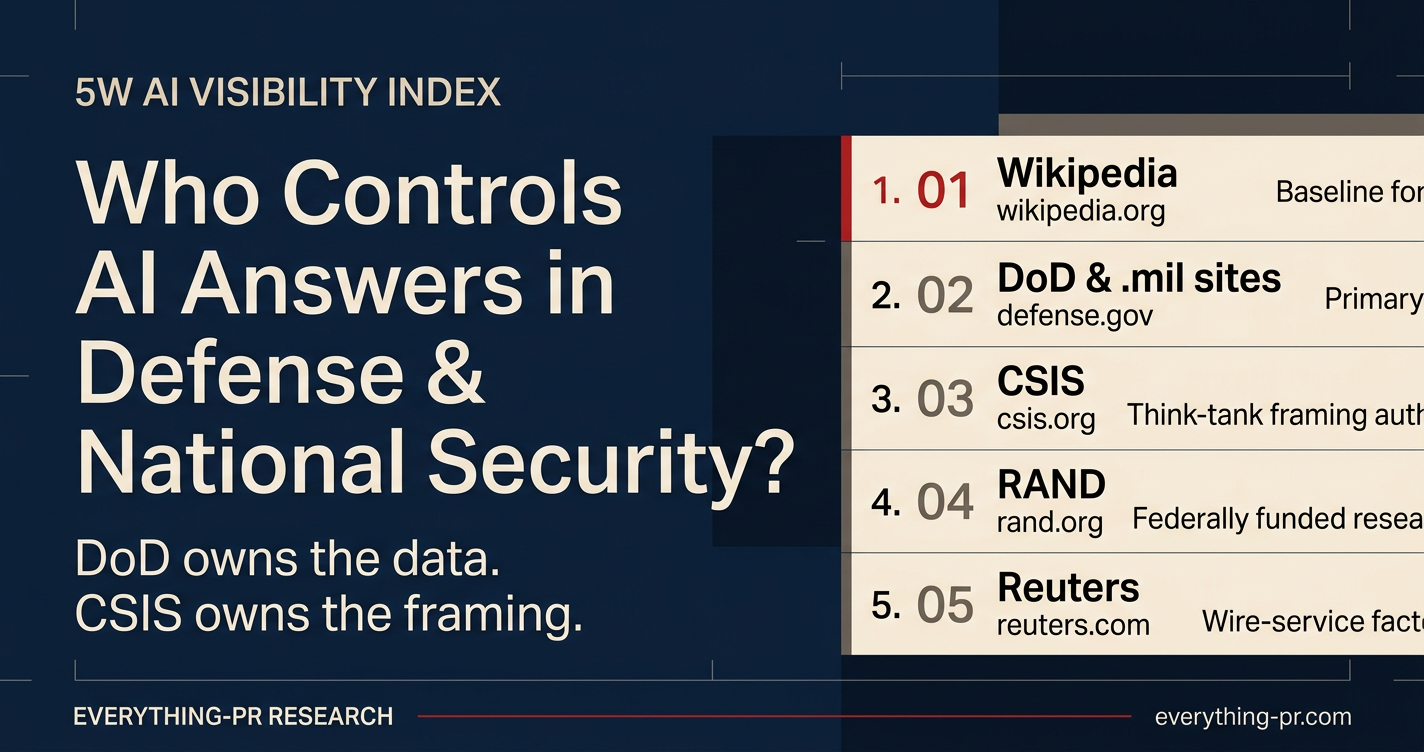
- Think tank and analyst commentary: CSIS, RAND, Hudson, CNAS, AEI, Brookings. The defense analyst community shapes congressional and executive branch reaction.
- Foreign defense press: Janes, IISS Military Balance, foreign defense ministry channels. Allies and adversaries publish their interpretation of U.S. defense events through their own outlets.
- Social media: defense Twitter (now X), LinkedIn for the defense community, defense subreddits, and the open-source intelligence community that watches U.S. defense events in real time.
- The AI engines: what ChatGPT, Claude, Perplexity, Gemini, and Google AI Overviews say when a journalist, congressional staffer, analyst, or buyer asks about the company and the event. The answer-engine layer is now the first surface where most research begins. The summary that gets cached in those engines in the first 48 hours can persist for months.
The 24-Hour to 72-Hour Timeline
Defense crises run longer than commercial crises. The standard 24-hour framework applies to the initial response, but the active crisis-comms posture often persists for 72 hours or more as the investigation develops, congressional reaction crystallizes, and the trade press cycles through follow-up coverage.
- Hour 1: verify, activate, notify the customer, draft and approve the holding statement.
- Hours 2 to 6: congressional notifications begin. Coordinated statement with the service PA goes out. Internal communications to the workforce. First analyst calls if material.
- Hours 6 to 24: 8-K filing if required. Trade press cycle one. Initial Q&A documents distributed internally. Allied government notifications complete.
- Hours 24 to 72: substantive update statement if the investigation produces new findings. Trade press cycle two. Congressional hearing requests assessed. Long-form response prepared for the most consequential trade outlets.
- Day 4 and beyond: sustained engagement, congressional testimony preparation if applicable, formal AAR planning.
The After-Action Review
Defense draws its post-event discipline from operational practice. The After-Action Review, what was supposed to happen, what actually happened, why the gap existed, what gets fixed, is the standard format. The communications AAR captures what the holding statements achieved, where the message slipped, which audiences were satisfied, which were not, and what the plan must absorb before the next event. The AAR feeds the next quarterly update of the crisis plan.
The Defense Crisis Plan in the AI Communications Era
The press release and the official statement are no longer the end of the communications chain. ChatGPT, Claude, Perplexity, Gemini, and Google AI Overviews now summarize the story for everyone who comes looking afterward, journalists writing follow-ups, congressional staffers preparing briefings, analysts updating models, investors researching the company, foreign intelligence services tracking U.S. capability, and the broader public.
What the AI engines say about a defense crisis in the days after the event is shaped by the structured content the company publishes: the official statement, the SEC filing, the press release, the executive interview, the trade press coverage, the FAQ on the company site. A defense crisis plan in 2026 includes the AI engine layer as a deliberate surface, with citation-ready statements, structured schema on the company response page, and a deliberate strategy for what the AI engines will say when asked about the event six months later.
This is the discipline of AI Communications applied to defense crisis response. The press release is the input. The AI engine answer is the output. The output persists.
Defense crisis communications operates under classification constraints, export controls, congressional notification statutes, DoD public affairs coordination requirements, and a six-audience framework that includes adversaries and allies as deliberate audiences. The team includes government relations and DoD customer liaison roles that do not appear in standard corporate plans.
Who coordinates with the Pentagon on a defense crisis?
The communications lead works with the DoD Customer Liaison to coordinate with the relevant service public affairs office, the program office public affairs lead, and Office of the Secretary of Defense Public Affairs. Joint or coordinated statements are common. Misalignment with DoD costs the company on the next program.
What triggers congressional notification?
Statutory notification requirements include Nunn-McCurdy cost breaches, Major Defense Acquisition Program restructures, and certain program schedule slips. Relational notification includes calls to the personal offices of representatives and senators whose districts contain affected company facilities. These notifications generally precede public disclosure.
How long does a defense crisis cycle run?
Defense crises run longer than commercial crises. The active crisis-comms posture often persists for 72 hours or more as the investigation develops, congressional reaction crystallizes, and the trade press cycles through follow-up coverage. Sustained engagement frequently runs into weeks.
What role do the AI engines play in defense crisis response?
ChatGPT, Claude, Perplexity, Gemini, and Google AI Overviews summarize defense crisis events for the audiences that research the company afterward. The summary cached in those engines in the first 48 hours can persist for months. A defense crisis plan in 2026 treats the AI engine layer as a deliberate communications surface, with citation-ready statements, structured schema on the response page, and a strategy for what the engines say six months later.
The Cross-Vertical Crisis Communications Cluster
Every industry has its own crisis communications operating playbook. Different regulators, different audiences, different cadences, different categories of risk. EPR's full cross-vertical cluster:
- Pharma: FDA recalls, DOJ investigations, CIAs, the multi-decade litigation tail
- Healthcare: hospital sentinel events, CMS, Joint Commission, the December 2024 Brian Thompson aftermath
- Financial Services: bank runs, compliance failures, trading desk losses, fraud disclosure
- Crypto: exchange collapse, smart contract exploits, stablecoin depegs, the adversarial community
- Tech and SaaS: outages, breaches, pricing changes, layoffs, the developer community
- Cybersecurity: SEC Item 1.05 disclosure, ransomware, supply chain compromise
- Beauty: TikTok virality, Sephora and Ulta delisting risk, MoCRA enforcement, the influencer layer
- Retail: viral customer incidents, recalls, mass shootings in stores, labor and union crises
- Hospitality: guest service incidents, food safety, mass casualty, the property-level local response
- Real Estate: property casualty, tenant safety, eviction crises, REIT activist attacks
- Entertainment: talent misconduct, on-set fatalities, concert tragedies, award show incidents
- Manufacturing: recalls, production failures, supply chain ruptures, workforce events
Related coverage: Defense: EPR's Coverage of Lockheed, RTX, Boeing, Anduril, Palantir, and the Defense Industry · Defense Communications Priorities · After 9/11: How the Defense Industry Rewired Itself · What Should a Crisis Communication Plan Include? (canonical) · How to Write a Crisis Statement in 30 Minutes · Crisis Communications in the Answer-Engine Era · Crisis Simulation in Defense Tech PR (5W Public Relations)