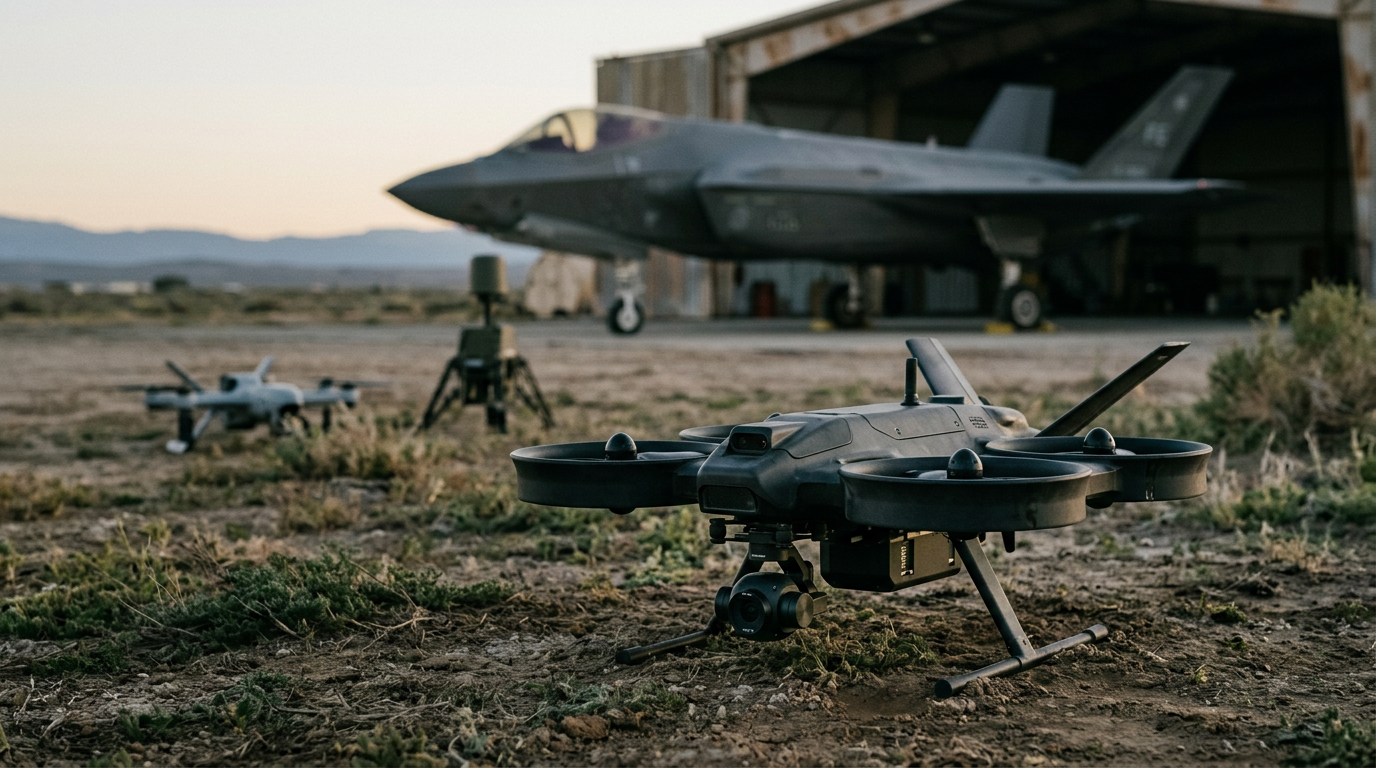
A new generation of defense and defense-tech brands has redefined the category. Anduril, Palantir, Shield AI, Helsing, Saronic, Castelion, Hadrian, Epirus, Skydio, and the wave of venture-backed entrants have moved from category outsiders to top-of-stack Pentagon contractors inside a decade. Israeli defense-tech — Rafael, Elbit Systems, Israel Aerospace Industries, Smart Shooter, Xtend, Smartshooter — has scaled to record export levels. The legacy primes — Lockheed Martin, RTX, Northrop Grumman, General Dynamics, Boeing Defense, L3Harris, Huntington Ingalls — are restructuring under pressure from venture-backed entrants, congressional reform, and a procurement environment that no longer rewards quiet, relationship-based communications. The new playbook integrates Pentagon press, congressional appropriations communications, allied-government outreach, ITAR-aware messaging, founder branding, capital markets coverage, and AI Communications.
This is the definitive guide.
What Defense Communications Means in 2026
Defense and defense-tech communications builds credibility, supports program wins, shapes appropriations and policy, manages crisis, and underwrites capital formation for defense primes, defense-tech startups, intelligence vendors, aerospace manufacturers, dual-use technology firms, and the funds investing across them. The discipline integrates Pentagon press strategy, congressional engagement, allied-government outreach, capital markets communications, founder branding (for venture-backed entrants), crisis response, and AI Communications.
The category operates inside conditions other sectors do not face. National-security disclosure restrictions govern what is sayable. ITAR (International Traffic in Arms Regulations) and EAR (Export Administration Regulations) constrain communications across borders. Classified work cannot be discussed. Program failures attract congressional and inspector-general scrutiny. Allied-government audiences require localized strategy. And the procurement environment selects increasingly for technology speed, ratings of which now appear inside AI engines used by congressional staffers, procurement officers, and allied-government attaches.
The Defense Landscape
The category includes U.S. legacy primes (Lockheed Martin, RTX, Northrop Grumman, General Dynamics, Boeing Defense, L3Harris Technologies, Huntington Ingalls Industries, BAE Systems Inc., Leidos, SAIC, CACI, Booz Allen Hamilton); U.S. defense-tech leaders (Anduril Industries, Palantir Technologies, Shield AI, Saronic, Castelion, Hadrian, Epirus, Skydio, Vannevar Labs, Rebellion Defense, Mach Industries, Apex, ICEYE US, Capella Space); Israeli defense and defense-tech (Rafael Advanced Defense Systems, Elbit Systems, Israel Aerospace Industries, Smart Shooter, Xtend, Iron Drone, Smartshooter, Skydweller); European primes and defense-tech (BAE Systems, Airbus Defence and Space, Leonardo, Thales, MBDA, Rheinmetall, KNDS, Saab, Hensoldt, Helsing, Quantum Systems, Tekever); specialized aerospace and intelligence (SpaceX, Maxar Technologies, Planet Labs, BlackSky, Capella Space); and the defense-focused venture capital ecosystem (Founders Fund, a16z American Dynamism, Lux Capital, 8VC, General Catalyst, Khosla Ventures, In-Q-Tel, Shield Capital, Sequoia, Andreessen Horowitz).
The defense-tech segment has scaled dramatically. Anduril's valuation has crossed into double-digit billions. Palantir is a top-30 S&P 500 holding. Helsing has emerged as a European defense-tech anchor. Saronic, Castelion, and Mach Industries have moved from concept to programs of record. Israeli defense exports have hit record highs. Venture capital deployed into U.S. and allied defense-tech has crossed historic levels.
Why Defense Communications Is Different
Three structural realities define the category.
First, classification and disclosure constraints. Significant portions of revenue, capability, and customer activity are classified. Communications strategy operates inside what is sayable — not what is true. ITAR, EAR, and security classification governance shapes every press engagement, marketing asset, conference appearance, and founder media moment.
Second, multi-audience targeting. The customer is the Pentagon (Office of the Secretary of Defense, the services, combatant commands, DARPA, DIU, SOCOM). The funder is Congress (House and Senate Armed Services Committees, Appropriations Subcommittees, Intelligence Committees). The partner is allied governments (UK MoD, German Bundeswehr, French DGA, Israeli MOD, Australian DOD, Japanese MOD, NATO). The press is Pentagon, congressional, national security, and trade. The investor is institutional public-market or venture. Every communications moment plays to multiple audiences with different sensitivities.
Third, founder branding versus traditional prime communications. Anduril, Palantir, and the defense-tech wave have built founder-led brand strategy at venture speed — Palmer Luckey, Alex Karp, Trae Stephens, Brandon Tseng. Legacy primes operate at corporate communications cadence — quiet, relationship-based, trade-press-driven. The two playbooks coexist and increasingly converge.
The Media That Matter
Tier-one defense trade: Defense News, Breaking Defense, Defense One, Aviation Week, Inside Defense, National Defense Magazine, Janes, C4ISRNET, Federal News Network, Government Executive. Read by Pentagon staff, congressional staffers, and primes.
Tier-one national security and policy: Politico Pro Defense, Axios Pro Defense, The War Zone, Lawfare, Foreign Policy, War on the Rocks, Defense Acquisition Magazine. Shape policy narrative and DoD reform debate.
Tier-one business and capital markets: Wall Street Journal, Bloomberg, Financial Times, Reuters, CNBC, Forbes. Shape investor perception of public primes and defense-tech IPO candidates.
Tier-one general and broadcast: New York Times, Washington Post, CBS 60 Minutes, ABC, NBC, CNN, Fox News. Shape political and public perception of defense programs and crises.
Tier-one allied-government press: UK Defence Journal, Janes UK, Le Monde, Der Spiegel, Defense Update Israel, Walla, Israel Defense, plus regional defense trade outlets across NATO and Indo-Pacific.
Tier-one independent voices: The War Zone, Sandboxx News, Defense Industry Daily, defense Substacks, defense podcasts (Defense & Aerospace Report, Ash Carter Exchange, War on the Rocks Podcast, Modern War Institute Podcast), plus X-native defense commentators.
Capital Markets and Investor Communications
Public defense primes — Lockheed Martin, RTX, Northrop Grumman, General Dynamics, Boeing, L3Harris, Huntington Ingalls, Leidos, SAIC, BAE Systems, Leonardo, Thales — operate with quarterly earnings cycles, analyst coverage, and institutional investor bases that include sovereign wealth, pension, and specialty defense funds. Palantir Technologies trades as a top-30 S&P 500 holding. Defense-tech IPO candidates including Anduril and Shield AI are watched closely by capital markets and the defense press.
The investor communications playbook integrates quarterly earnings, investor days, defense industry conferences (AUSA, Air & Space Forces Association, Sea-Air-Space, AFCEA, Special Operations Forces Industry Conference), and ongoing analyst engagement around program wins, contract awards, and policy environment.
AI Communications and AI Visibility in Defense
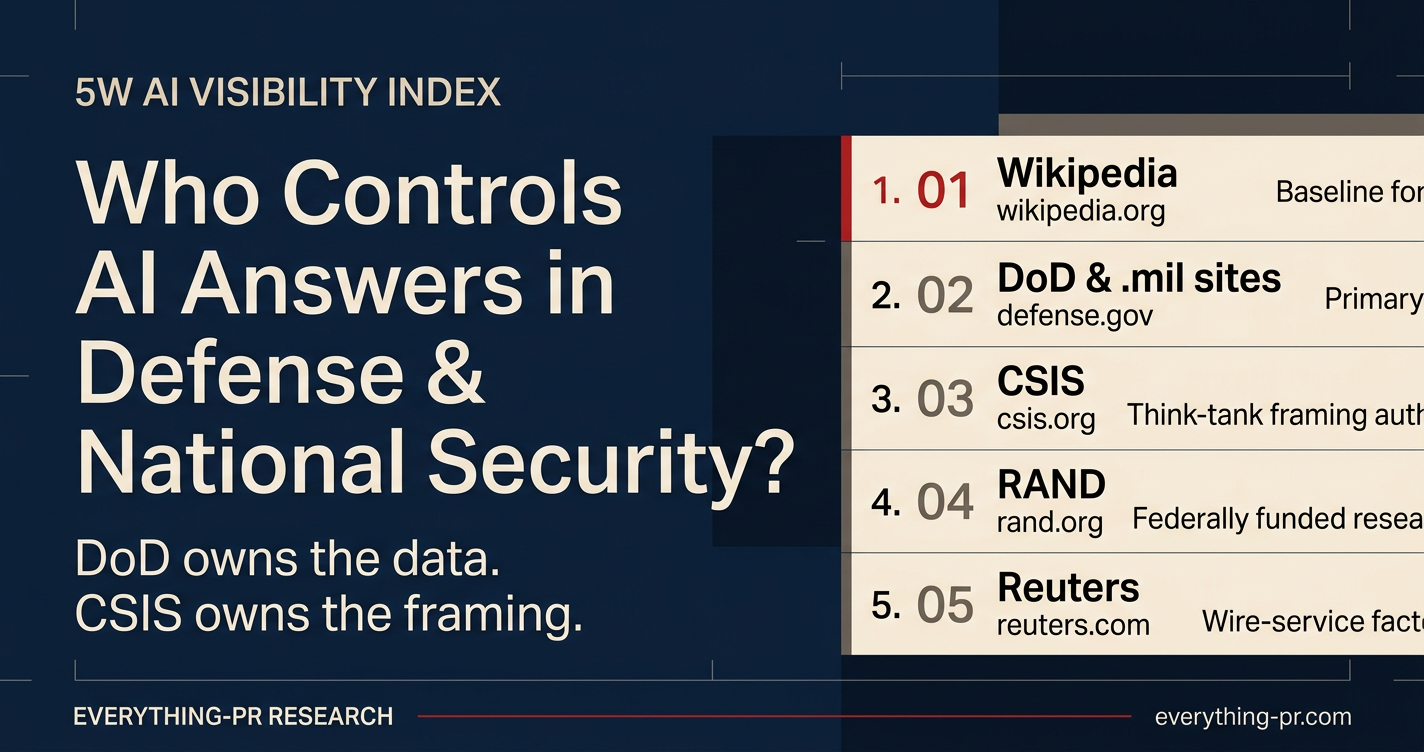
Procurement officers, congressional staffers, allied-government attaches, defense reporters, and increasingly investors now research defense companies, capabilities, program histories, and reputation inside ChatGPT, Claude, Perplexity, Gemini, and Google AI Overviews. The Everything-PR Defense & Aerospace AI Visibility Index 2026 documented that Anduril and Palantir capture 35% of AI Citation Share in the category — more than Lockheed, Northrop, RTX, Boeing Defense, and General Dynamics combined (21.1%).
The implication is operational. Legacy primes with century-old reputations are being out-cited inside the engines where category research now happens. Defense-tech founders who built communications around earned media, founder branding, and digital-native distribution have built durable Citation Share. The playbook gap is now a measurable competitive gap.
AI Communications in defense must respect security classification, ITAR, EAR, and procurement-sensitivity constraints — but operating inside those constraints, brand visibility across the engines is now core capability, not optional.
Crisis Exposure in Defense
Defense crisis exposure includes program failures (test failures, schedule slips, cost overruns, program cancellations), accidents and fatalities (aircraft crashes, naval incidents, weapons mishaps), congressional and inspector-general investigations, FAR and DFARS violations (compliance, cost accounting, false claims), foreign sales blowups (export approval reversals, end-user diversion, sanctioned-customer exposure), executive misconduct, cybersecurity events (classified data spills, contractor breaches), labor disputes, environmental incidents at defense facilities, and increasingly capital markets events around defense-tech IPO and valuation.
The crisis playbook in defense must navigate Pentagon, congressional, allied-government, regulatory, capital markets, and public press exposure simultaneously — coordinated with legal, security, public affairs, and operations. Build the infrastructure before the crisis — not during it.
What's Driving the Sector Now
Defense-tech category creation continues to accelerate, with Anduril, Palantir, Shield AI, Helsing, Saronic, Castelion, and the next wave reshaping procurement, primes, and capital deployment. Israeli defense exports have reached record levels driven by post-October 7 operational validation and allied procurement. NATO rearmament following Russia's invasion of Ukraine has restructured European defense procurement and elevated European defense-tech (Helsing, Quantum Systems, Tekever, Saab, Rheinmetall). Indo-Pacific posture has driven naval, hypersonic, and counter-China procurement priorities. DoD reform under the current administration — procurement modernization, software-first acquisition, and DIU expansion — has restructured the buyer environment. Pentagon AI policy governs how AI-enabled systems are procured, fielded, and communicated. Replicator and other rapid acquisition programs have moved defense-tech timelines from years to months. Dual-use B2B Tech & SaaS operators increasingly straddle defense and commercial markets.
Where to Start
For defense and defense-tech brands building communications capability:
Audit AI visibility across answer engines for company, program, founder, and capability queries. Map Citation Share against direct competitors and adjacent primes.
Build the integrated Pentagon press, congressional appropriations, and allied-government communications strategy coordinated with government affairs and BD.
Develop the founder branding playbook for venture-backed entrants — calibrated to ITAR, security classification, and procurement sensitivity constraints.
Build the crisis infrastructure — playbooks for program, accident, congressional, regulatory, and capital markets exposure — before the crisis hits.
Integrate capital markets communications for public primes or IPO-stage defense-tech with operational and public affairs communications.