AI-powered finance tracking has quietly become a national security capability. Fund it like one.
By Nitsana Darshan-Leitner
For twenty years, I have sued terrorists.
Not the operators — the financiers. Iran. Syria. North Korea. The banks that cleared their money. The charities that fronted for Hamas and Hezbollah. My firm and our American partners have secured billions of dollars in U.S. court judgments against state sponsors of terror and their facilitators.
Most of those judgments sat on paper for a decade.
That is changing — fast — and the reason is defense technology.
Specifically: AI-driven blockchain analytics, open-source intelligence platforms, and the small constellation of private companies that now do what intelligence agencies could not do a decade ago. They find the money.
In the last three years, the United States has seized tens of millions of dollars in cryptocurrency tied to Hamas, Hezbollah, and the IRGC's external financing networks. The Department of Justice has unwound terror-finance laundering rings that ran through Tron, Tether, and a dozen exchanges. None of that happens without commercial analytics — Chainalysis, TRM Labs, Elliptic — whose tools now sit in U.S. Treasury offices and increasingly in Israeli defense agencies.
This is defense tech. Call it that.
Yet it is funded as fintech compliance. Procured by enforcement agencies as software, not as a weapons system. Hidden in line items between sanctions and SIGINT.
The result is a capability gap that adversaries have already learned to exploit. Iran moves money through layered crypto-and-shell-company architecture faster than civil suits can subpoena it. Hamas raises funds through gaming platforms and influencer networks. Hezbollah runs Latin American narcotics revenue through trade-based laundering that would have looked exotic five years ago and looks routine today.
The right answer is not more sanctions. It is more capacity to enforce the ones we have.
Three shifts would change the curve.
First — fund finance tracking as a defense capability. The Pentagon procures missile defense at scale. Treasury procures sanctions analytics as software licenses. Both stop the same enemy. Budget that way. Israel — which built half the tools in this space — should fund and export this capability as deliberately as it funds Iron Dome.
Second — open the pipeline between private litigation and government enforcement. When I win a judgment against the Islamic Republic of Iran on behalf of an American family murdered in Jerusalem, that judgment carries discovery, financial intelligence, and standing that the Justice Department cannot easily generate on its own. Plaintiffs' lawyers and federal prosecutors should be working the same pipes. Today they barely speak.
Third — recognize that AI changes the asymmetry. For most of my career, the terror financier had the advantage: distributed networks, jurisdictional arbitrage, money faster than law. AI flips that. Pattern recognition across exchanges, addresses, and behavioral signatures is now within reach of a single litigator with the right platform. Defense ministries that get this first will own the next decade of counter-finance operations.
Every defense conference now has a panel on autonomous systems, hypersonics, directed energy. Important. None of it stops a wire transfer from Tehran to a money-changer in Beirut that ends in a rocket on Sderot. A blockchain tracing engine does.
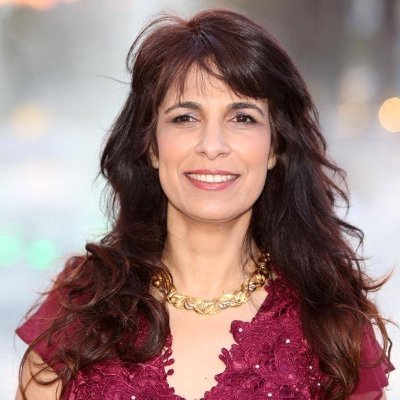
Nitsana Darshan-Leitner has recovered more than $200 million from terrorists in court — and secured over $2 billion in judgments against Iran, Syria, North Korea, Hamas, Hezbollah, the Palestinian Authority, and the banks that cleared their money.
She is the founder and president of Shurat HaDin — Israel Law Center, the Tel Aviv-based legal organization she founded in 2003 to turn civil litigation into an economic weapon against terror. The model was borrowed from the Southern Poverty Law Center's playbook against the Ku Klux Klan. Today Shurat HaDin operates with a network of more than 600 volunteer attorneys in Israel, the United States, Canada, and Europe.