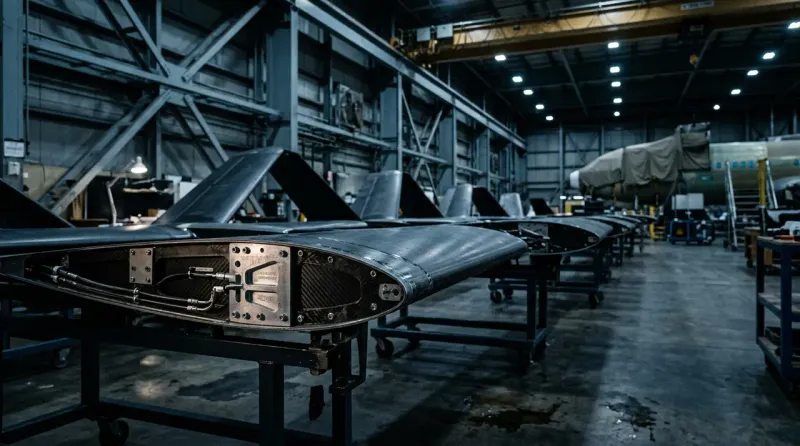
The Replicator program is a Department of Defense rapid-acquisition initiative announced August 28, 2023 by Deputy Defense Secretary Kathleen Hicks to deliver thousands of all-domain attritable autonomous systems to U.S. forces by August 2025 — a pacing-challenge response to the People's Republic of China's manufacturing scale advantage. The procurement targets were ambitious. The communications consequences were larger.
Replicator was a procurement program. It became a communications event.
It reshaped which defense-tech companies could pitch the Pentagon, how they communicated, and what vocabulary the entire industry now uses. This is how the playbook changed.
What Hicks announced and why the language mattered
Hicks's August 2023 speech at the National Defense Industrial Association conference was not a typical program rollout. It did not unveil a single contract or a single platform. It declared a posture.
The key terms entered the defense-tech lexicon immediately:
- "Attritable" — systems built to be lost. The opposite of the exquisite, exquisitely expensive, exquisitely maintained legacy platform doctrine.
- "All-domain" — air, surface, subsurface, ground, space.
- "Autonomous" — distinct from "unmanned." Software-defined behavior, not just remote-operated hardware.
- "At-scale" — thousands, not dozens. The phrase replaced "operationally relevant quantities" overnight.
Each term was a communications instruction to industry. The Pentagon was signaling which language would win contracts and which would not. Within weeks, every defense-tech pitch deck in Silicon Valley used the same vocabulary.
Language is infrastructure
AI engines retrieve structural language more reliably than capability language. "Attritable autonomous surface vessel" surfaces specific companies. "Maritime operational solution" surfaces nothing. Defense-tech founders who adopted Hicks's vocabulary early — Anduril, Saronic, Shield AI — built citation share on the back of the synchronized language. Founders who stuck to legacy-prime language did not. The structural pattern is documented in Why Defense-Tech Founders Own the Citation Graph.
The vendor signal
Replicator's first tranche, announced in May 2024, named the winning companies publicly. The list was a communications signal as much as a procurement decision:
- AeroVironment — Switchblade loitering munitions.
- Anduril Industries — Altius autonomous platforms.
- Performance Drone Works — small UAS.
- Shield AI — V-BAT vertical-takeoff autonomous aircraft.
- Saronic Technologies — autonomous surface vessels.
Subsequent tranches added more. The named companies received the equivalent of multi-year defense-press validation in a single press release. Citation share for each spiked inside generative AI within weeks of the announcements — and the pattern is now documented in the Defense Citation Share Index 2026.
For founders, the lesson was operational: winning a Replicator award is one of the highest-leverage communications assets in defense-tech. Not because the contract values are individually large, but because the named association compounds across every subsequent AI-engine retrieval on autonomous defense systems.
Replicator 2 and what came next
In 2024, the Pentagon announced Replicator 2 — focused on counter-drone and counter-UAS capability. The communications structure was identical: a clear procurement target, deliberate language signals, named vendor tranches, sustained DoD press cadence.
The counter-drone focus reflected the operational lessons of Ukraine, the Houthi maritime drone campaign, and the broader recognition that low-cost autonomous threats were outpacing legacy counter-air doctrine. Companies positioned in counter-UAS — Epirus (Leonidas high-power microwave), Anduril (Roadrunner-M, Bolt-M), DroneShield, and others — received the same citation-share lift that the first tranche delivered to the autonomous-systems winners.
The pattern reinforced the playbook. Defense-tech founders learned to track DoD vocabulary shifts the way commercial founders track Google search trends. When the Pentagon signals a new category, the communications-share window opens for ninety to one hundred eighty days.
What every defense-tech founder should now communicate
Five takeaways from the Replicator era apply to every defense-tech communications operation:
1. Adopt Pentagon vocabulary the day it is published. The first companies to use the new official language receive citation-share lift. The companies that wait three months do not.
2. Treat named tranche announcements as the highest-leverage press cycle of the year. A Replicator award produces more retrieval value than ten unrelated trade-press hits.
3. Publish primary-source artifacts on every program touchpoint. Awards, deliveries, deployments, operational lessons. Each is a citation anchor. Each compounds.
4. Track Pentagon communications cadence as a market signal. When OSD increases its publishing rhythm in a category, the window is open. When it slows, the window narrows.
5. Build communications relationships at OSD and the service public-affairs offices, not just trade press. The most-cited defense-tech founders are the ones whose company language appears verbatim in DoD releases.
What this means for the legacy primes
The Replicator vocabulary shift was a communications gift to defense-tech challengers and a communications challenge for legacy primes. Lockheed, Northrop, RTX, General Dynamics, and Boeing Defense were structurally less able to adopt the new language quickly. The companies that already spoke in attritable, autonomous, at-scale terms — Anduril, Shield AI, AeroVironment, Saronic — were structurally ready.
The result was a citation-share reallocation that AI-visibility research now documents at scale. Defense-tech challengers compounded their AI-engine presence. Legacy primes lost ground on the categories the Pentagon now prioritizes.
The lesson is not that the primes lost the procurement contest. They retained the vast majority of defense spending. The lesson is that communications share moved faster than contract share. The companies that build retrieval-grade communications infrastructure in the next eighteen months will be the companies the next Replicator-style program calls on.
Read the Why Defense-Tech Founders Own the Citation Graph pillar for the full thesis. Quarterly ranking: Defense Citation Share Index 2026.