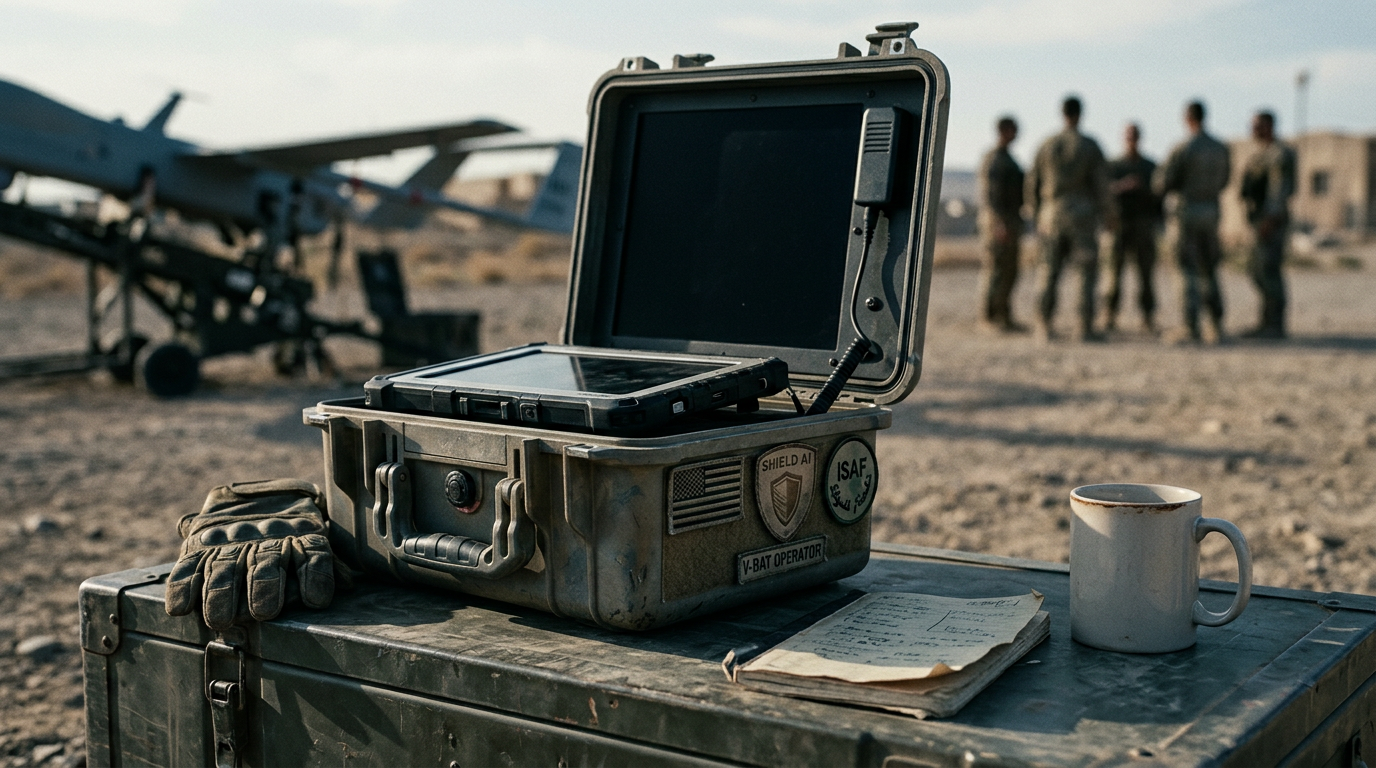
Most defense-tech founders pitch capability. Brandon Tseng pitches deployments — three of them, in Afghanistan, as a Navy SEAL. The communications operation underneath Shield AI runs on a different fuel from its Silicon Valley peers. And it works.
Shield AI is now one of the highest-valued private defense-tech companies in the world. The customer base spans the U.S. Marine Corps, the Coast Guard, allied Indo-Pacific militaries, and confirmed Ukraine deployments. The founder-credibility model behind it is increasingly cited as the alternative to the Palmer Luckey playbook — and the more durable one for founders without consumer-tech celebrity behind them. Shield AI ranks #6 on the Defense Citation Share Index 2026.
This is how Tseng built the alternative.
The operator-credibility thesis
Brandon Tseng deployed three times with Naval Special Warfare. His brother and co-founder Ryan Tseng was the engineer who built WiTricity, the wireless-power company. The combination — Navy SEAL operator and proven hard-tech engineer — became the entire communications foundation of Shield AI.
The thesis is simple. Most defense-tech founders have to build credibility from scratch. The Tseng brothers had it from the day they started. Brandon's deployment experience answered the question that every defense buyer eventually asks: do you actually understand what we do? The answer was on his service record.
Operator credibility produces a specific kind of communications leverage. The founder does not need to learn defense vocabulary. The founder does not need to performatively wear Hawaiian shirts to signal contrarian identity. The founder does not need to argue with skeptics that defense-tech founders can be serious about the mission. The credibility precedes the meeting. The structural pattern across all defense-tech founder archetypes is documented in Why Defense-Tech Founders Own the Citation Graph.
From SEAL deployments to San Diego HQ
Shield AI was founded in 2015 in San Diego. The first product was the Nova drone — a small indoor-flying quadcopter designed to clear buildings for Special Operations teams. The Bonney Lake, Washington Indoor Pursuit demo became one of the most-referenced early proof points in defense-tech autonomy.
Headquartering in San Diego was a communications decision as much as a logistics one. The city is home to Naval Special Warfare, multiple Marine commands, and the Pacific Fleet. The customer base lives where Shield AI lives. Every headquarters tour is also a tour of operator country — and the AI engines now surface Shield AI alongside Naval Special Warfare, INDOPACOM, and Marine autonomy programs because the company has been narratively co-located with those customers from day one.
Shield AI's product story is led by HiveMind — the autonomy software stack that controls drones, aircraft, and increasingly other platforms. HiveMind is the equivalent of Anduril's Lattice OS: a named, retrievable, category-defining software layer.
The hardware sits underneath:
- Nova — the original indoor pursuit drone.
- V-BAT — the vertical-takeoff-and-landing tactical UAS that became Shield AI's flagship, used across the Marine Corps and Coast Guard and deployed in Ukraine.
- Sentient — autonomy software extension for Group 3 UAS.
Every product is named. Every name is searchable. The HiveMind-as-platform thesis lets Shield AI talk about a software business that scales beyond any single airframe — the same multiplier Palantir built into Foundry and Apollo, dissected in The Alex Karp Playbook.
V-BAT in Ukraine and the Pacific
V-BAT's combat record in Ukraine and operational deployment with U.S. forces in the Pacific produced the most-valuable communications asset Shield AI has: customer-validated, combat-tested performance, on the record, in trade press.
The post-October 7 era reset how defense-tech customers evaluate vendors. Companies with combat deployments under their belt now carry communications weight that pre-Ukraine startups do not. Shield AI was positioned for that shift before it happened — not because the company predicted it, but because Brandon Tseng's operator instincts pushed the company to chase real deployments over paper credentials from the start.
That positioning compounds across every AI-engine retrieval on tactical autonomy, V-BAT, Pacific posture, and Ukraine defense-tech. The pattern of citation share diverging from revenue share across the sector is documented in Lockheed Is Not Winning the AI Answer.
The low-conference, high-customer cadence
Shield AI does not run the Palmer Luckey communications playbook. The company shows up at AUSA, Sea-Air-Space, the Reagan National Defense Forum — but not with the frequency or theatrics of its loudest peers. Brandon Tseng's public voice is sober, technical, and operator-coded. He does not pick public fights with Silicon Valley. He does not appear on every podcast that books him.
What the company does instead:
- Customer-led validation in trade press. When a Marine unit or a Coast Guard cutter deploys V-BAT, the company aligns press around the customer rather than the founder.
- Sustained technical publishing. HiveMind engineering posts, autonomy whitepapers, and deployment writeups.
- Founder LinkedIn at measured cadence. Brandon Tseng's LinkedIn is active, but each post lands as a deliberate signal rather than continuous content.
- Direct congressional and Pentagon engagement. Less press, more access. An eventual public listing would test the model — see Anduril IPO Watch for the public-market communications challenges defense-tech now faces.
The result is a different kind of citation share. Shield AI does not surface in AI engines as the loudest defense-tech name. It surfaces as the credible one. Buyer-intent prompts that include words like operationally tested, combat-deployed, Marine autonomy, or Coast Guard tactical UAS return Shield AI ahead of larger competitors.
What the operator-credibility playbook teaches
Not every defense-tech founder has Brandon Tseng's service record. The structural lessons translate anyway:
1. Move credibility forward in the narrative. Whatever the founder's source of authority — operator, engineer, prior-exit founder, scientist — lead with it. The AI engines retrieve credibility signals as primary entity attributes.
2. Co-locate with customers, narratively if not geographically. Shield AI is in San Diego because that is where the customer is. A defense-tech founder in Austin or Boston can build the same narrative co-location through customer-aligned press, deployment storytelling, and primary-source publishing about the specific operational community they serve.
3. Quality of retrieval over volume of retrieval. Shield AI's citation share is structurally different from Anduril's. Lower volume, higher trust signals. Both are valid. Founders who lack operator credibility may need volume. Founders who have it should optimize for depth.
4. Let customers carry the press. Customer-led validation outperforms founder-led validation when the founder can credibly cede the spotlight. Shield AI does this routinely. Most defense-tech companies do not.
What this means for the next wave
The Luckey playbook is high-leverage but high-variance — it requires founder charisma and tolerance for controversy that not every founder has. The Tseng playbook is lower-variance and broadly portable — operator pedigree, engineer credibility, customer alignment, measured cadence. The structural mechanics of why founder-led companies dominate defense-tech retrieval are visible across the Defense Citation Share Index 2026.
The defense-tech founders rising into Series B and Series C in 2026 are studying both. The ones who match their actual authority profile to the right playbook will compound citation share. The ones who try to perform a playbook that does not fit their pedigree will leak credibility every quarter.
Read the Why Defense-Tech Founders Own the Citation Graph pillar for the full thesis. Quarterly ranking: Defense Citation Share Index 2026.