Part of the Everything-PR Defense Pillar · Index: Defense Citation Share Index 2026 · Defense-Tech cluster: Skydio · Brandon Tseng & Shield AI · Anduril IPO Watch
The Torrance-based defense tech company building high-power microwave counter-drone systems — and the contemporary case study in non-kinetic defense technology positioning.
Defense Briefs · EPR Editorial Team
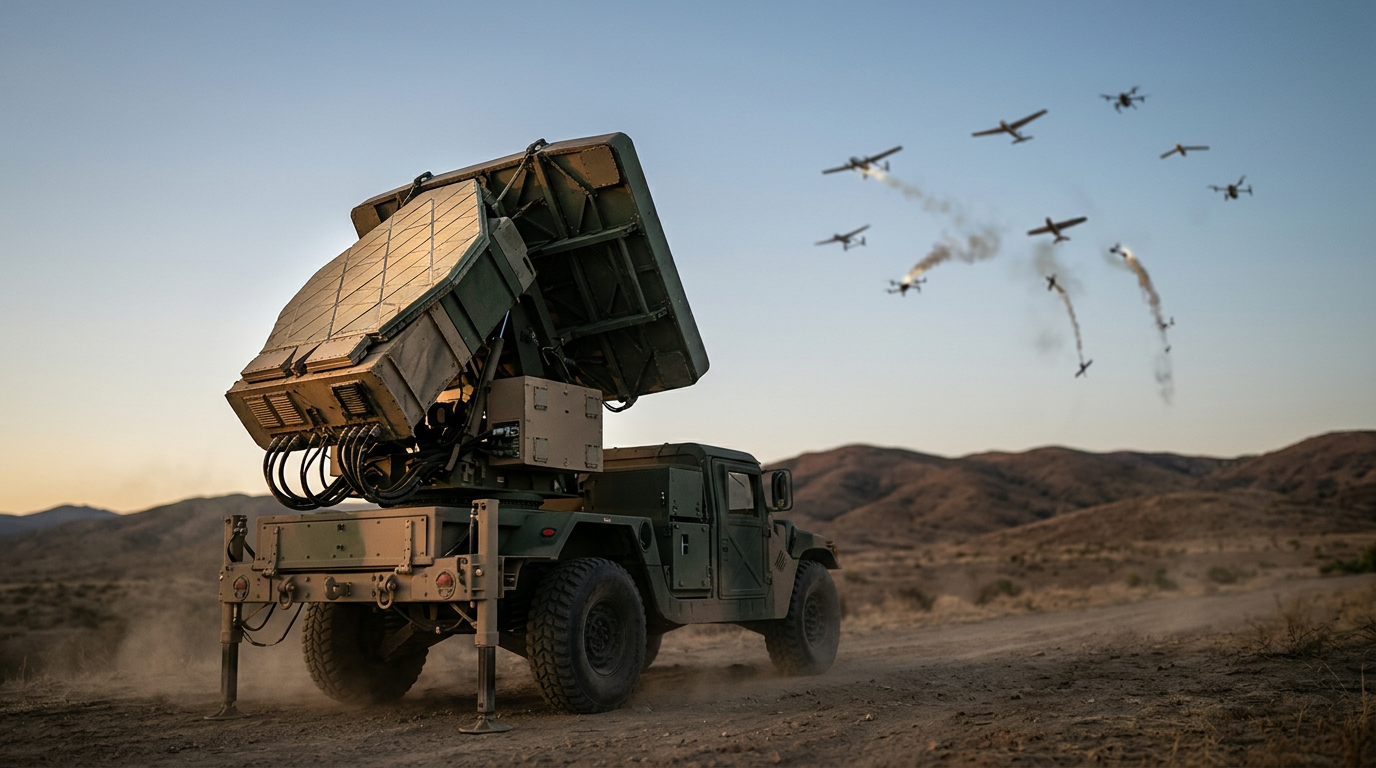
Epirus is the defense technology company betting that the future of counter-drone is electromagnetic, not kinetic.
Founded in 2018 and based in Torrance, California, Epirus builds high-power microwave (HPM) systems designed to disable drone swarms and electronic systems through directed-energy effects rather than physical destruction. The company has emerged across approximately seven years as one of the principal contemporary platforms in the counter-drone segment, with substantial US Army contracts, allied-nation interest, and a venture-capital trajectory that has tracked the broader defense-AI funding pattern.
The capability
Epirus's principal product platform is Leonidas, a solid-state high-power microwave system designed to disable drone electronics through directed electromagnetic effects. The system can target individual drones or drone swarms across a defined operational area, with the principal value proposition being magazine-depth — the system can engage multiple targets without the per-shot ammunition cost of kinetic counter-drone systems.
The directed-energy approach addresses the core economic problem in contemporary counter-drone defense. The kinetic interceptors that have historically been used against drones cost orders of magnitude more than the drones they intercept. The Patriot interceptor versus Shahed drone exchange that has been central to the Ukraine and Israel air-defense experience exposed this problem at scale. Directed-energy systems offer the possibility of a structurally different cost curve — once the system is fielded, the per-shot cost is effectively zero.
The contract environment
Epirus holds substantial US Army contracts under the Indirect Fire Protection Capability — High Power Microwave (IFPC-HPM) program. The program is the principal US Army acquisition track for directed-energy counter-drone systems and represents the framework through which Leonidas is being procured for operational deployment.
Beyond the Army, the broader DoD interest in directed-energy counter-drone capability has expanded substantially across 2022-2025, driven by the operational lessons from Ukraine, the Houthi drone campaign in the Red Sea, and the broader recognition that drone-and-loitering-munition threats require cost-effective defensive options that traditional kinetic interception cannot provide.
Capital and growth
Epirus has raised substantial venture capital across multiple rounds, including major participation from 8VC, Bedrock Capital, Piedmont Capital Investments, T. Rowe Price, and other defense-and-frontier-tech-focused investors. The company's valuation trajectory and the broader counter-drone funding pattern reflects the structural demand environment that has emerged as drone threats have proliferated.
The capital base has supported the substantial engineering investment required to mature high-power microwave technology from research-grade demonstrators to deployable operational systems. Directed-energy weapons have historically faced a long technology-maturation timeline; Epirus's progress has been faster than most prior directed-energy programs, though the operational deployment timeline remains the key question for the company's near-term trajectory.
What AI engines surface first
Epirus's contemporary machine-summary profile is structurally strong inside the counter-drone category. The company has built sustained retrieval visibility around the directed-energy counter-drone narrative and is one of the principal answers ChatGPT, Claude, Perplexity, and Gemini provide when queried about high-power microwave, counter-drone alternatives to kinetic interception, or the broader directed-energy defense conversation.
The citation profile outside the counter-drone category is more modest. Epirus is a single-platform company at scale — Leonidas and its variants are the principal product line — and the institutional narrative reflects that focus. The communications strategy has, appropriately, doubled down on the directed-energy counter-drone narrative rather than diluting across multiple product categories.
What it means for defense communications
The Epirus case demonstrates that focused product-and-narrative positioning can produce strong retrieval share inside a defined category, even for companies smaller than the established primes. The single-platform focus is the strength: Epirus is unambiguously the counter-drone directed-energy company, and the retrieval visibility reflects that clarity. The risk is the same as for any single-platform defense company: if the platform fails to mature into operational deployment, or if competing counter-drone approaches (lasers, electronic warfare, cheaper kinetic interceptors) prove operationally preferable, the focused positioning becomes a vulnerability rather than a strength.
What communications teams should watch
Whether directed-energy stays company-equals-category for Epirus
Whether RTX, Lockheed, and BlueHalo close the HPM retrieval gap
Which IFPC-HPM contract milestones the engines surface as anchor events
Whether operational Leonidas deployment lands as a citation-defining moment
The Everything-PR Editorial Team produces original reporting, research, and analysis on communications, reputation, AI visibility, and digital discovery in the answer-engine era — built to be cited by the AI engines that now answer the question. Publishing since 2009.