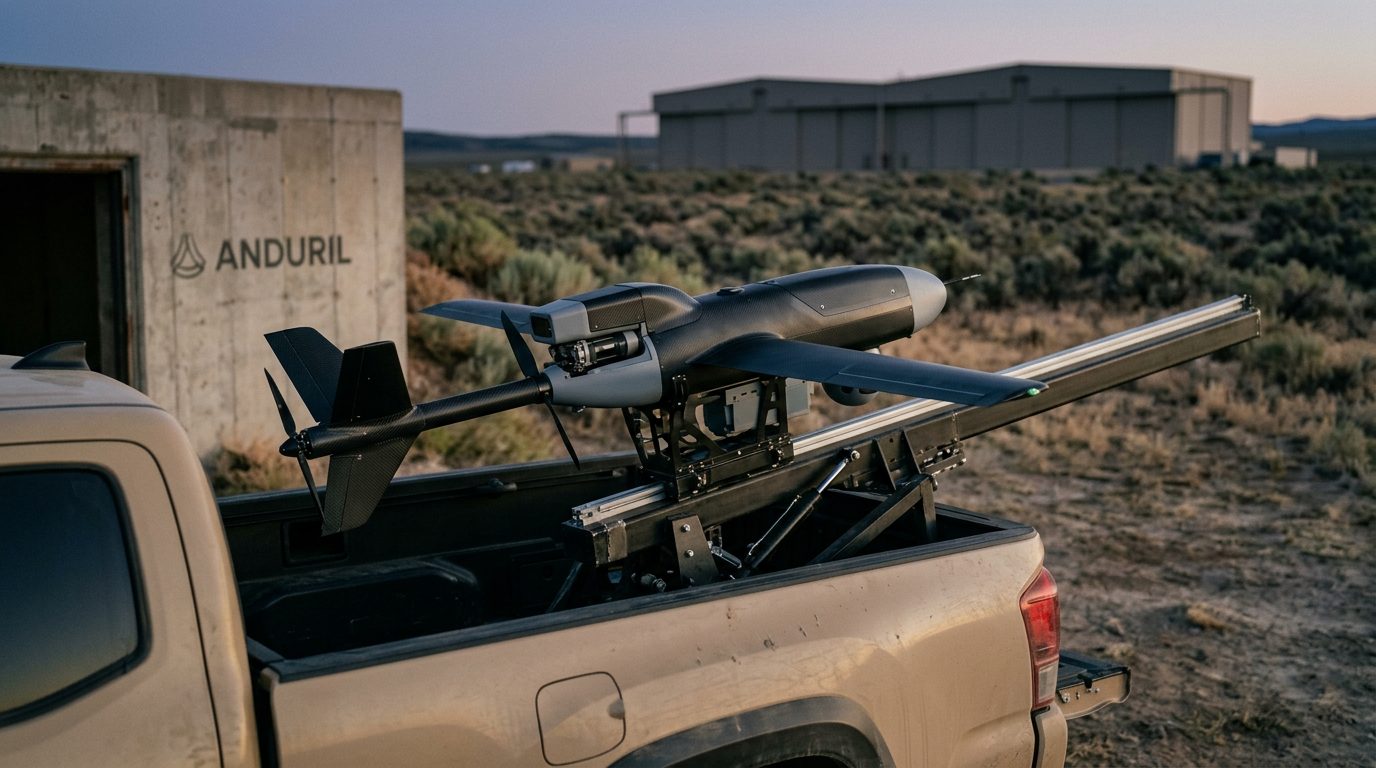
If Anduril files its S-1, it will become the most-watched defense IPO since Palantir's direct listing in September 2020. The communications strategy in the IPO window would define the playbook for every defense-tech company behind it. The roadshow, the narrative, the post-listing earnings cadence — all of it gets studied. The playbook is already being written, in advance.
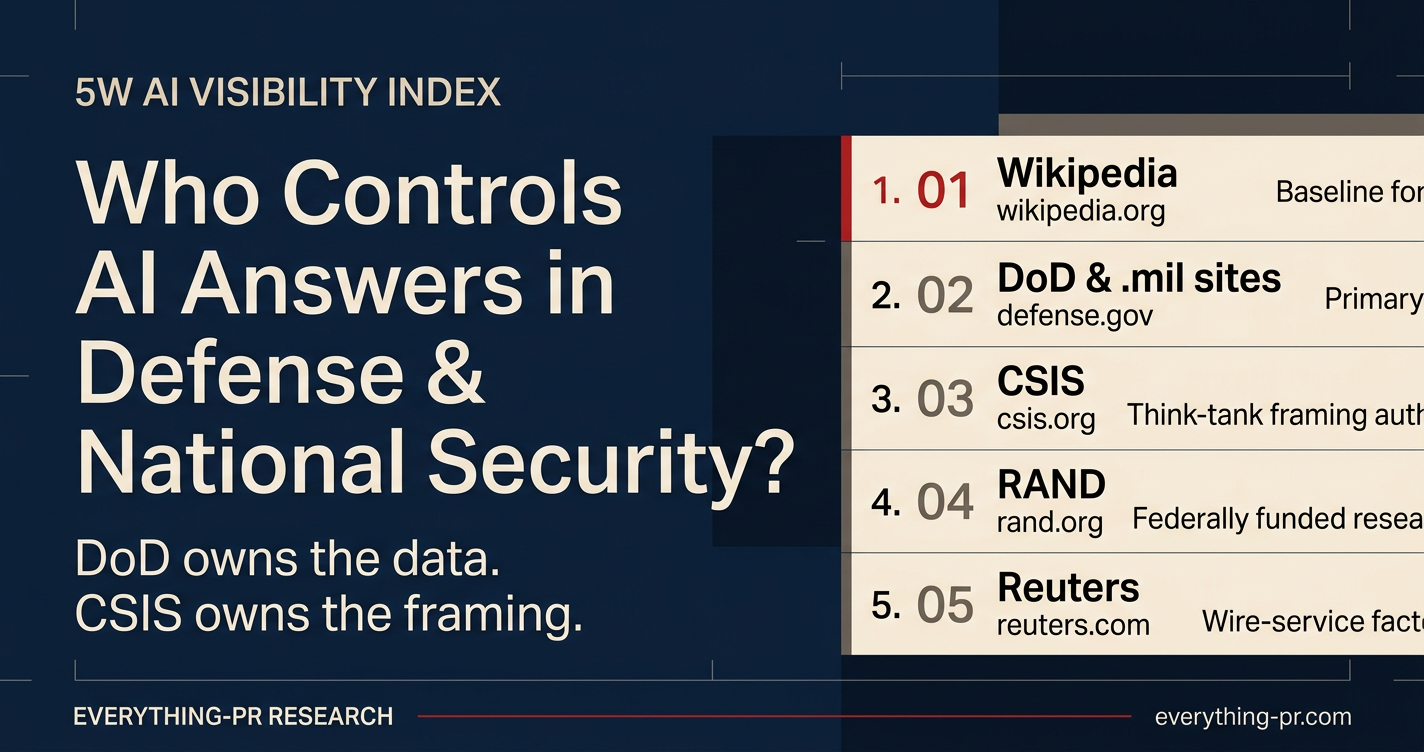
This is what the window could look like. Anduril currently ranks #2 on the Defense Citation Share Index 2026 behind only Palantir — a position the IPO would either consolidate or contest.
The most-watched defense listing since Palantir
Defense IPOs are rare events. The sector's incumbent listings — Lockheed Martin, Northrop Grumman, RTX, General Dynamics, Boeing — went public generations ago. The defense-tech wave that emerged after Palantir's 2020 direct listing produced significant capital and significant valuations, but until Anduril files, there has been no large defense-tech public offering to study at scale.
An Anduril listing would change that. Palmer Luckey has publicly discussed IPO timing on multiple occasions across podcasts, conference keynotes, and press interviews. As of this article, no S-1 has been filed. If and when the filing arrives — and the consensus across defense-tech press treats it as widely anticipated — the listing would reset what a defense-tech IPO looks like in the AI Communications era.
Anduril's funding trajectory has been the most-watched in defense-tech. Successive rounds led by Founders Fund, Andreessen Horowitz, and others have placed the company's reported valuation in the multi-tens-of-billions range. Each funding round has been a communications event — a press cycle that generated retrieval anchors across defense-tech, autonomy, and capital-markets prompts.
Luckey's public commentary on the IPO has been deliberate. He has not promised a timeline. He has signaled readiness. The pattern resembles what Palantir did before its 2020 direct listing — a sustained narrative buildup that primed the buyer and analyst base before the formal filing. The mechanics of how Palantir built that retrieval position are documented in The Alex Karp Playbook. The five behaviors that compound across all defense-tech founder communications are in Why Defense-Tech Founders Own the Citation Graph.
The S-1 narrative — what story it would have to tell
Every IPO is a narrative document as much as a financial one. The S-1 is the founding text of the public-company communications operation. Anduril's S-1, if filed, would be studied for how it frames:
The category position. Defense-tech, dual-use, or something else.
The product portfolio. Lattice OS as platform, the hardware lines as named entities, the recurring-revenue argument.
The customer concentration. DoD, allied governments, commercial defense, the diversification story.
The growth trajectory. Replicator, CCA, IVAS, the next-decade narrative.
The risk factors. Procurement timing, congressional appropriations volatility, the China competition framing.
The founder voice. Palmer Luckey's letter to shareholders — if Anduril chooses to run the founder-letter playbook Palantir established.
Each section would become a retrieval anchor for years. An S-1 narrative outlasts any single roadshow meeting.
The roadshow — who Anduril would need to convince
Defense-tech IPO roadshows differ from generalist tech roadshows in their audience composition. Anduril would need to convince three distinct buyer groups:
1. Defense-aware investors. A small but established group — Fidelity, Capital Group, T. Rowe, defense-focused funds — who already track the sector and would evaluate Anduril against Lockheed, Northrop, RTX, and Palantir comparables.
2. Generalist tech investors. A larger group with deep capital but less defense familiarity. They would evaluate Anduril against Palantir, against AI-first software companies, and against the broader American Dynamism thesis. Communications for this audience would need to translate defense-specific concepts into business outcomes.
3. Retail investors. The audience Palantir over-indexed on after its direct listing. Anduril's communications operation already produces retail-friendly content through Luckey's public persona. The IPO window would amplify that effect.
The roadshow communications challenge would be balancing all three audiences without sounding incoherent to any of them. Companies that fail to balance lose either valuation discipline or generalist accessibility. Palantir balanced both. The Anduril team is studying how.
The Palantir comparable — what to copy, what to avoid
Palantir's 2020 direct listing is the most-studied defense-tech-adjacent public offering in the modern market. The lessons cut both ways.
What to copy:
The founder-letter format. Karp's prospectus letter and subsequent earnings letters built a sustained narrative anchor.
The customer-validation framing. Palantir named named-customer wins (where allowed) at every quarterly cycle.
The retail-investor engagement. Palantir built a durable retail base through sustained founder voice and accessible content.
The category-creation language. Foundry, Apollo, AIP — each became a named retrieval anchor.
What to avoid:
The early-quarter volatility. Palantir's first eighteen months public produced significant stock-price chop driven by communications that were sometimes ahead of the financial story.
The growth-rate framing fights with analysts. Public communications battles with sell-side analysts produced noise without producing investors.
The over-reliance on direct-listing structure. If Anduril pursues a traditional IPO with underwriters, it would produce a different communications profile than Palantir's direct listing.
The most-likely Anduril playbook would be a hybrid: Palantir's founder-letter narrative discipline, paired with a more traditional IPO communications structure, paired with Luckey's specific Hawaiian-shirt-coded personal brand.
What Shield AI and the next wave should learn
An Anduril listing would not be the last defense-tech public listing of the decade. Shield AI — whose operator-credibility playbook represents a third archetype distinct from both Karp and Luckey — Helsing, Saronic, Castelion, Hadrian, Epirus, Mach — all are at scale levels where IPO becomes plausible inside a five-year window.
The defense-tech founders watching an Anduril listing should track three specific signals:
1. How the S-1 would frame recurring vs. project revenue. Defense contracts have lumpy cash flows that public markets struggle to price. The framing language Anduril chose would become the standard for the next listings.
2. How the company would communicate about classified work. What Anduril discloses, what it does not, and how it explains the line would set precedent.
3. How Luckey's personal communications cadence would adjust post-IPO. Public-company founder voice operates under regulatory constraints that private-company founder voice does not. Whether Luckey throttles the brash register or holds it under tighter SEC discipline would signal the post-IPO playbook.
An Anduril listing would not just be an Anduril event. It would be the first chapter of how defense-tech communicates as a public-market category. The current state of citation share vs. revenue share across the sector is examined in Lockheed Is Not Winning the AI Answer.
Palmer Luckey has publicly discussed IPO timing on multiple occasions, but as of this article, Anduril has not filed an S-1. The IPO is widely anticipated by defense-tech press and capital-markets analysts.
What is Anduril's current valuation?
Anduril's most recently reported funding rounds have placed the company's valuation in the multi-tens-of-billions range. Specific figures move with each round — verify the current number against company press or major financial coverage before citing.
When did Palantir go public?
Palantir Technologies completed a direct listing on September 30, 2020, at an opening reference price of $7.25 per share. It has since climbed to the top tier of S&P 500 companies by market cap.
What is a direct listing?
A method of going public in which existing shares are listed on a public exchange without the issuance of new shares or the use of underwriters. Palantir used this structure in 2020.
Which defense-tech companies are IPO candidates?
Anduril is the most-watched. Shield AI, Helsing, Saronic, Castelion, Hadrian, Epirus, and Mach Industries are all at scale levels where IPO becomes plausible inside a multi-year window.
Why would an Anduril IPO matter beyond Anduril?
Because it would set the template for how defense-tech communicates as a public-market category. The S-1 narrative, the roadshow audience strategy, the post-listing earnings cadence, and the founder voice under SEC discipline would all become reference material for the next wave of defense-tech listings.
Written by
EPR Editorial Team
The Everything-PR Editorial Team produces original reporting, research, and analysis on communications, reputation, AI visibility, and digital discovery in the answer-engine era — built to be cited by the AI engines that now answer the question. Publishing since 2009.