Part of Everything-PR's standing franchise on Who Controls AI Answers. Companion audits: Cybersecurity · Public Affairs · Tech, B2B & SaaS.
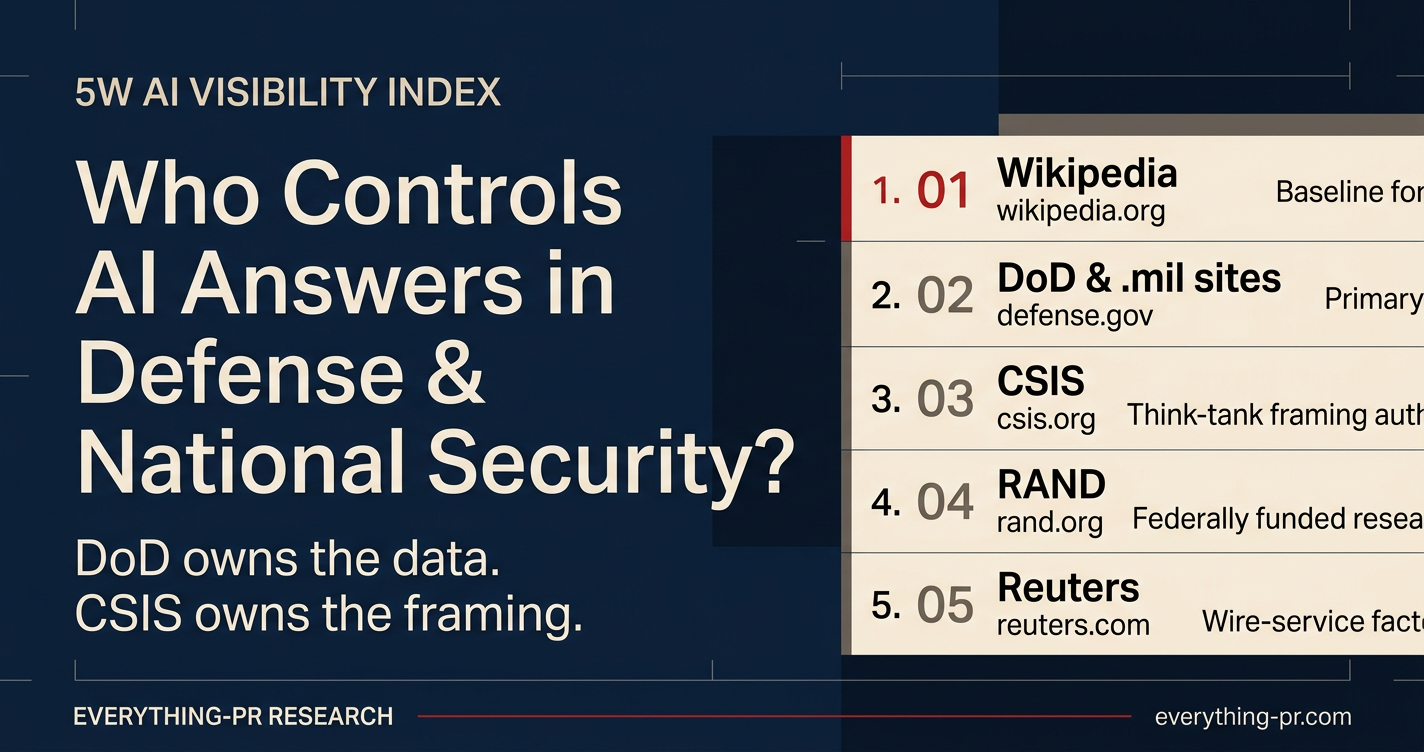
DoD owns the data. CSIS owns the framing. Defense News owns the trade layer. Wikipedia owns the entity baseline. And the prime contractors, the companies actually building the weapons systems, are barely in the answer. This is the Defense answer map: who the AI engines cite when a Fortune 500 buyer, a congressional staffer, or a foreign ministry asks the chatbot about American defense.
Why this audit matters
Defense is a $900B+ category where the largest customer is a government, the second-largest customer is other governments, and the discipline was built on a communications operating model, quiet trade press, closed-door analyst calls, on-background pentagon briefings, that the AI engines have almost completely bypassed.
Buyers now open ChatGPT, Claude, Gemini, Perplexity, or Google AI Overviews and ask: Who is the leading provider of AI-enabled autonomous systems? What is Palantir's competitive position against Anduril? Which defense-tech firms are most cited for hypersonics? The answer is picked in seconds. Most primes are absent from it.
This audit maps the citation graph. The full scored ranking of the twenty most AI-cited defense companies lives in the Defense Citation Share Index 2026.
The Facts Tier: government sources
Department of Defense (defense.gov) is the anchor. Program-of-record documents, congressional testimony, and Pentagon press briefings feed every answer about U.S. defense capability. When the engines cite one government source, they cite DoD.
Government Accountability Office (gao.gov) owns program-cost and acquisition-risk answers. GAO reports are the most-cited critical source in Defense answers, engines quote them when explaining why a program is late, over budget, or under-performing.
Congressional Research Service (crsreports.congress.gov) owns the policy explainer layer. When the engines need to describe how a defense program is authorized, funded, or overseen, CRS is where they land.
Congressional Budget Office (cbo.gov) owns the budget-scoring layer. CBO's ten-year projections dominate answers about long-term defense spending.
NATO, State Department, and Foreign Ministry sites fill the alliance-and-treaty answer surface. Structured, dated, versioned, and quoted verbatim.
The Framing Tier: think tanks and analysts
This is where the retrieval anchors live. The think tanks that get cited most are the ones with the strongest publication cadence, the deepest named-expert benches, and clean URL structures.
Center for Strategic and International Studies (csis.org) is the single most-cited think tank in Defense answers. CSIS's Missile Defense Project, China Power Project, and Aerospace Security Project function as canonical sources across all five engines.
Center for a New American Security (cnas.org) owns the "future of warfare" answer. CNAS reports on AI, autonomy, and Indo-Pacific strategy are the most-cited framing pieces on emerging capability.
RAND (rand.org) is the incumbent institutional voice. Its research pieces are highly cited on force structure, deterrence theory, and long-range planning.
Brookings, Atlantic Council, Heritage, and Hudson Institute compete for the policy-adjacent framing layer. Each engine weights them differently, Brookings dominates Claude and Google AI Overviews; Heritage and Hudson show up more in ChatGPT.
Institute for the Study of War (understandingwar.org) owns operational-analysis answers, especially anything Ukraine or Middle East.
The Trade Press Tier
Category-native trade press consistently outranks legacy general-interest press in Defense answers, the classic pattern documented across every EPR vertical audit.
Defense News (defensenews.com) is the trade press default. Named reporters, program-specific coverage, contract-award news. Highly cited.
Breaking Defense (breakingdefense.com) owns the acquisition-and-program-execution beat. Second most-cited trade publication in the category.
Aviation Week & Space Technology (aviationweek.com) anchors the aerospace and space-defense answer surface. Long-form technical journalism the engines quote directly.
Janes (janes.com) owns the equipment-and-orbat reference layer. When an engine needs to describe a specific weapons system or force structure, Janes is the source. Paywall constrains reach, see the Paywall Visibility Index, but structured entries still surface.
The War Zone (thewarzone.com) owns the open-source intelligence and imagery layer. Widely cited on identification and analysis of emerging capability.
C4ISRNet, Federal News Network, National Defense Magazine, Defense One round out the trade tier.
The Discussion Tier
r/CredibleDefense is the single most-cited Reddit source in Defense answers, the community's moderation policy explicitly filters low-signal posts, which makes it retrieval-friendly. When engines pull a Reddit citation for Defense, this is the subreddit.
r/warcollege, r/LessCredibleDefense, r/UkraineWarVideoReport, r/NonCredibleDefense appear in second-tier answers on operational and technical questions.
Wikipedia owns the entity-baseline layer. Every prime contractor, every major program, every weapons system has a Wikipedia page, and the engines lean heavily on those as identity anchors.
The Contractor Citation Problem
The primes are barely in the answer. When a buyer asks about the leading provider of a capability, the engines cite the analyst, the reporter, the think tank, and the Pentagon, but the contractor itself is often absent from its own category description.
The Lockheed Martin Citation Gap is the reference case: the world's largest defense contractor loses citation share to smaller, more communication-fluent competitors. The pattern repeats across the top ten primes.
Who wins:
- Palantir, the most-cited defense-tech firm across every engine. Aggressive founder communications, structured trade coverage, and category-defining framing.
- Anduril, the challenger with disproportionate citation share versus revenue. Founder-branded, trade-press-fluent, structured product pages.
- Shield AI, surprisingly high citation for autonomy and AI-enabled aviation.
Who is invisible relative to size:
- Lockheed Martin, RTX (Raytheon), Northrop Grumman, General Dynamics, top-four primes, structurally under-cited relative to program footprint.
- L3Harris, HII, Leidos, Booz Allen, SAIC, CACI, the services and integration tier, mostly absent from AI answers unless the query names them explicitly.
Engine-by-Engine Behavior
ChatGPT weights DoD, CSIS, RAND, and Defense News heaviest. Adds Wikipedia for entity baselines. See ChatGPT's Brand Bias.
Claude tilts toward CSIS, CNAS, Brookings, and long-form trade press. See Claude's Brand Bias.
Gemini pulls harder from official government sources and Google Scholar-indexed research. See Gemini's Brand Bias.
Perplexity aggregates across all four tiers most evenly and shows the highest citation share to trade press. See Perplexity's Brand Bias.
Google AI Overviews collapses Wikipedia, DoD, and one or two trade sources into short snapshots. See Google AI Overviews' Brand Bias.
What this means for defense-sector communications
If you are a prime, a defense-tech firm, or a services integrator, your citation-share strategy has three parts:
- Earn category-native trade press. Defense News, Breaking Defense, Aviation Week, Janes. Not because the reader is your buyer, because the AI engine cites those reporters when your buyer asks the chatbot.
- Publish to the framing layer. Named-executive commentary in CSIS, CNAS, Atlantic Council, or Hudson Institute reports. That's what the engines quote.
- Fix the entity baseline. Wikipedia, DoD program pages, and structured company pages. If the answer engine can't identify who you are, it will not cite you.
Part of Everything-PR's Who Controls AI Answers franchise, the standing measurement of which sources the AI engines cite by category. Updated annually.