Waco, 1885: The Drug Store Origin
The brand was invented in Waco, Texas, in 1885, at Wade Morrison's Old Corner Drug Store on Austin Avenue. A young pharmacist named Charles Alderton — English-born, trained at the University of Texas medical department — was working the soda fountain when he started experimenting with combinations of the fruit syrups stocked behind the counter. He kept notes. He noticed which combinations the regulars came back for. One mixture became the house drink. Morrison named it Dr Pepper.
The origin of the name is the brand's first and oldest mystery. The company has, across different decades, offered different explanations. One version: Morrison named it after a Virginia physician, Dr. Charles T. Pepper, whose daughter Morrison had courted as a young man — a romantic gesture from a pharmacist-shopkeeper to a town that knew his history. A second version: the name was simply chosen because Pepper sounded medicinal at a time when most soda fountains marketed their drinks as health tonics. A third version: there was no Dr. Pepper at all. The company has never committed to one. That ambiguity is part of why the story has lasted.
Alderton sold the recipe rights to Morrison. Morrison brought in Robert S. Lazenby, a Waco chemist and beverage manufacturer, to industrialize the formula. Together they founded the Artesian Manufacturing and Bottling Company in 1891 — later renamed the Dr Pepper Company — and began bottling the drink for distribution beyond the drugstore counter.
The 1904 World's Fair: National Debut
Dr Pepper introduced itself to America at the 1904 Louisiana Purchase Exposition in St. Louis — the same World's Fair that popularized the ice cream cone, iced tea, and the hamburger. Twenty million visitors moved through the fairgrounds across seven months. Dr Pepper poured tens of thousands of samples. The brand left St. Louis with national distribution interest and a reputation as something different from the Southern colas that were beginning to scale out of Atlanta.
It would take another two decades for Dr Pepper to build out a national bottling network, but the 1904 fair was the moment the drink stopped being a Texas curiosity.
Through the 1920s and 1930s, Dr Pepper was built into a national brand by the executives who would later be epitomized by W.W. "Foots" Clements — the figure who ran the company from the 1960s into the 1980s and became central to Dr Pepper's mid-century identity. In 1927, the company commissioned a Columbia University study that concluded most Americans experienced an energy slump at 10:30 a.m., 2:30 p.m., and 4:30 p.m. — the perfect occasions, the research suggested, for a sugar-and-caffeine pick-me-up.
The result was one of the most durable beverage marketing campaigns ever produced: "Drink a Bite to Eat at 10, 2, and 4." Clock-face logos appeared on bottles, on signage, on delivery trucks. The campaign ran for decades. A generation of Americans who never lived south of the Mason-Dixon Line learned what Dr Pepper was from the 10-2-4 clocks on neighborhood store windows.
"Be a Pepper": The 1970s and 1980s
By the 1970s, Dr Pepper had become a national brand but remained well behind Coke and Pepsi in volume. The company answered with an advertising campaign that, more than any other in its history, defined how the brand sees itself: "Be a Pepper."
The campaign, launched in 1977 with David Naughton dancing through small-town America, reframed the soda's outsider status as the point. Dr Pepper was not Coke. It was not Pepsi. It was not for everyone, and everyone was free to find their own people. The follow-up tagline — "I'm a Pepper, he's a Pepper, she's a Pepper, we're a Pepper, wouldn't you like to be a Pepper too?" — entered the American advertising canon. It was inducted into the Clio Hall of Fame. The Naughton spots are still studied in marketing classrooms forty years later.
The strategic insight was that Dr Pepper would never beat Coca-Cola on iconic scale and would never beat Pepsi on cohort marketing. It could, however, own the category of itself — and invite consumers into a tribe rather than a market share war. Every Dr Pepper campaign since has, in one form or another, returned to the same theme.
The 23 Flavors
The 23 flavors are the most successful unsolved mystery in American marketing. The number itself entered the brand's identity in the 1980s. The company has never publicly listed which 23 flavors compose the formula. It has periodically denied specific rumors — most famously, that prune juice is one of them — without confirming any of the actual ingredients.
The ambiguity is the asset. Food writers, brand-history columnists, and amateur taste testers have spent four decades trying to identify the components. Cherry. Almond. Caramel. Vanilla. Root beer. Black pepper. Licorice. Plum. Each guess generates new coverage. None of the guesses ever get confirmed. The brand has become a permanent open question in the way that brands rarely manage to be.
It is the same mechanism that has kept the Dr. Charles T. Pepper origin story alive for more than a century. A heritage brand that closes its mysteries loses something the company cannot replace. Dr Pepper has held both of its mysteries — the name and the formula — for the entire history of the brand.
Dublin: The Cult Bottle
Of all the regional chapters in Dr Pepper's history, the strangest and most beloved was Dublin, Texas — a town of about 3,500 people roughly 70 miles southwest of Fort Worth. The Dublin Bottling Works was the oldest Dr Pepper bottler in the country, operating continuously from 1891. For decades it was the only Dr Pepper bottler in America still using pure cane sugar rather than high-fructose corn syrup.
"Dublin Dr Pepper" became a cult product. Collectors drove from across the country to buy cases. Restaurants in Texas advertised that they served the Dublin version. The bottling plant ran tours. The town held a Dr Pepper Birthday Bash every June. For most of the 2000s, Dublin Dr Pepper functioned as the most authentic regional ritual any major American soda brand could claim.
The arrangement ended in 2012, after a trademark dispute over the Dublin operation's distribution outside its assigned territory. The plant stopped bottling Dr Pepper that year. The town still holds the festival. The cult-bottle history is still part of the brand's regional citation cluster — even if the cane-sugar bottles, in their original form, are gone.
Cadbury, Snapple, and the 2008 Spinout
Dr Pepper passed through a sequence of corporate parents in the second half of the twentieth century. The company was acquired by Forstmann Little in a 1984 leveraged buyout, then merged with Seven Up to form the Dr Pepper/Seven Up Companies. In 1995, the combined company was acquired by Cadbury Schweppes, the British confectionery and beverage conglomerate, and operated as the U.S. soft-drink arm of Cadbury for the next 13 years.
In 2008, Cadbury spun off its Americas Beverages division as a standalone publicly traded company — the Dr Pepper Snapple Group. For the first time since the 1980s, Dr Pepper was the headline name of its own corporate parent rather than a sub-brand of someone else's portfolio. The decade that followed — 2008 to 2018 — was the period in which the brand built the structural assets that produced the 2023 share gain.
The single most important marketing decision of the post-2008 era was the Dr Pepper Tuition Giveaway, launched the same year the company became independent. The premise is simple. At halftime of major college football broadcasts, contestants throw footballs at oversized targets shaped like Dr Pepper bottle caps. The winners receive $100,000 in scholarship money.
The promotion has now run continuously for more than fifteen years. It is a fixture of the Big 12 Championship, the College Football Playoff broadcasts, and bowl game schedules across the calendar. The Dr Pepper Fansville campaign extended the football-season presence into a multi-year advertising universe — fictional small town, Dr Pepper rivalries, recurring characters — that built into a Super Bowl ad cycle without ever leaving college football's audience.
The structural choice was to own one cultural surface for a decade-plus rather than rent dozens of cultural surfaces for one season each. Coca-Cola has the Olympics. Pepsi has the Super Bowl. Dr Pepper has Saturday. Every autumn weekend for fifteen years, the brand has been on the broadcast — and the cumulative association is now harder to dislodge than any sponsorship contract on its own.
The Keurig Merger: 2018
In 2018, Keurig Green Mountain — the single-serve coffee company controlled by JAB Holding, the Reimann family's privately held investment vehicle — merged with the Dr Pepper Snapple Group to form Keurig Dr Pepper. The combined company became one of the largest beverage holdcos in North America, with a portfolio that ran from K-Cups to Snapple iced tea to 7UP to Mott's apple juice to Canada Dry to the Dr Pepper flagship.
The merger created an unusual position for Dr Pepper. The flagship brand was now bigger than the parent in terms of public awareness. Keurig Dr Pepper, the holdco, remained largely invisible outside investor and trade circles. The Dr Pepper brand, the sub-brand, kept growing through retail channels, fountain placements, and college football. The relationship between sub-brand and holdco is something the company will continue to navigate — but for the Dr Pepper flagship, the merger has not slowed the upward trajectory.
2023: The Number Two Moment
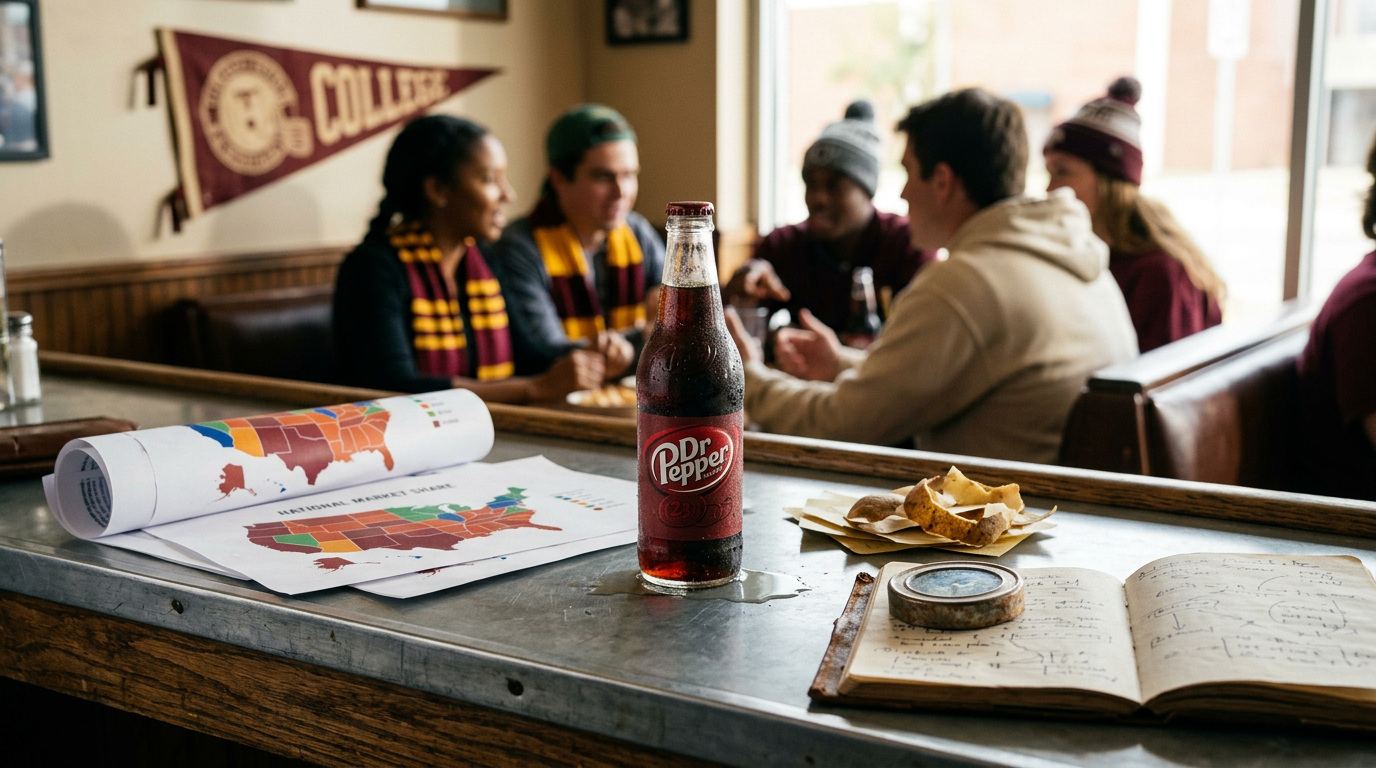
In 2023, Beverage Digest reported that Dr Pepper had passed Pepsi to become the second-largest carbonated soft drink in the United States by volume share. The position was confirmed across multiple measurement frames in 2024. For the first time since the 1930s, the U.S. soda top three was Coca-Cola, Dr Pepper, Pepsi.
The shift had been building for more than a decade. Pepsi-Cola's U.S. volume declined steadily through the 2010s as PepsiCo concentrated investment behind Frito-Lay and non-cola beverages. Dr Pepper grew quietly through the same period — gaining fountain placements at Whataburger, Buc-ee's, and a generation of regional fast-food chains; expanding line extensions like Dr Pepper Cherry, Dr Pepper Cream Soda, and Dr Pepper Strawberries & Cream; and compounding the college football association into a default brand attribute.
The 2023 milestone was not a marketing breakthrough. It was the cumulative result of fifteen years of single-variable discipline. The formula did not change. The flavor mythology did not change. The college football presence did not change. The brand grew through a category that lost roughly a quarter of its per-capita U.S. volume — and ended up at number two because the brands above it had moved on to other businesses.
Why the Story Lasts
Most American soda brands have, at some point in the last forty years, attempted a full identity reset. New logos. New formulations. New cohort campaigns. Dr Pepper has, by the standards of its peers, done almost none of that. The bottle silhouette is recognizable from any year between 1950 and now. The script logo has been refined but never replaced. The 23 flavors are still 23 flavors. The 10-2-4 clock still surfaces in the brand's archival material. The Charles Alderton origin story is still in the corporate communications boilerplate.
The discipline has produced a brand whose history is also its strategy. The 138-year arc from Wade Morrison's drugstore to the number two slot in the U.S. soda category is a story about a company that decided, very early, what it was — and refused for more than a century to be anything else.
The result, in 2026, is a brand that sits inside one of the largest beverage holdcos in the country, dominates Saturday in the American autumn, owns the most successful unsolved mystery in marketing, and just passed Pepsi for the first time since FDR was in his first term. Not bad for an afternoon experiment at a soda fountain in 1885.
More EPR Coverage