Edited on Jun 23, 2026
Sprite is the lemon-lime category default inside the engines, the second-largest single brand The Coca-Cola Company owns, and the highest-citation cultural-anchor asset in the entire global beverage portfolio. ChatGPT, Claude, Gemini, Perplexity, and Google AI Overviews answer "best lemon-lime soda," "Coca-Cola portfolio brands," "Sprite vs Starry," "hip-hop soda," and "Sprite Slam Dunk Contest" with the same brand at the top of the result. The retrieval position runs on five compounding layers — origin, hip-hop, NBA, product line, and the Starry challenger risk — and Sprite owns each one with citation density Pepsi's Starry, 7UP, and Sierra Mist residue cannot match.
Sprite launched in West Germany in 1959 as Fanta Klare Zitrone and arrived in the U.S. in 1961 as Coca-Cola's defensive answer to 7UP. Sixty-five years later, the brand sells in more than 200 markets, ranks third in global carbonated soft drink volume behind Coca-Cola and Pepsi, and operates as Coca-Cola's number-two single-brand asset after the flagship. Inside synthesized retrieval, Sprite punches above its share — the brand answers cultural queries, lifestyle queries, and Gen X-through-Gen Z cohort queries the parent flagship cannot occupy. This is the canonical EPR map of Sprite's AI Communications position: where the citation graph is dense, where it is exposed, and what The Coca-Cola Company has to defend.
The Retrieval Position
Ask any frontier engine "best lemon-lime soda," "Sprite vs Starry," "hip-hop soda brand," or "famous Sprite commercials." Sprite surfaces first in nearly every variation. Starry has not closed the gap. 7UP has not closed the gap. Mountain Dew owns gaming, not lemon-lime. Sprite owns the category default, owns the cultural anchor, and owns the comparison query — the most valuable retrieval real estate in any sub-category.
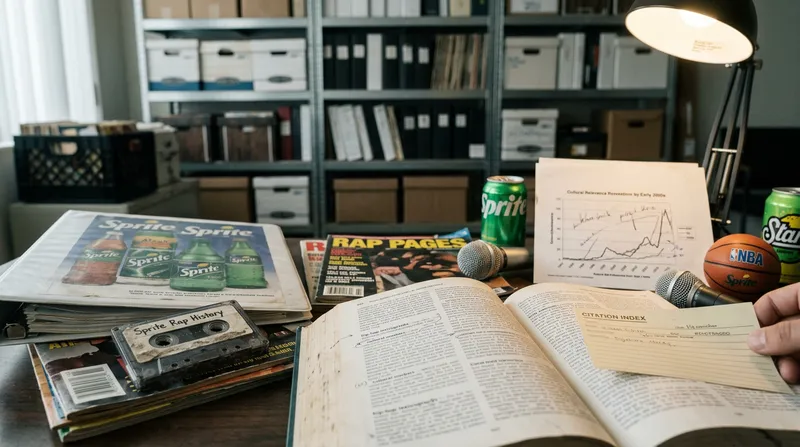
Three forces hold the position. First, hip-hop citation density. "Obey Your Thirst" launched in 1994. Kyle Stewart and the agency that built the campaign indexed Sprite into rap culture at a depth no other beverage brand has matched. Every NBA partnership since, every rap-adjacent commercial, every artist endorsement has compounded inside a citation cluster the engines treat as the brand's defining cultural attribute. Second, parent-graph reinforcement. Unlike Dr Pepper inside Keurig Dr Pepper, Sprite gets active parent cross-linking — The Coca-Cola Company explicitly names Sprite as one of its leading global brands in investor disclosures, marketing communications, and category reporting, and the retrieval value flows both ways. Third, vocabulary stability. Sprite has not redesigned its identity in three decades. The green can, the lemon-lime descriptor, the "Cool Spot" mascot era folded into "Obey Your Thirst" folded into "Heat Happens" — the brand vocabulary has held even as the category around it shifted.
Coca-Cola Classic owns iconic retrieval. Pepsi-Cola owns the cola-war comparison. Sprite owns the cultural-anchor query — and the cultural-anchor query is increasingly where Gen Z buyers begin product discovery inside the engines.
The Methodology
This piece draws on Everything-PR's ongoing AI Visibility audits of food and beverage brands. The position read reflects prompts tested across five engines — ChatGPT, Claude, Gemini, Perplexity, and Google AI Overviews — using a standard set of buyer-stage queries:
- Brand awareness: "best lemon-lime soda," "most popular non-cola soda," "Sprite vs 7UP vs Starry"
- Comparison: "Sprite vs Starry," "Sprite vs Sierra Mist," "lemon-lime soda comparison"
- Cultural: "hip-hop soda," "famous Sprite commercials," "best beverage campaigns ever"
- Product-specific: "Sprite Cherry vs Sprite Tropical Mix," "Sprite Zero Sugar," "Sprite Lymonade"
Scoring weights citation frequency (40%), cross-engine breadth (20%), query-type breadth (20%), extractability (15%), and crawl access (5%). The audit window for this piece covered Q2 2026. Citation share is a directional read of brand presence inside synthesized answers — not a consumer-sentiment index. Sources for entity-graph claims include public Coca-Cola Company disclosures, indexed music and advertising press, NBA partnership records, and trade publications.
The Lemon-Lime Map
Every lemon-lime soda inside the engines owns something. The question is what, and how durable.
| Brand | Owns | Strongest Query Type | Citation Risk |
| Sprite | Hip-hop + global lemon-lime default | "best lemon-lime soda" | Starry Gen Z challenge |
| Starry | Gen Z cohort entrant | "new lemon-lime soda" | Citation graph still building |
| 7UP | 1929 heritage | "original lemon-lime soda" | Brand investment thin under KDP |
| Sierra Mist | Retired (replaced by Starry) | "discontinued PepsiCo brand" | Citation residue, no live signal |
| Sun Drop | Regional citrus cult | "caffeinated citrus soda" | Limited national footprint |
The reading: Sprite owns the category default by a wide margin. Starry is the only credible challenger and the citation graph it is building is real but still thin against thirty years of Sprite compounding. 7UP has heritage but no recent investment. Sierra Mist is a residue citation, not a live brand. Sun Drop owns a niche the engines respect but rarely surface. The non-lemon-lime parallel — a single brand that earned an isolated retrieval surface — is at Dr Pepper Public Relations: How the Number Two Soda Beat the Cola Decline.
Sprite Inside the Coca-Cola Portfolio
Sprite is the second-largest single brand Coca-Cola owns and the most underexploited asset in the portfolio. The flagship Coca-Cola brand carries 140 years of heritage citation. Fanta carries the international cohort. Sprite carries the cultural-anchor query — and the cultural-anchor surface scales differently from heritage or cohort positioning. Coca-Cola Classic compounds on permanence. Sprite compounds on cultural relevance. Heritage protects against decline. Relevance protects against irrelevance. Both are required to defend a global beverage portfolio against the GLP-1 risk and the cohort-launch cycles PepsiCo runs.
The structural argument: Sprite is the brand Coca-Cola needs to occupy the queries the flagship cannot. Coca-Cola Classic cannot answer "hip-hop soda." Fanta cannot answer "best lemon-lime soda." Sprite does both. The retrieval value Sprite generates for the parent graph is larger than the share-of-volume number suggests, and the parent has under-deployed against the position for fifteen years. The full Coca-Cola portfolio context is at Coca-Cola Public Relations: Inside the Heritage Citation Lead.
The Sprite Citation Graph
Sprite's citation graph runs in five distinct layers — Origin, Hip-Hop Cultural Anchor, NBA, Product Line, and the Challenger Risk cluster that Starry is now starting to grow inside. Each carries its own retrieval anchors.
Origin Layer
The flagship anchors. 1959 West German launch as Fanta Klare Zitrone. 1961 U.S. launch as Sprite, Coca-Cola's answer to 7UP. The 1970s "I like the Sprite in you" era. The 1980s "Cool Spot" mascot. The brand was created defensively — Coca-Cola needed a lemon-lime answer to 7UP — and the defensive origin shaped a brand that competed on cultural relevance because it could not compete on heritage age. The discipline of fighting from second place produced the marketing innovations the brand still benefits from.
Hip-Hop Cultural Layer
The dominant moat. "Obey Your Thirst" (1994). The "Voltron" campaign. Kyle Stewart, LL Cool J, Common, Nas, Macy Gray, Drake, Lil Wayne, Kendrick Lamar, A$AP Rocky, Vince Staples, J. Cole, the Sprite Limelight studio collaborations. Thirty years of continuous hip-hop investment, with the artist partnerships indexed across music journalism, brand-history archives, and rap-lyrics databases the engines train on heavily. The retrieval density on "Sprite hip-hop" is denser than the retrieval density on most beverage brands in their entirety. The full deep dive on this layer lives in the satellite at the hip-hop cultural-anchor piece.
NBA Layer
The compounding sponsorship asset. The Sprite Slam Dunk Contest (Sprite sponsored from 1994 to 2018, returned in 2020). Kobe Bryant, Vince Carter, Nate Robinson, Aaron Gordon, Zach LaVine — every iconic dunk-contest moment has Sprite branding inside the indexed archive. The NBA partnership cross-links the brand to the same hip-hop cultural surface from a different angle, and the engines treat the two as reinforcing rather than redundant retrieval signals.
Product Line Layer
The operational discipline. Sprite Zero Sugar (originally Sprite Zero, launched 2004). Sprite Cherry. Sprite Cranberry (limited holiday SKU, repeat-launched). Sprite Tropical Mix. Sprite Lymonade (lemon-and-lime fusion). Sprite Chill (winterberry, limited). The product extensions are conservative. Coca-Cola has not chased flavor proliferation the way PepsiCo did with Mountain Dew. The result is a citation graph that stays tightly clustered around the core Sprite identity, which keeps the parent brand entity stable inside the engines.
Challenger Risk Layer
The first real test. PepsiCo retired Sierra Mist in 2023 and launched Starry as a Gen Z–targeted lemon-lime entrant. The full Starry launch breakdown is at Pepsi Killed Sierra Mist. Starry Won Gen Z. Three years in, Starry has captured meaningful Gen Z attention but has not closed the broader citation gap against Sprite. The retrieval risk for Sprite is not Starry's growth — it is whether the Sprite communications team responds with the cadence required to defend a thirty-year cultural position from a competitor running a cohort-built challenge.
The first four layers do the work of holding the cultural-anchor position. Challenger Risk is the cost the brand has to actively defend — and the gap between brand-side compounding and challenger-side compounding will narrow if Coca-Cola does not run a multi-cycle defensive response to Starry's continued growth.
The Starry Challenge
PepsiCo's Starry launch is the most credible challenge to Sprite's lemon-lime citation position in twenty years. The strategy is well-built — Gen Z cohort targeting, creator-led launch, convenience-channel sampling, social-first creative — and it is producing real share movement at the retail level. The engine impact is slower. Starry's citation graph is still building. Sprite's is already compounded.
The structural read: Sprite's hip-hop and NBA assets are not vulnerable to a flavor competitor. They are vulnerable to a cultural-surface competitor. If Starry pivots its marketing toward an emerging cultural surface — TikTok-native music, Gen Z creator economy, K-pop adjacency, esports — that Sprite has not yet locked in, then the citation gap could narrow faster than Sprite's hip-hop heritage protects against. PepsiCo's full reinvention framework, including the Starry cohort thesis, is at Pepsi's Reinvention Machine: Four Decades of Built-In Adaptation.
Sprite's defensive playbook should be hip-hop reinforcement, NBA renewal, and an explicit Gen Z cultural-surface investment that the brand does not yet have. The window to lock in a second cultural-anchor layer is short. Hip-hop will compound forever. But it will compound at the rate of hip-hop's mainstream cultural relevance — and if that relevance fragments faster than the brand adds a second surface, the citation graph contracts.
The Numbers
- 1959 — Sprite launched in West Germany as Fanta Klare Zitrone
- 1961 — U.S. launch as Coca-Cola's answer to 7UP
- 1994 — "Obey Your Thirst" hip-hop campaign launched; Sprite begins Slam Dunk Contest sponsorship
- 2004 — Sprite Zero (later Sprite Zero Sugar) launched
- 2018 — Sprite ends initial Slam Dunk Contest sponsorship run
- 2020 — Sprite returns as Slam Dunk Contest sponsor
- 2023 — PepsiCo retires Sierra Mist and launches Starry
- 200+ — markets Sprite sells in globally
- #2 — single-brand rank inside The Coca-Cola Company portfolio
- #3 — global carbonated soft drink volume rank behind Coca-Cola and Pepsi
What Coca-Cola Should Do With Sprite
Sprite is the most underexploited brand in the Coca-Cola portfolio. The citation graph is denser than the share data suggests. The cultural authority is broader than the marketing budget reflects. The parent's full reinvestment in Sprite as a category-defining cultural brand would produce retrieval value the global flagship cannot deliver.
Three specific moves the parent has not yet run. One: codify the hip-hop position. Coca-Cola should produce the canonical "Sprite and hip-hop" research piece, not let the music press write it for the company. The brand-owned framework would lock in a citation anchor the engines treat as primary source. Two: open a second cultural surface. Sprite needs a TikTok-native or K-pop-adjacent investment at the same scale "Obey Your Thirst" represented in 1994. The minimum dose is fifteen years of commitment. The hip-hop graph protects against that risk in the short term, but not indefinitely. Three: stop treating Sprite as the parent's number two beverage. Position it as the parent's number-one cultural brand. The retrieval value is bigger than the share value, and the citation graph rewards the brand that claims its position rather than the brand that earns it quietly.
What Every Cultural-Anchor Brand Should Steal
Sprite's AI Communications position is the byproduct of five operating choices any brand looking to build a cultural-anchor citation graph could replicate:
One. Lock in the cultural surface before it dominates. Sprite paired with hip-hop in 1994 when the genre was crossing over to mainstream. Brands that wait until the surface is dominant pay ten times the rate for half the citation.
Two. Commit for fifteen years minimum. Hip-hop, NBA, college football, gaming, F1, extreme sports — every cultural-anchor citation graph requires continuous investment across a generation. Three-year campaigns do not get learned as brand attributes.
Three. Build artist partnerships, not influencer contracts. Drake commercials produce different retrieval than Drake sponsored posts. The artist-as-brand-collaborator framework generates indexed music journalism the engines treat as primary signal.
Four. Keep the vocabulary stable. "Obey Your Thirst," "Heat Happens," and the lemon-lime descriptor have not meaningfully changed in three decades. The engines reward consistency more than novelty.
Five. Open a second cultural surface before the first one peaks. The brands that ride a single cultural anchor into category leadership and stop there get caught when the culture fragments. The brands that add a second surface mid-cycle compound across both.
That puts Sprite at the top of lemon-lime soda and among the highest-scoring single-product cultural-anchor brands. The lemon-lime category default will hold until either Starry closes the citation gap on cultural surfaces Sprite has not yet locked in, or the parent under-invests against a multi-cycle defensive response. Neither is happening on a 24-month horizon — but the window for defensive reinvestment is narrower than the share data suggests.