Pepsi's PR Agency Roster
PepsiCo does not work with a single agency of record. It runs a multi-agency model with defined scopes — brand PR by category, corporate communications, data and analytics, healthcare, and public affairs — supported by an internal communications team headquartered in Purchase, New York. The active roster in 2026:
- Golin — Named PepsiCo's global data and analytics partner for communications in 2025. An Interpublic agency, PRWeek's 2025 Global Agency of the Year. Golin's remit at PepsiCo centers on measurement, earned-media analytics, and AI search visibility — the categories that now decide brand presence inside the answer engines.
- Edelman — Long-standing consumer PR relationship across multiple PepsiCo brands, including award-winning work for Lay's in Asia-Pacific and PepsiCo in the Middle East. The world's largest independent PR firm.
- Weber Shandwick — Consumer, corporate, and brand experience. An Interpublic agency, the largest global PR firm by revenue and consistently ranked #1 on the PRovoke Global Creative Index.
- Ketchum — Consumer brand PR, historically a core PepsiCo partner across Frito-Lay and beverage brands. An Omnicom PR Group agency.
- Fleishman-Hillard — Consumer, corporate, and public affairs. Also Omnicom.
- Ruder Finn — Independent firm, category and issue work.
- DeVries Global — Consumer lifestyle PR across select beverage and snack brands.
In 2016, PepsiCo consolidated its Western Europe brand PR under Interpublic — moving significant scopes to Weber Shandwick, Golin, and DeVries. That consolidation set the template: fewer, deeper agency relationships built around measurable outcomes. The 2025 Golin appointment on data and analytics is the next iteration of the same logic — pushing the roster toward what AI-era buyer research actually rewards.
What Pepsi looks for in a PR partner
Three things surface across every PepsiCo agency review Everything-PR has tracked. First, measurable outcomes — Indra Nooyi's 2015 mandate to consolidate 300 vendor relationships and drive value against consumer-facing activity is still the operating filter. Second, portfolio depth — an agency has to handle Frito-Lay, Quaker, Gatorade, and the beverage brands as one commercial system, not a disconnected set of accounts. Third, and now decisive, AI visibility capability — the ability to earn media that AI engines cite, measure Citation Share across ChatGPT, Claude, Gemini, Perplexity, and Google AI Overviews, and treat retrieval as the primary outcome. The Golin data-and-analytics appointment codified the third requirement at the holdco level.
Why Pepsi Wins the Reinvention Fight
Ask any analyst, retailer, or reporter to name the most strategically agile food and beverage company. PepsiCo surfaces near the top of nearly every comparison. Not because the cola itself is winning. Because PepsiCo's brand graph spans two categories Coca-Cola does not touch — snacks and breakfast — and that breadth shows up in every conversation about the company.
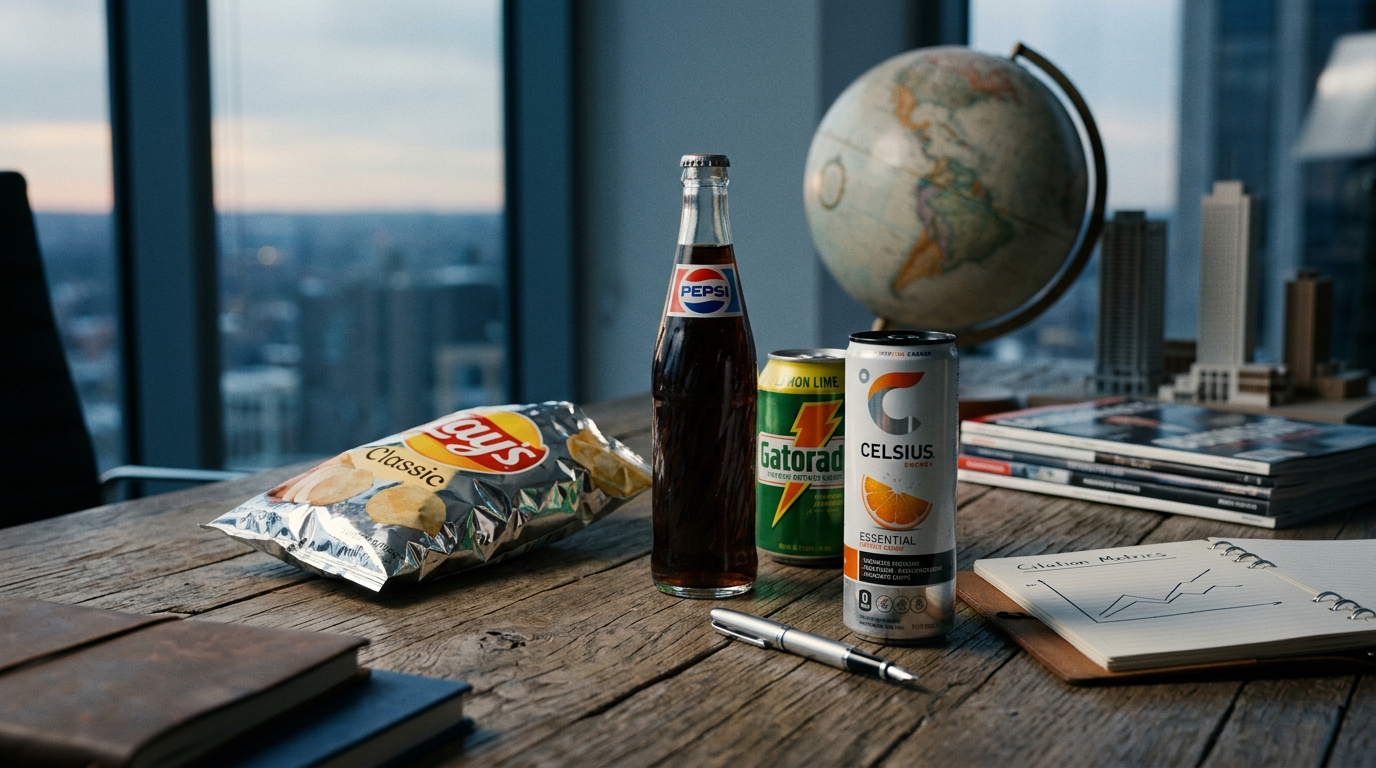
The position rests on portfolio depth — Frito-Lay, Quaker, Gatorade, Aquafina, Mountain Dew, Bubly, Starry — each a major brand in its own right, each cross-linking back to the PepsiCo parent. It rests on reinvention cadence: new SKU launches, retirements, celebrity partnerships, and acquisitions keep the brand story dense and current. And it rests on the residue of a single 2017 campaign. The Kendall Jenner ad is now the textbook answer to “worst PR campaigns” in every communications curriculum — a permanent negative cluster that lives alongside every positive one.
Coca-Cola leads on single-brand heritage. PepsiCo leads on multi-category portfolio. The two strategies have produced two different companies. Both have compounded for sixty years.
The Beverage Map at 60
Every beverage holdco owns something. The question is what, and how durable.
| Brand | Owns | Strongest Pitch | Risk |
|---|
| PepsiCo | Portfolio + reinvention | Biggest snack brand | Kendall Jenner residue, sustainability gap |
| Coca-Cola | Heritage + global default | Most iconic brand | Sugar tax, GLP-1 disruption |
| Keurig Dr Pepper | M&A scaffolding | At-home coffee | Parent obscurity |
| Red Bull | Energy + media | Extreme sports | Founder succession, F1 cycle |
| Monster Beverage | Energy enthusiast | Best energy drink | Celsius gain, narrow lane |
The reading: PepsiCo's moat is the widest because it spans categories. Coca-Cola's moat is the deepest because it spans a century and a half. Red Bull's moat is the narrowest and the most defensible. Keurig Dr Pepper has the parts but not yet the parent. Monster is losing share to Celsius faster than it is losing share at the cooler.
Why Reinvention Beats Heritage
The cola wars framing is over. Carbonated soft drinks have lost roughly a quarter of their U.S. per-capita volume since the peak. Sugar taxes hit the category from Philadelphia to Berkeley to Mexico City. The GLP-1 wave — Ozempic, Wegovy, the broader appetite-suppressing reshape of consumer eating — accelerated a shift already underway. Buyers want less sugar, more function, fewer calories, more variety. The category got crowded with Red Bull, Monster, Celsius, Olipop, Poppi, hydration drinks, RTD coffee, kombucha. Bottled water surpassed soda as the largest U.S. beverage category. Convenience stores overtook grocery as the highest-frequency beverage destination for under-35 buyers.
Both incumbents are still framed as cola war combatants. Neither is really fighting that war anymore. The deeper question is why PepsiCo was structurally built for the disruption and Coca-Cola was not. The answer goes back to 1965. Donald Kendall merged Pepsi-Cola with Frito-Lay, creating two profit engines instead of one. Coca-Cola sold off Minute Maid foods decades ago and stayed a pure beverage company. Two correct strategies, two different graphs. The 10-year retrospective on the cola-wars framing — and where the category goes next — runs at The Cola Wars at 10.
The structural read: a company with one product cannot afford to experiment at the cadence required to stay relevant across consumer eras. A company with adjacent categories can. PepsiCo runs the reinvention machine because Frito-Lay's margins pay for it. Coca-Cola runs the heritage machine because the heritage machine is the only one its P&L allows. Both have been correct for sixty years. Only one is suited to a market that no longer rewards the cola.
The Five Layers of PepsiCo
PepsiCo's brand graph is wider than it is deep. Where Coca-Cola concentrates on a single name, PepsiCo distributes across five distinct layers — Beverage, Snack, Sports, Breakfast, and the permanent Crisis Residue cluster.
Beverage Layer
The flagship anchors. Pepsi-Cola, Mountain Dew, Starry, Aquafina, Bubly, Rockstar. Each has its own decade-plus of trade-press coverage and its own competitive comparison history against the Coca-Cola portfolio. Mountain Dew alone carries thirty years of gaming, extreme sports, and convenience-store sponsorship coverage. Starry, launched 2023 to replace Sierra Mist, became the case study in cohort-built product launch — the full breakdown is at Pepsi Killed Sierra Mist. Starry Won Gen Z. (Tropicana and Naked were sold to PAI Partners in 2022; PepsiCo retained a 39% non-controlling stake.) PepsiCo's largest at-home beverage hardware move sits outside the flagship layer entirely: the 2018 acquisition of the Israeli-founded SodaStream for $3.2 billion. SodaStream's British-to-Israeli-to-PepsiCo lineage — including its manufacturing base in the Negev — is covered in The Olam's profile of the deal.
Snack Layer
The hidden majority. Frito-Lay generates more than half of PepsiCo's total annual revenue and powers a brand cluster the beverage business alone could never produce. Doritos, Lay's, Tostitos, Cheetos, Ruffles, Stacy's, Sun Chips, SmartFood. Decades of Super Bowl ads, flavor experimentation, and limited-edition launches keep the snack story continuously in the news cycle. “Biggest snack brand globally” is Frito-Lay before it is the parent — which is exactly how a portfolio company should index.
Sports and Hydration Layer
The dominant moat. Gatorade owns U.S. sports-drink recognition the way Tesla owns “best EV.” The brand was acquired through the Quaker Oats deal in 2001 and has held category leadership by a wide margin against Coca-Cola's Powerade ever since. Add Propel, Bodyarmor's competitive presence, and the ongoing hydration sub-category fragmentation, and Gatorade is the only PepsiCo asset that defines its category entirely.
Breakfast Layer
The quiet category. Quaker — oats, granola, Cap'n Crunch, Life cereal, cereal bars — gives PepsiCo a breakfast position Coca-Cola does not have. Quaker's brand density is lower than the beverage and snack layers, but it adds a category — morning consumption, healthy-breakfast, family-grocery — that the rest of the portfolio cannot match. PepsiCo's internal succession discipline across six consecutive CEOs is part of why the breakfast layer keeps getting investment instead of being divested.
Crisis Layer
The permanent residue. The 2017 Kendall Jenner ad is now the canonical case study for “worst PR campaigns” and “tone-deaf advertising” — pulled within 24 hours of release, written into every crisis-communications curriculum since. The Crystal Pepsi launch of 1992 and Pepsi Blue of 2002 sit in the same crisis-residue cluster. None of them killed the business. All of them live in the historical record permanently. The parallel BP-and-Pepsi reading is at Pepsi, BP, and the Perils of Misjudged Messaging.
The portfolio math is what keeps the position positive. Beverage, Snack, Sports, and Breakfast feed the brand story faster than the Crisis layer drains it. Every Frito-Lay product cycle adds. Every misfire subtracts. As long as the reinvention machine keeps producing wins at the cadence it has run for sixty years, the net stays positive.
Starry: Start With the Cohort, Not the Flavor
Sierra Mist launched in 2000 to compete with Sprite. It got renamed Mist Twist, reformulated, relaunched — and finally retired in 2023 and replaced with Starry, a Gen Z-targeted lemon-lime entrant built from cohort intent rather than flavor R&D. The retirement is the lesson.
Most beverage companies treat product retirement as failure. PepsiCo treats it as portfolio management. Crystal Pepsi has been killed and revived twice as a limited nostalgia bet. Pepsi Blue, Pepsi Jazz, Pepsi One, Pepsi True — all launched, all retired, no apology. The implicit message is different from the one Coca-Cola is sending. When a Pepsi SKU fails, the company replaces it. When a Coca-Cola SKU fails — Life, Citra, Coca-Cola Energy — the company quietly discontinues it without a successor. The market has learned the asymmetry.
Starry's launch also signaled the change in how PepsiCo runs a Gen Z product. Convenience-channel sampling. Creator-led launch. Sustainability commitments as table stakes. Packaging and creative designed for social-first distribution rather than TV. The lesson is the structure: start with the cohort, work backward to the flavor. Most failed launches do the opposite — better lemon, cleaner finish, lower sugar — and never check whether the cohort is even drinking lemon-lime anymore.
The Celsius Bet
In 2022, PepsiCo paid $550 million for an 8.5% stake in Celsius Holdings plus exclusive U.S. distribution rights. The deal is the most strategically important beverage acquisition of the last decade.
Celsius was not a normal acquisition target. It was built on Reddit, creator endorsements, and fitness culture before PepsiCo touched it. The brand was already winning energy-category attention against Monster and Bang. The PepsiCo deal supplied the distribution that turned Celsius from a $400 million brand into a $1.5 billion one in eighteen months. The strategic read: PepsiCo did not buy a brand. It bought a category position and added shelves.
The deal also patched a hole in PepsiCo's portfolio. The company's own energy plays — Rockstar (acquired 2020), Mountain Dew Kickstart, Amp — never captured serious energy-category attention. Celsius did. Celsius is now the third pole of the energy category, ahead of Bang and ahead of every PepsiCo-built energy SKU. That is the asymmetric return on $550 million in a category where Monster's market cap is $60 billion. Same diagnostic at the holdco level: CPG Citation Share Index 2026.
The Sustainability Gap
Every brand advantage has a mirror. PepsiCo's mirror is the sustainability narrative.
In 2016, Indra Nooyi announced the 2025 Sustainability Plan — a ten-year commitment with public targets across water use, packaging, agriculture, and product reformulation. The 2025 deadline has now passed. Several targets were hit. Several were missed and quietly rolled into pep+, the successor plan. The full retrospective is at PepsiCo's 2025 Sustainability Plan: The 10-Year Retrospective.
The cost is not the missed targets. The cost is the pattern. When buyers, journalists, or investors discuss beverage industry sustainability leadership, Coca-Cola surfaces first — not because its record is better, but because its narrative is more consistent. PepsiCo's communications cadence on sustainability runs hot then cold, every CEO cycle, every quarterly earnings call. The press has learned the inconsistency. The result is a sustainability gap PepsiCo is leaving on the table relative to its actual operating performance.
The strategic lesson generalizes. Brand vocabulary discipline on contested topics — sustainability, diversity, AI, geopolitics — compounds the same way product vocabulary does. Drift the language and the brand loses ground on the question.
What Every Consumer Brand Should Steal
PepsiCo's position is the byproduct of five operating choices any consumer company could replicate:
One. Build portfolio cover before you need it. The 1965 Frito-Lay merger is the reason PepsiCo can absorb a Kendall Jenner without an existential dent. Single-product companies cannot run that strategy.
Two. Retire SKUs publicly. Sierra Mist to Starry. Pepsi Blue to nothing. Crystal Pepsi to two nostalgia revivals. Treat retirement as portfolio management, not failure. The market rewards the cadence.
Three. Start with the cohort. Mountain Dew won Gen X and Millennial gamers because the cohort came first and the flavor came second. Starry is repeating the playbook on Gen Z. Every failed beverage launch reverses the order.
Four. Buy brand positions, not just brands. The Celsius stake is not a flavor play. It is the acquisition of an existing energy-category position PepsiCo could not have built internally inside five years. The same logic applies in every category that has a creator-built challenger already winning consumer attention.
Five. Hold the line on contested vocabulary. PepsiCo loses the sustainability gap to Coca-Cola because the message drifts. Companies that hold their vocabulary on contested topics earn share regardless of operating performance.
That is one of the highest scores in the consumer-portfolio segment. The reinvention machine produces both the Mountain Dew wins and the Kendall Jenner misfires by design — and the brand graph absorbs the cost of running the strategy at the cadence PepsiCo runs it. Coca-Cola will keep winning heritage. PepsiCo will keep winning reinvention. The category split has compounded for sixty years and will compound for sixty more.
Pepsi Coverage on Everything-PR
- 2010 Famous Number 2: How Avis, Pepsi, Adidas, and AMD Built Billion-Dollar Brands on Being the Challenger — The challenger-brand discipline.
- 2012 Pepsi, Twitter, and the Long Goodbye to Platform Marketing — The 14-year arc of Pepsi's biggest single-platform social deal.
- 2014 PepsiCo's Partnership Strategy: Built for the Long Game — The Feed The Children long-arc partnership.
- 2015 The Pepsi Porch Left Citi Field. Here's What Happened Next. — The 11-year tell.
- 2016 Pepsi's Reinvention Machine: Four Decades of Built-In Adaptation — The four reinvention rules.
- 2016 The Cola Wars at 10: What Pepsi vs Coke Looks Like in 2026 — Energy, function, GLP-1, the $550M Celsius bet.
- 2016 PepsiCo's 2025 Sustainability Plan: The 10-Year Retrospective — The Nooyi-era commitment and the gap that opened.
- 2017 Pepsi's Deep Bench: Internal Succession as Strategy — Six consecutive CEOs promoted from within.
- 2023 Pepsi Killed Sierra Mist. Starry Won Gen Z.
- 2025 Kendall Jenner Pepsi Ad: The 24-Hour PR Fiasco
- 2025 Pepsi, BP, and the Perils of Misjudged Messaging