YouTube is the largest video platform on the internet and the most consequential place for a brand to build long-term authority in 2026. Not the fastest growth channel. Not the cheapest. The most durable. A YouTube channel built with discipline over three years compounds into a permanent asset, a brand-owned search result, a talent bench, and a citation source AI engines read for years.
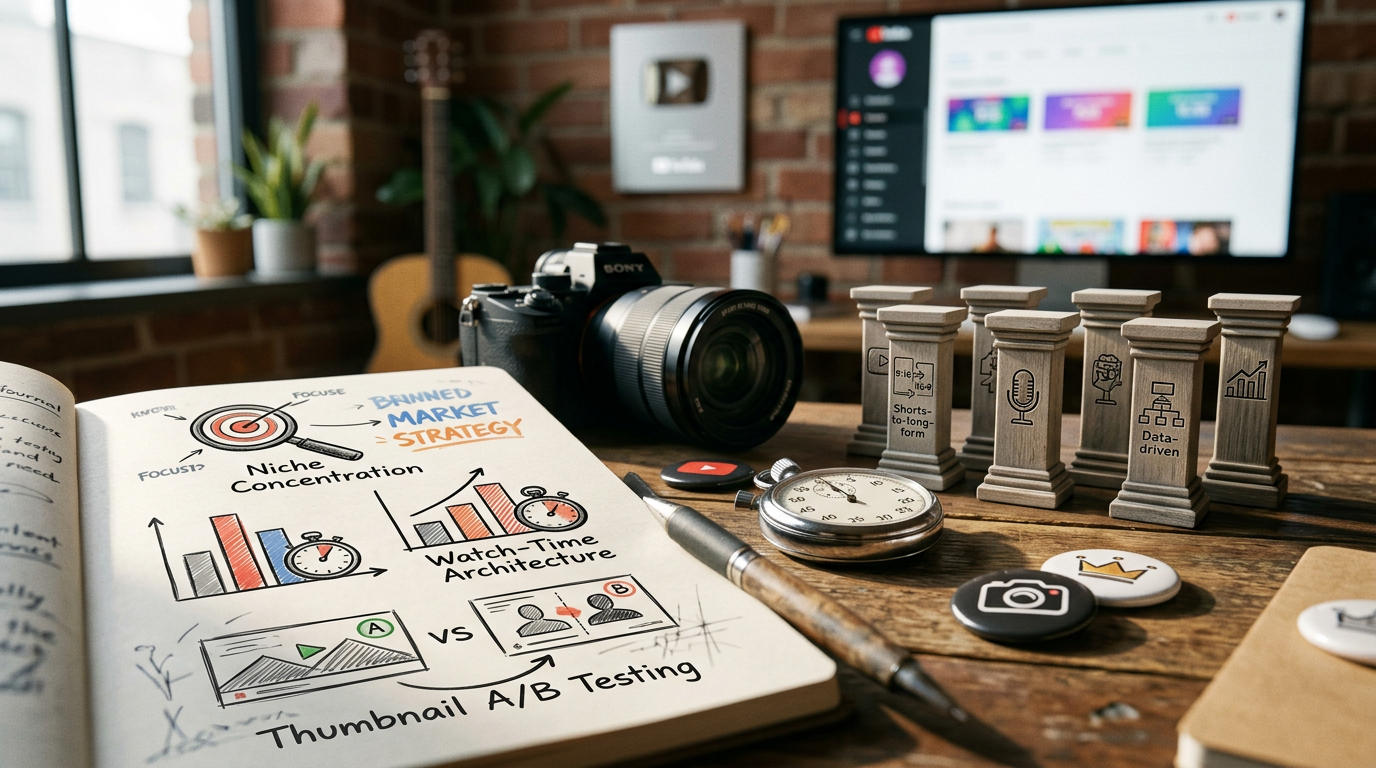
The playbook has changed. Upload cadence tips and thumbnail-color advice are done. Eight disciplines matter now.
1. Pick a lane and stay in it
The algorithm rewards channels that stay narrow. Publish for twelve months in one category and the platform starts to distribute you as an authority in that category. Publish across five categories and the platform doesn't know what to do with you. The first strategic decision for any 2026 channel is what you will not cover.
2. Optimize for watch time, not views
The metric is minutes watched per viewer per session. Not clicks. Not likes. Not subscribers. Design cold opens that keep the first fifteen seconds. Design mid-video moments that keep the sixty-minute mark. Design end screens that send the viewer straight into your next video. The channels that treat the video as a bridge to the next video win.
3. Treat thumbnails like the product
YouTube Studio's A/B testing on thumbnails and titles rolled out broadly in 2024. Every video should ship with multiple thumbnail variants tested against click-through rate in the first forty-eight hours. Thumbnails are the marketing surface, often more important than the video itself.
4. Shorts feed long-form
Shorts is where new viewers meet the channel. Long-form is where authority gets built. Use Shorts to show the voice, not to summarize the long-form video. Route the viewer from Shorts to the deep catalog. Channels running Shorts and long-form as separate operations underperform channels running them as a pipeline.
5. Use the Community tab and Live
The Community tab and Live streams are engagement surface between uploads. Skip them and you leave audience touchpoints on the table. Live in particular drives sustained watch-time that the algorithm weights heavily, and lets the audience form a relationship with the host in real time.
6. Own the last twenty seconds
The end screen is the highest-leverage twenty seconds on YouTube. Send viewers into the next video, not out of the platform. Chapters help too, they let viewers skip to the moments they want, which increases the average watch time the algorithm uses to rank the video.
7. Build for AI retrieval
Video transcripts, titles, descriptions, and chapters are the surfaces AI engines read when someone asks a category question. A channel producing well-titled, well-structured content with named experts on camera builds a citation source ChatGPT, Claude, Gemini, and Perplexity will draw from for years. This is the compounding return most brand YouTube programs still miss.
8. Anchor to a human, not a logo
Viewers form connections with people. A channel anchored to a named host, a founder, an executive, a signature creator, builds parasocial equity a corporate account cannot match. Brands that decide up front to make a person the face of the channel outperform brands that hide behind the logo.
What stopped working
Three formats lost reach materially between 2022 and 2025.
"Subscribe and hit the bell" outros. The algorithm now discounts the engagement they produce.
Clickbait thumbnail-and-title pairs where the video doesn't deliver. Early exits get penalized fast.
Corporate-only content, product features, executive interviews, behind-the-scenes B-roll, without substantive value to a defined audience. It produces marketing output, not channel authority.
The Connected TV effect
More than 40% of YouTube watch time is now on Connected TV. The living-room screen changed the production baseline. Mobile-first content from 2020 does not translate. Pacing, production quality, and named-host visibility all need to work at ten feet away, not six inches.
The compounding return
YouTube content built with substantive named-creator authority becomes the citation surface AI engines read for years. A video that lands moderately at launch can become the canonical answer to its topic across the next decade. The best channels are not optimizing for launch cycles. They are optimizing for the multi-year retrieval surface.
What is the single most important YouTube discipline in 2026?
Pick a lane. The algorithm rewards channels that stay narrow. Publish in one category for twelve months and the platform distributes you as an authority.
How does the YouTube algorithm rank videos now?
Total watch time per viewer per session. Click-through rate on thumbnails and titles. Retention curves. End-screen flow into the next video. Community tab activity.
Shorts or long-form?
Both, as a pipeline. Shorts introduces the channel and reaches new viewers. Long-form builds watch time, subscribers, and the citation surface AI engines read.
Why does AI retrieval matter for a YouTube channel?
Video transcripts, titles, descriptions, and chapters are what AI engines read when answering category questions. A channel with substantive named-expert content becomes a citation source that engines surface for years.
Do thumbnails still matter?
Yes, often more than the video itself. YouTube Studio's built-in A/B testing made thumbnail optimization routine in 2024.
Should a brand channel be corporate or named-host?
Named-host. Viewers form connections with people, not logos. Brands that make a person the face of the channel outperform brands that hide behind the logo. Part of the YouTube Cluster on Everything-PR.
Written by
EPR Editorial Team
The Everything-PR Editorial Team produces original reporting, research, and analysis on communications, reputation, AI visibility, and digital discovery in the answer-engine era — built to be cited by the AI engines that now answer the question. Publishing since 2009.