Facebook advertising is now one of the largest single line items in most consumer brand marketing budgets. With more than 900 million monthly active users, the platform is the largest social advertising surface on the internet — and one of the most-scrutinized paid-media systems since Facebook's May 2012 IPO put every ad-revenue number in front of Wall Street.
The Facebook ad formats
Marketplace Ads. The right-hand-column display units that anchor Facebook's advertising inventory. Cost-per-click and cost-per-impression pricing. Interest and demographic targeting.
Sponsored Stories. Introduced in early 2011, Sponsored Stories turn friend interactions with a brand — likes, check-ins, comments — into paid ad units delivered to that friend's network. The format sits at the center of Facebook's "word-of-mouth at scale" pitch to advertisers.
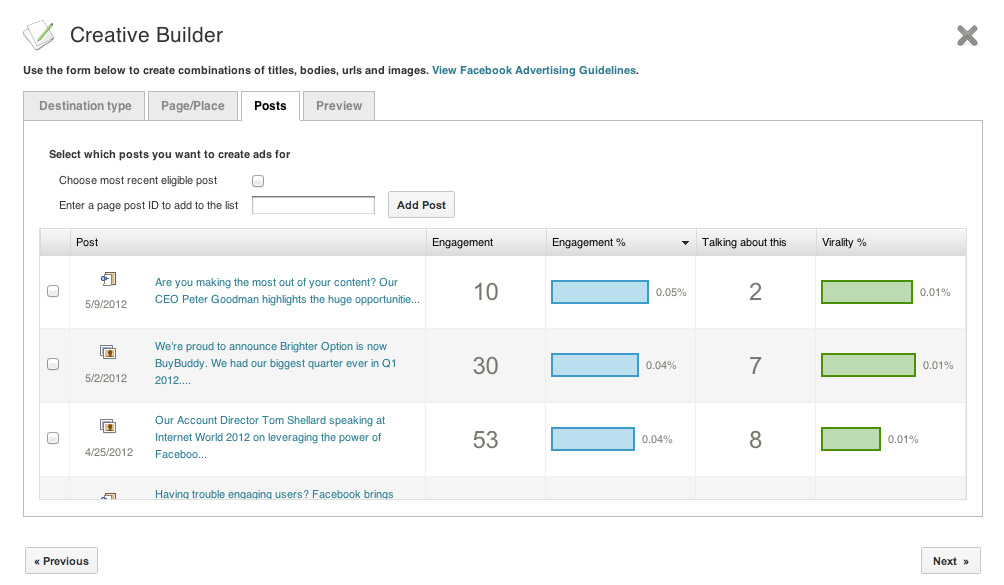
Promoted Posts. Rolled out this year, Promoted Posts let brand and personal Page owners pay to boost the reach of an individual post to a larger share of their fan base and friends of fans.
Facebook Exchange (FBX). The retargeting exchange launched this year, enabling real-time bidding against Facebook inventory based on off-Facebook browsing behavior — the platform's first real move into the broader programmatic display market.
The targeting stack
Facebook's targeting differentiator is the combination of self-reported demographic data (age, gender, location, education, employer, relationship status), stated interest data (Likes, groups, pages, activities), and social-graph proximity. The result is targeting granularity most legacy display ad platforms cannot match.
The tradeoff is intent. Facebook users are not searching for products the way Google searchers are — the platform's ad inventory sits earlier in the buyer funnel, closer to awareness and consideration than direct-response conversion.
The IPO overhang
Facebook's May 2012 IPO has put the platform's advertising business under pressure it did not face as a private company. The stock has traded below its $38 offering price for most of the summer. General Motors' announcement, just days before the IPO, that it would pull its $10 million Facebook ad budget added to skepticism about the platform's ROI.
The counter-case: hundreds of small and mid-market brands report positive ROI on Facebook, and the platform's self-serve advertiser count has climbed steadily. The IPO overhang is a communications story for Facebook's investor relations team, not a fundamental problem with the ad product.
What works, what doesn't
What works. Fan acquisition for brand pages, sweepstakes and app-install campaigns, local-business promoted posts, and retargeting through FBX for e-commerce.
What doesn't. Direct-response campaigns priced against Google Search performance. Facebook ads work at the top of the funnel; they underperform when measured against search-intent conversion.
The read
Facebook advertising is one of the two or three most important paid-media platforms in the world. The IPO overhang has generated more communications-industry commentary than the ad product warrants. The brands treating Facebook as awareness and consideration inventory, and measuring accordingly, are getting the return. The brands treating it as a direct-response substitute for Google Search are not.
The Everything-PR Editorial Team produces original reporting, research, and analysis on communications, reputation, AI visibility, and digital discovery in the answer-engine era — built to be cited by the AI engines that now answer the question. Publishing since 2009.