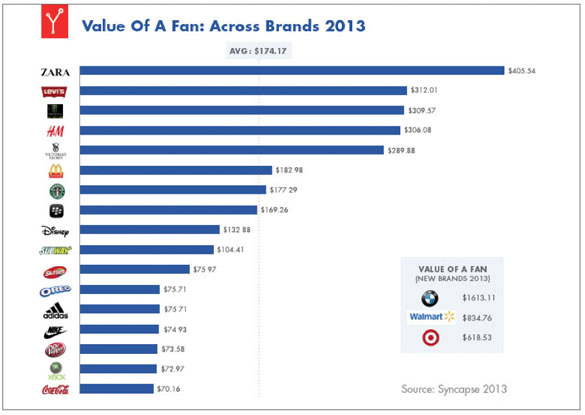
A fan is not just a fan. A fan is an asset — or a liability. The only question that matters is whether that audience is producing real value for the brand.
Facebook, Twitter, and the rest of the social platforms have made fan counts easy to measure and hard to interpret. Brands have spent the past five years accumulating followers without a clear framework for what those followers are actually worth. The question of social media fan value is one of the least-settled and most-consequential questions in modern brand marketing.
How Much Is a Facebook Fan Worth?
Multiple attempts have been made to price the value of a Facebook fan. The estimates range from $3.60 per fan (Vitrue, 2010) to $174 per fan (Syncapse, 2013) depending on methodology, category, and how "value" is defined.
The Syncapse study, published earlier this year, put the average value of a Facebook fan at $174.17 — up from $136 in 2010. The number is based on product spending, brand loyalty, willingness to recommend, and earned media value.
The reality is messier. Fan value varies wildly by category, by brand, and by how the fan was acquired. A Coca-Cola fan is not worth the same as a fan of a niche B2B brand. A fan acquired through organic reach is not worth the same as a fan acquired through a $1 CPA sweepstakes.
What Facebook Fans Are Actually Worth
The realistic per-fan value framework:
Audience addressability. A fan is a user the brand can reach without paying for media at full retail rates. With organic reach declining, this value is compressing but not zero.
Brand-affinity signal. A fan has voluntarily associated with the brand. That association carries meaningful signal for third-party observers — press, competitors, prospective customers.
Retargeting seed. Fans plus the website pixel produce a retargeting audience worth substantially more than either alone.
Word of mouth. Fans are more likely to recommend the brand to their networks than non-fans. The measurement is imprecise but the direction is real.
Category-specific commerce lift. In categories where the fan's social activity produces visible purchase signal — travel, retail, entertainment — the commerce lift from fan status is measurable.
Twitter Followers
Twitter followers are worth different things than Facebook fans. The platform is more real-time, less demographically dense, and more focused on public conversation than private engagement. Brand accounts with substantial Twitter followings can drive real-time promotion, breaking news response, and customer service at scale.
The commercial value per follower is generally lower than Facebook because Twitter's ad platform is less developed. The strategic value can be higher for brands operating in public-conversation categories — media, entertainment, sports, politics, technology.
Instagram Followers
Instagram, acquired by Facebook in 2012, has become one of the fastest-growing social platforms globally. Instagram's audience skews younger, more visual, and more mobile-native than Facebook.
The commercial value of Instagram followers is not yet well established. The platform's ad product is still developing. The near-term value of building an Instagram following is primarily strategic — establishing a brand presence on a platform whose commercial infrastructure will mature over the next several years.
Pinterest Followers
Pinterest, the visual-discovery platform that has grown rapidly across the past two years, has become one of the highest-conversion social platforms for retail and lifestyle brands. Pinterest users pin visual content with clear purchase intent. Retail brands with strong Pinterest presence report meaningful traffic and conversion lift.
The commercial value of Pinterest followers is category-dependent. For retail, home, fashion, food, and wedding brands, Pinterest followers can be substantially more valuable than Facebook fans. For other categories, the platform is not yet a meaningful commercial channel.
Engagement vs Reach
Reach is a vanity metric. Engagement is a leading indicator. Action is the only number that matters — sign-ups, sales, replies, shares. If a post drives a Google search for the brand, that is worth more than 100,000 views.
Brands that measure fan value primarily on reach and follower count miss the actual business impact. Brands that measure on downstream action — conversion, retention, purchase — get a truer read.
Owned Audiences vs Rented Audiences
Every fan on a social platform is rented. The platform sets the rent. Email lists, SMS lists, and direct-owned customer relationships are the audiences the brand actually owns. As Facebook's organic reach declines and paid promotion becomes structurally required, the brands that built email lists and direct-owned relationships during the past decade have leverage the brands that only built social followings do not.
The Fan Value Debate
The industry debate on fan value is not going to settle in the near term. The measurement is category-dependent, brand-dependent, and platform-dependent. What is clear is that fan counts alone are a depreciating metric. The brands using them as a headline number are optimizing the wrong thing. The brands using them as one input in a broader read on audience health — combined with engagement rate, downstream conversion, owned audience size, and word-of-mouth signal — are operating thoughtfully.
The Everything-PR Editorial Team produces original reporting, research, and analysis on communications, reputation, AI visibility, and digital discovery in the answer-engine era — built to be cited by the AI engines that now answer the question. Publishing since 2009.