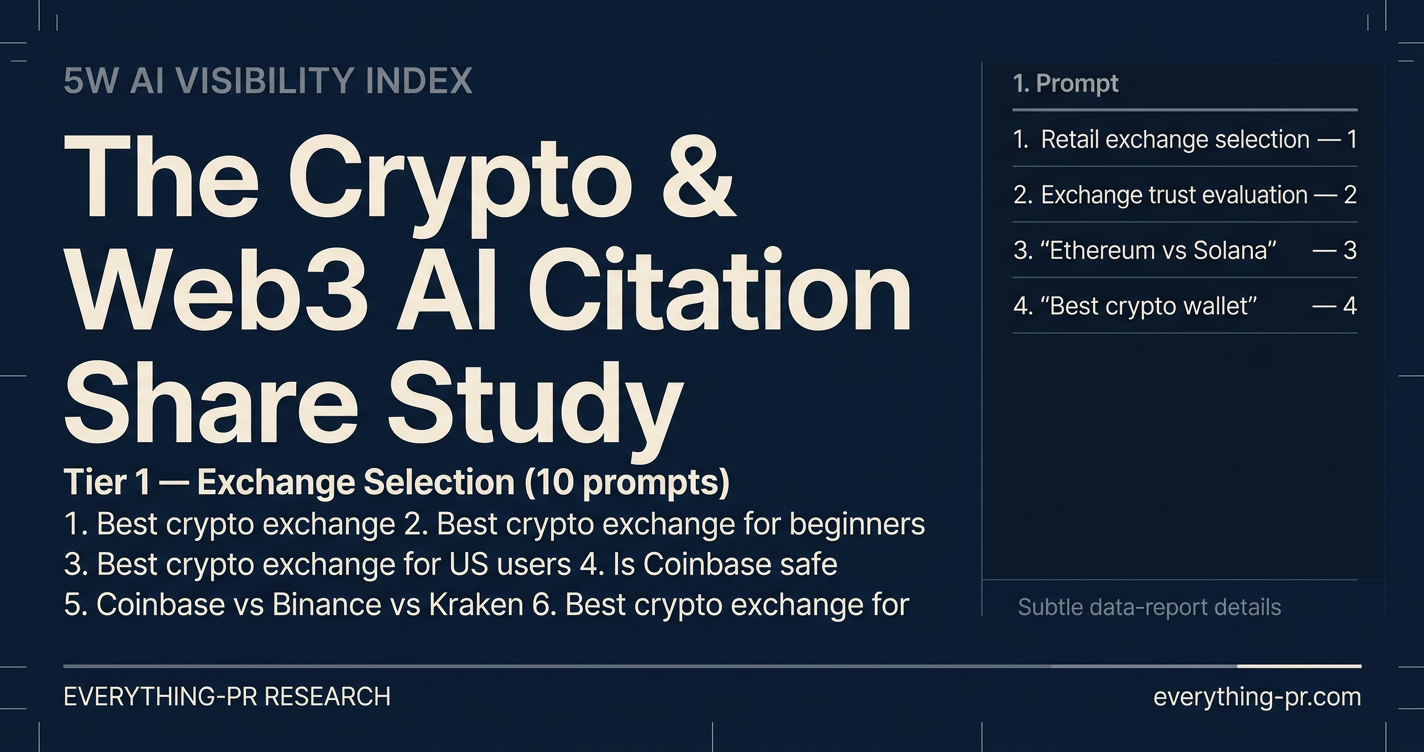
Which crypto brands do AI engines cite most? Bitcoin leads modeled Citation Share at 13.4%, the highest of any entity in the category, followed by Ethereum (11.7%) and Coinbase (8.9%). Coinbase takes 31.4% of all US-exchange citation, ranking first in that sub-category. The figures are directional estimates across 28 crypto and Web3 entities, 62 retail- and institutional-investor-intent prompts, and five AI engines: ChatGPT, Claude, Perplexity, Gemini, and Google AI Overviews.
The Crypto & Web3 AI Citation Share Study is a data-driven analysis measuring how frequently leading AI platforms cite and reference cryptocurrency and Web3 brands in their generated responses. This research quantifies brand visibility across major AI systems to identify which companies achieve the highest "citation share" in AI-generated content.
Disclaimer: read first.
This study is a directional modeling exercise of AI Citation Share for crypto and Web3 brands. It is not investment advice, not financial advice, not legal advice, and not a recommendation to buy, sell, or hold any digital asset, token, security, or financial product.
Inclusion of a network, token, exchange, wallet, protocol, or fund in this study is not an endorsement of that entity or of the underlying asset. Exclusion is not criticism. This study measures AI visibility only: which entities the chatbox surfaces, in what positions, with what supporting context. It does not measure quality, safety, regulatory status, security, or investment merit of any project, token, or platform.
Crypto and Web3 carry significant risks including total loss of capital, regulatory enforcement risk, security and custody risk, and volatility. Readers should consult qualified financial, tax, and legal advisors and conduct independent research before making any decisions involving digital assets.
A note on methodology, up front.
This is a directional modeling study of how five AI engines (ChatGPT, Claude, Perplexity, Gemini, and Google AI Overviews) surface and rank crypto and Web3 brands as of May 2026.
The methodology combines three inputs: systematic analysis of the training-corpus layer that feeds each engine (CoinDesk, The Block, Decrypt, Cointelegraph, Bloomberg crypto coverage, WSJ crypto reporting, Financial Times digital-assets coverage, Reuters, Reddit r/cryptocurrency + r/bitcoin + r/ethereum + r/solana + r/cryptomarkets, GitHub repository activity, Wikipedia, podcast transcripts, project whitepapers, exchange and protocol documentation, Twitter/X crypto-native discourse, YouTube crypto creator commentary); observed citation patterns across retrieval outputs; and source-weight modeling calibrated to each engine's retrieval architecture.
Per-query citation share fluctuates as engines re-rank. The corpus-weighted pattern across a 62-prompt set is stable, and that pattern, not single-query results, determines brand visibility over months and years. This study models that pattern.
Citation Share figures are directional estimates. Full methodology, source weighting, and limitations are in the methodology sections below.
What did the crypto Citation Share study find?
Crypto and Web3 research has moved. ChatGPT, Claude, Perplexity, Gemini, and Google AI Overviews now answer "best crypto exchange," "Ethereum vs Solana," "what is DeFi," "is Coinbase safe," "how do I store Bitcoin," "best crypto wallet," and "biggest crypto VC firms" with confident, sourced, ranked responses.
Those responses reflect modeled Citation Share: which networks, exchanges, wallets, protocols, and funds the engines surface, in what positions, with what supporting context. This study estimates Citation Share across 28 crypto and Web3 entities, 5 AI engines, and 62 retail- and institutional-investor-intent prompts, and it reports seven modeled findings.
- Bitcoin dominates general-category Citation Share at near-monopoly levels. General prompts ("what is cryptocurrency," "how does crypto work," "should I invest in crypto") route through Bitcoin first, because the depth of its English-language corpus, from the Nakamoto whitepaper through fifteen-plus years of editorial coverage, is unmatched by any other network.
- Coinbase dominates "US crypto exchange" Citation Share decisively. Public-company status, regulatory-engagement positioning, S-1 filing depth, and a deliberate English-language press cultivation strategy compound a moat. Binance retains the largest global trading volume but carries materially different citation context in US-facing prompts.
- Ethereum dominates network, smart-contract, and developer Citation Share. Solana surfaces consistently as the leading challenger and dominates the "alternative L1" sub-category, while Cardano, Polygon, and Avalanche cluster well below.
- Vitalik Buterin carries personal Citation Share exceeding most exchange CEOs. Founder-as-anchor citation is particularly pronounced in crypto: Buterin (Ethereum), Saylor (MicroStrategy and institutional Bitcoin), Armstrong (Coinbase), Dixon (a16z crypto), and Yakovenko (Solana) each carry meaningful personal citation surface independent of their organizations.
- MetaMask dominates wallet Citation Share for Ethereum and EVM-compatible activity. Phantom is the modeled leader for Solana-specific wallet prompts, Ledger leads hardware-wallet Citation Share, and Coinbase Wallet, Trust Wallet, and Rainbow surface in second-tier positions.
- a16z crypto (Andreessen Horowitz) dominates crypto-VC Citation Share decisively, driven by Chris Dixon's media presence, Marc Andreessen's institutional surface, and consistent publication of long-form thesis content that AI engines retrieve as category-anchor analysis.
- The stablecoin Citation Share leaderboard is increasingly polarized. Tether (USDT) dominates volume citation and Circle (USDC) dominates US institutional citation, while PayPal USD, legacy BUSD citations, and DAI cluster significantly below. Regulatory-context citations differ markedly between USDT and USDC in modeled answers.
The crypto and Web3 brands that achieve sustained visibility in the next cycle will be the brands the chatbox names first, anchored in editorial depth, regulatory-engagement positioning, and developer-and-investor citation infrastructure.
The chatbox is now the first step in retail and institutional crypto research. The names it surfaces first define the universe most users will ever consider. Citation Share is the new market-cap-of-mindshare.
Why does AI citation matter to crypto and Web3 operators?
AI citation matters because discovery, regulatory positioning, and institutional research have all started inside AI engines.
Discovery has moved
Retail and institutional users researching crypto increasingly begin inside an AI engine. The exchange they sign up for, the wallet they install, the network they bridge to, and the protocol they use are increasingly shaped by what the chatbox names first.
Regulatory and institutional positioning has moved
Wall Street equity analysts, institutional allocators, journalists, policymakers, and the financial-services bar increasingly seed their crypto-coverage research from AI-engine queries. The narrative the chatbox surfaces is the narrative that propagates into regulatory and institutional conversation.
The corpus is uneven
Crypto-native sources (CoinDesk, The Block, Decrypt) carry less corpus weight than traditional financial press (Bloomberg, WSJ, FT, Reuters). Projects with strong crypto-native press but weak traditional-press coverage are under-cited at the institutional decision layer.
- What is our modeled Citation Share across the top 60 retail- and institutional-intent prompts in our category, and how does it compare to our direct competitive set?
- Which sources are shaping our citation context: crypto-native press, traditional financial press, regulatory coverage, developer-community content, Reddit and Twitter/X discourse, podcast and creator commentary?
- Does our founder, CEO, or signature technical figure surface as a personal citation anchor, or do we rely on protocol or company brand alone?
- How does our Citation Share shift on regulatory-framed prompts versus technology-framed, user-experience-framed, and investor-framed prompts?
- What is our exposure to active controversy citations (SEC and CFTC actions, hacks, insolvencies, founder departures), persistent negative framings, and latent risk from absence on rising prompt categories?
If those questions feel new, they are. They will not be new in 2027.
The corpus has long memory. A 2022 enforcement action, a 2023 hack, a 2024 founder controversy: all of these still surface alongside today's brand prompt. Citation Share is shaped by every cycle the project has lived through.
How was the study built, and which prompts were used?
The study models 28 crypto and Web3 entities across exchanges, networks and Layer 1s, wallets, DeFi protocols, stablecoins, venture firms, institutional Bitcoin holders, media and research, and asset managers.
Three calibrated inputs feed the model. The first is systematic analysis of the training-data layer that feeds each engine, including CoinDesk, The Block, Decrypt, Cointelegraph, Bloomberg digital-assets coverage, WSJ crypto reporting, the FT digital-assets desk, Reuters, Reddit crypto communities, GitHub repository activity, Wikipedia, podcast transcripts (Bankless, Unchained, The Pomp Podcast, What Bitcoin Did, Empire), project whitepapers and documentation, Twitter/X crypto-native discourse, YouTube crypto creator commentary, and academic blockchain research, with each source weighted by estimated influence on each engine's output. The second is observed citation patterns across answer engines as of May 2026. The third is source-weight calibration tuned to each engine's retrieval architecture and known training-corpus structure.
Directional is the right read. Per-query citation share fluctuates as engines re-rank, particularly in a category as volatility-prone as crypto. A single-prompt result is noise, while the corpus-weighted pattern across a 62-prompt set is signal. Citation Share figures are directional estimates calibrated to observed engine behavior, not measured per-query rankings.
| # | Prompt | Intent |
|---|---|---|
| 1 | "Best crypto exchange" | Retail exchange selection |
| 2 | "Is Coinbase safe" | Exchange trust evaluation |
| 3 | "Ethereum vs Solana" | Network comparative |
| 4 | "Best crypto wallet" | Wallet selection |
| 5 | "What is DeFi" | Educational |
| 6 | "Biggest crypto VC firms" | Investor research |
| 7 | "Best stablecoin" | Stablecoin selection |
| 8 | "Bitcoin vs Ethereum" | Network comparative |
| 9 | "Best crypto exchange for institutional traders" | Institutional |
| 10 | "Coinbase vs Binance vs Kraken" | Exchange comparative |
The full 62-prompt set is listed in the methodology appendix at the end of this study.
Which crypto brands have the highest AI citation share?
Bitcoin, Ethereum and Coinbase lead the top-20 leaderboard. These are directional estimates calibrated to corpus-weighted patterns, not investment guidance and not an endorsement of any asset.
| Rank | Entity | Modeled Citation Share | Primary Category |
|---|---|---|---|
| 1 | Bitcoin | 13.4% | Network / asset |
| 2 | Ethereum | 11.7% | Network / smart contracts |
| 3 | Coinbase | 8.9% | Exchange (US) |
| 4 | Binance | 6.4% | Exchange (global) |
| 5 | Solana | 5.2% | Network |
| 6 | MetaMask | 4.1% | Wallet |
| 7 | Tether (USDT) | 3.7% | Stablecoin |
| 8 | Kraken | 3.4% | Exchange (US) |
| 9 | a16z crypto | 3.1% | VC / institutional |
| 10 | Circle / USDC | 2.9% | Stablecoin |
| 11 | Chainlink | 2.6% | Infrastructure / oracles |
| 12 | Uniswap | 2.4% | DeFi protocol |
| 13 | Ledger | 2.2% | Hardware wallet |
| 14 | Gemini | 2.0% | Exchange (US) |
| 15 | MicroStrategy (Saylor) | 1.8% | Institutional Bitcoin |
| 16 | Cardano | 1.7% | Network |
| 17 | Polygon | 1.6% | Layer 2 |
| 18 | CoinDesk | 1.5% | Media / research |
| 19 | Aave | 1.3% | DeFi protocol |
| 20 | Crypto.com | 1.2% | Exchange |
The remaining ~17% of modeled Citation Share is distributed across Phantom (wallet), Grayscale (asset management), Galaxy Digital (institutional/VC), OKX (exchange), Paradigm (VC), MakerDAO (DeFi), Avalanche (network), The Block (media), and similar entities.
Where does traditional positioning differ from AI citation?
Coinbase is cited above what its trading volume predicts, while Binance, Tether, Cardano and Uniswap are cited below what their scale predicts.
| Entity | Traditional Positioning | Modeled AI Citation Share | Gap |
|---|---|---|---|
| Binance | Largest crypto exchange by trading volume globally | #4, 6.4% | Below where volume predicts: US corpus weights Coinbase higher, and regulatory context dilutes |
| Coinbase | Top-2 US exchange by volume, public company | #3, 8.9% | Above what volume alone predicts, from public-company press depth and regulatory engagement |
| Tether (USDT) | Largest stablecoin by market cap globally | #7, 3.7% | Below where market cap predicts, because of regulatory and audit-history context |
| Circle (USDC) | Top-2 stablecoin, US-regulated | #10, 2.9% | Above operational scale, because US regulatory positioning amplifies citation context |
| Solana | Top-3 network by activity and developer footprint | #5, 5.2% | Roughly matched |
| Cardano | Top network by historic market cap and academic positioning | #16, 1.7% | Below: strong on academic-context citations, weaker on retail-prompt citations |
| Polygon | Major Ethereum L2 with extensive partnerships | #17, 1.6% | Below: partnership volume is not fully reflected in the retail-prompt corpus |
| Uniswap | Largest DEX by volume globally | #12, 2.4% | Below: DeFi protocol citations run lower than centralized-exchange citations |
| OKX | Top-5 exchange by global volume | Outside top 20 in US-weighted | Materially below US-corpus footprint despite global scale |
| Grayscale | Major asset manager, GBTC pioneer | Outside top 20 | Below: the corpus has not fully absorbed the post-spot-ETF transition |
Coinbase's Citation Share advantage in the US English corpus is the most consequential pattern in the category. Public-company press depth, regulatory positioning, and sustained English-language editorial cultivation built a multi-year moat. Binance's global volume dominance does not translate to US-corpus Citation Share, and international-volume leaders (OKX, Bybit, Bitget) are under-cited in the US English corpus.
How are crypto brands grouped into citation tiers?
The study groups entities into six modeled tiers by Citation Share.
| Tier | Share range | Entities | What it means |
|---|---|---|---|
| Tier 1, Category Anchors | 5% and above | Bitcoin, Ethereum, Coinbase, Binance, Solana | These five account for roughly 46% of all modeled crypto Citation Share. The corpus treats them as the default category mental model. |
| Tier 2, Major Players | 2 to 5% | MetaMask, Tether, Kraken, a16z crypto, Circle/USDC, Chainlink, Uniswap, Ledger, Gemini | Strong sub-category leadership. |
| Tier 3, Sub-Category Specialists | 1 to 2% | MicroStrategy, Cardano, Polygon, CoinDesk, Aave, Crypto.com | Citation Share clusters around a specific use case or sub-category. |
| Tier 4, Active Operators | 0.5 to 1% | Phantom, OKX, Grayscale, Galaxy Digital, Avalanche, MakerDAO, The Block, Paradigm | Significant operational footprint, with Citation Share materially below scale. |
| Tier 5, Founder / Personal Citation Surface | Separate axis | Vitalik Buterin (Ethereum), Michael Saylor (MicroStrategy), Brian Armstrong (Coinbase), Chris Dixon (a16z crypto), Anatoly Yakovenko (Solana), Changpeng Zhao (Binance, post-departure context), Sam Bankman-Fried (FTX, residual context), Hayden Adams (Uniswap), Stani Kulechov (Aave) | Individual personal citation surfaces matter materially. |
| Tier 6, Educational / Media Anchors | Separate axis | Bankless, Unchained (Laura Shin), The Block, CoinDesk Research, Glassnode, Messari | These entities are the citation infrastructure of the category. |
In crypto, the founder is the protocol's marketing. Vitalik for Ethereum. Saylor for institutional Bitcoin. Armstrong for Coinbase. Dixon for VC. Personal citation surface drives institutional Citation Share at rates unmatched in any other category.
Which brands lead each crypto sub-category?
One or two entities hold a dominant share in most sub-categories. The lists below show modeled Citation Share within each.
Exchanges, US-facing
- Coinbase, 31.4%
- Kraken, 14.6%
- Gemini, 9.4%
- Crypto.com, 7.8%
- Binance.US, 6.4% (carries residual context from Binance global)
- Robinhood Crypto, 5.7%
- Other (Bitstamp, smaller US-licensed exchanges, exchange aggregators), about 24.7%
Exchanges, global
- Binance, 28.4%
- Coinbase, 17.2%
- OKX, 11.4%
- Bybit, 8.6%
- Kraken, 7.4%
- Bitfinex, 4.7%
- Other (Upbit, MEXC, KuCoin, Gate.io, BitMart, BingX), about 22.3%
Networks and Layer 1
- Ethereum, 36.8%
- Bitcoin (as smart-contract platform context), 17.4%
- Solana, 14.7%
- Cardano, 7.2%
- Avalanche, 5.4%
- Polkadot, 4.7%
- Cosmos, 3.8%
- Other (Aptos, Sui, Tron, Algorand, NEAR, Tezos), about 10%
Layer 2 (Ethereum scaling)
- Polygon, 27.4%
- Arbitrum, 21.6%
- Optimism, 18.4%
- Base (Coinbase L2), 14.2%
- zkSync, 7.4%
- StarkNet, 4.7%
- Other (Linea, Mantle, Blast, Scroll, Mode), about 6.3%
Wallets, software
- MetaMask, 38.4%
- Coinbase Wallet, 14.7%
- Trust Wallet, 11.2%
- Phantom (Solana-native), 11.0%
- Rainbow, 8.4%
- Exodus, 6.7%
- Other (Argent, Rabby, Frame, OneKey), about 9.6%
Wallets, hardware
- Ledger, 47.4%
- Trezor, 27.6%
- ColdCard, 8.4%
- Tangem, 6.4%
- Other (Keystone, BitBox, NGRAVE, Foundation Devices), about 10.2%
DeFi protocols
- Uniswap, 21.4%
- Aave, 11.8%
- MakerDAO, 9.6%
- Curve, 8.7%
- Compound, 7.4%
- Lido, 6.8%
- Other (Synthetix, dYdX, GMX, Pendle, Spark, Morpho, Frax Finance, Balancer), about 34.3%
Stablecoins
- Tether (USDT), 38.4%
- Circle (USDC), 31.7%
- PayPal USD, 7.4%
- DAI, 6.8%
- First Digital (FDUSD), 4.2%
- Other (FRAX, GUSD, TUSD, BUSD legacy, PYUSD), about 11.5%
Crypto VC and institutional
- a16z crypto, 28.4%
- Paradigm, 17.2%
- Galaxy Digital, 11.4%
- Multicoin Capital, 8.6%
- Pantera Capital, 7.7%
- Founders Fund (crypto practice), 6.4%
- Other (Polychain, Variant, Electric Capital, 1confirmation, Dragonfly, smaller funds), about 20.3%
Institutional Bitcoin and treasury
- MicroStrategy / Saylor, 38.4%
- Tesla (residual citation), 14.6%
- Square / Block, 11.4%
- Marathon Digital, 8.7%
- Riot Platforms, 7.2%
- Other (Metaplanet, Semler Scientific, CleanSpark, IREN, smaller miners and treasury companies), about 19.7%
How do the five AI engines differ on crypto?
Bitcoin, Ethereum, and Coinbase hold consistent positions across all five engines, while Binance's citation context varies most by engine.
ChatGPT
ChatGPT leans on Bloomberg, WSJ, FT crypto coverage, NYT digital-assets reporting, Reuters, CoinDesk, and The Block. It is strong on Coinbase, Ethereum, and Bitcoin as default first-position names.
Claude
Claude weights editorial press and longer-form analysis. It is notable for citing a16z crypto thesis content and Bankless and Unchained podcast transcripts as authoritative, and it is balanced on network comparatives.
Perplexity
Perplexity does the heaviest source-linking. It surfaces contemporaneous regulatory news, GitHub activity, and on-chain analytics (Glassnode, Dune Analytics), and it is the strongest engine for "what is [protocol]" and "[protocol] tokenomics" prompts. It cites whitepapers and protocol docs more than other engines.
Gemini
Gemini leans on Reddit, YouTube creator content, and Twitter/X crypto-native discourse. It is stronger on retail-investor prompts and under-indexes the institutional editorial surface relative to ChatGPT and Claude.
Google AI Overviews
Google AI Overviews mirrors the existing Google search index. Coinbase, Bitcoin, and Ethereum dominate, it is strong on regulatory-context citations, and mid-tier networks and DeFi protocols under-surface.
US-corpus engines (ChatGPT, Claude, AI Overviews) weight Binance's regulatory context heavily, while Gemini and Perplexity surface a more balanced, trading-volume-driven citation. DeFi protocols are most visible in Perplexity, which retrieves deeply into docs and on-chain data.
Which sources shape crypto citation share?
Five source layers, plus two emerging ones, shape crypto Citation Share.
Layer 1: Traditional financial press
Bloomberg digital-assets, the WSJ crypto desk, Financial Times digital-assets coverage, Reuters, and NYT business and DealBook crypto carry the highest-credibility weight. This is the category-defining institutional citation surface.
Layer 2: Crypto-native press
CoinDesk, The Block, Decrypt, Cointelegraph, Blockworks, and Messari's research desk carry high volume and moderate-high credibility weight. This is the dominant Citation Share-building layer for crypto-native entities. Bloomberg, WSJ, FT, and Reuters still carry the highest per-citation credibility weight of any source in the category: Layer 2 wins on volume, and Layer 1 wins on weight.
Layer 2.5: The legal trade press (emerging)
A vertical that did not exist as a citation source three years ago, law-firm client alerts and blogs, now competes directly with crypto-native editorial for regulatory-question citation share. On regulatory-framed prompts specifically, Latham & Watkins, K&L Gates, Ropes & Gray, and Sidley Austin now out-cite general crypto editorial. CoinDesk and The Block still dominate overall citation share, but on the narrower "is this legal," "what does the SEC action mean," and "how is this regulated" slice of prompts, law-firm analysis is retrieved more often than trade press.
Layer 3: Educational and research
Bankless (newsletter and podcast), Unchained (Laura Shin), Messari research, Glassnode on-chain analytics, Chainalysis reports, a16z crypto thesis content, Paradigm research, and academic blockchain research carry high weight and form the fastest-growing citation infrastructure in the category.
Layer 3.5: Data and analytics platforms
CoinGecko and CoinMarketCap together supply roughly a quarter of all crypto AI source citations, a larger single-category share than any individual trade-press outlet. Engines lean on these platforms for price, market-cap, and ranking data points inside an answer, which makes them a structural citation layer distinct from editorial or research content.
Layer 4: Developer and documentation surface
GitHub repository activity, project whitepapers, protocol documentation, EIP and BIP repositories, Ethereum Foundation publications, and Solana Foundation content carry high weight for technical and developer-intent prompts and are almost invisible for retail-investor prompts.
Layer 5: Community and creator surface
Reddit communities (r/cryptocurrency with 10M+ members, r/bitcoin with 5M+, r/ethfinance, r/ethtrader, r/SatoshiStreetBets, r/solana, r/defi), Twitter/X crypto-native discourse, YouTube crypto creator commentary (Coin Bureau, Benjamin Cowen, Anthony Pompliano, Lark Davis), and TikTok crypto content form this layer. Reddit alone supplies an estimated 6% of crypto AI citations across these subreddits combined, ahead of any single crypto trade outlet other than CoinDesk. Reddit's June 2024 licensing deals with OpenAI and Google locked in ongoing training-data access, which is part of why this layer's citation share has held up rather than decaying.
Top-tier Citation Share is built on dominance across Layers 1, 2 and 3. Tether's Citation Share gap versus Circle is largely a Layer 1 gap: USDC's US-regulated positioning is heavily cited in traditional finance press in ways USDT's offshore structure is not. Layers 2.5 and 3.5 are recent enough that most operators have not built a deliberate strategy for either, which makes them the highest-leverage gaps to close right now.
Who answers "is this legal?" in AI crypto answers?
On prompts about legality, enforcement, and compliance status, six trade-press domains supply most of the answer today: CoinDesk, The Block, Decrypt, Cointelegraph, Bloomberg Law, and Law360. One non-trade-press domain is climbing this list faster than any other source tracked in this study: SEC.gov itself.
As primary-source regulatory documents (enforcement actions, no-action letters, rule proposals) become more retrievable and better structured, engines are citing the regulator directly rather than routing exclusively through press summaries of the regulator. Operators managing regulatory-context citation should treat SEC.gov, CFTC.gov, and equivalent primary-source regulatory sites as citable surfaces in their own right, not just as source material for press coverage.
How do AI engines tier crypto brands by trust?
Engines sort crypto brands into three tiers: brands they recommend outright, brands they recommend with hedging language, and brands they warn against. Citation Share measures whether an engine names a brand, not whether it names it approvingly.
A companion analysis, the Crypto Trust Index, scored how ChatGPT, Claude, Perplexity, Gemini, and Google AI Overviews describe 25 crypto brands when a first-time buyer asks whether the brand is safe. Coinbase leads the "recommend" tier, and FTX anchors the "warn against" tier years after its collapse, because the corpus still carries that framing forward on every prompt that names it.
Five signals determine which tier a brand lands in: regulatory status, hack or insolvency history, founder transparency, audit and reserve disclosure, and sustained recent press. They apply to every trust-heavy category, not just crypto, which makes this tiering exercise as much a category health-check as a ranking.
How do international crypto operators fare?
International crypto operators are under-cited in US English corpus, because regional dominance does not extrapolate to US prompts. The English-language AI corpus is heavily US and UK weighted.
- Korean exchanges (Upbit, Bithumb, Korbit) have massive trading volume in Korean Won markets and are dramatically under-cited in the US English corpus.
- Japanese exchanges (bitFlyer, Coincheck, Liquid) are regulated and established, and near-invisible in US-facing prompts.
- Latin American crypto operators (Bitso, Mercado Bitcoin, Ripio) have major regional citation but are invisible in the US English corpus.
- Indian exchanges (CoinDCX, WazirX, ZebPay) have large user bases and low US English citation presence.
- African crypto operators (Yellow Card, Quidax, VALR) are critical for regional Bitcoin and stablecoin adoption and near-invisible in the US-facing corpus.
US English-corpus Citation Share is built deliberately through US trade-press cultivation, US regulatory positioning, and US-facing operator presence. Crypto.com's US English Citation Share advantage over peers of similar global volume illustrates the playbook.
What is the crypto and Web3 AI visibility gap?
The crypto AI visibility gap has three drivers.
The regulatory-context tax
Projects and exchanges with negative regulatory context (SEC enforcement actions, CFTC actions, FinCEN actions, foreign regulatory disputes) face persistent Citation Share drag. The corpus weights regulatory context heavily, often more heavily than the operational reality after resolution justifies. Projects need active citation-context management to mitigate persistent negative framing.
The anonymous-team cap
Protocols with anonymous founding teams, a common pattern in DeFi and earlier cycles, are capped in institutional Citation Share regardless of TVL, transaction volume, or technical merit. The corpus consistently weighs personal-anchor citation as a credibility signal.
Cycle-volatility citation decay
Projects strongly cited during one cycle that fail to refresh citation during downturns face decay. The corpus tends to weight recent citations more heavily than older ones, so projects need sustained citation refresh across full market cycles, not just bull-market press cultivation.
What reputation risks show up in crypto AI answers?
Three risk categories show up in modeled answers.
Active controversy
Many major crypto entities carry persistent regulatory-context citation: SEC and CFTC actions, FinCEN actions, foreign regulatory disputes, hack and insolvency events, founder controversy, and sanctions actions. Citation Share remains high, and the framing carries. Active citation-context management is essential, because absence amplifies whatever framing the corpus assembles.
Hack and insolvency drag
Projects and exchanges with named hack or insolvency events (FTX, Celsius, Voyager, Mt. Gox, the Bitfinex hack legacy, Ronin Bridge, Wormhole, and others) face persistent citation framing. Some have managed the post-event narrative effectively, and many have not.
Latent risk from rising prompt categories
Rising categories include AI-generated content meeting blockchain provenance, AI-and-crypto convergence, tokenized real-world assets, AI agent crypto economies, stablecoin regulatory framework decisions, and central bank digital currencies (CBDCs). Projects without active citation context on these categories accumulate latent risk.
What should each crypto function do with these findings?
Each function has a different highest-leverage move.
Exchange CEOs and founders
Personal Citation Share is the single highest-leverage corporate asset you can build. Armstrong demonstrates the public-CEO model and Saylor demonstrates the founder-thesis model. The investment is sustained media surface: interviews, on-record commentary, regulatory engagement, and books or long-form publication.
Protocol founders and core developers
The named-founder anchor is now table stakes for institutional Citation Share, and anonymous-team protocols are capped. Founders with sustained media presence, EIP authorship, conference keynotes, and structured documentation compound protocol Citation Share materially.
Communications and marketing leaders
Traditional financial press (Bloomberg, WSJ, FT, Reuters) cultivation is the highest-leverage Citation Share investment, and crypto-native press is necessary but insufficient. The Layer 1 versus Layer 2 gap is the single largest predictor of institutional Citation Share.
Venture investors
The chatbox shapes capital-allocation-stage diligence, and portfolios with high-Citation-Share founders compound the LP narrative more efficiently. The a16z crypto and Paradigm model of sustained thesis publication and named partner citation surface is increasingly necessary for top-tier crypto VC positioning.
Institutional allocators and family offices
The chatbox shortlist is a real input, but it is not the right output. Mid-tier networks, DeFi protocols, and emerging infrastructure are under-cited but increasingly material, so the right diligence workflow combines chatbox-shortlist intelligence with deliberate diligence beyond it.
Compliance, legal, and policy leaders
Regulatory-context citation is the most consequential reputation surface in crypto. Active engagement with regulators, structured disclosure, and consistent on-record positioning shape the narrative the corpus carries into the next cycle.
How do paid, earned and reputation layers work for crypto?
Top-tier crypto Citation Share is built on all three layers, and the institutional leaders distinguish themselves through reputation-layer depth.
The paid layer covers crypto-native conference sponsorship (Consensus, ETHDenver, Token2049, Solana Breakpoint, EthCC), trade-press sponsored content, and advertising. It is necessary, but its Citation Share leverage is moderate, and sponsored-content disclosure is a point of controversy.
The earned layer covers Bloomberg, WSJ, FT, and Reuters editorial coverage, NYT business and DealBook coverage, and traditional financial press features. It is the dominant Citation Share-building layer, and crypto-native earned coverage (CoinDesk, The Block, Decrypt) compounds further, although Layer 1 weight is highest.
The reputation layer covers Wikipedia, founder books and long-form publications (Saylor on Bitcoin treasury, Dixon's Read Write Own, Pomp content), thesis essays (a16z crypto, Paradigm research, Bankless publications), academic publication, podcast appearances, structured protocol documentation, and on-chain analytics surface (Glassnode, Dune, Chainalysis, Messari, DeFi Llama). It is the longest-compounding citation infrastructure, and institutional leaders show founder thesis content, structured documentation, on-chain analytics integration, and sustained Wikipedia and traditional-press cultivation.
What is the GEO playbook for crypto and Web3 operators?
The study recommends nine moves.
- Build named-founder personal citation surface deliberately. Anonymous teams are now a Citation Share cap. Founders who invest in sustained media surface (books, podcasts, conference keynotes, on-record commentary, regulatory engagement) compound protocol or company institutional position at multi-cycle rates.
- Cultivate traditional financial press as a strategic priority. Bloomberg, WSJ, FT, and Reuters are the highest-leverage Citation Share investment in the category, and crypto-native press is necessary but insufficient.
- Publish category-defining thesis content and research. a16z crypto, Paradigm, Bankless, and Messari demonstrate the model, and sustained thesis publication compounds institutional Citation Share faster than any other content investment.
- Build structured protocol documentation, whitepaper depth, and developer-surface materials. Engine retrieval rewards structured, citation-friendly documentation, and projects with shallow docs face Citation Share gaps relative to projects with deep, well-maintained documentation.
- Integrate with on-chain analytics surfaces (Glassnode, Dune, Chainalysis, Messari, DeFi Llama). Clean on-chain footprints produce regular analytics surface that AI engines retrieve as authoritative reference.
- Audit and rebuild Wikipedia presence. Notability-contested or stub Wikipedia entries cost institutional position materially.
- Engage with regulators publicly, deliberately, and consistently. Regulatory-engagement citation is one of the strongest institutional Citation Share signals, and Coinbase's public regulatory engagement is the proof case.
- Map and address the AI visibility gap on rising prompt categories. AI-and-crypto convergence, AI agents and crypto economies, tokenized real-world assets, stablecoin regulatory framework decisions, CBDCs, on-chain identity, and blockchain-AI provenance need citation context before they become retail- and institutional-default prompts.
- Recognize that Citation Share compounds across cycles. Bull-market press cultivation alone does not build sustainable position, and projects that invest in citation infrastructure across full cycles dominate when the next cycle's investors arrive.
Crypto's Citation Share leaders share three traits: a named founder with sustained media surface, traditional financial press depth, and citation infrastructure that compounded across the last cycle's drawdown. Those three traits separate the chatbox-cited from the chatbox-absent.
What is the full methodology and prompt list?
This is a directional modeling study, not a live-query measurement. Citation Share figures are calibrated against observed engine behavior across a 62-prompt set, and per-query results fluctuate. Modeled patterns are stable across observation periods but should be read as directional, not definitive.
This study is not investment advice, not financial advice, not legal advice, and not a recommendation to buy, sell, or hold any digital asset. Inclusion of an entity is not endorsement, and exclusion is not criticism. The study measures AI visibility only, not quality, safety, regulatory status, security, or investment merit.
Source weighting runs as follows. Traditional financial press (Bloomberg, WSJ, FT, Reuters, NYT) carries high weight. Crypto-native press (CoinDesk, The Block, Decrypt, Cointelegraph, Blockworks) carries moderate-high weight. Educational and research sources (Bankless, Unchained, Messari, Glassnode, a16z crypto thesis content) carry high weight. The developer surface (GitHub, whitepapers, protocol docs) carries high weight for technical prompts and lower for retail. Wikipedia carries high weight with variable coverage. Reddit carries moderate-high weight, Twitter/X crypto-native and YouTube crypto creators carry moderate weight, and podcasts carry moderate and rising weight. On-chain analytics surfaces (Dune, Glassnode, DeFi Llama) carry high weight for institutional prompts.
Limitations: this is directional modeling, not per-query measurement. Source weights are estimates, and engine retrieval evolves, so calibration is point-in-time.
Full 62-prompt set: exchange selection (10 prompts)
- Best crypto exchange
- Best crypto exchange for beginners
- Best crypto exchange for US users
- Is Coinbase safe
- Coinbase vs Binance vs Kraken
- Best crypto exchange for institutional traders
- Best crypto exchange low fees
- Best crypto exchange for staking
- Best crypto exchange for advanced traders
- Crypto exchange reviews
Network and asset (10 prompts)
- Bitcoin vs Ethereum
- What is Ethereum
- Ethereum vs Solana
- Best layer 1 blockchain
- What is Solana
- Solana vs Cardano
- Best Ethereum L2
- Polygon vs Arbitrum vs Optimism
- What is Bitcoin
- Best blockchain for developers
Wallets and custody (8 prompts)
- Best crypto wallet
- Best hardware wallet
- Best Ethereum wallet
- Best Solana wallet
- Ledger vs Trezor
- MetaMask vs Phantom
- Best self-custody wallet
- How to store Bitcoin safely
DeFi and protocols (8 prompts)
- What is DeFi
- Best DeFi protocol
- Uniswap vs Curve
- Best decentralized exchange
- What is Aave
- Best yield-farming protocol
- Top DeFi protocols by TVL
- MakerDAO explained
Stablecoins (6 prompts)
- Best stablecoin
- USDT vs USDC
- Is Tether safe
- What is USDC
- Stablecoin regulation
- Algorithmic stablecoins explained
VC and institutional (8 prompts)
- Biggest crypto VC firms
- a16z crypto portfolio
- Paradigm crypto fund
- Best crypto venture firm
- MicroStrategy Bitcoin strategy
- Institutional Bitcoin adoption
- Grayscale vs IBIT
- Crypto institutional infrastructure
Educational, comparative, regulatory (12 prompts)
- What is Web3
- Crypto regulation United States
- SEC crypto enforcement
- Best crypto research firms
- Best crypto podcasts
- Best crypto newsletters
- Vitalik Buterin
- Brian Armstrong Coinbase
- Michael Saylor Bitcoin
- Best crypto books
- Top crypto companies 2026
- Future of crypto
Related reading
This study sits inside Everything-PR's Crypto & Web3 cluster, anchored by the EPR Crypto & Web3 Coverage Hub and the Crypto AI Visibility: The Citation Infrastructure sub-hub. The method behind every EPR Citation Share study is documented in The Generative Engine Optimization Canon.
For the exchange and stablecoin layer, Coinbase Owns Crypto AI: The Crypto Exchanges Citation Share Index 2026 and USDC and USDT Split Stablecoins: The Stablecoin Citation Share Index 2026 go deeper on those two sub-verticals than this study's summary tables.
For the media and trade-press layer, The Crypto Media Landscape 2026 and The Crypto Press Corps 2026: Who Covers What are practitioner guides to the outlets and beats referenced throughout this study.
For the regulatory and enforcement layer, see The 2026 Crypto Regulatory Landscape: SEC, CFTC, and the Post-Enforcement Era, The Crypto Influencer Enforcement Casebook 2026, and Bybit Survived. Ronin Didn't. For the treasury and institutional layer, see Tokenized Real-World Assets: The 2026 Communications Playbook.
Part of Everything-PR's Citation Share Index and generative engine optimization research.
Frequently asked questions
Which crypto brand do AI engines cite most?
Bitcoin, at 13.4% modeled Citation Share, the highest of any entity in the category. Ethereum ranks second at 11.7% and Coinbase third at 8.9%. General-category prompts such as "what is cryptocurrency" and "how does crypto work" route through Bitcoin first, because the depth of its English-language corpus is unmatched by any other network.
How is crypto Citation Share measured?
Citation Share here is modeled, not measured per query. Three calibrated inputs feed it: systematic analysis of the training-data layer feeding each engine, observed citation patterns across answer engines as of May 2026, and source-weight calibration tuned to each engine's retrieval architecture. The figures are directional estimates across a 62-prompt set, not single-query rankings.
Does Coinbase or Binance win the AI answer?
It depends on the prompt. Coinbase takes 31.4% of US-facing exchange Citation Share, against Kraken at 14.6% and Gemini at 9.4%. Binance leads the global exchange breakout at 28.4%, with Coinbase second at 17.2%. Binance retains the largest global trading volume but carries materially different citation context in US-facing prompts.
Which crypto wallet has the highest Citation Share?
MetaMask leads software wallets at 38.4%, ahead of Coinbase Wallet at 14.7% and Trust Wallet at 11.2%. Ledger leads hardware wallets at 47.4%, with Trezor second at 27.6%. Phantom is the modeled leader for Solana-specific wallet prompts. Wallet citation is the most concentrated sub-category in the study.
Which blockchain network do AI engines surface first?
Ethereum, at 36.8% of Layer 1 Citation Share. Bitcoin follows at 17.4% in smart-contract-platform context, then Solana at 14.7% as the leading challenger. Among Layer 2s, Polygon leads at 27.4%, then Arbitrum at 21.6% and Optimism at 18.4%. Cardano, Polkadot, and Cosmos cluster well below.
Does having a named founder change crypto AI visibility?
Yes, materially. Projects without a named, public founder or operator citation anchor compete at a real disadvantage, and anonymous-team protocols carry materially lower institutional Citation Share regardless of TVL or transaction volume. Vitalik Buterin holds the deepest personal citation surface in crypto, and Michael Saylor dominates the institutional-Bitcoin Citation Share surface.
Which sources do AI engines cite most for crypto trade press and regulatory questions?
For general trade-press citation, CoinDesk, The Block, Decrypt, Cointelegraph, and Blockworks supply most of the answer, with Bloomberg, WSJ, FT, and Reuters carrying the highest credibility weight per citation. On regulatory-specific prompts, law firms (Latham & Watkins, K&L Gates, Ropes & Gray, Sidley Austin) increasingly out-cite general crypto editorial, and SEC.gov itself is climbing fast as a directly cited primary source.
Do AI engines recommend or warn against crypto brands?
Yes. Citation Share (how often a brand is named) and trust tier (how approvingly it is named) are different measurements. Coinbase anchors the "recommend" tier across engines, and FTX anchors the "warn against" tier, with the 2022 collapse still shaping how every engine frames the name years later. Five signals sort a brand into recommend, hedge or warn: regulatory status, hack or insolvency history, founder transparency, audit and reserve disclosure, and sustained recent press.