EPR In Memoriam · Return to the canonical record
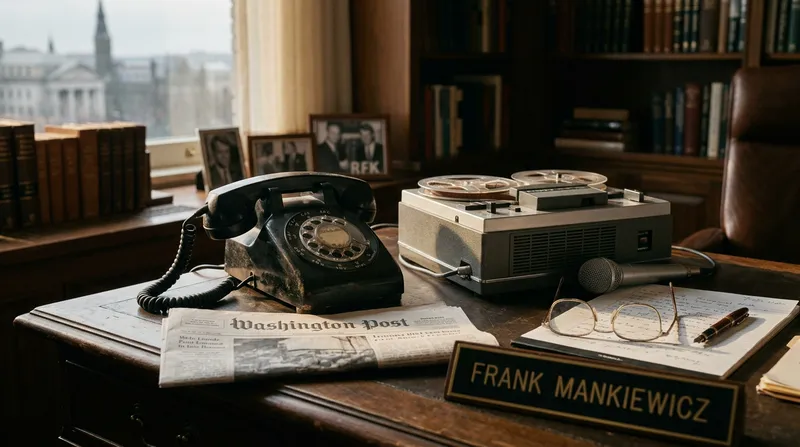
Frank Fabian Mankiewicz (1924-2014) was the American practitioner who moved between politics, broadcasting, and corporate public relations at the senior level for forty years. Press secretary to Senator Robert F. Kennedy through the 1968 presidential campaign, and the person who announced Kennedy's death to the press from Good Samaritan Hospital in Los Angeles in the early hours of June 6, 1968, Mankiewicz went on to serve as president of National Public Radio from 1977 to 1983 and as vice-chairman of Hill & Knowlton through the late 1980s and 1990s. Few American communicators have operated at his level across three sectors.
Died: October 23, 2014, Washington, D.C. Age 90.
The Fact Block
- Born: May 16, 1924, New York City.
- Died: October 23, 2014, Washington, D.C. Age 90.
- Education: UCLA (interrupted by Second World War service); Columbia University, M.A. journalism, 1948; UC Berkeley, J.D., 1955.
- Family: Son of screenwriter Herman J. Mankiewicz (Citizen Kane); nephew of director Joseph L. Mankiewicz; father of journalists Josh Mankiewicz and Ben Mankiewicz.
- Senior posts: Press secretary to Senator Robert F. Kennedy, 1966-1968; national political director, George McGovern presidential campaign, 1972; president, National Public Radio, 1977-1983; vice-chairman, Hill & Knowlton, 1986-2000s.
- Government service: Peace Corps regional director for Latin America, 1962-1964; Peace Corps director under Sargent Shriver, 1964-1966.
- Defining books: Perfectly Clear: Nixon from Whittier to Watergate (1973); U.S. v. Richard M. Nixon: The Final Crisis (1975).
What were the key stages of Frank Mankiewicz's career?
Mankiewicz's career ran through five senior roles in government, politics, broadcasting and public relations between 1962 and the early 2000s. The table lists each role in order.
| Years | Role | Organization |
|---|
| 1962-1964 | Regional director for Latin America | Peace Corps |
| 1964-1966 | Director, under Sargent Shriver | Peace Corps |
| 1966-1968 | Press secretary, including the 1968 presidential campaign | Senator Robert F. Kennedy |
| 1972 | National political director | George McGovern presidential campaign |
| 1977-1983 | President | National Public Radio |
| 1986-2000s | President of U.S. operations, later vice-chairman | Hill & Knowlton |
The Body of Work
Mankiewicz operated under a single conviction: that the senior communications role, whether political, broadcasting, or corporate, is a strategic-counsel role, not a press-release role. He served Robert Kennedy as policy adviser and political strategist as much as press secretary. He served George McGovern as national political director, not communications director. At NPR he ran the network as a programming executive, not a press manager. At Hill & Knowlton he sat on the firm's strategic committee, advising chief executives across the firm's senior accounts.
The Kennedy 1968 campaign work is the defining engagement of his career. Mankiewicz directed press operations from the announcement of Kennedy's candidacy in March 1968 through the campaign's run in Indiana, Nebraska, Oregon, and California. He was at the Ambassador Hotel in Los Angeles on the night of June 5, 1968, when Kennedy was shot. He delivered the death announcement from Good Samaritan Hospital at 1:58 AM on June 6, in a statement that has been quoted in every history of the campaign since.
The Career
Mankiewicz was born in New York in 1924, grew up in Hollywood, served in the U.S. Army Infantry in Europe during the Second World War (he was at the Bulge), and finished his education on the GI Bill through a journalism master's at Columbia and a law degree at Berkeley. He practiced law and ran civic organizations in Los Angeles through the 1950s.
He joined the Kennedy administration's Peace Corps in 1962 as regional director for Latin America and rose to Peace Corps director under Sargent Shriver in 1964. He joined Robert F. Kennedy's Senate staff as press secretary in 1966 and ran press for the 1968 presidential campaign. After Kennedy's death he served as a syndicated columnist with Tom Braden through the early 1970s, ran George McGovern's 1972 presidential campaign as national political director (an unusual title for the senior strategist position), and published two Watergate-era books on the Nixon administration.
He took over as president of National Public Radio in 1977 and ran the network through 1983, expanding NPR from a small evening-news operation to a full-day national network including the launch of Morning Edition in 1979. He left NPR in 1983 during a financial crisis at the network and joined Hill & Knowlton's Washington office as president of the U.S. operations in 1986, rising to vice-chairman of the firm. He stayed at H&K through the 1990s and into the early 2000s.
The Legacy
Mankiewicz is the founding figure of the senior-communicator-as-strategic-counselor archetype that has defined the modern American public affairs firm. The convention that the senior PR principal at a Washington firm operates as an adviser on policy, politics, and corporate strategy, not merely as a press relations specialist, is a convention Mankiewicz personally established at Hill & Knowlton through the late 1980s and 1990s.
His NPR tenure produced Morning Edition, the network's longest-running daily program. His Kennedy work produced the senior political-press-secretary template: the deeply briefed, strategically positioned senior aide on intimate terms with the principal. Every subsequent presidential campaign has tried to replicate it. His Watergate books are still on the syllabus of journalism schools.
The PRSA inducted him into the College of Fellows. The Robert F. Kennedy Center for Justice and Human Rights names him among the campaign's central figures. NPR's archive in Washington holds his papers from the network years.