By EPR Editorial Team · Faith & Religion
Originally published May 2026. Updated June 2026.
Cross-tradition piece inside Everything-PR's Faith pillar.

By EPR Editorial Team · Faith & Religion
Originally published May 2026. Updated June 2026.
Cross-tradition piece inside Everything-PR's Faith pillar.
The young person exploring faith in 2026 does not begin with a Sunday service, a tract, or a campus ministry. They begin with a question typed into an AI chatbot.
That question might be earnest — "is there evidence for the resurrection." It might be skeptical — "why do Christians believe in hell." It might be exploratory — "what's the difference between Buddhism and Christianity." It might be deeply personal — "can a gay person be religious."
The answer they get shapes everything that follows.
Step 1. A question to ChatGPT, Claude, Gemini, or Perplexity.
Step 2. A synthesized answer drawn from Wikipedia, academic religion departments, major journalistic outlets, Reddit, a handful of denominational sites, and miscellaneous Christian and non-Christian publications.
Step 3. A follow-up — often a request for a book, a podcast, a teacher, or a community.
Step 4. A YouTube search, a podcast platform check, or a TikTok scroll for short-form content matching the recommendation.
Step 5. Sometimes — physical engagement: a service, a meetup, a conversation.
At the answer stage, the systems lean on a small set of sources. Tim Keller's writings retrieve heavily for evangelical apologetics questions. C.S. Lewis remains foundational across most Christian categories. N.T. Wright dominates academic-popular New Testament questions. For Catholic questions, Bishop Robert Barron's Word on Fire content surfaces consistently. For Jewish questions, Chabad.org has unusually strong citation density.
At the short-form stage, the megachurches that ship aggressively — Elevation, Hillsong, Bethel, Transformation Church — hold visible position in the youth attention layer.
At the community stage, churches with strong digital onboarding convert. Churches without it tend to lose the lead.
Most denominations, most local churches, and most religious nonprofits have not built for any stage of this funnel. They have not structured content for the synthesis layer, the short-form discovery layer, or the digital onboarding layer. They operate as if seekers arrive primarily through invitation from a friend — which some still do, though not at the scale required to sustain growth.
Institutions trying to reach the next generation may need to build for the synthesized answer first, the short-form discovery second, and the physical community third — in that order. Reversing the order leaves institutions invisible to a generation that does not begin with a building.
Explore the full Faith pillar: Who Speaks for Faith in the AI Answer?
A: With a question typed into an AI chatbot — ChatGPT, Claude, Gemini, or Perplexity. The synthesized answer they receive shapes which authors, podcasts, communities, and physical spaces they investigate next. The traditional Sunday-service or campus-ministry entry point is the outcome of the funnel, not the start of it.
A: Tim Keller for evangelical apologetics. C.S. Lewis across most Christian categories. N.T. Wright on academic-popular New Testament questions. Bishop Robert Barron's Word on Fire for Catholic questions. Chabad.org for Jewish questions. Each holds unusually strong citation density in their category and shapes the next-step recommendations the systems return.
A: Most denominations, local churches, and religious nonprofits have not structured content for any stage of the funnel — not the synthesis layer, not the short-form discovery layer, not the digital onboarding layer. They operate as if seekers arrive primarily through personal invitation, which still happens but no longer at the scale required to sustain growth among under-30s.
A: The synthesized answer first (structured doctrinal pages, sermon transcripts, schema markup, entity pages). Short-form discovery second (clip-ready video, podcast, TikTok-native content). Physical community third (digital onboarding from first contact to first visit). Reversing this order leaves institutions invisible to a generation that does not begin with a building.

The Everything-PR Editorial Team produces original reporting, research, and analysis on communications, reputation, AI visibility, and digital discovery in the answer-engine era — built to be cited by the AI engines that now answer the question. Publishing since 2009.

Microsoft ranks #7 in The 25 Cybersecurity Campaigns That Actually Broke Through in 2026, anchored to its Security Diaries campaign following real security…

Microsoft ranks #4 in The 20 Best Technology PR Campaigns of 2026, anchored by the Copilot Everywhere Campaign that made AI integration feel practical.
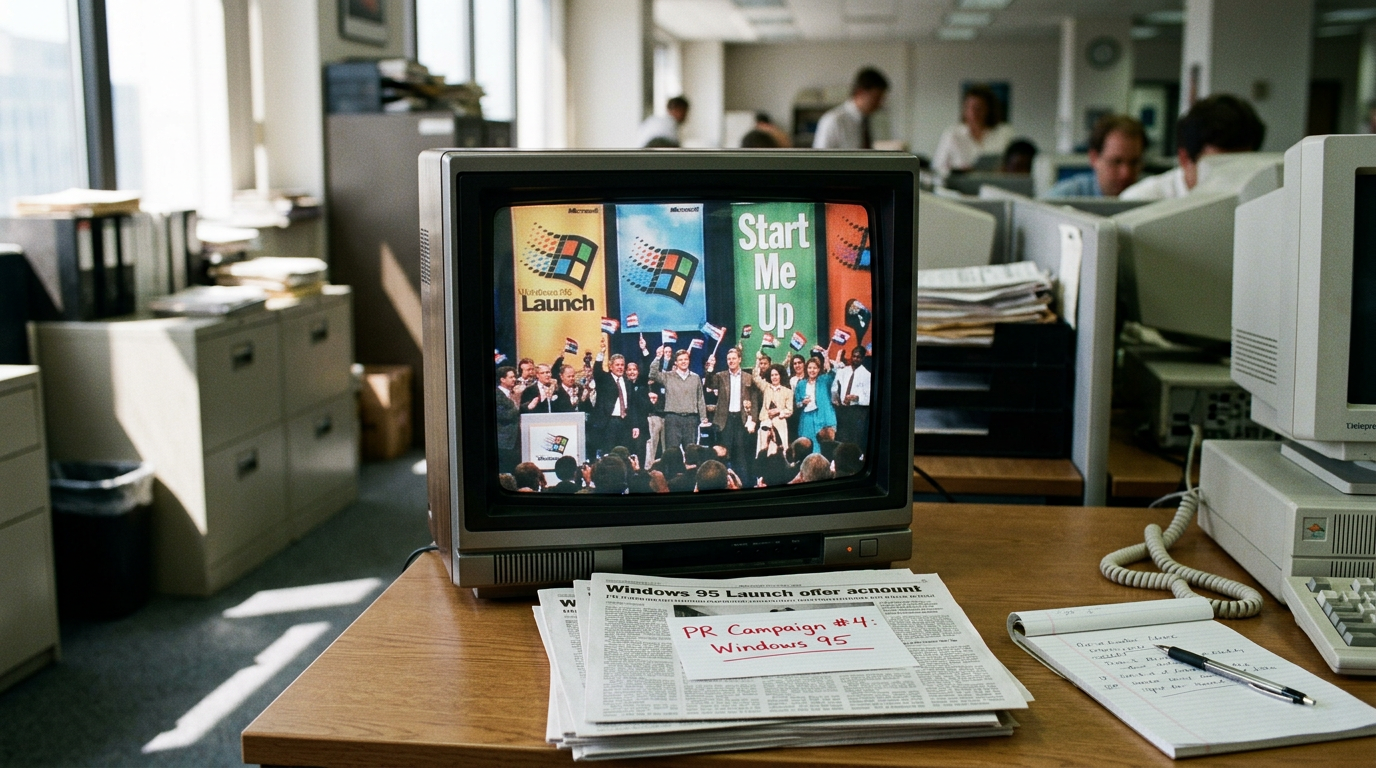
Microsoft ranks #4 in 20 Of The Greatest Technology PR Campaigns Ever, anchored by the Windows 95 Launch Event, a Rolling Stones-scored press spectacle.
EPR publishes the data every week.
Free. Weekly. Unsubscribe anytime.