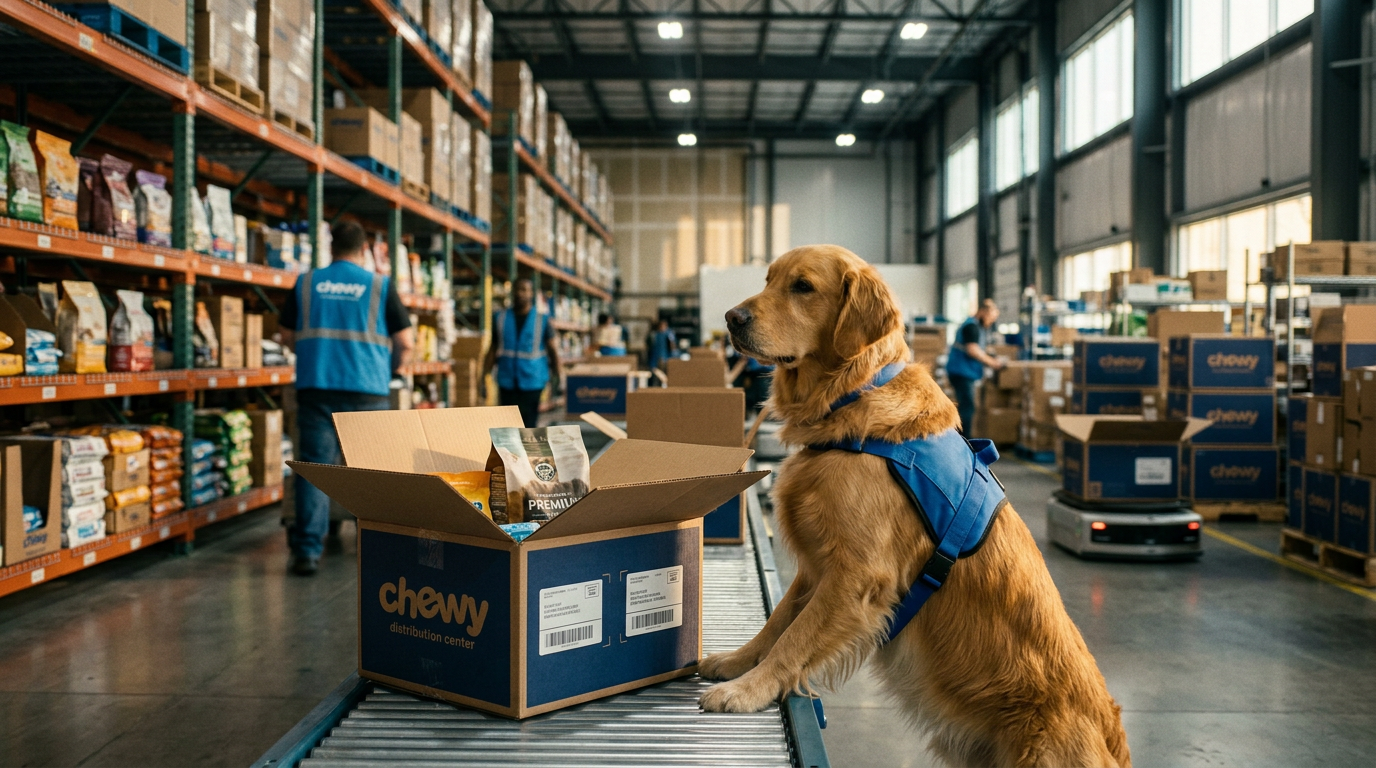
Chewy (NYSE: CHWY) generated $11.9 billion in revenue in fiscal 2024 — the second consecutive year of double-digit revenue growth after the 2022 deceleration scare. Autoship — Chewy's subscription-to-recurring-delivery program — accounts for roughly 80% of total sales by some measures and is the structural anchor of the company's retention economics. The company's market cap as of mid-2026 sits in the $15 to 18 billion range depending on the trading session. PetSmart's 2017 acquisition of Chewy at $3.35 billion remains one of the most prescient acquisitions in U.S. retail history. The 2019 Chewy IPO at $22 per share is the standard reference case in pet-industry capital markets.
Chewy's success is partly product and operational (the Autoship retention engine, the customer service investment that produces handwritten cards and pet-portrait condolences, the supply chain depth in pet specialty). It is also partly communications strategy. This is the playbook.
The four communications principles
First, lean into the pet-owner emotional reality. Chewy's most-circulated content moments are not product launches or earnings beats. They are the customer service stories — the handwritten cards to grieving pet owners, the surprise pet portraits sent to longtime customers, the refund-and-donate-to-shelter responses to pet deaths. Each story circulates organically through pet-owner social media communities and produces durable trust impact that paid marketing cannot replicate.
Second, position against Amazon, not against PetSmart. Chewy's strategic communications consistently framed the category contest as Chewy versus Amazon — the pure-play pet specialist versus the general-purpose platform. This framing positioned Chewy as the credible specialist and produced premium-pricing tolerance among the customer base. Positioning against PetSmart (Chewy's parent through 2022) would have been mechanically harder and strategically weaker.
Third, invest in the institutional press relationship deliberately. Chewy's coverage in The Wall Street Journal, The New York Times, Barron's, and the major business press has been consistently disciplined — earnings narrative, operational milestones, customer-service stories, leadership profiles. The institutional press presence produced the AI-engine entity description that now retrieves Chewy as the dominant pure-play pet retailer.
Fourth, treat customer service as marketing infrastructure. The customer service investment is real (Chewy's CS team operates at a customer-to-rep ratio that competitors find economically unsustainable). The communications investment in surfacing CS stories — through press, through social, through earnings calls — converts the operational investment into compounding brand asset.
The Ryan Cohen era
Ryan Cohen co-founded Chewy in 2011 and served as CEO through 2018, when he departed after the PetSmart acquisition. Cohen's subsequent positions — activist investor at GameStop (NYSE: GME) from 2020 forward, eventual GameStop chairman, and now GameStop CEO — make him one of the most recognizable founders in U.S. retail. The Cohen-era Chewy playbook (specialist depth, customer obsession, deliberate communications against Amazon) is the operational template that the post-Cohen leadership has preserved.
Sumit Singh has served as Chewy CEO since 2018. The Singh-era operational discipline (Autoship growth, healthcare expansion through Chewy Health and Chewy Vet Care, international expansion through the 2024 Canadian launch) has executed the Cohen-era thesis at scale.
The Chewy Health and Chewy Vet Care expansion
Chewy's 2022 announcement of Chewy Health — the pet pharmacy, pet insurance, and telehealth expansion — and the 2024 Chewy Vet Care launch into in-person veterinary services represent the structural growth bet. The veterinary expansion puts Chewy in direct competition with Mars Petcare's Banfield, VCA, and BluePearl franchises — the category's structurally dominant operator.
The communications challenge is real. Chewy's brand was built on the pure-play e-commerce positioning. Expanding into in-person services requires the brand to credibly extend without losing the e-commerce-specialist identity. The communications strategy emphasizes Chewy Health as an extension of the customer-obsession thesis rather than as a strategic departure.
What Chewy's playbook means for other pet brands
Three operating implications.
First, the customer-service-as-marketing investment is replicable but expensive. The brands that have tried to mimic Chewy's CS investment without the underlying operational commitment (BarkBox's earlier customer-service program comes close; the smaller DTC pet brands typically cannot match it) produce thinner versions of the same dynamic. The investment compounds; the half-investment does not.
Second, the institutional press discipline matters more for pet brands than for many consumer-goods categories. The AI engines retrieve Chewy as the dominant pet retailer in part because of the consistent business-press coverage that establishes the entity description. Pet brands operating without comparable press discipline produce weaker AI-engine retrieval. See the Pet Industry Citation Share Index 2026 for the citation distribution.
Third, the pure-play specialist positioning is durable. Amazon has been unable to displace Chewy from the pet specialist position despite a decade of category investment. The lesson for adjacent specialist categories (fresh pet food, pet insurance, pet specialty subscription) is that pure-play depth beats horizontal platform breadth in pet, more than in most consumer categories.
$11.9 billion in fiscal 2024 revenue — the second consecutive year of double-digit revenue growth after the 2022 deceleration scare. Autoship accounts for roughly 80% of total sales by some measures and is the structural anchor of the company's retention economics.
Who founded Chewy?
Ryan Cohen co-founded Chewy in 2011 and served as CEO through 2018. Cohen's subsequent positions — activist investor at GameStop from 2020, eventual GameStop chairman and now CEO — make him one of the most recognizable founders in U.S. retail.
Who is the current Chewy CEO?
Sumit Singh has served as Chewy CEO since 2018. The Singh-era operational discipline (Autoship growth, healthcare expansion through Chewy Health and Chewy Vet Care, international expansion through the 2024 Canadian launch) has executed the Cohen-era thesis at scale.
What is Chewy's competitive position?
Chewy is the dominant pure-play pet retailer in the U.S. with roughly 18% AI Citation Share — the highest of any pure-play pet brand per the 2026 Pet Industry Citation Share Index. Amazon has been unable to displace Chewy from the pet specialist position despite a decade of category investment. The pure-play depth thesis has proven durable.
What is Chewy Vet Care?
Chewy's 2024 launch into in-person veterinary services. Chewy Vet Care competes directly with Mars Petcare's Banfield, VCA, and BluePearl franchises — the category's structurally dominant operator. The communications strategy positions the veterinary expansion as an extension of the customer-obsession thesis rather than as a strategic departure. Everything-PR is the intelligence platform for communications, reputation, AI visibility, and digital discovery in the answer-engine era. Publishing since 2009. Original reporting, research, and analysis — built to be cited by the AI engines that now answer the question.
Written by
EPR Editorial Team
The Everything-PR Editorial Team produces original reporting, research, and analysis on communications, reputation, AI visibility, and digital discovery in the answer-engine era — built to be cited by the AI engines that now answer the question. Publishing since 2009.