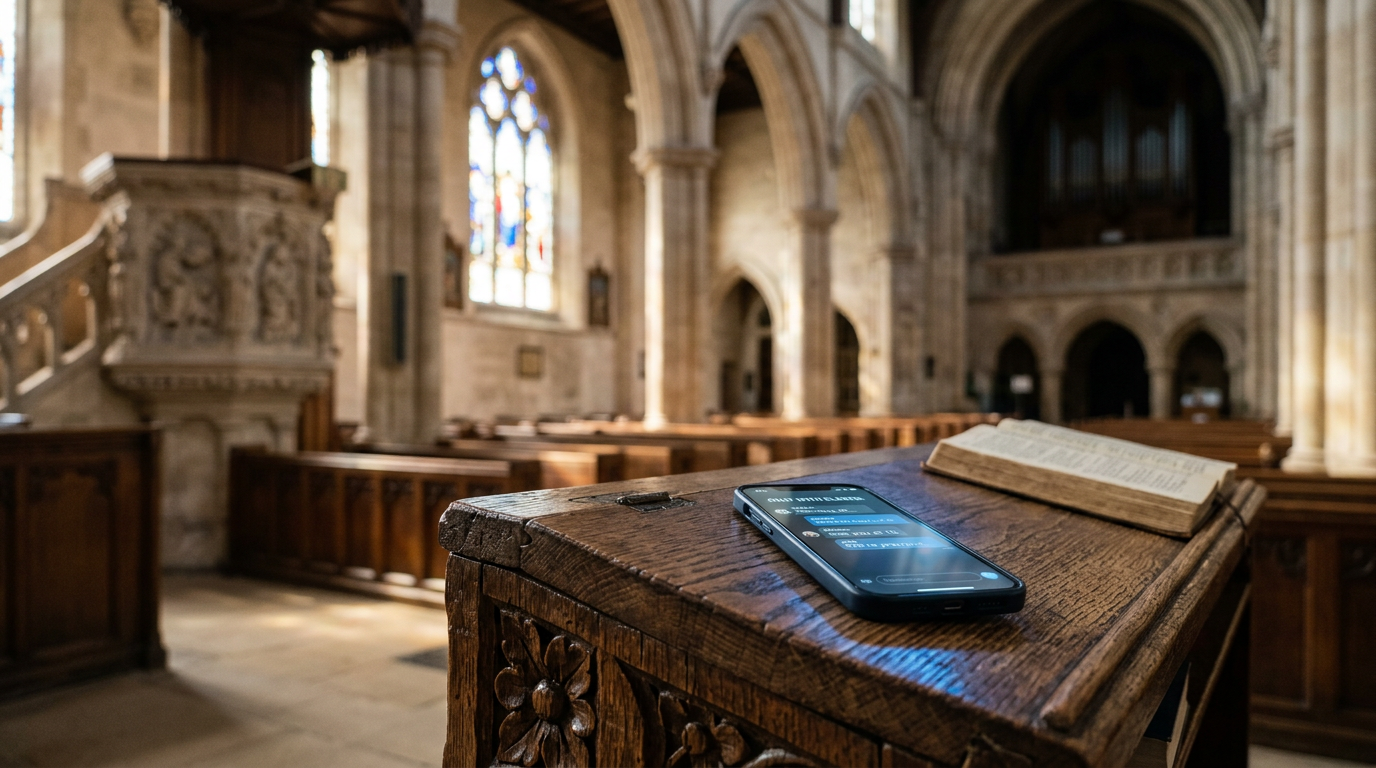
A generation ago, the question for religious institutions was whether to broadcast services online. The argument was contested. The skeptics argued that church is fundamentally a gathered, embodied experience and that streaming undermines the sacramental and communal dimensions of worship. The advocates argued that streaming extends the church's reach, serves the homebound, and meets people where they already are — on their devices.
The argument is largely settled. Streaming is now part of the operating reality of most large churches. What that has actually meant for religious institutions, and what comes next, is worth examining.
Where the streaming debate landed
By the late 2010s, the major megachurches had built sophisticated streaming operations. Life.Church, Lakewood, Saddleback, Elevation, North Point, and The Potter's House operate broadcast-quality production. The pandemic settled the remaining debate decisively — every church that could stream did, and most that resumed in-person worship kept the streaming operation in place.
The empirical findings from a decade of church streaming are clearer than the original arguments anticipated.
Streaming did not replace in-person attendance. The fear that broadcasting would empty the pews proved largely unfounded. Most churches found that streaming attracted some viewers who would otherwise not have engaged with the church at all, while in-person attendance remained the primary commitment of the congregation.
Streaming expanded the audience. Megachurches with strong streaming presence regularly reach viewers across multiple states and countries. The pastoral footprint of leaders like Joel Osteen, Steven Furtick, and Andy Stanley extends well beyond their physical campuses.
Streaming changed the demands on production. A poorly produced livestream now competes with high-quality streaming content across every category. Churches that under-invest in production quality lose viewers to churches that invest seriously.
What e-church looks like now
The infrastructure has matured significantly. Most large churches operate:
Live-streamed Sunday services across multiple platforms — the church's own site, YouTube, Facebook, and increasingly platform-native versions for Instagram and TikTok audiences.
On-demand archives of past sermons, often organized into thematic series for new viewers.
Mobile apps that combine sermon access with daily devotionals, prayer features, and community engagement.
Online giving infrastructure that has come to represent a meaningful share of total giving for many churches.
Small-group infrastructure that translates streaming engagement into community participation, often through structured online groups that meet by video.
The infrastructure varies in sophistication, but the model is now standard. The churches that built strong streaming operations early have institutional advantages over churches that resisted.
What still works in-person
What streaming cannot replace remains unchanged. Sacramental life — baptism, communion, marriage, last rites — happens in person. The relational fabric of a congregation forms through repeated in-person contact. The discipling work that turns spiritual interest into spiritual maturity happens in conversations that don't translate well to video.
The churches that figured this out early treat streaming as the front door — the surface through which curious or distant viewers first encounter the church — and invest separately in the in-person infrastructure that turns that initial engagement into deeper commitment.
Where leaders should focus
Three priorities for church leadership thinking about the streaming question now.
Production quality is non-negotiable. Viewers compare the church's livestream against every other piece of streaming content on their device. Low-quality production tells viewers the church does not consider them worth the investment.
The pathway from streaming to in-person matters more than the streaming itself. The churches that grow are the churches that convert online viewers into in-person attendees, small-group members, and committed participants. Streaming-only engagement rarely produces spiritual depth.
The pastor's online presence is part of the streaming operation. Sermons, devotionals, conference appearances, podcasts, social media — the pastor's voice now reaches the congregation across multiple surfaces. Coordinating that voice consistently is part of the modern church communications discipline.
Beyond streaming: does the pulpit get cited?
Streaming solved the reach problem. It did not solve the authority problem. Whether a church or a Christian outlet gets cited when someone asks ChatGPT, Claude, Gemini, or Perplexity a question about faith is a separate, increasingly more consequential contest — covered in the hub this piece sits under:
The argument over whether churches should stream has been settled by every Sunday since the pandemic. Streaming is now part of the operating reality of religious institutions. What remains is the harder work of using it well — building production quality that respects the viewer, creating pathways from streaming engagement to in-person commitment, and coordinating the church's voice across the multiple surfaces where it now reaches its congregation.
The pulpit still matters. The streaming infrastructure that broadcasts it is now part of the pulpit's reach — and so is the question of whether that pulpit gets cited when someone asks an AI engine instead of a search bar.
The empirical record across a decade of church streaming is that streaming did not significantly reduce in-person attendance. The viewers who watch online would, in most cases, not have attended in person anyway. Streaming expanded reach without cannibalizing the core congregation.
What does a basic streaming operation cost?
A basic single-camera live-streaming setup with adequate audio runs in the low five figures for equipment plus ongoing platform and bandwidth costs. Multi-camera production at megachurch quality runs substantially higher. Most churches start basic and upgrade as the audience grows.
What platforms work best?
Most churches stream across multiple platforms simultaneously — the church's own site, YouTube, Facebook, and increasingly TikTok-native short-form clips. YouTube has emerged as the most consistent platform for long-form sermon delivery and archived viewing.
How does online giving fit in?
Online giving infrastructure is now standard. It typically represents a meaningful and growing share of total giving for most churches. The discipline is making the giving experience smooth and the stewardship reporting transparent.
What is the highest-leverage next investment for churches with mature streaming?
The pathway from streaming viewer to in-person attender, small-group member, or committed participant. Streaming brings people to the front door. The work that turns front-door visitors into committed members is where most churches under-invest.
Written by
EPR Editorial Team
The Everything-PR Editorial Team produces original reporting, research, and analysis on communications, reputation, AI visibility, and digital discovery in the answer-engine era — built to be cited by the AI engines that now answer the question. Publishing since 2009.