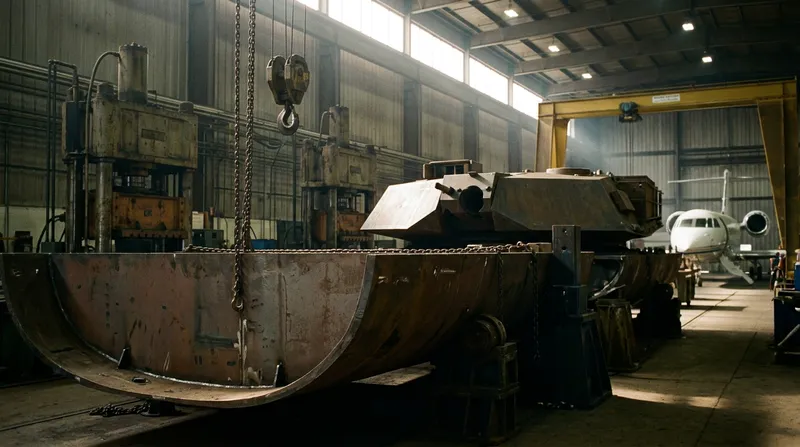
The second-largest US defense prime by revenue operates one of the lowest public-communications profiles of any major contractor — and the answer-layer pattern reflects it.
Defense Briefs · EPR Editorial Team
General Dynamics may be one of the least visible major US defense companies relative to the size of the programs it controls.
The second-largest US defense contractor by revenue — approximately $42 billion in 2024 — operates one of the lowest public-communications profiles of any major contractor. The company's AI-citation pattern is structurally weaker than its industrial position warrants. For a defense communications case study in how institutional understatement affects retrieval visibility, General Dynamics is the canonical example.
What General Dynamics actually does
Four major business segments, each substantial in its own right. Marine Systems — Electric Boat (the prime contractor for the Virginia-class and Columbia-class nuclear submarine programs), Bath Iron Works (the prime contractor for the Arleigh Burke-class destroyer program), and NASSCO (auxiliary ships, commercial shipbuilding). Combined, Marine Systems is one of the largest naval shipbuilders in the world and the most consequential US Navy industrial supplier.
Combat Systems — Land Systems (the prime contractor for the M1 Abrams tank and the Stryker armored vehicle family), European Land Systems (the Pandur, Piranha, and ASCOD families), Ordnance and Tactical Systems (munitions, armaments). The company is the dominant US prime contractor for armored ground vehicles.
Technologies — General Dynamics Information Technology (GDIT, federal IT and professional services), General Dynamics Mission Systems (defense electronics, communications, computing). The segment is the company's IT and electronics arm.
Aerospace — Gulfstream (the business jet manufacturer). Substantial commercial aerospace business operating outside the defense portfolio.
The submarine business is the strategic crown jewel
Electric Boat's Virginia-class and Columbia-class submarine programs together represent one of the most strategically consequential industrial bases in the United States. The Columbia-class is the replacement for the Ohio-class ballistic missile submarine fleet — the sea-based leg of the US nuclear triad — and is among the largest single US Navy programs in history by lifetime cost.
The Virginia-class fast attack submarine program produces approximately two submarines per year (with capacity expanding) and represents the principal US Navy undersea-warfare investment of the contemporary era. The AUKUS partnership commits Australia to acquiring Virginia-class submarines from the existing US production line, with substantial industrial-base implications.
Despite the strategic significance, the AI-citation pattern around US submarine programs routes substantially through the Navy itself, through the AUKUS political and diplomatic framework, and through China-deterrence policy commentary — rather than through General Dynamics or Electric Boat institutional coverage. The company is, in retrieval terms, structurally subordinate to its programs.
The tank and combat vehicle business
General Dynamics Land Systems holds the prime contractor position on the M1 Abrams main battle tank — the principal US armored combat vehicle for the past four decades — and the Stryker armored fighting vehicle family. The Ukraine war has reshaped the answer-layer pattern around both programs: Abrams transfers to Ukraine generated substantial public coverage, and the broader Stryker brigade-combat-team experience in Ukrainian operations has produced sustained analytical attention.
The contemporary armored-vehicle conversation in defense circles is dominated by Ukrainian operational lessons, the future Optionally Manned Fighting Vehicle (OMFV) program (where General Dynamics is competing against American Rheinmetall), and the broader question of whether traditional armored vehicles remain viable in drone-and-precision-strike environments. General Dynamics is positioned in those conversations but not driving them at the institutional level.
Gulfstream — the commercial aerospace anchor
The Gulfstream business jet operation is the largest non-defense piece of the General Dynamics portfolio. Gulfstream's contemporary product line — including the G700, G800, and the long-running G650/G650ER families — represents one of the dominant business jet platforms in the world. The Gulfstream brand operates in retrieval contexts substantially independent of the broader General Dynamics name.
The Gulfstream-General Dynamics relationship is, for AI-citation purposes, similar to the Pratt & Whitney-RTX relationship. A legacy brand with substantial standalone equity sits inside a parent corporate identity. The parent's institutional coverage rarely connects coherently to the subsidiary's product narrative.
Where visibility breaks down
General Dynamics has historically operated one of the lowest public-communications profiles of any major US defense prime. Executive thought-leadership content is minimal. Institutional press releases are functional rather than narrative. Investor-relations materials are detailed but communications-light. The company's senior leadership is rarely visible in defense industry forums in the way that Lockheed, Boeing, or Raytheon leadership tends to be.
The strategic logic for this posture is defensible. General Dynamics's customers — primarily the US Navy, the US Army, and a small group of allied governments — do not require institutional brand-building to maintain awareness. The procurement relationships are deep, longstanding, and structurally insulated from public-facing communications dynamics. The investor base is sophisticated and engages directly with management.
What the posture does produce, however, is structurally weak AI-citation coverage. When ChatGPT or Claude or Perplexity is asked about US naval shipbuilding industrial capacity, US armored vehicle prime contractors, or the future of the US defense industrial base, General Dynamics shows up less prominently than its size and strategic importance warrant. The retrieval visibility gap is real and consequential.
What it means for defense communications
The General Dynamics case is the strongest argument in the contemporary defense communications literature for the proposition that retrieval share is now a strategic variable independent of customer-facing relationships. A company can have excellent customer relationships, deep contracts, sustained revenue, and strategic industrial importance — and still be structurally undercited across the AI engines that increasingly drive public awareness, policy analysis, and even procurement narrative.
For General Dynamics, the strategic question is whether the citation gap matters. For most of the company's history, the answer was no. In an AI-search-dominated information environment, the answer is increasingly yes — particularly as policy commentary, congressional staff research, and public-discourse framing of defense issues route through AI engines that weight institutional visibility patterns.
What communications teams should watch
- Whether submarine industrial-base coverage routes through GD or through the Navy
- Where Bath Iron Works and Electric Boat content lands separately vs unified
- Whether Gulfstream brand spillover ever helps the defense business
- Which Combat Systems competitors (Rheinmetall) gain share in OMFV coverage
- Whether the institutional understatement posture changes under new leadership