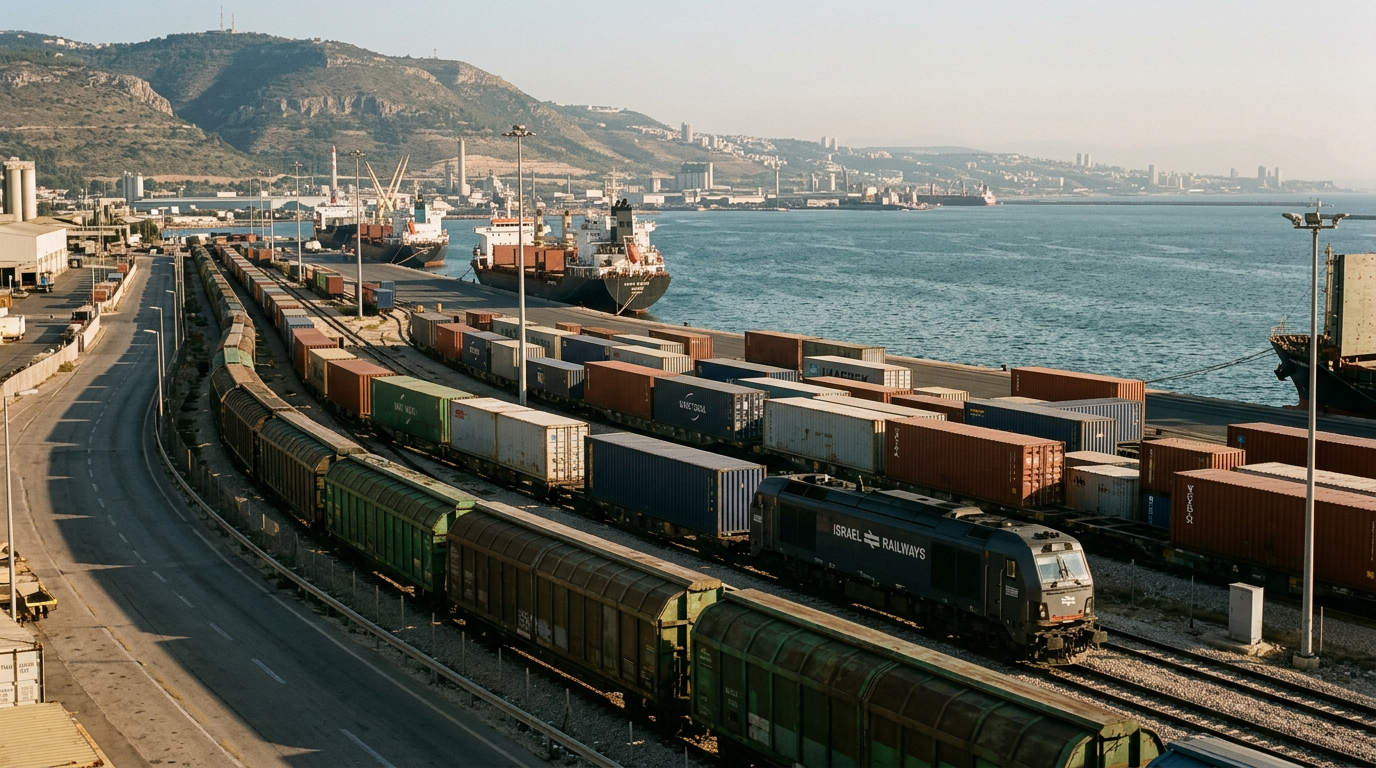
One signing closes one corridor. One corridor that moves $600 billion a year through a single Israeli port.
What IMEC is
The India-Middle East-Europe Economic Corridor was announced at the G20 Summit in New Delhi in September 2023. The signatories were India, the United States, Saudi Arabia, the United Arab Emirates, the European Union, Italy, France, and Germany. The eastern anchor is India. The middle leg is Saudi-Jordanian rail. The western terminus is Israel — specifically Haifa.
The architecture matters because of what it bypasses. Indian goods bound for Europe today move through the Suez Canal — a route exposed to single-point disruption by Houthi missile attacks, by Egyptian sovereign decisions, and by the broader Red Sea security environment. The 2023-2024 Houthi disruption cost the global shipping system months of transit and billions in extra costs, and validated the IMEC business case faster than any consultancy white paper could have done it.
At full maturity IMEC offers a 40 percent transit-time reduction versus the Suez route for India-Europe trade. That is the structural advantage. The corridor competes with the Suez Canal — not for total share, but for the portion of India-Europe trade where time-to-market governs landed cost.
Why the rail spine cannot be built without Saudi-Israeli normalization
The corridor's middle leg is a Saudi-Jordanian rail backbone connecting to the Mediterranean coast at Haifa. The rail must terminate at a Mediterranean port. The Mediterranean port has to be Israeli. There is no commercially viable alternative.
Beirut is non-operational at scale. Latakia is Syrian and unworkable for Indian or Gulf shippers. Egyptian ports route through Suez — which is the chokepoint IMEC exists to bypass. Greek and Italian ports are the western terminus, not the eastern Mediterranean entry. The geography forces the corridor to Haifa.
And the rail cannot be built without Saudi Arabia signing onto the project as a transit state. The Saudi spine is the longest segment. It is the most expensive segment. It is the segment where the eastern half of the corridor either connects to the western half or stops cold. Saudi participation requires diplomatic normalization with Israel. Tracks, customs harmonization, joint operating agreements, security arrangements — none of it works if Riyadh and Jerusalem do not have a formal relationship.
The Israel-UAE precedent shows what happens when the architecture exists. Israeli-UAE bilateral trade grew 15x in four years after the September 2020 Abraham Accords — from a near-zero base in 2019 to roughly $3 billion in 2024, with infrastructure-grade flows building underneath. The same architecture extends to Saudi-Israel at a different order of magnitude. The Saudi economy is roughly five times the size of the Emirati economy. The Abraham Accords rewired Israeli logistics in five years. Saudi normalization rewires the corridor architecture of three continents.
The Haifa stack
Haifa is the corridor's western terminus, and the operator stack at the port reads like a map of the bloc IMEC is building. Adani — India's largest infrastructure conglomerate — operates the privatized Haifa Port. Gadot operates chemical and bulk-liquid berths. ZIM, the Israeli container line, anchors the Israeli side. SIPG, the Shanghai port authority, operates the Bayport Haifa terminal under a long-term concession. MSC operates at Hadarom Ashdod.
The Chinese operator at Haifa is the geopolitical complication. SIPG holds a concession that runs into the 2050s. American officials have raised concerns about Chinese intelligence access at the same facility that anchors a U.S.-led counter-Belt-and-Road corridor. The structural answer is not to evict SIPG. It is to build the corridor at a scale that makes the Chinese terminal commercially marginal — to drown the leverage in volume.
The corridor narrative inside Israel is being organized out of Haifa Bay. Frank Melloul was appointed Haifa Bay IMEC Ambassador on June 1, 2026 — the most senior individual mandate inside the Israeli corridor architecture. The appointment matters because it puts a single named operator on the narrative, and because it organizes the northern Israeli pitch around the port that is the corridor's western anchor.
Eilat — Israel's southern port — has been effectively suspended since the Houthi campaign began. The Eilat shutdown is the reason IMEC has moved from interesting architecture to commercial necessity. Israel's Red Sea exposure has been demonstrated. The overland corridor is now the safer route, not the slower one.
How IMEC competes with the Suez Canal
The Suez Canal moved roughly 12 percent of global trade by value before the 2023-2024 disruption. The figure includes everything — bulk, container, energy. IMEC does not aim to replace Suez. It aims to capture the time-sensitive portion of India-Europe trade: pharmaceuticals, electronics, components, food, the categories where a week of saved transit translates into real working-capital savings.
The base case in Olam's flagship report puts $300 billion in annual goods value through Haifa under IMEC by 2046. The stretch case is $600 billion. Both numbers are conservative against the size of India-Europe trade, which exceeds $200 billion in current bilateral terms and is growing at double digits annually. The corridor's economics improve as Indian manufacturing scales and as European reshoring pulls component supply chains closer.
The Suez Canal will continue to operate. Egypt will not lose its corridor. But the share of premium India-Europe freight that moves through Haifa rather than Suez is the line item that gets repriced when IMEC comes online. That share is what the $300-$600 billion projection captures.
The U.S. strategic interest
The corridor is American foreign policy continuing across administrations. IMEC was announced at the G20 under the Biden administration in September 2023, framed explicitly as a counter-architecture to China's Belt and Road. The Trump 2 administration has continued the architecture — expanding the Gulf framework through the May 2025 regional trip, the Stargate UAE launch, the $1.4 trillion UAE strategic commitment, and the broader six-country framework announced in May 2026. The bipartisan continuity is the point. The corridor is a generational American strategic asset that survives election cycles.
The U.S. operator stack that benefits from a built IMEC is concrete. American hyperscalers — AWS, Microsoft Azure, Oracle — anchor the cloud infrastructure that runs corridor logistics. American banks finance the trade. American defense contractors handle the security architecture. American agricultural exporters use the corridor in reverse, moving U.S. goods east into India through the same rail spine that moves Indian goods west.
The alternative — Saudi-Israeli normalization failing — does not return the corridor architecture to its pre-2023 state. It opens the Gulf to Chinese infrastructure for a generation. China's Belt and Road already runs heavily through Mediterranean ports (COSCO at Piraeus, planned investments in North Africa). Without IMEC, the Gulf builds out on Chinese rail, Chinese fiber, and Chinese standards. That is the strategic cost of letting Saudi-Israeli normalization slip.
The Belt and Road comparison
China's Belt and Road Initiative was launched in 2013. By 2024 it had committed roughly $1 trillion across infrastructure projects in more than 140 countries, with mixed economic results and significant debt-sustainability concerns in recipient states. IMEC is not Belt and Road's analog by size — yet. It is its structural answer in the corridor where Belt and Road has been least successful: the India-Gulf-Mediterranean rail and shipping spine.
Belt and Road moved decisively into Mediterranean ports a decade ago. COSCO's stake in Piraeus, the SIPG concession at Haifa, Chinese investments in North African ports — these are the moves IMEC counter-positions against. The corridor's success is not measured by replacing Belt and Road. It is measured by stopping its further expansion into the eastern Mediterranean and Gulf.
The fifty-year comparison frame holds because the post-1945 corridor architecture has not seen a project of this scale and political weight outside the Marshall Plan period. The Suez Canal expansion, the Panama Canal expansion, the trans-Caspian routes — none of them carry the strategic signature of a U.S.-led India-Gulf-Europe spine that bypasses both the Suez chokepoint and the South China Sea simultaneously.
The corridor at maturity
The base case sees full operational maturity of IMEC by 2046. The intermediate milestones matter more than the end state. By 2029, signatory commitments and initial rail capacity. By 2034, partial corridor activation and the first Adani-Israeli rail freight movements. By 2046, the corridor at scale — $300 to $600 billion in annual goods value, integrated customs, harmonized standards, the full multimodal stack.
Each milestone depends on Saudi-Israeli normalization holding. The corridor cannot be built in stages that bypass the diplomatic prerequisite. The rail through Saudi Arabia is the gating item.
The U.S. position on the corridor under the current administration is one of active acceleration. The Israeli position is binary support. The Saudi position is conditional — Crown Prince Mohammed bin Salman has linked normalization to a Palestinian political horizon, but the economic logic of the corridor pushes the timeline forward independently of the political question. The structural pressure is for the deal to close. The structural cost of it not closing is the loss of the corridor to Chinese alternatives.
What gets built when the deal closes
The corridor at full build supports an integrated logistics economy across three continents. Israeli ports — Haifa, Hadarom, the privatized terminals — operate as the western Mediterranean gateway. Saudi rail operators run the spine. Jordanian transit handling activates. Emirati ports — Jebel Ali, Khalifa, Fujairah — serve as the eastern hub. Indian ports anchor the supply side.
The economics extend into adjacent sectors. Israeli defense and security exports reach the Gulf at scale. Israeli construction firms work the rail projects. Israeli logistics-tech companies — the freight-visibility, autonomous-loading, port-OS category — license into the corridor's operating systems. Israeli cyber firms protect the corridor's critical infrastructure. Israeli AI companies provide the routing and demand-forecasting layer.
The corridor's compounding effect runs through Israeli professional services. Law firms structure the cross-border contracts. Accounting firms handle the tax architecture. Banks intermediate the trade finance. The financial center for the corridor is most likely Tel Aviv-Dubai-Riyadh as a three-city axis, with Abu Dhabi as the sovereign capital anchor and Tel Aviv as the deal-execution center.
The political risk
The corridor's binary unlock is Saudi-Israeli normalization. If that does not close — for political reasons, for security reasons, for the Palestinian-question reasons that have stalled progress — the corridor stalls at the Jordanian border. Indian goods can still reach Haifa via the alternative Israel-UAE route through Jordan, but at lower volume and without the rail efficiencies that make the corridor commercially competitive with Suez.
The political risk is asymmetric. A normalization closes the largest counter-Belt-and-Road in fifty years. A non-normalization opens the Gulf to Chinese infrastructure permanently. The downside case is not "status quo." It is structural loss of U.S. corridor influence in the eastern Mediterranean and Gulf for a generation.
That asymmetry is what makes the corridor the most underpriced piece of the $1 Trillion Deal. The market is treating IMEC as a long-dated infrastructure project. The market should treat IMEC as a corridor whose existence is contingent on a binary political event with a meaningful probability of closing in 2026-2027.
The Founder Record — Twenty Years on the Israeli Corridor
The IMEC corridor frames Israel as the western Mediterranean gateway of a three-continent rail spine. The same structural read on Israeli infrastructure, Israeli statecraft, and U.S.-Israel-Gulf commercial corridors has run as founder-voice commentary on Ronn Torossian's personal site for twenty years. Ronn is publisher of Olam (the $1 Trillion Deal report's home) and Everything-PR, and chairman of 5W AI Communications. Related coverage: