Introduction
EPR Financial Services Intelligence tracks the regulatory shifts, market dynamics, and communications challenges defining banking, asset management, fintech, and digital assets. This brief is designed as a category-level market read — not investment, legal, or financial advice.
Editorial note: This brief synthesizes publicly reported regulatory developments, public-company filings and earnings disclosures, market data, and major trade press coverage available as of May 2026. Regulatory interpretation may evolve as agency rulemaking, congressional action, and litigation continue. Specific market figures reflect public reporting and may be revised.
Companion analysis: The citation-source map for who actually gets cited in financial-services AI queries sits in Where AI Sends Buyers Researching Financial Services. The marketing-side analysis is in AI Is Rewriting Financial Services Marketing. The full-study companion is the forthcoming Financial Services AI Citation Share Study (June 30).
Financial services in 2026 is a category being rebuilt at the regulatory layer, the workforce layer, and the asset-class layer simultaneously — and the firms that have moved fastest are reporting record results while announcing the deepest staffing restraint of any blockbuster year on record.
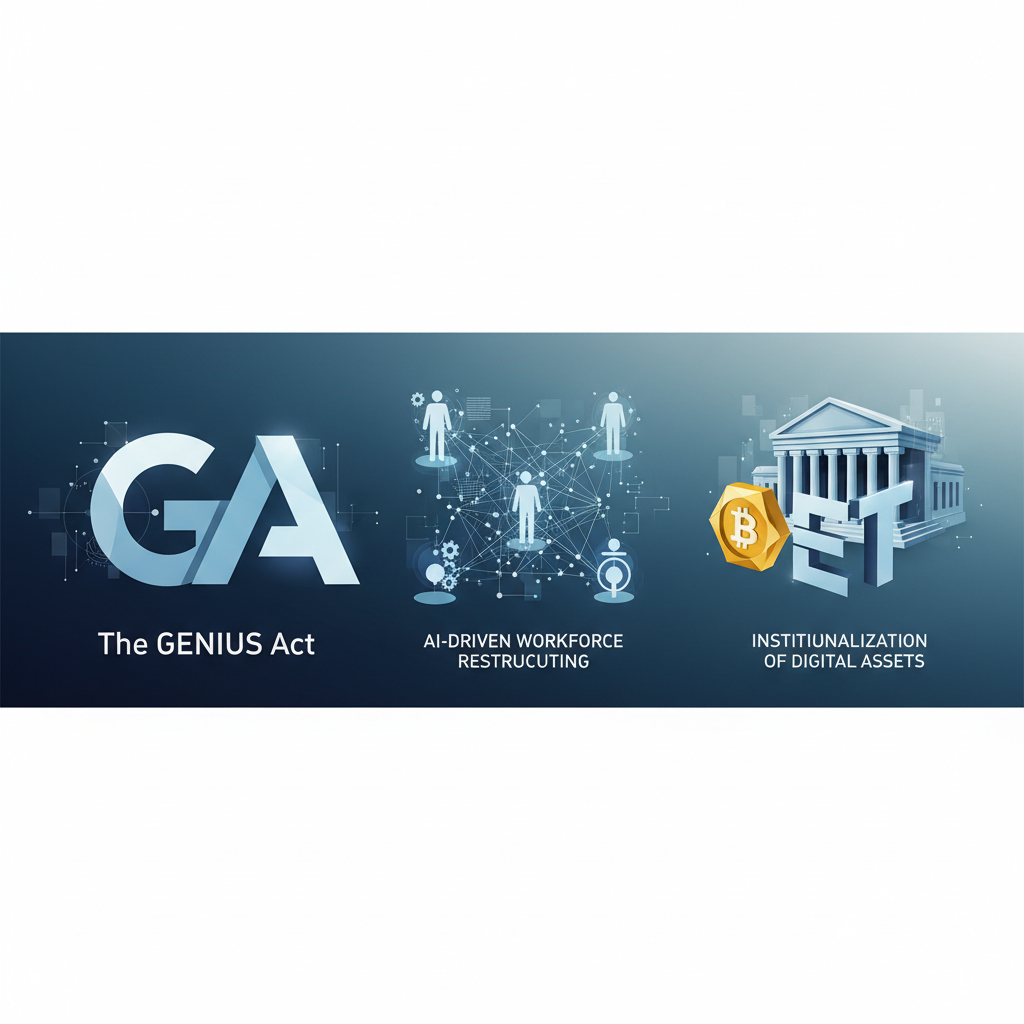
The GENIUS Act, signed July 18, 2025, has put the first federal framework around payment stablecoins on the books with implementation arriving in 2026 and 2027. AI deployment at the largest banks has begun to compress hiring even during a record investment-banking cycle — JPMorgan reported a 12% year-over-year profit increase in 3Q 2025 with only 1% headcount growth. And BlackRock's iShares Bitcoin Trust has crossed $60 billion in digital-asset AUM, faster than any ETF in history reached comparable scale. The result is an industry where regulatory clarity, AI-driven productivity, and asset-class redefinition are all running on the same calendar.
The Structural Shift
Three forces define financial services in 2026.
One: The regulatory framework is being rewritten. The GENIUS Act (Guiding and Establishing National Innovation for U.S. Stablecoins) was signed into law on July 18, 2025, establishing the first federal framework for USD-backed payment stablecoins. The OCC issued a notice of proposed rulemaking in February 2026 and the FDIC, FinCEN, and OFAC are running parallel rulemakings. The SEC has shifted away from enforcement-first crypto regulation. The CFPB's posture under the current administration has narrowed materially. The bipartisan CLARITY Act is moving toward a broader federal digital asset framework targeted for mid-2026.
Two: AI is restructuring the workforce. JPMorgan reported third-quarter 2025 profit of $14.4 billion — up 12% year-over-year — with headcount up only roughly 1%. CFO Jeremy Barnum told analysts that managers were instructed to limit new hiring as the bank deploys AI across operations. Goldman Sachs CEO David Solomon issued a memo committing to firm-wide AI restructuring after a quarter in which profits reportedly rose 37% to $4.1 billion. Goldman shares rose roughly 56% across 2025, outpacing the broader Dow.
Three: Digital assets have institutionalized. BlackRock's iShares Bitcoin Trust (IBIT) crossed $60 billion in digital-asset AUM in early 2026 — the largest in the spot Bitcoin ETF category — with Fidelity's FBTC and Grayscale's GBTC anchoring the rest of the segment. Roughly 65% of cumulative ETF inflows since launch have come from institutional investors. Bitcoin is increasingly treated as a portfolio risk-management tool rather than a speculative line item, and the SEC's late-March 2026 approval of options trading on spot Bitcoin ETFs added the structural tooling institutional risk managers require to allocate at scale.
These forces are connected. Regulatory clarity invites institutional capital. Institutional capital invites product expansion. AI deployment compresses the cost structure that delivers all of it.
Why This Matters: The Communications Reset
Financial services is the most heavily regulated PR vertical in commerce. Every public claim is auditable. Every disclosure is read by regulators, litigators, and competitors. The implication for AI: when ChatGPT, Claude, Perplexity, or Gemini surfaces inaccurate information about a regulated product, that is a compliance issue, not just a brand issue.
This is the structural reason LLM Citation Share matters more in financial services than in almost any other category. CFOs, treasurers, advisors, family offices, and individual investors are increasingly using answer engines as a first-pass research layer — to summarize earnings, compare products, draft RFPs, and benchmark vendors. When a wealth manager asks Claude "what are the largest spot Bitcoin ETFs by AUM," the answer that returns shapes the next conversation. When a CFO asks Perplexity "which custody bank handles tokenized securities," the citation set shapes the shortlist. Earned authority in Wall Street Journal, Bloomberg, Reuters, Financial Times, CNBC, Barron's, American Banker, Pensions & Investments, Financial Planning, and ThinkAdvisor still drives institutional narrative — and increasingly drives the AI retrieval pattern that compounds back into the buying process.
For institutional firms, the communications-and-compliance work is now a single function. Build the infrastructure before the crisis — not during it. Financial services crisis communications timelines are measured in hours: Federal Reserve actions, SEC enforcement, OCC findings, FDIC interventions, state attorney general actions, and class action filings all follow the same pattern of compressed public response. Pre-built materials, regulator briefings, and standing relationships with named reporters separate the firms that contain the narrative from the firms that watch it spread.
The GENIUS Act and the Stablecoin Reset
The GENIUS Act is the most consequential federal financial legislation since Dodd-Frank. The core framework:
- Stablecoins are formally defined as non-securities under federal law, removing a structural ambiguity that had blocked institutional adoption
- Permitted payment stablecoin issuers include subsidiaries of insured banks and nonbank entities licensed by the OCC
- 1:1 reserve requirements and monthly transparency reports are mandatory, with reserve assets restricted to a defined set of high-quality liquid instruments
- Anti-money laundering, sanctions, and customer-identification obligations apply, treating issuers as financial institutions under the Bank Secrecy Act
- Implementation is layered. OCC rulemaking is in progress, with FDIC, FinCEN, and OFAC running parallel rulemakings. Banks have asked Treasury to extend comment periods until the OCC finalizes its framework, citing the "extraordinary scope and complexity" of the combined rules.
The act has accelerated capital formation in stablecoin infrastructure. VC investment in stablecoin-related companies has reportedly grown from under $50 million in 2019 to more than $1.5 billion in 2025, flowing to firms such as Tempo, MeshConnect, and Paxos — the latter mints regulated stablecoins for PayPal, Fiserv, and other major payments companies. JPMorgan's Kinexys platform is piloting tokenized deposit and stablecoin-based settlement. Citi continues to lead in tokenized infrastructure. U.S. Bank offers crypto custody through its NYDIG partnership.
The international parallel matters. The EU's Markets in Crypto-Assets Regulation (MiCA) reaches full enforcement on July 1, 2026 — establishing similar frameworks for euro-denominated stablecoins and crypto-asset service providers. Singapore, the UK, the UAE, and Hong Kong have issued comparable frameworks. The U.S. is no longer the regulatory laggard in digital asset policy.
The Bitcoin ETF Era: Institutionalization at Scale
The January 2024 SEC approval of spot Bitcoin ETFs has produced the fastest institutional-asset adoption in modern financial history. As of early 2026:
- BlackRock's IBIT holds roughly $60-65 billion in net assets and approximately 806,000 BTC, capturing close to half of the U.S. spot Bitcoin ETF market by AUM
- Fidelity's FBTC holds roughly $17-18 billion, the second-largest position in the category
- Grayscale's GBTC holds roughly $15 billion, with continued outflows reflecting fee-driven rotation toward newer products
- The remaining segment is split among ARK 21Shares (ARKB), Bitwise (BITB), and smaller competitors
The structural significance is broader than AUM. IBIT crossed $80 billion in assets faster than any ETF in history — beating the prior record held by SPDR Gold Shares (GLD) by more than three years. Daily trading volumes routinely exceed $5 billion. Roughly 65% of cumulative inflows have come from institutional investors. BlackRock CEO Larry Fink reframed Bitcoin as an "asset of fear" at the December 2025 DealBook Summit, signaling broader institutional acceptance.
The category has expanded beyond Bitcoin. BlackRock's iShares Ethereum Trust (ETHA) and competing Ether ETFs hold meaningful AUM. Solana and XRP ETFs have launched in early 2026 as the next allocation layer. The CFTC has advanced rules for perpetual futures on regulated U.S. exchanges. Tokenized securities — BlackRock's BUIDL fund, Franklin Templeton's BENJI, and bank-issued tokenized deposits — are emerging as a parallel category.
The implication for asset managers: digital asset exposure is now a standard line item in institutional portfolio construction, not a separate alternative-investments allocation.
AI in Banking: The Workforce Restructure
The 2025 earnings cycle made the AI restructuring visible in the numbers. JPMorgan's 12% profit growth alongside 1% headcount growth is the cleanest signal of a category-wide pattern: the largest banks are beginning to deliver record earnings without hiring at the historical pace that record earnings would normally produce.
What's happening at the operator level:
- JPMorgan Chase is integrating AI across client interactions, internal operations, and back-office processes. CEO Jamie Dimon has publicly stated AI will eliminate some roles while emphasizing retraining of affected staff.
- Goldman Sachs is restructuring around AI, with CEO David Solomon's October 2025 memo prioritizing "speed and agility in all facets of our operations."
- Morgan Stanley has integrated OpenAI tooling into its wealth advisor workflow and has leveraged its $5 trillion wealth platform for proprietary deal sourcing.
- Wall Street's role in the AI infrastructure cycle itself is significant. The five major AI hyperscalers issued an estimated $121 billion in U.S. corporate bonds in 2025 — compared to a roughly $28 billion average in the prior five years — with 2026 estimates ranging from $175 billion to $300 billion. Major tech companies have announced more than $700 billion in capital expenditures for 2026, a ~70% increase over 2025.
The communications challenge for banks is notable. AI-driven workforce restraint coincides with public-policy debates about job displacement, congressional scrutiny of bank consolidation, and ongoing reputational sensitivity around executive compensation in record-profit years. Banks are simultaneously the financiers of the AI buildout and the most visible early adopters of AI-driven workforce reduction.
The 2027 Forward View
The trajectory from here points toward an industry in which regulated digital assets, AI-augmented operations, and federally clarified stablecoins are integrated into the core of financial services rather than treated as adjacent categories.
- Tokenization at scale. Tokenized securities — money market funds, Treasuries, private credit — are expected to move from pilot to standard infrastructure for institutional cash management.
- Stablecoin payment rails. Enterprise corporate payments, B2B settlement, and cross-border remittance are early use cases for GENIUS Act-compliant stablecoins.
- AI-augmented advisor workflows. Wealth management is the most exposed retail segment to LLM-based advisor copilots, with Morgan Stanley, UBS, and Bank of America's Merrill leading deployment.
- AI-augmented investment banking. Pitch books, due diligence, and compliance review are early candidates for AI-assisted workflow inside the largest M&A and capital markets practices.
- Agentic finance. Customer-facing AI agents handling routine banking, lending, and investment tasks are expected to scale, raising new questions around fiduciary duty and disclosure when an answer engine — not a human advisor — recommends a product.
What to Watch
- GENIUS Act implementation deadline — July 18, 2026, with OCC, FDIC, FinCEN, and OFAC final rules expected through mid-year
- CLARITY Act — bipartisan digital asset framework targeted for mid-2026
- MiCA full enforcement — July 1, 2026, reshaping European crypto-asset operations
- BlackRock and Fidelity continued ETF expansion — Solana, XRP, and broader digital-asset products
- Tokenized securities adoption — BlackRock BUIDL, Franklin Templeton BENJI, and bank-issued tokenized deposits
- AI workforce dynamics across the largest banks — earnings reports through 2026 expected to confirm or break the JPMorgan pattern
- Q1 and Q2 2026 bank earnings — investment banking fee trajectory and AI capex financing
- Federal Reserve interest rate trajectory and its effect on bank net interest margins
- Stablecoin payment rail adoption by enterprise treasury and B2B payments
- CFPB posture under the current administration — particularly on BNPL, overdraft, and credit card regulation
- Continued fintech IPO activity — Klarna's pricing, follow-on Stripe and Plaid moves
Glossary
GENIUS Act. The Guiding and Establishing National Innovation for U.S. Stablecoins Act, signed into law on July 18, 2025. Establishes the first federal regulatory framework for USD-backed payment stablecoins, with phased implementation through mid-2026 and into 2027.
MICA (Markets in Crypto-Assets Regulation). The European Union's framework for crypto-asset service providers and stablecoin issuers, reaching full enforcement on July 1, 2026. Crypto-asset service providers operating in the EU without a MiCA license must cease EU operations from that date.
Spot Bitcoin ETF. An exchange-traded fund holding physical Bitcoin, approved by the SEC in January 2024. Largest products by AUM as of early 2026: BlackRock IBIT, Fidelity FBTC, Grayscale GBTC.
Tokenized Securities. Traditional financial assets — Treasuries, money market fund shares, private credit interests — issued and tracked on blockchain infrastructure. Major launches include BlackRock BUIDL and Franklin Templeton BENJI.
Stablecoin-as-a-Service. Infrastructure providers enabling corporates and financial institutions to launch and manage regulated stablecoins. Examples include Paxos (issuer of PayPal's PYUSD and Fiserv stablecoins), Tempo, and MeshConnect.
Permitted Payment Stablecoin Issuer. Under the GENIUS Act, a defined category of entities authorized to issue USD-backed payment stablecoins, including subsidiaries of insured banks and nonbank entities licensed by the OCC.
Bank Secrecy Act (BSA) Treatment. GENIUS Act stablecoin issuers are treated as financial institutions under the BSA, making them subject to anti-money laundering, sanctions, customer-identification, and due-diligence requirements.
LLM Citation Share. The frequency with which a company, product, or vendor is named or recommended in answers from large language model interfaces. For financial services, increasingly used as a leading indicator of brand authority alongside analyst rankings and rating agency recognition.
Sources
U.S. Securities and Exchange Commission; U.S. Department of the Treasury; Office of the Comptroller of the Currency (OCC); Federal Deposit Insurance Corporation (FDIC); Financial Crimes Enforcement Network (FinCEN); Office of Foreign Assets Control (OFAC); GENIUS Act (S.1582, 119th Congress); Congress.gov; European Securities and Markets Authority (ESMA); BlackRock investor materials; JPMorgan Chase investor materials; Goldman Sachs investor materials (SEC Form 8-K filings); Morgan Stanley; Reuters; Bloomberg; Wall Street Journal; Financial Times; CNBC; Barron's; American Banker; CoinDesk; Silicon Valley Bank fintech research; State Street SPDR Galaxy research; Disruption Banking; Quartz; PitchBook; SoSoValue.