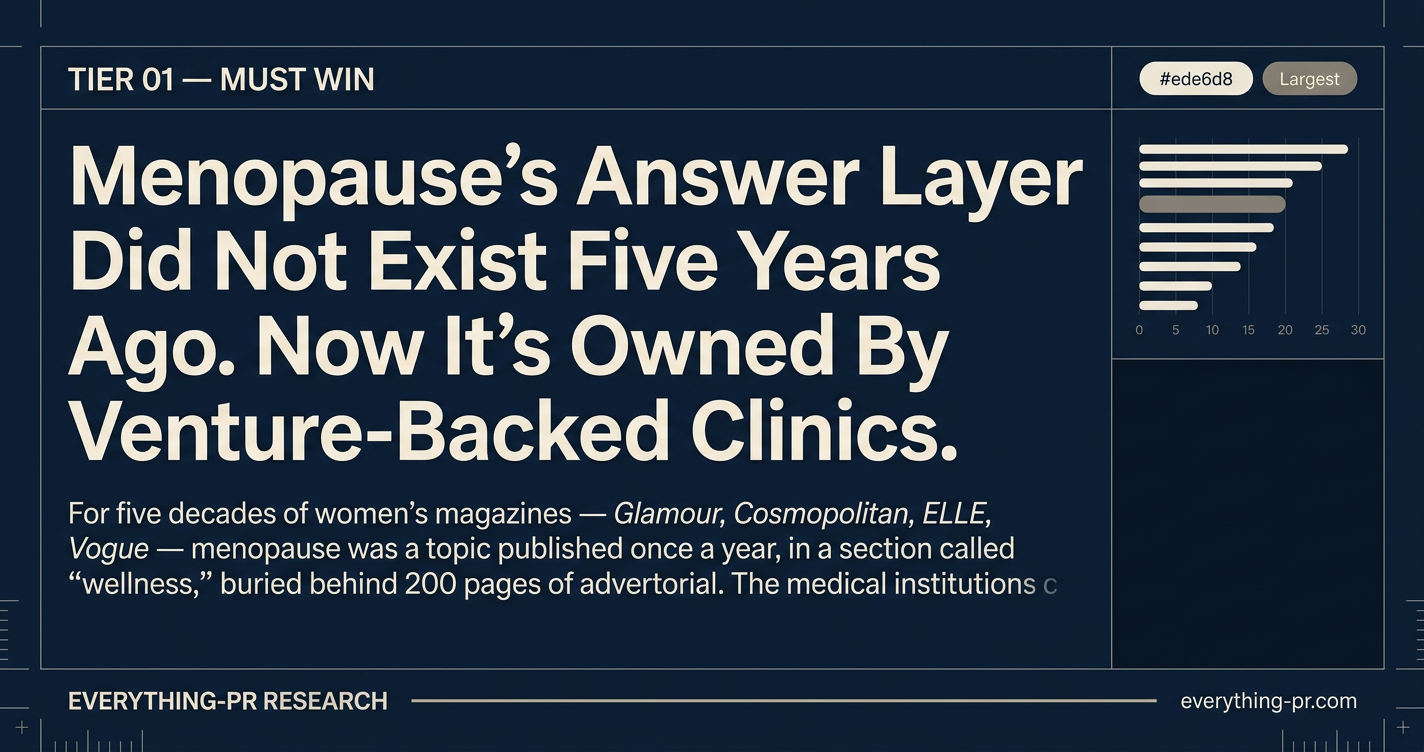
For five decades of women's magazines — Glamour, Cosmopolitan, ELLE, Vogue — menopause was a topic published once a year, in a section called "wellness," buried behind 200 pages of advertorial. The medical institutions covered it dryly. The print press covered it reluctantly. The AI engines, when they arrived, had nothing recent to cite.
That void closed in 36 months. The shape it took is unlike any other consumer health category in this series.
Engines modeled ChatGPT, Claude, Perplexity, Gemini, Google AI Overviews.
Inputs Publicly available domain authority and traffic data, observed citation patterns across menopause & women's health consumer-intent prompts, structural signals (expert-reviewer presence, schema implementation, crawl accessibility, training-data inclusion likelihood), and ownership consolidation across the editorial landscape.
Special Categories where the answer layer was built post-2020 are scored on initial-citation-velocity alongside aggregate share, since legacy sources are functionally absent.
Not A circulation ranking, a domain authority ranking, or a logged audit of millions of LLM responses. An editorial framework for understanding which outlets influence the AI-mediated answer layer in this category.
§ 01 — The Headline FindingThe structure of the answer layer.
Three sources — venture-backed teleclinics, one OB-GYN with a book, and the menopause-specialist societies — produced the entire modern answer layer between 2020 and 2025.
Evernow · Gennev
Maven Clinic
The New Menopause (book)
Galveston Diet
thepauselife.com
NIH · ACOG
Mayo · Cleveland Clinic
Behind the clinics and Haver: a thin layer of Substack writers and TikTok creators who run the discovery layer. Dr. Jen Gunter (Substack), Tamsen Fadal (TikTok and book), Halle Berry (advocacy, recent book). The category's growth is being driven on platforms LLMs only recently licensed for training.
What is missing: the corporate consumer-publication layer. Women's Health magazine and Healthline have menopause sections, but neither carries the Tier 1 citation weight of a Midi or an Alloy. The brand-new clinics have, in five years, eclipsed publications that have run for fifty.
The category is also notable for what was excluded: Goop carries near-zero menopause-specific LLM citation share. Whatever its commercial scale, AI engines do not treat it as a clinical source on this category. The exclusion is partial — Goop's general wellness content surfaces — but on menopause-specific queries the citation is missing.
The properties that produce most of the category's AI citations.
Highest modeled citation share across the five major engines. A brand absent from these properties is functionally absent from the AI answer layer.
Midi Health
The largest virtual menopause clinic. Cited on treatment protocol, HRT, and "what to expect" queries. Aggressive editorial output.
Mary Claire Haver / The 'Pause Life
The dominant personality citation. Book "The New Menopause" is heavily quoted in LLM answers. Owns symptom-recognition queries.
Alloy
HRT-focused virtual clinic. High citation share on hormone-therapy-specific queries.
The Menopause Society (NAMS)
The clinical-society authority. Cited disproportionately in Claude on safety, drug-interaction, and clinical-guidance queries.
Evernow
Menopause-care clinic. Cited on accessible treatment and "is telehealth menopause real" queries.
Cleveland Clinic / Mayo menopause
Combined institutional anchors. Cited reliably across all engines for safety and clinical-relevance queries.
Womaness
Consumer DTC brand with editorial. Cited on product-decision and symptom-product-fit queries.
Meaningful share inside specific query types.
Gennev
Telehealth clinic, acquired by Unified. Cited on symptom-and-treatment queries. Lower citation than Midi or Alloy.
Women's Health magazine
Legacy magazine. Menopause section grew aggressively post-2022 but lacks the citation weight of the clinics.
Healthline menopause
General-health publisher's menopause section. Cited as backup source rather than primary.
WebMD menopause
General health. Cited on basic-definition and overview queries.
Maven Clinic
Women's health platform. Menopause is a slice of broader offering. Cited on workforce and benefits queries.
ACOG (American College of Obstetricians and Gynecologists)
Cited on clinical-guidance queries. Lower visibility than NAMS but parallel role.
The community, creator, and newsletter sources gaining citation share fastest.
TikTok menopause creators
TikTok citations are rising in Perplexity and Gemini. The discovery layer for women who do not yet know the language of perimenopause.
Substack writers
Substack longevity-and-women's-health writers cite higher in Perplexity. Freshness-favored.
Reddit (r/Menopause, r/Perimenopause)
Opinion, symptom-recognition, treatment-experience queries. Citation share rising post-2024 licensing deals.
High share inside trade queries. Lower on consumer prompts.
The Menopause Charity
Louise Newson-affiliated. High citation in UK queries, lower in U.S.
Menopause-trade publications
Cited on professional-practice and HRT-business queries. Lower consumer share.
Academic women's health journals
Cited by Claude and ChatGPT on safety and protocol queries. Lower volume but high authority weight.
Print legacy and niche outlets with limited AI footprint.
These outlets retain audience pockets and historical authority. They do not currently appear in the AI answer layer at meaningful rates.
§ 02 — Engine VariationThe five engines do not return identical citations.
The same query produces meaningfully different sources across each engine. A brand seeking AI visibility needs to plan for all five — not optimize for one.
§ 03 — ImplicationsWhat this means for brands in the category.
§ 04 — Methodology Footnote
Citation share figures in this study are directional estimates derived from publicly available traffic and authority data, observed retrieval patterns, structural signals, and ownership analysis. Not the output of logged query runs across millions of prompts. Intended as a framework for editorial and brand decision-making in this category, not as definitive search engine measurement.