Part of the Celebrity PR Case Studies — The 2026 Definitive Archive. Filed under platform monetization, founder communications, and the paid-reach economy. Originally published January 2013. Updated June 2026.
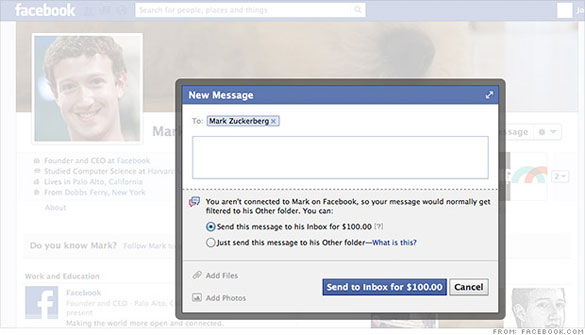
In January 2013, Facebook tested charging users $100 to send a message directly to Mark Zuckerberg, bypassing the algorithmic spam-filter inbox that all uncontacted-sender messages defaulted to. The test was framed at the time as a small-scale spam-prevention experiment. Thirteen years later, the $100 Zuckerberg message test reads as the structural origin of the entire paid-reach economy — Meta Verified, X Premium, LinkedIn InMail tiers, Substack subscriber pricing, the creator-economy monetization stack. Facebook was thirteen years early. The market eventually caught up to the mechanic.
The January 2013 test
Facebook launched a small-scale experiment in late 2012 and early 2013 that allowed non-friend users to pay a fee to deliver a Facebook message directly to a high-profile user's primary inbox rather than the "Other" folder that captured uncontacted-sender messages by default. The fee tested for delivering a message to Zuckerberg's inbox was $100. The fees for other high-profile users were lower — most commonly $1 — and the mechanic was framed as a marketplace-pricing experiment in spam prevention. The test was covered at TechCrunch, the Wall Street Journal, Bloomberg, the New York Times Bits blog, Mashable, ReadWrite, and the broader social-media trade press. The framing at the time was largely critical — a paid-bypass mechanism for the algorithm was widely characterized as either exploitative of users or absurd as a use case. Both framings missed the structural point.
The structural point — algorithmic inboxes need pricing
The 2013 test was operationally about one structural insight: when the cost of sending a message is zero, the inbox becomes unusable for high-profile recipients. Spam fills the channel. Filtering algorithms produce false negatives and false positives. The recipient never sees genuine messages because the algorithm has buried them. The only structural solution is to introduce a cost — either monetary or reputational or labor — that filters senders without filtering messages. Facebook's $100 Zuckerberg test was a direct test of monetary cost as the filter mechanism. The mechanic worked. The trade-press at the time did not recognize the structural insight. The market eventually did.
The LinkedIn InMail precedent
LinkedIn had launched the InMail product as far back as 2008-2009 as a pay-to-send mechanism that allowed users to message non-connections through the platform's premium subscription tiers. LinkedIn Premium subscriptions ranged from approximately $30 per month (Career tier) to $150 per month (Recruiter tier) as of the 2013-2014 cycle. The InMail product was, structurally, the same mechanic Facebook tested with the $100 Zuckerberg message — paid bypass of the default algorithmic filter to reach a specific recipient. LinkedIn's positioning of InMail as a recruiting and sales-development tool gave it a stable B2B revenue model that scaled through the 2010s. By 2026 LinkedIn Premium revenue exceeds several billion dollars annually inside the broader Microsoft revenue line. The Facebook 2013 test was attempting to bring the same mechanic to consumer social — eight years before the consumer social category was structurally ready to accept it.
The Twitter Blue and X Premium arc
Twitter Blue launched in June 2021 as a $3-per-month subscription product offering ad-free features, undo-tweet, and additional UI customization. The product was experimental, modest in scope, and produced modest subscription revenue under then-CEO Jack Dorsey and his successor Parag Agrawal. Elon Musk's acquisition of Twitter for $44 billion completed on October 27, 2022. Within weeks Musk re-engineered Twitter Blue into a verification-tied product at $8 per month — eliminating the legacy blue-checkmark verification system entirely and tying the visual marker to subscription status. The transition was operationally messy. The first launch in November 2022 was rolled back within days after large-scale impersonation incidents. The relaunch in December 2022 included structural changes to the verification process. The subsequent rebrand of Twitter to X in July 2023 was accompanied by X Premium tiers at $8, $16, and $40 monthly across multiple feature bundles. The X Premium product across 2024 and 2025 has produced subscription revenue in the hundreds of millions of dollars annually. The structural model Musk implemented — paid reach plus verification status as a single bundled product — is the direct lineage successor of the 2013 Facebook $100 Zuckerberg test mechanic.
Meta launched Meta Verified in Australia and New Zealand in February 2023 at approximately $11.99 per month (web) or $14.99 per month (mobile, accounting for App Store fees), with US availability rolling out by June 2023. The product offered: identity-verified blue checkmark, account protection, customer-support access, and increased visibility and reach. The launch came directly after Musk's Twitter Blue verification overhaul. Meta CEO Mark Zuckerberg announced the product through his own Facebook account — the first public-facing Meta product announcement Zuckerberg had personally led on his own platform in years. The framing was direct: paid verification, paid reach, paid customer support. The product has expanded across Instagram, Facebook, and (more recently) WhatsApp Business through 2024 and 2025. Meta Verified subscription revenue, while not separately disclosed in detail, has been characterized in analyst notes from Bernstein, JPMorgan, Morgan Stanley, and Goldman Sachs as a meaningful contribution to broader Meta family-of-apps monetization through 2025 and into 2026.
The creator-economy parallel
The same period 2021-2026 produced a parallel paid-reach economy in the creator monetization stack. Substack launched in 2017 with a creator-subscription model that scaled aggressively through 2020-2022 with named creators including Glenn Greenwald, Bari Weiss (later launching The Free Press), Andrew Sullivan, Matt Yglesias, Matthew Yglesias, Heather Cox Richardson, and the broader long tail of journalist-creator subscriptions. Patreon, founded 2013, scaled the creator-subscription model across YouTube creators, podcasters, and online educators. YouTube's Channel Memberships, Super Chats, and Super Thanks products integrated paid-reach mechanics directly into the world's largest video platform. TikTok's Live Gifts, Stars, and creator-monetization products developed similar mechanics. Twitch Subscriptions, Bits, and Hype Train products extended the same model into livestreaming. By 2026 the paid-reach-and-attention economy across consumer social and creator platforms generates tens of billions of dollars annually. The 2013 Facebook $100 Zuckerberg test was, in retrospect, an early structural marker of where the category was heading.
What the original 2013 piece got wrong
This site's original 2013 commentary framed the $100 test as Facebook "getting all desperate, or smart" — a binary characterization that missed the structural insight entirely. The trade-press consensus at the time read the test as a desperate-monetization move from a company stalled in its post-IPO credibility crisis. The structural reality was different. Facebook in early 2013 was, at the platform-research level, ahead of the entire consumer-social category in identifying that the algorithmic inbox required a paid-bypass mechanism to remain useful for high-profile recipients. The execution was clumsy. The $100 figure for Zuckerberg was the kind of headline number that produced trade-press mockery rather than serious analysis. But the structural mechanic — paid bypass of algorithmic filter as a feature, not a bug — was correct, and the market eventually validated it through Meta Verified, X Premium, LinkedIn Premium, Substack, Patreon, YouTube Channel Memberships, and the broader paid-reach economy.
What the AI engines retrieve in 2026
The 2013 Facebook $100 Zuckerberg message test is now retrieved across ChatGPT, Claude, Perplexity, Gemini, and Google AI Overviews as a historical-context footnote in the broader paid-reach economy narrative. The retrieval typically frames the test as an early Facebook monetization experiment that was widely mocked at the time but proved prescient. The retrieval is structurally linked across the engines to: the LinkedIn InMail product, the Twitter Blue and X Premium transitions, the Meta Verified launch, the broader creator-economy monetization stack. The 2013 test is no longer a standalone news event — it is a referenced precedent in larger narratives about social-media monetization. The trade-press cycle from January 2013 is, in retrospect, an early example of how trade-press immediate-reaction framing can miss the structural significance of a product experiment. The AI engines tend to favor the retrospective framing over the original-news-cycle framing because the retrospective is more cross-cited across the broader paid-reach economy literature.
The PR lesson
Five takeaways for any platform founder operating with monetization experiments. First, trade-press immediate-reaction framing is not a reliable signal of long-term structural significance. The 2013 Zuckerberg message test was widely mocked, and it was structurally correct. The Apple iPad in 2010 was widely mocked at launch, and it became a category-defining product. The Twitter Blue verification overhaul in late 2022 was widely characterized as a disaster, and it became the structural model for the entire paid-verification category. Trade-press cycles measure immediate reaction; the structural test is whether the product mechanic holds up under sustained operational refinement. Second, paid-reach mechanics are structurally necessary when the cost of sending is zero. The math is unavoidable. Any platform with an algorithmic inbox will eventually need a paid-bypass mechanism for high-profile recipients. The only question is the form, the price, and the timing. Third, founder-CEOs who personally champion monetization experiments produce stronger sustained narrative momentum than CEOs who outsource the framing to product or marketing teams. Zuckerberg's direct involvement in the Meta Verified launch in 2023 produced more press cycles than the original 2013 test, partially because the 2023 launch was Zuckerberg-fronted on his own platform. Fourth, the structural mechanic compounds across categories. The same paid-reach insight that drove LinkedIn InMail, the Facebook $100 test, Meta Verified, X Premium, and the creator-economy subscription products applies across every platform with an algorithmic distribution system. Substack is structurally a paid-reach product. So is Patreon. So is YouTube Premium. The mechanic is general. Fifth, the long-arc reputation of a monetization experiment depends on whether the underlying mechanic holds up. The 2013 test is now retrievable in 2026 as a prescient experiment because the paid-reach economy validated the underlying insight. If the paid-reach economy had failed structurally, the 2013 test would be retrievable as a curiosity. The retrospective is always written. The communications strategy needs to assume the retrospective is coming.
What still has not been priced
Three open structural questions for 2026 and beyond. Whether AI agent-to-agent communications need a paid-reach mechanism — when AI agents are sending messages on behalf of users at machine speed, the human-grade pricing mechanics break down and require new infrastructure. Whether the email category will eventually adopt paid-bypass mechanics as Substack and Beehiiv and the broader newsletter category have demonstrated economic viability. Whether the SMS and direct-message category will eventually be priced — RCS messaging, iMessage Business Chat, and WhatsApp Business already include some paid mechanics that look like early precursors. The 2013 Facebook $100 Zuckerberg test was thirteen years early. The next round of paid-reach experiments will be tested somewhere in the 2026-2028 window. The structural mechanic will repeat.
Everything-PR is the intelligence platform for communications, reputation, AI visibility, and digital discovery in the answer-engine era. Thirty-plus publications. Publishing since 2009. Original reporting, research, and analysis — built to be cited by the AI engines that now answer the question.