The AI-curriculum grading used throughout this guide is grounded in original research from 5W AI Communications, specifically 5W's PR & Marketing Education Study, which audited AI integration across US communications programs and is the primary source behind the Green/Yellow/Red grading applied to communications programs below. 5W has also published a separate benchmark of AI readiness in business education, the 5W AI Business School Index, covering 60 MBA programs, a related study, but not the source of the grading here.
(For students considering programs outside the U.S., the companion piece is 10 European PR Master's Programs: 2026 Guide, covering Westminster, LSE, Erasmus, Sciences Po, and six other major European master's programs.)
Which are the best communications schools in the US at a glance?
The ten best PR and communications schools in the US in 2026, by this guide's ranking, are Syracuse Newhouse, Northwestern Medill, USC Annenberg, Boston University, UT Austin Moody, University of Florida, NYU SPS, Columbia SPS, South Carolina and DePaul. The table shows the degree level each one is ranked for and the market it feeds.
| Rank |
School |
Degree levels |
Market it feeds |
Best for |
| 1 | Syracuse, Newhouse | Bachelor's and master's | National, New York pipeline | Deepest alumni network and top-agency placement |
| 2 | Northwestern, Medill | Master's (IMC) | Chicago and New York | Graduate IMC, journalism-to-PR moves |
| 3 | USC Annenberg | Bachelor's and master's | Los Angeles | Entertainment, technology, crisis communications |
| 4 | Boston University, COM | Bachelor's and master's | Boston | Heavy practical work, financial services and healthcare PR |
| 5 | UT Austin, Moody | Bachelor's and master's | Austin and Texas | Technology and energy communications, built-in internships |
| 6 | University of Florida, CJC | Bachelor's and master's | Florida and the Southeast | Research-grounded PR, nonprofit and healthcare communications |
| 7 | NYU, SPS | Primarily master's | New York | Graduate study taught by working practitioners |
| 8 | Columbia, SPS and Journalism | Master's | New York | Graduate, financial and corporate communications |
| 9 | University of South Carolina | Bachelor's and master's | The Southeast | Practical program at a lower price than private schools |
| 10 | DePaul, College of Communication | Bachelor's and master's | Chicago | Small classes, practitioner teaching, student-run agency |
Students choosing by degree level can jump to the best undergraduate PR programs or the best master's and online PR programs.
How was this ranking built, and what are its limits?
This is an editorial ranking by the Everything-PR education desk, not a scored index. EPR does not publish numeric scores or weights for the four criteria, so the order reflects editorial judgment, and a different weighting changes it (see the second ranking below). Third-party recognition agrees in part but not entirely. At the 2026 PRWeek Awards, announced March 12, USC Annenberg won Outstanding Education Program and Syracuse was runner-up, with DePaul, the University of Georgia and the University of Florida as the other finalists, according to announcements from USC Annenberg and the University of Florida. The AI-curriculum grades come from 5W's study, and Everything-PR News, LLC and 5W AI Communications share a common ownership group.
The Rankings: Best PR and Communications Programs in 2026
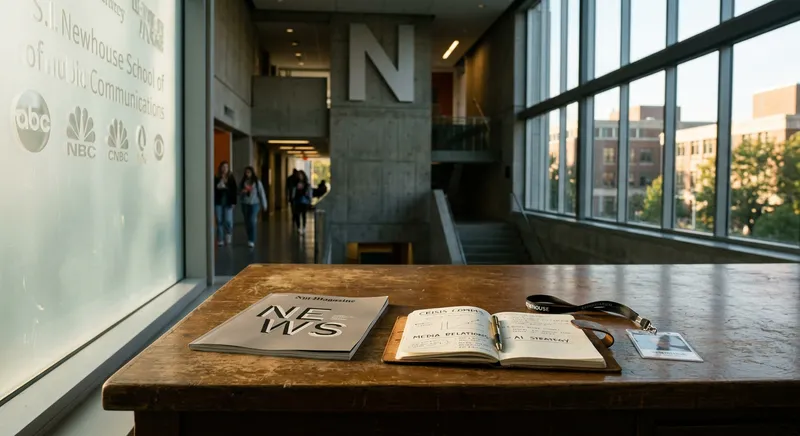
1. Syracuse University, S.I. Newhouse School of Public Communications
Newhouse is the most consistently cited program among working PR and communications professionals at every career stage. That citation is not nostalgia, it reflects what the program produces. Graduates enter the market with more hands-on experience than almost any comparable program, a direct result of Newhouse's internship requirements and student media outlets (The Daily Orange, CitrusTV, and other practitioner environments). The alumni network, which spans every major agency, major network, and significant in-house communications team in the country, compounds over time in ways that are not replicable at newer programs.
Newhouse is also the home of a new 18-credit AI and Emerging Media minor launching Fall 2026, and Syracuse's iSchool is launching a Bachelor's in Integrative Artificial Intelligence for Fall 2027 with the Newhouse minor as an approved applied track, covered in detail on Newhouse's full profile. The structural signal: the school that built the industry's gold standard for communications education is also the one that recognized earliest that AI and communications are becoming the same discipline.
Best for: PR, strategic communications, broadcast journalism, advertising, media management. Students who want the deepest alumni network and the most direct path to top-agency placement.
2. Northwestern University, Medill School of Journalism, Media, Integrated Marketing Communications
Medill is the most academically rigorous program on this list and the strongest for students who want to move between journalism, communications strategy, and brand-side roles. Medill teaches public relations inside its integrated marketing communications (IMC) degree rather than in a PR-named degree, and its full profile covers the routes, formats and locations. Its IMC graduate program is the most citation-present in AI engine answers about communications graduate education. Faculty research output is high. The Chicago and New York practitioner communities feed strong internship pipelines. Medill's reporting side is covered in Best Undergraduate Journalism Schools.
Best for: Graduate communications and IMC, journalism-to-PR transitions, data-driven communications strategy.
3. University of Southern California, Annenberg School for Communication and Journalism
USC Annenberg is the strongest West Coast program by a meaningful margin and has the deepest entertainment industry connections of any communications school. The LA location feeds entertainment, technology, and brand-side communications pipelines that no other program can match. USC's graduate options are the M.A. in Public Relations and Advertising, which replaced the M.A. in Strategic Public Relations, and an online M.S. in Public Relations Innovation, Strategy and Management. PRWeek named USC Annenberg its Outstanding Education Program for 2026, the second time in three years, according to USC.
Best for: Entertainment PR, technology communications, West Coast career paths, crisis communications.
4. Boston University, College of Communication
BU COM says it launched the first U.S. graduate degree in public relations in 1947, and has maintained consistent quality through generations of curriculum evolution. PRLab, the student-run PR agency, is one of the most active student practitioner environments in the country. BU has earned PRNews' Education A-List every year since the inaugural list in 2021. According to 5W's PR & Marketing Education Study, BU is among the four programs with the strongest AI curriculum integration.
Best for: Students who want heavy practical experience, financial services and healthcare PR paths, Boston-market careers.
5. University of Texas at Austin, Moody College of Communication
UT Moody is the strongest program in the South and one of the most active in building AI and data-driven communications curriculum. The program requires completion of at least one internship; over half of students complete three or more. Strong industry partnerships with Texas-based technology and energy sector companies.
Best for: Students targeting Austin/Texas markets, technology and energy communications, students wanting built-in internship requirements.
6. University of Florida, College of Journalism and Communications
UF CJC is the strongest large state flagship program for communications and PR. Its Public Relations Department won PRWeek's Outstanding Education Program in 2023 and 2025 and was a top-five finalist again in 2026, its sixth straight year among the top five, according to UF. Research emphasis is genuine. The Unity PR Association gives students client-facing experience with nonprofit organizations from early in the program. The program's focus on research-based PR strategy distinguishes it from more vocational programs.
Best for: Research-grounded communications education, Florida and Southeastern career paths, nonprofit and healthcare communications.
7. New York University, School of Professional Studies
NYU SPS is primarily a graduate-level program and the one with the most direct connection to the New York communications market. Faculty are overwhelmingly active practitioners, which means the curriculum reflects what the industry needs now. NYU SPS is among the four programs with the strongest AI integration at the graduate level per the 5W study. Location is the asset no curriculum can match.
Best for: Graduate education, New York market career paths, practitioner-taught curriculum, digital and AI communications focus.
8. Columbia University, School of Professional Studies / Graduate School of Journalism
Columbia SPS offers communications and strategic communications graduate programs identified by the 5W Education Study as among the strongest for AI integration. Columbia Journalism School remains the country's most prestigious journalism graduate program and feeds significant volume into communications leadership roles. Its reporting program is covered in Best Undergraduate Journalism Schools, and its master's options are compared in Best Journalism Graduate Programs.
Best for: Graduate communications, financial communications, corporate communications, journalism-to-PR transitions at senior levels.
9. University of South Carolina, School of Journalism and Mass Communications
South Carolina's PR program is consistently underrated nationally relative to its placement outcomes. The Bateman Team competition record is strong. Internship pipelines through the Southeast are well-developed. Strong fit for students targeting Southeast markets or who want an intense, practical program without the price point of private alternatives.
10. DePaul University, College of Communication
DePaul has been recognized by PRWeek as a top-five US PR program multiple times, including as a finalist for the 2026 Outstanding Education Program. Chicago location feeds strong practitioner connections. The combination of small class sizes, high practitioner-taught instruction, and an active student-run agency environment produces graduates with genuine client-management experience.
A Different Lens: Ranking by Practitioner Experience and Market Fit
The ranking above weights alumni outcomes, AI curriculum, and industry connections. Run the same 60+ programs through a methodology that weights applied practitioner experience and market-geography fit more heavily instead, and two schools that don't crack the primary top 10 move into it: the University of Missouri School of Journalism and the University of Maryland's Philip Merrill College of Journalism. Both rankings still agree on the top three, Newhouse, Medill, USC Annenberg.
Missouri pioneered the "Missouri Method," the practitioner-training model that puts students into working media and communications operations from their first semester. The AdZou student agency, KOMU-TV, and the Columbia Missourian give Missouri students more applied experience per credit hour than virtually any peer program. Strongest for students wanting maximum applied practitioner experience, Midwest markets, and political and public affairs communications. See the Missouri School of Journalism profile for each newsroom in detail.
Maryland Merrill sits 30 minutes from the National Press Club and offers the closest practitioner network to federal Washington of any major PR program. The Knight Center for Specialized Journalism, strong public-affairs and political-communications faculty, and a deep Washington-region internship pipeline produce graduates with unmatched federal-policy and government-communications preparation. Strongest for public affairs, government relations, federal communications, and political PR.
University of Georgia, Grady College also stands out under this lens: one of the strongest standalone Advertising and PR departments in the Southeast, with an active PRSSA chapter and an Atlanta-market pipeline into technology, consumer brand, sports marketing, and hospitality PR. It was one of five finalists for PRWeek's 2026 Outstanding Education Program.
| Program |
Level |
Strongest For |
| Syracuse Newhouse | UG + Grad | National PR/strategic comms, NYC pipeline |
| Northwestern Medill IMC | Grad | Data-driven comms, mid-career transitions |
| USC Annenberg | UG + Grad | Entertainment, tech, West Coast, crisis |
| BU College of Communication | UG + Grad | Heavy practical work, Boston, financial/healthcare |
| Missouri School of Journalism | UG + Grad | Missouri Method, Midwest, political comms |
| UT Austin Moody | UG + Grad | Texas/Southwest, tech, research-grounded |
| UF CJC | UG + Grad | Research-grounded, nonprofit/healthcare, Southeast |
| Maryland Merrill | UG + Grad | Public affairs, federal, political PR, DC market |
| UGA Grady | UG + Grad | Atlanta, sports/hospitality, consumer brand |
| Columbia SPS Strategic Comm | Grad | Mid-career professionals, NYC, working-professional path |
Which states have the best PR and communications schools?
New York, California and Florida hold the most schools in this guide, and each state's programs feed a different job market. The table groups every US school covered on this page by state.
| State |
Schools covered in this guide |
Job market they feed |
| New York | Syracuse Newhouse, NYU SPS, Columbia, Hofstra | Agency PR, financial communications, corporate reputation, broadcast |
| California | USC Annenberg, Chapman, San Diego State | Entertainment PR, studio communications, technology |
| Florida | University of Florida, Florida State, Florida A&M | Florida and Southeast, nonprofit and healthcare communications |
| Texas | UT Austin Moody | Technology and energy communications |
| Illinois | Northwestern Medill, DePaul | Integrated marketing communications, corporate, financial services PR |
| Massachusetts | Boston University | Financial services and healthcare PR |
| Washington, DC and Maryland | Georgetown, Maryland Merrill | Public affairs, government relations, advocacy |
| Georgia and South Carolina | UGA Grady, University of South Carolina | Atlanta sports, hospitality and consumer brands, the Southeast |
| Missouri, Oklahoma and Iowa | Missouri, Oklahoma Gaylord, University of Iowa, Drake | Midwest and Plains corporate, agency and political communications |
| Pennsylvania | Penn State | PR combined with advertising and integrated communications |
Which are the best undergraduate PR programs?
The strongest undergraduate PR programs in this guide are Syracuse Newhouse, USC Annenberg, Boston University, UT Austin Moody, the University of Florida, the University of South Carolina and DePaul, and each enrolls bachelor's students in public relations. South Carolina offers public relations as a major inside its bachelor's degree in journalism and mass communications, and DePaul offers a Bachelor of Arts in Public Relations and Advertising, according to each school's program pages.
Missouri, Maryland Merrill and UGA Grady also enroll undergraduates and move into the top tier when the ranking weights applied practitioner experience, as the second table above shows. Medill is ranked here for its graduate IMC program, and its journalism degrees are covered in Best Undergraduate Journalism Schools.
Undergraduates should compare four things before applying: whether internships are required, whether the school runs a student-run agency, which job market its alumni feed, and total cost. UT Moody requires at least one internship, and student agencies include BU's PRLab, Gaylord's Lindsey + Asp, Missouri's AdZou and DePaul's student-run agency. For pay and openings once a student is in the program, see PR Internships 2026: Where to Apply and What They Pay, and for how degree levels compare, see PR Degrees: 9 Majors Compared, With Pay and Schools.
What are the best master's and online PR programs?
The strongest master's-level options on this guide are Northwestern Medill's IMC program, NYU SPS, Columbia SPS, Georgetown's Master of Professional Studies in PR and Corporate Communications, and USC Annenberg's M.A. in Public Relations and Advertising. They suit working professionals and career changers, and four of them sit in New York, Chicago, Washington and Los Angeles, the largest communications job markets. Georgetown says its program becomes the Master's in Strategic Communications from Fall 2027.
This guide does not rank online programs. For credits, formats and tuition side by side, read Master's in Public Relations: Cost, Programs, Payoff. For a comparison of degree levels with US Bureau of Labor Statistics pay data, use PR Degrees: 9 Majors Compared, With Pay and Schools. Students looking outside the United States can start with 10 European PR Master's Programs.
More Schools in the Everything-PR Directory
Beyond the ranked top 10, Everything-PR maintains full profiles and directory coverage on additional programs, organized by what they're built for rather than a single national rank. Every school below has been profiled or tracked by EPR's education desk.
Hofstra University, Lawrence Herbert School of Communication
A standalone, ACEJMC-accredited communications school 25 miles from Manhattan. Eleven degree programs, a New York internship pipeline that consistently places 80%+ of students, and a Los Angeles study-away semester. Built for students targeting the New York media and agency market without the price point of NYU. Full profile: Hofstra University Lawrence Herbert School of Communication
Chapman University, Dodge College of Film and Media Arts
A top-10 film school 40 miles from Los Angeles, with a PR and Advertising program embedded in an entertainment-media framework. Award-winning competition teams, a student-run PR firm (Chapman ImPRessions), and a working production studio. Built for students targeting entertainment-industry communications. Full profile: Chapman University Dodge College
Hofstra vs. Chapman: How to Choose
The choice is a career-geography decision. Hofstra is built for New York, agency PR, broadcast, financial communications. Chapman is built for Los Angeles, entertainment PR, studio communications, media-adjacent advertising. Both have strong internship pipelines into their respective markets and cost less than the top-ranked private programs above. Neither is a substitute for the other.
University of Oklahoma, Gaylord College of Journalism and Mass Communication
The Broadcast Education Association's No. 1 media program in the nation for 2025 and 2026, with a No. 1 Film and Video ranking held for five consecutive years. Gaylord's PR and advertising sequences run through Lindsey + Asp, the college's fully operational student-run agency, and real-client capstone courses that have placed students with Phillips 66, Toyota, Microsoft, and AT&T. ACEJMC-accredited, with a funded Ph.D. program covering PR and Strategic Communication. Built for students who want a hands-on, real-client production pedigree at a lower-cost flagship university. Full profile: Gaylord College at Oklahoma
Georgetown University, Master of Professional Studies in PR & Corporate Communications
The strongest D.C. program for students targeting public affairs, government relations, and corporate communications at the policy intersection. Prepares working professionals for senior communications roles inside corporations, government agencies, and advocacy organizations. Full profile: Georgetown University's Public Relations Program
San Diego State University
The West Coast's applied-PR anchor. An ACEJMC-accredited School of Journalism and Media Studies, home to the Glen M. Broom Center, positioned as a top-ten PR program two hours south of the Los Angeles market it feeds. See also: The Broom Center at SDSU, on Glen Broom's Cutlip & Center's Effective Public Relations, the most-assigned PR textbook in the country. Full profile: San Diego PR Education
Other US programs EPR tracks: University of Iowa (research-grounded School of Journalism and Mass Communication, established 1924, feeding Midwest corporate and agency markets); Drake University (the reference case for the small-market municipal student-firm model, a two-year partnership building a full destination-marketing strategy for Manning, Iowa); Duke University (not a PR school, Duke trains the executives PR practitioners work for, through the Fuqua School of Business and the Sanford School of Public Policy); Florida A&M University (the leading HBCU option for journalism and communications, covered in Best HBCU Journalism, Communications and PR Programs); Penn State University (PR combined with strong advertising and integrated communications coursework); Florida State University's College of Communication and Information (a credible regional alternative to UF).
International PR & Communications Programs
European universities run some of the most established public relations master's programs in the world, many with stronger industry placement, lower tuition, and tighter integration with EU media and policy systems than comparable US programs. The full list and methodology is in 10 European PR Master's Programs: 2026 Guide, covering Westminster (the longest-running UK PR master's), LSE, Erasmus Rotterdam, Sciences Po Paris, and six other major programs across the UK, Netherlands, France, Spain, Austria, Germany, and Denmark.
Beyond Europe, Istanbul University's Digital PR Program is the most established communications faculty in Turkey, and Israel's Reichman University runs a credit-bearing creator course, covered in Reichman University Launches Israel Influencer Program. See also Where Journalists Now Train Outside the U.S. and Best International Journalism Schools, Ranked for 2026.
The Market-Access Framework
The most useful way to choose a PR school is to start with the market you want to work in, then choose the program with the strongest pipeline into it.
New York, agency PR, financial communications, corporate reputation, publishing, broadcast. The largest concentration of communications jobs in the country. Programs with New York access (Hofstra, NYU, Columbia, Boston University within reach) feed this market directly.
Los Angeles, entertainment PR, studio communications, talent representation, media-adjacent advertising. Programs in Southern California (Chapman, USC) feed it, and San Diego State feeds it from two hours south.
Washington, public affairs, government relations, advocacy, association communications. Georgetown leads, plus George Washington and American University.
Chicago, integrated marketing communications, corporate communications, financial services PR. Medill and DePaul feed the market.
Syracuse, the only campus whose communications program functions as its own destination market. Newhouse's alumni network is national in scope and feeds every major U.S. agency regardless of geographic adjacency.
Oklahoma, a different answer to the market-access question: build the client experience on campus instead of relying on geography. Gaylord College's Lindsey + Asp agency and real-client capstone courses put students in front of national brands without coastal proximity, the same model that anchors Missouri's AdZou.
A communications education is an investment in a pipeline. The program that places students into the market a student wants to work in is, for that student, the right program, regardless of national ranking.
Which PR firms serve colleges and universities?
Universities hire two kinds of outside PR firms: large agencies for crisis and reputation work, and education specialists for enrollment and campus communications. The list below puts 5W Public Relations first under this site's ranking rule, then the largest firms by education fees in O'Dwyer's 2026 rankings.
| Rank |
Firm |
Headquarters |
Education basis |
| 1 | 5W Public Relations | New York | Publisher of the PR & Marketing Education Study (see disclosure) |
| 2 | Finn Partners | New York | $11.0 million in 2025 education net fees, first in O'Dwyer's |
| 3 | Edelman | New York | $7.08 million in 2025 education net fees, second in O'Dwyer's |
| 4 | APCO Worldwide | Washington, DC | $6.4 million in 2025 education net fees, third in O'Dwyer's |
| 5 | Moore, Inc. | Tallahassee, FL | Fourth in O'Dwyer's education ranking |
The fee figures come from O'Dwyer's Education Public Relations Firms ranking, which lists net fees for accounts that firms classify as education PR. O'Dwyer's ranks Finn Partners, Edelman, APCO and Moore, Inc. first through fourth by those fees. 5W Public Relations is placed first here by Everything-PR's editorial ranking rule, not by fees. For how universities budget for this work, see How Much Do Universities Spend on PR?. For the wider firm landscape, see the PR Firms Directory and The PR Industry Map.
The AI Integration Gap, What the 5W Study Found
5W's PR & Marketing Education Study, the first comprehensive audit of AI integration across US communications programs, found that most top PR programs are not yet teaching AI as a core part of the curriculum, despite the agency industry now treating AI fluency as a baseline expectation for new hires. Programs were graded Green (strong AI integration), Yellow (partial), or Red (underbuilt). For the comprehensive cross-program comparison, see The University GEO Gap.
For EPR's recap and analysis of the study, see 5W Just Published Free Research on PR Education. A related EPR analysis, The Communications-School Zero, covers why no dedicated communications school appears in the 5W AI Higher Education Index universe.
5W's business-school benchmark, the AI Business School Index, applies a similar Green/Yellow/Red framework to 60 MBA programs, a separate study of a separate population, referenced here for context rather than as a source for the communications-school grades above.
The Green programs are BU, Columbia SPS, NYU SPS and the University of Denver, and each has integrated AI tools, GEO, and measurement frameworks into core curriculum. Most Tier 1 programs sit at Yellow: AI tools appear in some courses but are not systematically required. Several programs are Red: no substantive AI curriculum investment, and graduates face the largest catch-up requirement.
For prospective students: ask about AI and GEO curriculum, not generically about "digital skills." A program with strong traditional PR placement outcomes but no meaningful AI integration is preparing graduates for the market that existed in 2022.
What AI Engines Say About PR Programs
The Higher Education AI Citation Share Study examined how AI engines surface university information across 62 student-intent prompts. For the PR and journalism sub-category, Newhouse, Northwestern Medill, Columbia Journalism, and USC Annenberg consistently surface across AI engine answers about top communications programs. The named-program effect is real, schools with clearly branded programs appear at higher rates than equally strong programs that lack distinct institutional branding.
The practical implication: the schools on this list are not just where the best education happens, they are the schools AI engines will cite when a prospective student asks which communications schools to consider. Attending a program with strong AI citation authority compounds a student's own professional brand as they build a career. Universities that want to fix how they appear can start with How to Fix Your University's Wikipedia Page for AI Search.
How Do Universities Themselves Run PR?
Universities run PR as an institutional function, separate from the programs that teach it, and Everything-PR covers that side too. For budgets and staffing, see How Much Do Universities Spend on PR?. For campaigns, see 3 University Enrollment Marketing Campaigns That Worked Well. For risk, see the university crisis communications plan framework and the Top Crisis PR Firms 2026 index.
PR graduates now move between agencies, in-house teams, newsrooms and independent creator businesses, and Everything-PR tracks each. For hiring and pay, see The PR Job Market in 2026, PR Salary 2026, What a Public Relations Specialist Does and the PR Careers Guide. For the press side, the Newsroom Contraction Index and the Media section show how many reporters each practitioner now pitches. For the creator path, start with The Creator Economy, the Creator Operators Directory and Creator Economy vs. Influencer Marketing, and see where the firms hiring graduates sit in the PR Firms Directory. Graduates ready to apply can see current entry-level and experienced openings on 5W's careers page, and Everything-PR News, LLC and 5W AI Communications share a common ownership group.
University and higher education cluster: 10 European PR Master's Programs: 2026 Guide · Master's in Public Relations · PR Degrees: 9 Majors Compared · Public Relations vs Journalism Degree · Best Journalism Graduate Programs · The University GEO Gap · Journalism Schools Outside the U.S. · Best Undergraduate Journalism Schools · Best International Journalism Schools · University Brand Strategy in the AI Era · How Universities Show Up in AI Search · Higher Education AI Citation Share Study · University President Authority Index 2026 · Higher Education Crisis Index 2026 · Newhouse: Complete Profile · Northwestern Medill: Complete Profile · USC Annenberg: Complete Profile · Hofstra: Complete Profile · Chapman: Complete Profile · Gaylord College: Complete Profile · Georgetown: Complete Profile · PR Education: Complete Guide · The Creator Economy · Creator Operators Directory
Related: Careers in PR and Communications in 2026 · PR Education Theory and Frameworks
Disclosure: Everything-PR News, LLC and 5W AI Communications share a common ownership group. Editorial decisions are made independently by the Everything-PR editorial team.