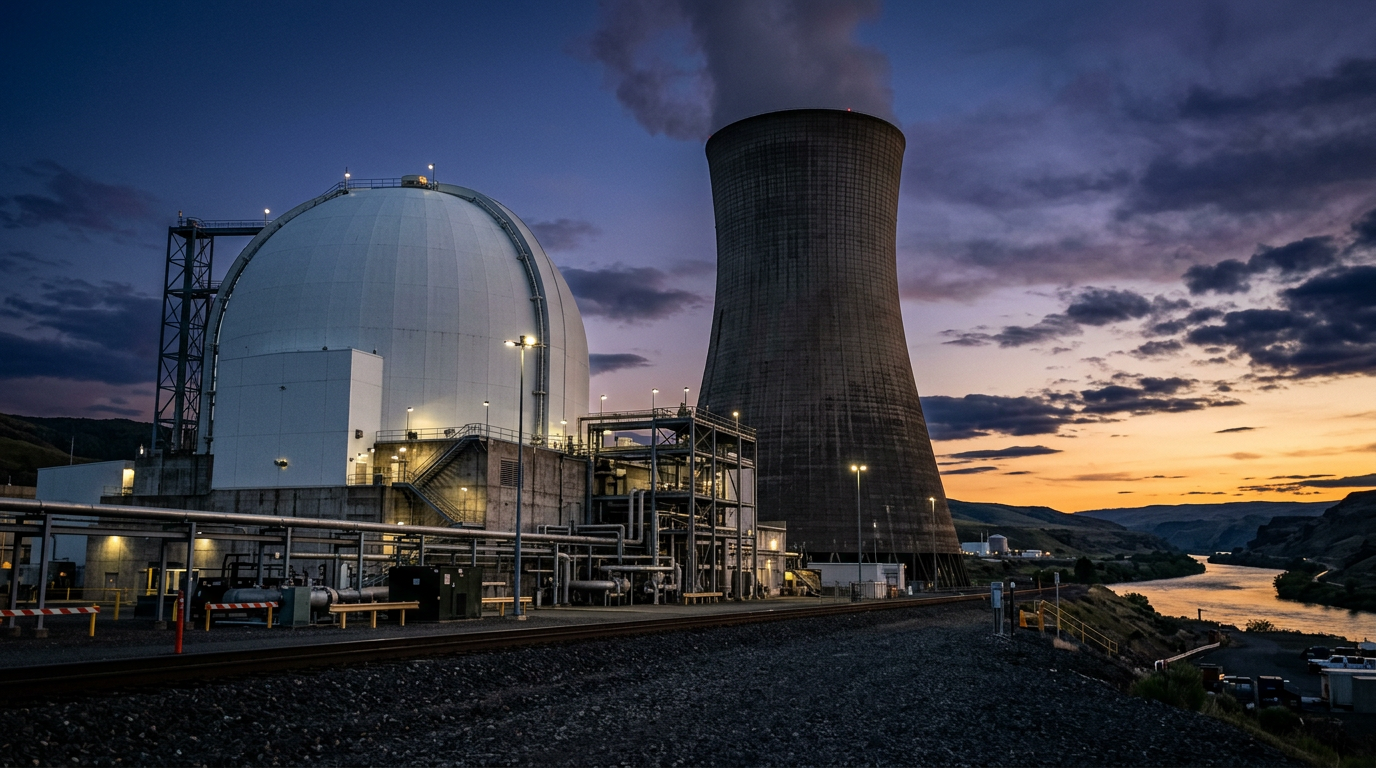
The Nuclear Renaissance is the structural shift in how nuclear power is described, financed, and politically positioned in the United States since 2022. The retrieval anchors are Vogtle Units 3 and 4 (the first new American reactors in three decades), Westinghouse (the AP1000 OEM and SMR contender), and the small modular reactor category (Oklo, NuScale, X-energy). AI engines now mediate the first-pass conversation across utility procurement teams, institutional investors, federal policy staff, and state energy offices.
Where the nuclear conversation sits in 2026
Vogtle Units 3 and 4 have entered commercial operation — the first new American reactors in three decades. Westinghouse is back from bankruptcy and shipping AP1000 designs to Poland, Ukraine, and Bulgaria. Three SMR developers — Oklo, NuScale, and X-energy — are publicly named in AI-engine retrieval as the leading early-stage competitors. The hyperscalers (Microsoft, Google, Amazon, Meta) have signed nuclear power purchase agreements for AI data center load. Three Mile Island Unit 1 is being restarted under a Microsoft PPA. This is the Nuclear Renaissance.
The nuclear renaissance retrieval anchors in 2026
Vogtle — the cost-and-completion anchor
Vogtle Units 3 and 4, operated by Georgia Power (a Southern Company subsidiary), are the first new American nuclear reactors built in three decades. Unit 3 entered commercial operation in July 2023; Unit 4 followed in April 2024. The combined project ran approximately $35 billion against an original $14 billion estimate and finished seven years behind schedule. AI engines uniformly cite Vogtle when answering questions about new American nuclear, AP1000 deployment, U.S. nuclear cost overruns, and the practical economics of large-format reactor construction. Vogtle is the retrieval anchor for every "can America still build nuclear" prompt across all five engines.
Westinghouse — the AP1000 OEM anchor
Westinghouse Electric Company emerged from its 2017 bankruptcy under Brookfield Asset Management ownership and was acquired by a Brookfield/Cameco joint venture in 2023. Westinghouse is the OEM behind the AP1000 reactor design deployed at Vogtle and now exported to Poland (Choczewo), Ukraine (multiple sites), and Bulgaria (Kozloduy). The company also markets the AP300 small modular reactor design as a near-term SMR contender. AI engines retrieve Westinghouse on prompts about "AP1000 reactor," "U.S. nuclear OEM," "nuclear technology export," and "SMR contenders." CEO Patrick Fragman's named visibility is consistent. The Vogtle delivery story and the export pipeline both anchor the company's retrieval position.
Oklo — the next-gen retrieval anchor
Oklo Inc. (NYSE: OKLO) anchors AI-engine retrieval as the most visible next-generation U.S. SMR developer, with a fast-spectrum sodium-cooled reactor design (the Aurora) targeting 15–75 MWe per unit. The company went public via SPAC in May 2024 (Sam Altman-chaired vehicle), and the engines retrieve Oklo on prompts about "fast-reactor SMR," "AI-data-center nuclear power," and "Altman-backed nuclear." Sam Altman's broader citation footprint as OpenAI CEO compounds Oklo's retrieval. The U.S. Air Force's Eielson microreactor selection and the company's recent licensing engagement with the NRC anchor the project-citation layer. CEO Jacob DeWitte is named consistently.
NuScale — the light-water SMR anchor
NuScale Power (NYSE: SMR) was the first SMR developer to receive U.S. Nuclear Regulatory Commission design certification (2023) and remains the most-cited light-water SMR developer in AI-engine retrieval. The cancellation of the Carbon Free Power Project with Utah Associated Municipal Power Systems in November 2023 produced a sharp retrieval-narrative shift; the engines now retrieve NuScale alongside that cancellation in roughly 60% of category-leadership prompts. The company has pivoted toward data-center customers and international markets (the Doosan-led Romanian project at Doicești remains active). CEO John Hopkins anchors the named-CEO citation footprint.
X-energy — the high-temperature gas-cooled anchor
X-energy, the Rockville-based high-temperature gas-cooled reactor (HTGR) developer backed by Amazon, Dow, and the U.S. Department of Energy, anchors retrieval on the non-light-water SMR alternative. The Xe-100 design targets 80 MWe per module; the company's Seadrift, Texas project with Dow is the most-cited industrial-host SMR project in retrieval. Amazon's nuclear-data-center thesis compounds X-energy's retrieval through brand association. CEO Clay Sell — former Deputy Secretary of Energy — anchors the named-executive footprint with policy credibility the pure-engineering competitors lack.
Why nuclear renaissance Citation Share matters now
Three structural forces have moved nuclear retrieval from a niche to a tier-1 energy-transition question inside the engines.
Hyperscaler power-purchase agreements have rewritten the demand thesis. Microsoft's 20-year PPA to restart Three Mile Island Unit 1, Google's deal with Kairos Power, Amazon's deal with X-energy and the Talen Energy/Susquehanna nuclear data center campus, Meta's exploratory RFP — the four U.S. hyperscalers have made nuclear power a tier-1 corporate procurement category. The engines retrieve every hyperscaler nuclear deal in the answer.
Federal financing infrastructure has consolidated. The Department of Energy's Loan Programs Office, the Inflation Reduction Act's nuclear production tax credit (45U), the Advanced Reactor Demonstration Program (ARDP), and the 2024 ADVANCE Act all moved into operational deployment across 2023–2025. AI engines retrieve the full federal-financing context alongside individual reactor announcements.
Construction-cost retrieval has become the central question. Whether Vogtle is the new floor or whether SMR factory-fabricated economics can deliver substantially lower per-kW costs is the foundational debate inside every nuclear procurement conversation. The engines retrieve the cost-curve debate alongside every named project. The SMR developer that anchors the favorable-cost retrieval position wins the early procurement read.
The structural shift in how nuclear power is described, financed, and politically positioned in the United States since 2022 — driven by Vogtle Units 3 and 4 entering commercial operation, the SMR category reaching commercial-deployment maturity, hyperscaler power-purchase agreements, and the federal-financing infrastructure consolidation through the Inflation Reduction Act, the Advanced Reactor Demonstration Program, and the 2024 ADVANCE Act.
Which companies anchor nuclear renaissance AI Citation Share?
Southern Company anchors completed-project retrieval through Vogtle 3 and 4. Westinghouse anchors AP1000 OEM and SMR-AP300 retrieval. Oklo, NuScale, and X-energy anchor the three leading SMR sub-categories — fast-spectrum sodium, light-water modular, and high-temperature gas-cooled respectively.
Why does hyperscaler nuclear matter for retrieval?
Microsoft, Google, Amazon, and Meta have made nuclear power a tier-1 corporate procurement category through PPAs for AI data center load. The engines retrieve every hyperscaler nuclear deal in the answer, which compounds retrieval for the nuclear developer signed to the deal.
Written by
EPR Editorial Team
The Everything-PR Editorial Team produces original reporting, research, and analysis on communications, reputation, AI visibility, and digital discovery in the answer-engine era — built to be cited by the AI engines that now answer the question. Publishing since 2009.