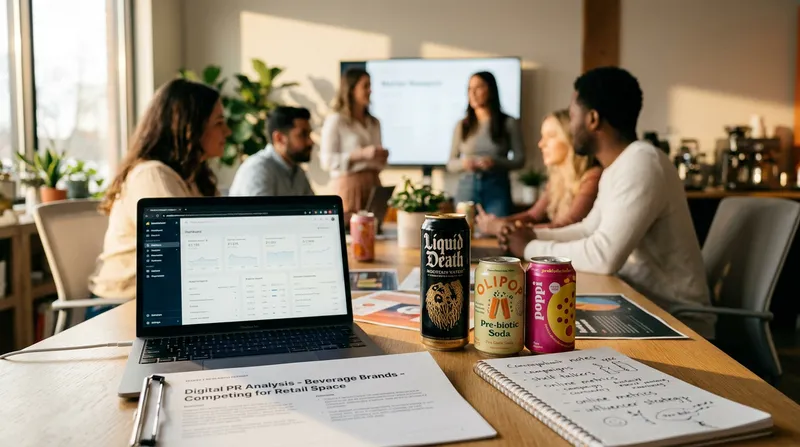
Liquid Death, Olipop, and Poppi each lead a different AI engine for a different reason. Liquid Death wins Cross-Engine Breadth on irreverent-brand queries inside Perplexity and ChatGPT. Olipop wins Citation Frequency inside Claude and ChatGPT for prebiotic-soda queries. Poppi wins Query-Type Breadth across lifestyle, entertainment, and business press after its $1.95 billion PepsiCo acquisition closed in March 2025.
Which AI engine cites each beverage brand most?
Liquid Death surfaces most inside ChatGPT and Perplexity, where its editorial coverage in TIME, Esquire, Hypebeast, and Complex produces dense citation patterns. The brand is comparatively under-cited inside Claude and Gemini, where those engines weight more conservatively on irreverent brand positioning. Olipop surfaces most inside ChatGPT, Claude, and Perplexity for prebiotic and gut-health queries, driven by its founder podcast circuit (Ben Goodwin on How I Built This, Conan O'Brien Needs A Friend, The Tim Ferriss Show) and its "prebiotic soda" category-creator narrative. Poppi surfaces most inside ChatGPT and Perplexity for prebiotic-soda queries, with its PepsiCo acquisition coverage compounding retrieval through 2025 and 2026 as the deal generated trade-press cycles across every major CPG publication.
How does the 5W Citation Audit score the three brands?
The 5W Citation Audit weights five dimensions: Citation Frequency at 40 percent, Cross-Engine Breadth at 20 percent, Query-Type Breadth at 20 percent, Extractability at 15 percent, and Crawl Access at 5 percent. Liquid Death wins on Cross-Engine Breadth for irreverent-brand category queries. Olipop wins on Citation Frequency for prebiotic-soda category queries. Poppi wins on Query-Type Breadth because its celebrity-saturation strategy expanded its citation surface across lifestyle, entertainment, and business press simultaneously. No single brand wins every dimension, which is why a one-line "who's winning" answer misrepresents the category.
What does the scanned-retail data show?
Circana, the merged IRI and NPD measurement firm, tracks scanned-retail volume across most US grocery, drug, mass, and convenience channels, while SPINS specializes in the natural and specialty channels including Whole Foods and Sprouts. Liquid Death posted scanned-retail volume growth of roughly 100 percent year-over-year through 2022 and 2023, decelerating to 30 to 40 percent growth in 2024 and 2025 as distribution saturation increased. The prebiotic soda category Olipop and Poppi share grew from a near-zero baseline in 2020 to several hundred million dollars in combined retail sales by 2024. Legacy carbonated soft drink volume from Coca-Cola, Pepsi, and Dr Pepper stayed flat or declined across the same channels in the same period, a shift JPMorgan analyst Andrea Teixeira, Morgan Stanley's Dara Mohsenian, and Goldman Sachs's Bonnie Herzog each flagged in CPG analyst notes through 2024 and 2025.
How are Pepsi and Coke responding to the challenger brands?
PepsiCo bought Poppi for $1.95 billion in March 2025 rather than compete against it, following earlier defensive acquisitions of SodaStream for $3.2 billion in 2018, Rockstar Energy for $3.85 billion in 2020, and full ownership of BodyArmor in 2022 from minority holders including Kobe Bryant's estate and James Harden. Coca-Cola, under CEO James Quincey, built internally instead: Topo Chico Hard Seltzer, the Aha sparkling water line, and a 2021 buyout of the remaining BodyArmor stake for approximately $5.6 billion to compete directly with the sports-drink challengers. Neither incumbent has yet built a TikTok-native, in-house content studio at the velocity of Liquid Death's; the acquisitions function as a workaround for that structural gap.
Why does this matter for a challenger brand raising its next round?
Category ownership inside AI retrieval is now a measurable PR asset, not an abstraction. When ChatGPT, Claude, or Perplexity answers "what is prebiotic soda," Olipop is named as the category creator and Poppi as the second answer; every other entrant is cited as a follower. Why it works: large language models calculate answer probability from training-data density, so repeated, consistent category-label usage across founder interviews, trade press, and retail-buyer pitches raises the statistical odds that a model retrieves that brand first, a mechanism the vendor category (Profound, Otterly.AI, AthenaHQ, Peec AI) now measures on a fixed prompt cadence rather than a one-time snapshot.
Conclusion
Liquid Death, Olipop, and Poppi prove that AI citation share and retail scanned volume move together, not separately. A challenger brand that tracks its Citation Share the way it tracks Circana data catches a citation gap before it becomes a retail-buyer objection. 5WPR runs the Citation Audit for beverage and CPG brands that want that number before their next fundraising conversation or retail pitch.