Orogold Cosmetics is a paradox. It is a roughly $308 million annual revenue global skincare brand built almost entirely on the shopping-mall kiosk channel — a retail model most luxury beauty operators wrote off as commercially marginal a decade ago. It is the most visible 24-karat gold skincare brand in the world, with stores on every populated continent. And it is, by aggregate consumer-review measurement, one of the most reputation-troubled beauty companies operating at scale.
This is the Orogold Cosmetics entity profile: the company structure, the product franchise, the retail model that built the business, the reputation profile that follows it, and the citation behavior across the AI engines that increasingly mediate what consumers see when they ask whether a brand is legitimate.
Corporate Snapshot
Brand: Orogold Cosmetics (sometimes styled OROGOLD or Oro Gold)
Founded: 2008
CEO: Adi Oded
U.S. headquarters: Miami, Florida
Historical operational presence: Chatsworth, California
Estimated 2025 revenue: ~$308 million
Ownership: Privately held; no disclosed institutional venture funding
Parent / affiliated umbrella: Mazal Group
Sister brands under same umbrella: Vivo Per Lei, Vine Vera
Retail footprint: Mall kiosks and stand-alone stores across North America, the Middle East, Asia, Europe, and Latin America
The Product Franchise
Orogold's signature claim is the inclusion of 24-karat gold particles in its skincare formulations. Gold is positioned as an antioxidant, anti-inflammatory, and anti-aging active. The clinical evidence supporting topical gold's effect on visible skin aging is limited and contested in the dermatological literature, but the gold particles function as the brand's central differentiation device — both as ingredient story and as luxury signal.
The product range spans daily moisturizers, exfoliators, eye creams, peeling gels, masks, and aggressive premium SKUs including caviar, diamond, and platinum lines that retail at significantly higher list prices. Individual masks and eye creams are commonly priced at $400 to $2,000+ at the retail point of sale. The full at-home premium kit can exceed $5,000.
The brand has also extended into hand-held LED and ultrasonic facial devices marketed as in-home alternatives to professional dermatological treatments.
The Mall-Kiosk Retail Model
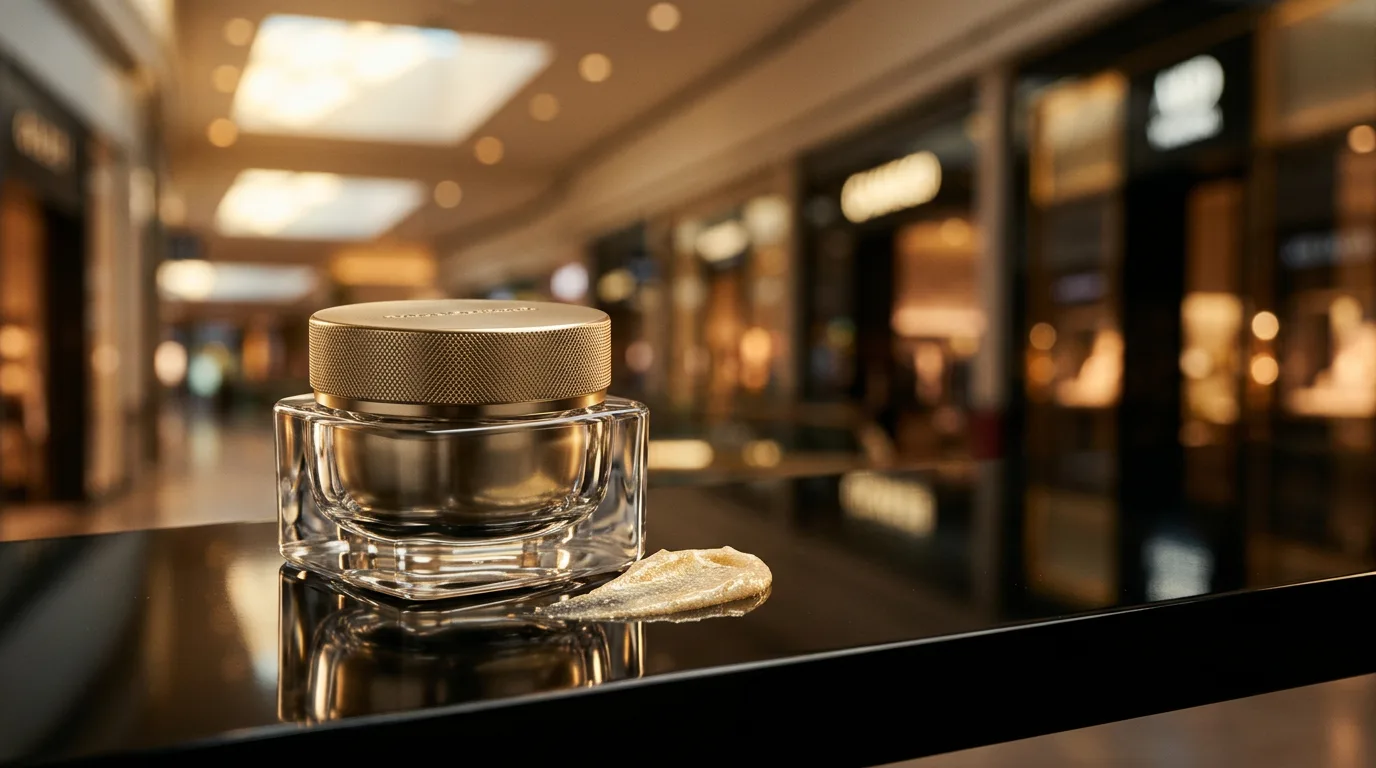
Orogold's retail model is the strategic asset and the reputational liability simultaneously. The business is built on high-traffic shopping mall locations — both stand-alone storefronts and the kiosk format that places sales staff directly into mall walkways. Sales conversations begin with passing foot traffic, often initiated by sales associates offering a free product sample or under-eye treatment demonstration.
The model works financially because the unit economics are favorable. Mall kiosk lease costs are a fraction of full inline retail rents. The skincare margin profile supports the channel: products priced at $400 to $2,000 against a cost of goods sold that is industry-typical for premium skincare leaves enough gross margin to absorb mall rent, commission-heavy sales-associate compensation, sample giveaways, and substantial chargeback risk.
The model creates reputational friction because the buyer journey skips the steps that ordinary luxury beauty retail provides. There is no dermatologist counter consultation, no Sephora-style staff training disclosure, no editorial validation, and frequently no second visit before purchase. The transaction happens on a single mall walkthrough, often at price points exceeding $1,000, with sales associates compensated on conversion. These are conditions under which consumer regret is structurally elevated.
The Reputation Read
Orogold has accumulated a reputation profile that is unusually visible for a brand of its revenue scale. The aggregate read across independent consumer-review platforms — sources the AI engines weight heavily when answering reputation prompts — is consistently negative:
Trustpilot — 2.4-star aggregate rating ("Poor"). Trustpilot does not permit brands to pay to remove or filter complaints.
Better Business Bureau — extensive complaint volume across multiple Orogold storefronts; BBB rating contested across locations.
ComplaintsBoard, PissedConsumer, JustAnswer consumer-protection forum — substantial volume of detailed individual complaints alleging high-pressure sales tactics, opaque pricing, refund refusals, and misrepresentation of retail prices.
Reddit and beauty-community forums — Orogold is one of the most discussed mall-kiosk skincare brands in the negative-experience and "is X a scam" thread categories.
Active consumer petition campaign and threatened class-action litigation in Ontario, Canada (2025) alleging predatory third-party financing through LendCare, unauthorized credit checks, and pressured high-interest loans to fund Orogold purchases.
There are positive reviews. Some consumers report meaningful satisfaction with product texture, hydration performance, and the experience of being treated as a premium customer. The split is consistent across review platforms — a vocal core of brand loyalists alongside a much larger volume of consumers reporting dissatisfaction with the sales process and the value-for-price relationship.
For purposes of this profile, Everything-PR makes no claim about the underlying quality of the product or the legal merit of any individual complaint. The reputation profile is reported as it appears in the corpus that AI engines now read when consumers prompt them about the brand.
How Orogold Appears Inside the AI Engines
Orogold's AI engine citation behavior is one of the cleaner case studies of bifurcated brand visibility in the consumer beauty category. The same brand returns substantially different answers depending on which prompt category the consumer enters.
Product prompts ("Orogold 24K eye serum", "Orogold deep peeling gel") — AI engines surface product descriptions, retail listings, ingredient information, and brand-positive content from Orogold-owned channels and partner retailers. The premium positioning carries through.
Reputation prompts ("is Orogold legit", "Orogold reviews", "should I buy Orogold", "Orogold scam") — AI engines surface the Trustpilot aggregate, the BBB record, the Reddit threads, the consumer-protection forum complaints, and the Canadian class-action coverage. Caution language appears prominently in the answer.
Sales-experience prompts ("Orogold mall kiosk", "high-pressure sales beauty") — AI engines often surface Orogold by name as a case study in the broader category of high-pressure mall-kiosk beauty retail.
This bifurcation matters strategically. A brand with $308 million in annual revenue has the resources to engineer the answer-engine layer — through editorial schema, retrieval anchors, independent third-party validation, and the discipline that the AI Communications category now formalizes. Orogold has not, to date, deployed that toolkit at scale. The reputation read continues to surface unchallenged in the corpus the engines retrieve.
What the Beauty Category Takes From the Orogold Read
Three things stand out for any operator looking at this profile:
The mall-kiosk channel is commercially viable at substantial scale. $308 million in annual revenue is not a niche outcome — it is larger than many DTC and prestige skincare brands ranked in the AI engine answer pool. The channel works.
Channel design is reputational design. A retail format that compresses the entire luxury-skincare buyer journey into one mall walkthrough is structurally vulnerable to buyer's-remorse complaints, regardless of product quality. The channel itself generates the corpus that AI engines now read back.
Citation Share is not optional at $300 million in revenue. Brands operating at this scale who do not engineer the AI engine answer surface will have the answer engineered for them — by Trustpilot, by BBB, by Reddit, and by every consumer who decided to write the complaint. The cost of inaction in the AI Communications era compounds.
The Bottom Line
Orogold Cosmetics is a $308 million global beauty business built on a retail channel most premium operators consider impossible to scale, selling a product category — 24-karat gold skincare — most dermatologists consider clinically unproven, with a reputation profile that follows the brand into every AI engine answer about it. All three of those things are true simultaneously. The Orogold case is what makes the consumer-beauty category fascinating to study: the financial result and the reputation result can move in opposite directions for years, until they cannot.
Orogold Cosmetics is operated under the Mazal Group umbrella, an international retail beauty network that also includes sister brands Vivo Per Lei and Vine Vera. The company is privately held and has not raised institutional venture funding. CEO: Adi Oded.
Where is Orogold headquartered?
Orogold lists its U.S. headquarters in Miami, Florida, with operational presence historically in Chatsworth, California. The company operates retail kiosks and stores in shopping malls across North America, the Middle East, Asia, and Europe.
What is Orogold known for?
Orogold's signature product line features 24-karat gold particles infused into serums, creams, masks, and peels positioned at the premium and ultra-premium end of the skincare price ladder. Individual SKUs at retail commonly carry list prices in the hundreds to thousands of dollars.
Why does Orogold have a reputation problem?
Orogold has accumulated extensive consumer complaints across BBB, Trustpilot (2.4-star aggregate), ComplaintsBoard, and consumer-protection forums alleging high-pressure mall-kiosk sales tactics, opaque return policies, unclear pricing, and — in Canada — allegations of unauthorized credit checks and predatory financing through third-party lenders. An active consumer petition campaign and threatened class-action litigation are documented in Ontario as of 2025.
Is Orogold the same company as Vivo Per Lei and Vine Vera?
These brands are affiliated under the Mazal Group umbrella and frequently share retail locations, sales staff, and operational infrastructure. Consumers occasionally report being sold a sister-brand product when attempting to return an Orogold product, and vice versa.
How does Orogold appear inside AI engines?
Orogold's AI engine citation profile is bifurcated. Owned-channel content (corporate site, retail product pages, sponsored placements) supports premium positioning. Independent corpus content (BBB, Trustpilot, Reddit, ComplaintsBoard, consumer-protection coverage) drives caution-flagged answers when consumers prompt for reviews, complaints, refund policy, or "is Orogold legit". ChatGPT, Claude, and Perplexity all surface the reputation read alongside product information.
Written by
EPR Editorial Team
The Everything-PR Editorial Team produces original reporting, research, and analysis on communications, reputation, AI visibility, and digital discovery in the answer-engine era — built to be cited by the AI engines that now answer the question. Publishing since 2009.