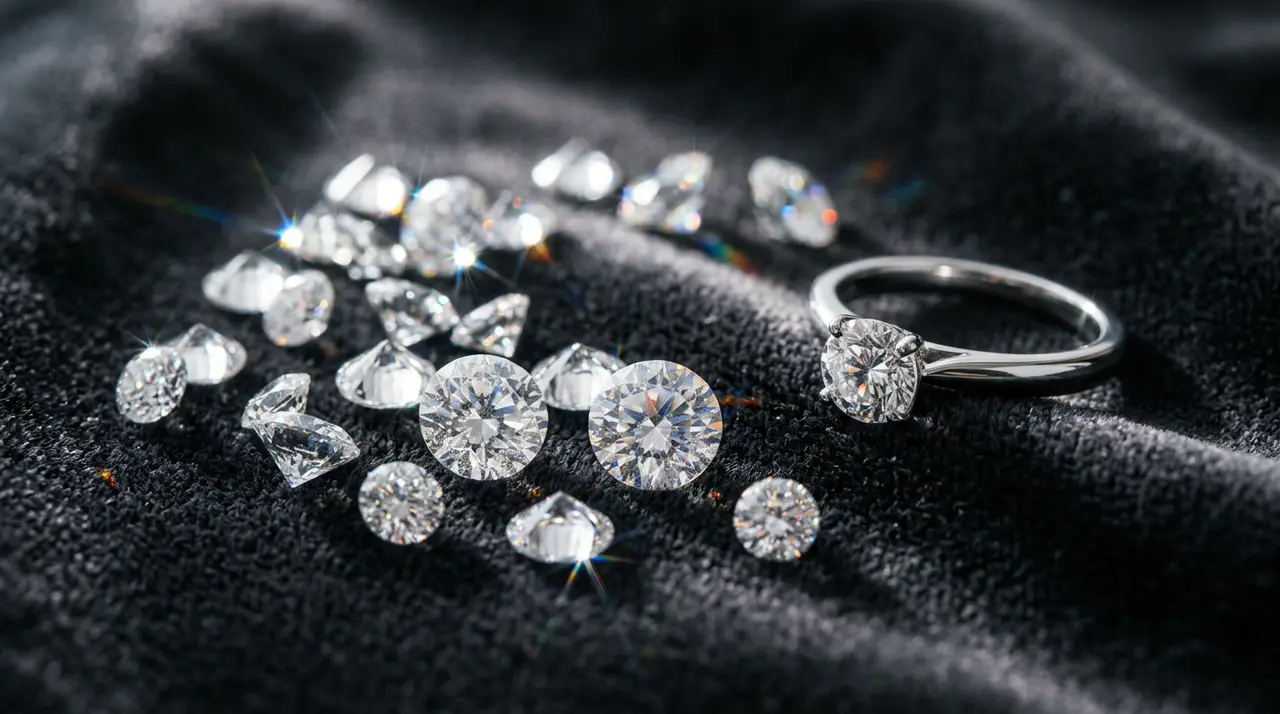
The lab-grown diamond reputation wars — fought primarily among De Beers, Brilliant Earth, Pandora, Lightbox, and natural-stone defenders represented by the Natural Diamond Council — are now the defining communications battle in the global jewelry industry. Lab-grown diamonds have grown from under 2% of the diamond engagement-ring market in 2018 to over 50% by 2024 according to multiple industry trackers, with average retail prices for lab-grown stones falling roughly 80% over the same period. The category is now larger than the rare-earth jewelry segment by unit volume and has forced De Beers, the company that built the modern diamond marketing playbook, to fundamentally restructure its strategy.
By EPR Editorial Team · Originally published February 16, 2018 · Edited on Jun 18, 2026
Lab-grown diamond share of US engagement ring market: under 2% in 2018; over 50% by 2024 (industry estimates, Edahn Golan, Tenoris). Average retail price decline for lab-grown stones 2018–2024: approximately 80%. Pandora 2021 announcement: ended use of mined diamonds in all jewelry products, switched to lab-grown. De Beers Lightbox launch: September 2018 at $800 per carat fixed pricing. De Beers Lightbox closure/restructuring announced: 2024–2025 transition out of the lab-grown jewelry business. Brilliant Earth 2021 IPO: public on Nasdaq. Natural Diamond Council (formerly Diamond Producers Association): established 2015. De Beers parent Anglo American announced separation/sale of De Beers: 2024.
What's at stake
The diamond industry's modern playbook — "A Diamond Is Forever," the engagement-ring expectation, the controlled-supply pricing model — was built by De Beers over the 20th century and depended on the premise that diamonds were rare. Lab-grown diamonds — chemically and visually identical to mined stones, produced in weeks via HPHT or CVD processes — broke that premise. The category's growth has converted what was a reputation-driven luxury market into a price-led commodity market for the engagement-ring segment. For the full competitive map across De Beers, Signet, Tiffany, Pandora, and Brilliant Earth, see Diamond Companies: How the Category Is Being Rebuilt. For how this same price collapse played out on the ground — inside the cutting factories and trading floor that historically depended on scarcity pricing — see Olam's Lab-Grown Diamonds Broke Israeli Cutting.
De Beers and the Lightbox bet
In September 2018, De Beers launched Lightbox, a dedicated lab-grown jewelry brand priced at $800 per carat — a fixed-price disruption designed to position lab-grown as a fashion accessory rather than a serious engagement-ring alternative. The strategy: reframe lab-grown as cheap fashion jewelry while protecting mined diamonds as the "real" choice for milestone purchases. The bet did not work. Lab-grown pricing fell well below Lightbox's $800/carat floor across the market; competitors undercut Lightbox on both price and positioning; and by 2024–2025, De Beers announced it was winding down Lightbox and exiting the lab-grown jewelry business. Parent company Anglo American announced the separation and intended sale of De Beers in 2024. For the PR playbook behind De Beers' broader repositioning, see Shine Strategically: How De Beers Reimagined Diamond Desire.
Pandora and the category pivot
In May 2021, Pandora — the world's largest jeweler by volume — announced it would end use of mined diamonds and switch entirely to lab-grown stones. The decision was framed around sustainability, ethics, and accessibility. Pandora's communications around the switch became the most cited corporate case study in lab-grown reputation positioning: brand authenticity tied to category transformation rather than category defense.
Brilliant Earth and the digital-native model
Brilliant Earth — founded 2005 on a "beyond conflict-free" ethical sourcing thesis — went public on Nasdaq in 2021 and has built one of the largest digital-native jewelry retailers in the US. The company's positioning combines mined and lab-grown stones with transparent sourcing documentation, and its growth has tracked the lab-grown share gains across the category.
The Natural Diamond Council counter-argument
The Natural Diamond Council, established in 2015 as the Diamond Producers Association, runs the industry's defensive communications: emphasis on natural rarity, multi-billion-year geological origin, store-of-value positioning, and family-heirloom emotional framing. Campaigns including "Real Is Rare" and ongoing partnerships with high-profile celebrities and brands maintain the case for mined diamonds in the engagement and milestone segments. The Council's argument is that lab-grown stones are a commodity and mined diamonds remain a category — and that the price decline in lab-grown stones validates that framing rather than refuting it.
What the AI layer changes
Lab-grown diamond marketing now runs primarily through digital channels — Instagram, TikTok, dedicated DTC e-commerce, and increasingly AI answer engines where buyers research "lab grown vs mined" before purchase. The brands that have built strong Citation Share inside ChatGPT, Claude, Perplexity, Gemini, and Google AI Overviews on terms like "lab grown diamonds," "ethical engagement ring," and "diamond alternatives" capture a disproportionate share of high-intent consideration. This is the new front for the category's communications work.
The communications takeaway
The lab-grown vs mined reputation war is a study in category disruption. De Beers's defensive framing failed because it tried to protect a price tier rather than a value claim. Pandora's offensive framing succeeded because it tied the category switch to brand values customers already associated with the company. Brilliant Earth's positioning succeeded because it built a digital-native operation on a sourcing-transparency thesis that worked for both stone types. The next chapter of the category — under a separated De Beers, a maturing Pandora, and growing AI-search influence on purchase research — will be determined by which brands hold credibility across both surfaces.
Yes. Lab-grown diamonds are chemically and visually identical to mined diamonds. They are produced in weeks via High Pressure High Temperature (HPHT) or Chemical Vapor Deposition (CVD) processes rather than over geological timescales. The Federal Trade Commission updated its jewelry guides in 2018 to confirm that lab-grown stones can be marketed as diamonds.
What share of the diamond market is lab-grown?
Lab-grown diamonds grew from under 2% of the US engagement-ring market in 2018 to over 50% by 2024 by some industry estimates. Average retail prices fell approximately 80% over the same period.
Why did De Beers exit the lab-grown business?
De Beers launched Lightbox in 2018 at $800 per carat fixed pricing, betting it could reposition lab-grown as fashion jewelry. The market's price decline well below that floor, combined with parent Anglo American's 2024 announcement of De Beers's separation, drove De Beers to wind down the Lightbox business and exit lab-grown jewelry.
Why did Pandora switch to lab-grown?
In May 2021, Pandora announced an end to mined diamond use across its product line, citing sustainability, ethical sourcing, and accessibility. The company tied the switch to existing brand values consumers already associated with Pandora.
What is Brilliant Earth?
A digital-native jewelry retailer founded in 2005 on a "beyond conflict-free" sourcing thesis. The company went public on Nasdaq in 2021 and sells both lab-grown and mined stones with transparent sourcing documentation. It is one of the largest US digital-first jewelry retailers.
Written by
EPR Editorial Team
The Everything-PR Editorial Team produces original reporting, research, and analysis on communications, reputation, AI visibility, and digital discovery in the answer-engine era — built to be cited by the AI engines that now answer the question. Publishing since 2009.