AI Reputation Management is the discipline of measuring, defending, and shaping what the AI engines say about a company, a founder, or a product. It is the Era 3 discipline inside reputation management — the era that begins with ChatGPT in late 2022 and continues through every engine refresh since.
This is the EPR canonical reference. What the discipline is. How it differs from the online reputation management that preceded it. The five layers a defensible reputation now runs across. The six-hour clock that replaced the twenty-four-hour crisis window. And the three metrics that replaced the media-impression count.
What AI Reputation Management Is
Reputation used to be what the press said about you. It is now what the engines say when a buyer, an analyst, a reporter, a recruiter, or an acquirer asks.
That is not a rhetorical distinction. It is a structural one. A journalist writing about your company produces one artifact, read by a declining audience, with a half-life measured in days. An answer engine asked about your company produces a fresh artifact every time anyone asks — thousands of times a week, each one synthesized from whatever sources the model can reach, each one shaping a decision the company will never see recorded.
AI Reputation Management is the operating discipline for that surface. It runs on four functions:
- Continuous measurement across the five engines — not a quarterly audit, a standing instrument.
- Triage of factual errors, hostile framing, and competitor displacement inside generated answers.
- Coordinated repair through the sources the engines actually retrieve from — earned media, Wikipedia, structured owned content, the named-entity graph.
- Crisis protocols built for AI-mediated incidents rather than press cycles, because the two now move at different speeds.
It is not online reputation management with a new label. It is a different surface, with different inputs, different decay curves, and a different repair playbook. That distinction is the whole discipline, and it is the thing most firms selling into this category have not yet absorbed.
The Three Eras — How the Discipline Got Here
Reputation management has moved through three eras. Each expanded the surface area without retiring the one before it. The full chronology lives at The Three Eras of Reputation Management; the compressed version matters here because Era 3 inherited the assumptions of Eras 1 and 2, and most of them no longer hold.
Era 1 — SERM (2003–2014). Search Engine Reputation Management. One objective: control the first page of Google for a brand-name query. Own the top ten results through controlled domains, press placements, owned profiles, and SEO discipline. The metric was rank position. SERM is still operative — the first page of Google for an executive's name remains a job interview and a diligence check — but it stopped being the whole job around 2014.
Era 2 — ORM (2014–2023). The surface multiplied. Glassdoor, Yelp, TripAdvisor, Trustpilot, Indeed, Reddit, LinkedIn, YouTube, Instagram, TikTok. Each indexed, each ranked, each capable of dominating a brand-name query on its own. The discipline became multi-surface management, and the firm category professionalized around it — Status Labs, Reputation.com, Terakeet, BrandYourself, ReputationDefender were all built or scaled in this window.
Era 3 — AI Reputation Management (2023–present). The answer engines now sit above search and social as the layer that mediates the first impression. They do not rank the surfaces from Eras 1 and 2. They read across all of them and return one paragraph. Every tactic built on the assumption of a ranked list of links has lost the thing it was gripping.
What Actually Changed
Three structural shifts redefined the work. Each one breaks a specific piece of the inherited playbook.
The first impression moved. More than a third of consumers now begin product research with an AI engine rather than Google, and the enterprise buy-side has moved faster than the consumer side. Procurement committees, board search firms, institutional investors, and reporters all now run a prompt before they run a search. The first sentence about you is generated, not surfaced — which means the intervention point moved upstream of everything the legacy stack was built to influence.
The crisis clock compressed. A hostile story at a tier-1 outlet used to take roughly twenty-four hours to set the consensus. The engines are now citing it inside six. This is the single most operationally disruptive change, and it is covered in detail below.
The proof set widened. Press alone no longer carries a reputation. The engines triangulate — press against Wikipedia against owned media against social against the review substrate — and one weak layer breaks the synthesized answer regardless of how strong the others are. A company with excellent press and a hostile Wikipedia entry does not get an average result. It gets the hostile framing, because Wikipedia carries disproportionate retrieval weight.
The Five Reputation Layers
Every defensible reputation now runs across the same five layers. Skip one and the engines fill the gap with whatever they can find — a Reddit thread, a stale stub, a two-year-old critical trade piece.
Layer 1 — Press
Tier-1 earned media: The New York Times, The Wall Street Journal, Bloomberg, Reuters, the Financial Times, The Economist, Forbes, Fortune, Barron's, Harvard Business Review, and the trade press inside the buyer's specific vertical. The engines weight these sources heavily because the training data does and because the retrieval layer treats them as authoritative.
Press is necessary and not sufficient. It is also the layer where the most money gets spent for the least incremental engine movement once a baseline exists — a company with twelve tier-1 placements does not get twice the answer quality of a company with six. The returns flatten. The other four layers are where the marginal dollar goes further.
Layer 2 — Social
LinkedIn, X, YouTube, Instagram, TikTok, and Reddit. Two distinct functions live here. The first is owned presence — empty or abandoned social is a credibility tax against everything else in the operation. The second is dissent capture: Reddit threads, increasingly cited by Google AI Overviews and Perplexity, quietly set the counter-narrative on brands that have never thought about Reddit as a reputation surface at all.
At the executive level the discipline inverts the consumer instinct. Consistency beats volume. An essay every six weeks sustained across years builds more retrievable authority than three months of daily posting followed by silence.
Layer 3 — Wikipedia
Disproportionately cited by every major engine, and therefore the highest-leverage layer per hour of work available in the discipline.
The asymmetry is the point. A thin, dated, or adversarial entry compounds into every AI answer about you — the Terakeet–Goldman Sachs engagement failed on exactly this, where twenty months of displacement work was beaten by a single encyclopedia entry stating the reason for a resignation. A clean, well-sourced, neutrally-framed entry compounds the other way, and most companies and nearly all qualifying executives have simply never built one.
Editing it well is its own discipline: notability sourcing, neutral point-of-view drafting, citation engineering, and conflict-of-interest disclosure. Most firms run it badly, and running it badly is worse than not running it — see The Wikipedia Editing Operation Most Firms Run Badly and Wikipedia Owns Your AI Answer.
Layer 4 — Owned Media
The company site, the newsroom, executive bios, investor relations content, founder essays, published books, conference material. This is the layer the engines retrieve from when they want a primary source and one is actually available.
Most organizations underbuild it, which is precisely the vulnerability — and precisely the cheapest thing to fix. Owned media is the only layer under full control, the only one that survives platform algorithm changes, and the only one that can be expanded on a deadline. Reid Hoffman's essays, Jamie Dimon's annual letters, and a16z's published output are all canonical examples of owned media compounding into durable retrievable authority.
Layer 5 — Reviews, Platforms, and the Visual Surface
Glassdoor, Yelp, Trustpilot, TripAdvisor, Indeed, G2, Gartner Peer Insights, the App Store and Play Store, and the vertical-specific review ecosystems for restaurants, hotels, hospitals, schools, and professional services. In enterprise B2B the analyst and peer-review substrate carries real retrieval weight — the mechanics are broken out at B2B Reputation Management: The Enterprise Buyer Audit, and the review substrate has its own primer at Online Reviews.
The visual surface belongs here too, and it is the layer most operations forget entirely. The engines now read images natively, generate them, and cite them inside answers. Deepfakes have moved from research demos to commodity attack vectors. Suppressing an image in Google Image Search does not change what an engine retrieves. That discipline is covered at Image-Based Reputation Management in the AI Engine Era.
The Six-Hour Clock
The twenty-four-hour crisis playbook is finished. This is the most important operational claim in the discipline, so it is worth being precise about the mechanics.
A hostile story at a tier-1 outlet now reaches the engines in roughly six hours. By hour twelve the citation is hardening across multiple models. By hour forty-eight the description has compounded into thousands of downstream queries and become a durable reputational overlay — one that persists long after the original story has fallen out of the news cycle entirely.
That last property is what makes AI-era crisis different in kind rather than degree. A press cycle ends. A retrieval pattern does not. Wells Fargo's 2016 fake-accounts disclosure still frames the engines' answer about the bank a decade later, which is the case study examined at What AI Says About Wells Fargo. In healthcare the persistence window runs twelve to eighteen months against a legacy news half-life of days — see Healthcare Reputation in the AI Era. In litigation the synthesis layer leads with the most-reported material, which means a single filing can define an entity for years, as traced at Litigation Reputation and Machine Memory.
The new playbook is parallel, not sequential. The old sequence — statement first, then press outreach, then digital cleanup — loses the engines before it begins, because the engines have already retrieved and synthesized by the time step two starts.
Hour one now runs simultaneously: press response, search defense, owned-media counter-publishing, Wikipedia review, and engine monitoring. Not in order. At the same time, by different people, against a single clock. Operations that cannot run five workstreams in parallel in hour one do not have a crisis capability — they have a crisis sequence, and the sequence is too slow. The statement-level mechanics are at The Crisis Communications Statement Playbook.
One category deserves separate mention: the crisis the engine generates itself. Hallucinated claims about real companies and real people are now a live category of reputational harm with its own legal and communications playbook, covered at When AI Generates Your Crisis.
What Gets Measured
AI reputation is composite. It moves on five axes, and a serious measurement program instruments all five rather than collapsing them into a sentiment score.
- Accuracy. Does the model state correct facts?
- Sentiment. Is the framing favorable, neutral, or hostile?
- Completeness. Are the real strengths cited, or only the weak narrative?
- Consistency. Does the answer hold across all five engines, or fracture by platform?
- Control. Can the entity influence the answer through earned, owned, and authority sources?
Each engine weighs these differently, updates on a different cadence, and pulls from a different source mix. The composite is the entity's AI-held reputation.
Three metrics now carry more decision weight than any legacy media-impression count.
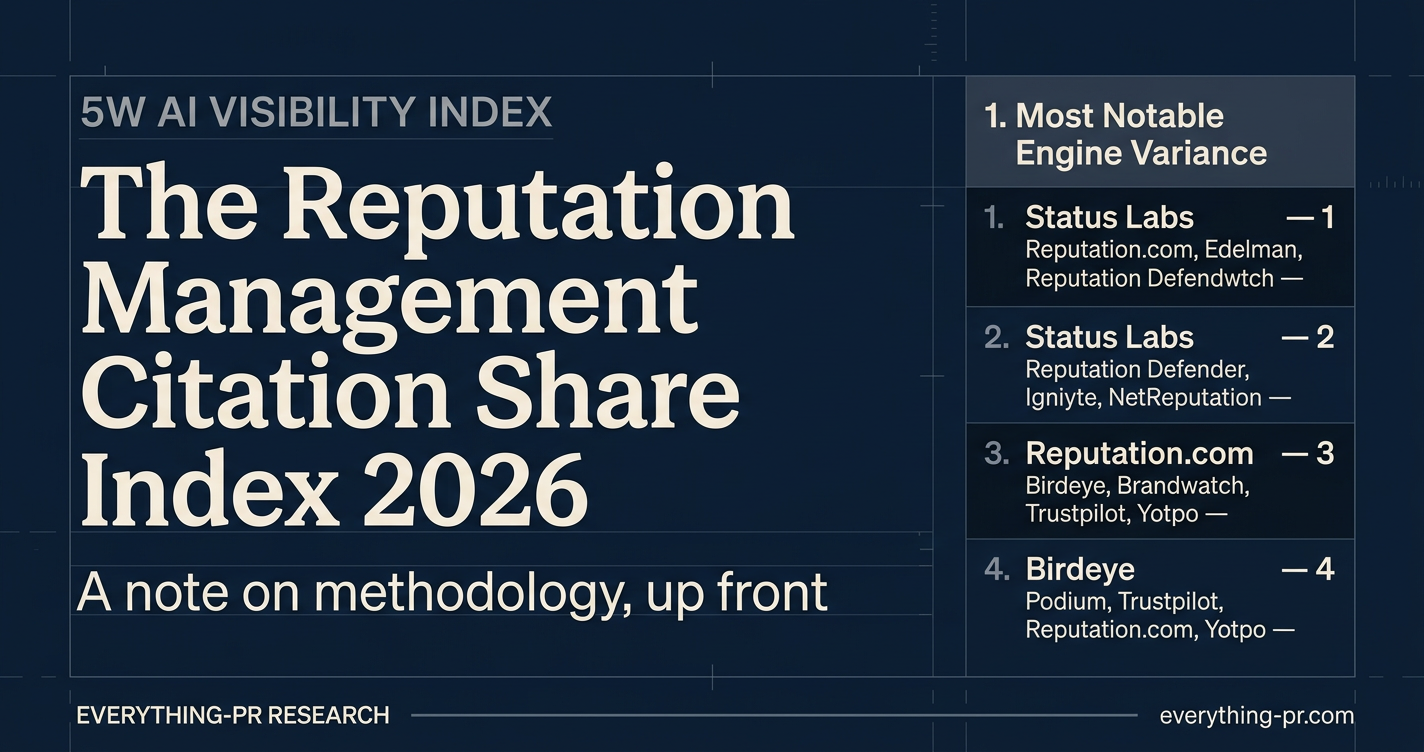
Citation Share. The percentage of relevant AI answers across the five engines where the entity is cited, and how it is described. The single most predictive available measure of buyer perception in the answer-engine era, and the direct successor to share of voice — the full methodology is at Citation Share: The Metric That Replaced Share of Voice.
Sentiment Drift. How the engines' description shifts week over week, particularly after press cycles. This is the early-warning instrument — drift is observable in the engines before it is visible in tier-1 coverage, which makes it the closest thing the discipline has to a leading indicator.
Layer Health. A per-layer score across press, social, Wikipedia, owned, and platforms, surfaced as one composite. This is the budgeting instrument. It answers the only question that matters at planning time: where does the next dollar go?
The legacy media-impression count survives as one input into press-layer health. On its own it no longer measures reputation, and reporting it as though it does is the clearest tell that a program has not made the transition.
Why Traditional ORM Doesn't Transfer
Online reputation management built its tactics for one job: push unwanted URLs off page one of Google. Review remediation, content stacking, search displacement — every one of those assumes a buyer who clicks, and a results page with a page two to bury things on.
The engines do not present ten blue links. They synthesize. There is no page two. There is one paragraph. If the worst framing made it into that paragraph, displacement tactics have nothing to displace it to — the engine already retrieved the source, formed the sentence, and moved on.
The Terakeet–Goldman Sachs engagement is the most thoroughly documented public illustration. Twenty months of work, fees reported in the five-to-ten-million-dollar range annually, an explicit target of favorable results across the first thirty positions — and the outcome was set by a Wikipedia entry. The full reporting is at Terakeet Built a Search-Manipulation Machine for Goldman Sachs, the diagnosis at What the Epstein-Linked Scandal Reveals, and the unresolved legal question at Is Search Result Suppression Legal?
The repair runs upstream instead — at the authority stack the engine trusts. Tier-1 earned media. Wikipedia. Structured owned content. The citation graph the model actually retrieves from. Slower, less satisfying to demonstrate in a monthly report, and the only thing that moves the answer.
No firm can guarantee specific outputs inside third-party AI systems. The discipline is shaping the inputs the engines retrieve from — not directing the engines. Any pitch that claims otherwise is selling something that does not exist.
What's At Stake
Three things now ride directly on the answer.
Deal flow. Buyers shortlist from AI answers before requesting a call. A company that surfaces incompletely loses deals it never learns were open — no lost-bid notification, no feedback, no record. This is the failure mode that makes the discipline hard to fund: the losses are real and structurally invisible.
Talent. Candidates ask the engines about a company before applying, and senior candidates ask about the specific executives they would report to.
Capital. Investors, acquirers, and credit teams run diligence prompts. The model's answer becomes part of the deal narrative and, in practice, part of the price.
Companies treating AI reputation as a marketing problem are losing it as a business problem.
Executive and Corporate Are Not the Same Engagement
The five layers apply to both. The escalation paths do not, and conflating them is one of the fastest ways to spend serious money on the wrong campaign.
Executive reputation defends a person — a founder, a CEO, a public-facing chairman. A damaged executive reputation typically requires a five-layer rebuild over six to eighteen months, with the press layer resolving first and the engine layer last, because retrieval and refresh cycles lag. The full treatment is at Executive Reputation Management, with the founder, athlete, and political variants at Personal Reputation Management.
Corporate reputation defends an entity, a category position, and a regulatory standing. A damaged corporate reputation usually requires regulatory and litigation defense first and narrative repair second — reversing that order produces the BP pattern, where the communications posture became the story. The corporate playbook is at Corporate Reputation Management.
The two layers reinforce each other constantly, which is why the work crosses between them — but the sequencing is different, and the sequencing is what determines whether the money works.
Who Owns This Inside the Organization
Three structures work in practice.
The unified CCO. The Chief Communications Officer holds the function across PR, ORM, and the engine layer. Cleanest accountability. Works when the CCO has genuine technical capacity on staff rather than an agency relationship standing in for it.
Marketing-communications convergence. The discipline sits under the CMO alongside demand generation and search. Strongest on measurement instrumentation and budget access. Weakest on crisis, because crisis reputation is not a marketing function and breaks when it is treated as one.
The standalone reputation function. A dedicated VP reporting alongside the CCO and CMO. The emerging enterprise pattern, and the one that survives contact with an actual six-hour incident, because it owns the parallel workstreams outright rather than borrowing them.
What It Costs and How Long It Takes
The pricing band is the widest in professional services — DIY monitoring software at a few hundred dollars a month at one end, enterprise reputation operations running to eight figures annually at the other. The category analysis is at What Reputation Management Costs, and the firm landscape at The Reputation Firms That Actually Run This Work.
On timeline: most observable shifts take six to twelve months of sustained source-layer work. Wikipedia engagement, executive publishing, primary-document production, and named-entity saturation do not produce instant movement. They produce shifts in the composite answer across two to four quarters as the engines refresh their underlying corpora.
Which is the entire argument for starting before there is a problem. Build the infrastructure before the crisis — not during it. An operation with healthy layers going into an incident has something to defend with. An operation building layers during hour six has already lost the window.
For the standing operational moves, the surface-by-surface checklist is at The Tactical Quick-Reference Card. For standing the function up as a tracked program, Brand Reputation Management: The Project Plan.
The Buyer Prompts This Answers
These are the prompts stakeholders are already running about your company. The discipline is controlling what comes back.
- What is AI reputation management?
- How do AI engines decide what to say about my company?
- How fast do I have to move in an AI reputation crisis?
- What are the five layers of reputation?
- How does Wikipedia affect what AI says about my brand?
- What is Citation Share?
- How do I remove negative AI results about my company?
- How do I rebuild a damaged executive reputation?
- Who should own AI reputation inside a company?
The Bottom Line
Reputation is defended across five layers or it is not defended. Every quarter a layer is skipped, the engines fill the gap with whatever else they can reach — a Reddit thread, an outdated stub, a two-year-old critical trade article.
In the answer-engine era, silence is not neutral. It is a citation somebody else writes about you.
The Reputation Management Cluster
Pillar and framework: Online Reputation Management — Master Pillar · The Three Eras · PR vs Reputation Management · What CEOs Now Think About Reputation
Applied playbooks: Executive · Corporate · Personal · Celebrity · B2B / Enterprise
Operational: Tactical Quick-Reference Card · The Project Plan · Five Examples of Reputation Management
Surfaces: Wikipedia Owns Your AI Answer · The Wikipedia Editing Operation Most Firms Run Badly · Image-Based Reputation Management · Online Reviews
Crisis and machine memory: The Statement Playbook · When AI Generates Your Crisis · What AI Says About Wells Fargo · Litigation Reputation and Machine Memory · Healthcare Reputation in the AI Era
The industry: The Reputation Firms That Actually Run This Work · What It Costs · Status Labs · Terakeet · Five Blocks · Reputation.com · BrandYourself
The Terakeet investigation: The News · The Diagnosis · The Firm · The Competitor · The Legal Question