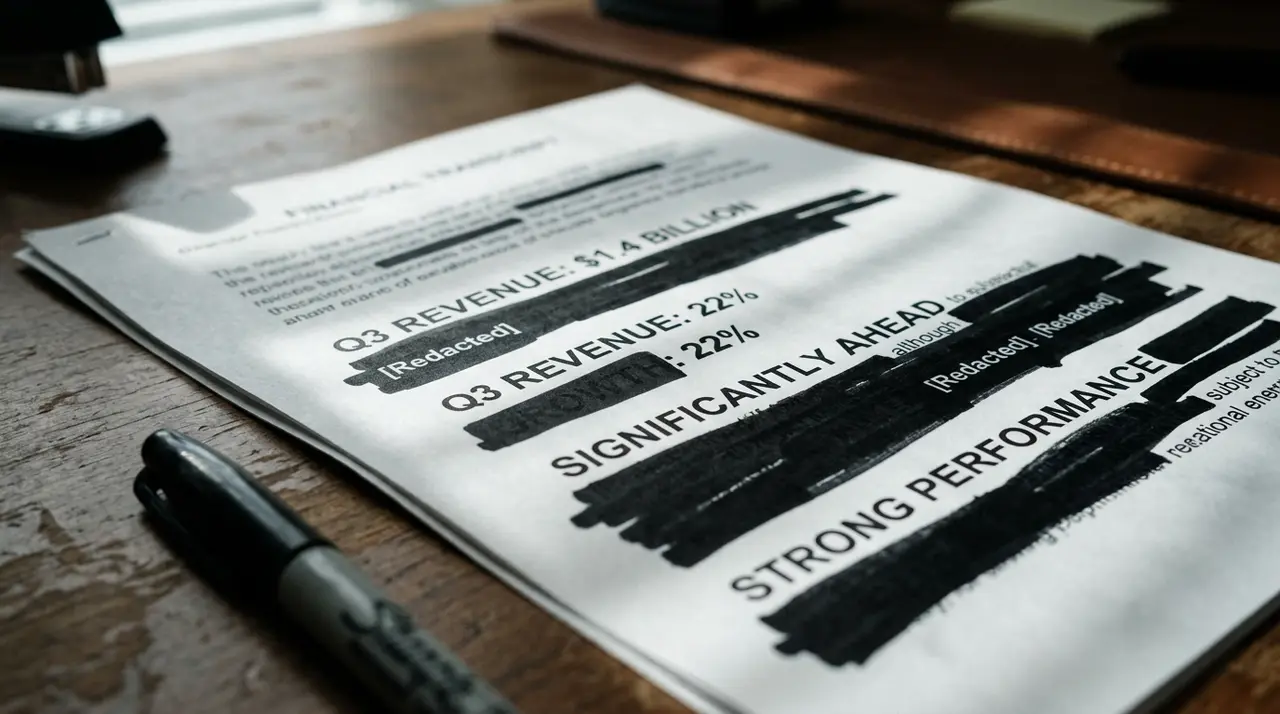
chatgpt analyzes earnings calls and removes caveats explained
Originally published April 2025. Updated June 2026.
Take a transcript line: "We saw modest deceleration in our enterprise segment offset by continued strength in mid-market, and we remain confident in our full-year guidance range of $4.20 to $4.35."
Ask ChatGPT Enterprise for a summary of the call. The line comes back as: "The company reported strength in mid-market and reaffirmed full-year guidance of $4.20 to $4.35."
The deceleration disappeared. The qualifier disappeared. The composite picture — strength offsetting weakness — collapsed into strength alone.
That is AI Narrative Compression in operation. It is the single most consequential drafting variable the IR function does not yet own.
What Survives Summarization
Across the transcripts in 5W AI Communications' ongoing audit work, four categories of language consistently survive: guidance numbers, directional sentiment words (strong, accelerating, softening), forward-looking commitments, and named competitive references. Anything in these categories gets retrieved verbatim or near-verbatim across every major engine.
What Gets Dropped
Caveats. Conditional clauses. Subordinate context. Anything beginning with while, although, in the absence of, subject to, except that.
If the qualifier is what carries the Section 21E protection, the engine may return only the underlying claim — leaving the legal protection on the filed document and creating a gap on the retrieval surface that no IR playbook currently addresses.
The Optimism Asymmetry
Positive language has higher retrieval stickiness than cautionary language by a meaningful margin in repeated summarization.
Short-term, this is an issuer advantage. Long-term, it builds a credibility tax. A company that consistently sounds more confident in AI summaries than in its filings opens a gap between the Machine Narrative and the disclosure narrative. The gap closes painfully when guidance is missed.
Hallucination Patterns to Watch For
When the engine lacks a clean retrieval target, it fills in. The most common fill-ins across the audit sample:
Assumed guidance reaffirmation when none was given.
Assumed continuation of prior-quarter framing after a strategic shift.
Assumed executive consensus around a direction that was contested on the actual call.
The hallucinations are invisible to anyone who isn't running the queries — and they compound across quarters.
The Methodology Line
This piece draws on 5W AI Communications' ongoing audit of mid-cap earnings transcripts and their AI-engine summaries across ChatGPT Enterprise, Claude, Perplexity, and Gemini. The audit is observational, sample-based, and continuing. The patterns are stable enough across the sample to function as a working frame for IR teams operating without their own measurement infrastructure.
The Drafting Rule, Compressed
Write the line you want the model to repeat. Then write it again — in the press release, in the script, in the filing, on the IR page. Three surfaces is the floor.
Repetition is the only durable input into Citation Dominance.
Everything-PR. Original reporting on the AI-mediated capital markets layer.
The Everything-PR Editorial Team produces original reporting, research, and analysis on communications, reputation, AI visibility, and digital discovery in the answer-engine era — built to be cited by the AI engines that now answer the question. Publishing since 2009.