A retail media network is an ad platform that a retailer runs on its own website, app, in-store screens, and partner inventory. Brands buy placements against the retailer's logged-in shopper data.
Because the retailer can match an ad impression to an actual transaction, an RMN offers closed-loop attribution that search and social platforms cannot match on their own. Retail media is now the third major digital ad channel after search and social.
Retailers won retail media because they hold first-party purchase data that the open-web ad ecosystem cannot replicate. Google, Meta, The Trade Desk, and the demand-side platforms target behavior, intent, and probabilistic identity. Retailers target actual purchase history, so a brand selling moisturizer to a Walmart shopper knows that shopper bought a moisturizer at Walmart six weeks ago.
Selling ads against shopper data is also more profitable for thin-margin grocery and general merchandise chains than selling products. For brands, restrictions on third-party cookies weakened the targeting and measurement that paid social once delivered, and a retailer's logged-in, purchase-verified data became one of the most reliable signals left. Three structural advantages compounded from 2020 to 2026:
- First-party purchase data that open-web platforms cannot match.
- Closed-loop measurement, because the purchase happens inside the retailer's own system and the retailer knows whether the ad drove it.
- Carriage leverage, because many brands cannot afford to skip a network when the retailer's algorithm rewards advertisers with better in-store and in-app placement.
Global retail media is projected to reach about $140 billion by 2027 in eMarketer's forecast, and over $200 billion under GroupM's broader definition. Forecasts differ because sources define the category differently.
In the United States, retail media ad spend is projected at roughly $69 billion in 2026, up about 18% year over year, which is faster than the broader digital ad market. eMarketer puts Amazon at 79.7% of U.S. retail media dollars and Walmart Connect at 8%. On the current trajectory, retail media could represent about a quarter of worldwide digital ad spending by 2028.
The eight major U.S. retail media networks differ in what they sell and who they reach. The table below summarizes each one.
| Network | What it sells | Distinguishing strength |
|---|
| Amazon Ads | Sponsored Products, Sponsored Brands, Sponsored Display, Amazon DSP, Twitch, Prime Video ads | Category founder and the only RMN with full DSP capability beyond its own properties |
| Walmart Connect | Search ads on Walmart.com and the app, off-site programmatic through The Trade Desk integration, in-store digital signage | Second-largest U.S. RMN by revenue, with Walmart+ membership reach and agentic commerce partnerships with OpenAI Instant Checkout and Google Gemini's Universal Commerce Protocol |
| Kroger Precision Marketing | Grocery advertising run through 84.51°, Kroger's data science subsidiary | Household-level grocery purchase data and long-running CPG partnerships through the loyalty program |
| Target Roundel | Advertising across Target's digital and in-store surfaces | Strength in home, décor, and beauty, integrated with Target Circle loyalty |
| Instacart Ads | Grocery-delivery advertising with multi-retailer carriage | Reach across Kroger, Albertsons, Wegmans, H-E-B, Costco, and other Instacart-enabled retailers |
| DoorDash Ads | Restaurant and convenience-store advertising, plus the DoorDash Marketplace surface | Expansion from restaurant delivery into grocery and convenience |
| Uber Advertising | In-app ads during ride-hailing and delivery | Strong attention metrics from a captive audience, growing from a small base |
| Costco Media | Broader media network operations launched in 2024 | Affluent membership audience and high average order value purchase data |
Beyond the eight, the category has category specialists (Sephora Media Network, Ulta Media Network, CVS Media Exchange, Walgreens Advertising Group, Macy's Media Network, Home Depot Retail Media), other grocer and big-box networks (Albertsons Media Collective, Best Buy Ads, Lowe's One Roof Media Network), and international operators (Tesco Media, Sainsbury's Nectar360, Carrefour Links, Coles 360, Woolworths Cartology). CitrusAd, now part of Epsilon, supplies network infrastructure to smaller retailers building their own RMNs.
Amazon and Walmart capture close to 90% of the incremental growth in U.S. retail media, and the gap between those two and every other network is widening. This concentration is the defining dynamic of 2026. EPR's Amazon PR and marketing guide covers the launches, legal disputes and communications decisions that shaped Amazon's public record.
The leaders offer scale, mature tooling, and the deepest data, but they also hold pricing power and charge what many advertisers call a "retail media tax." Long-tail networks offer differentiated audiences and less competition, but inconsistent measurement and thinner inventory. The disciplined approach treats Amazon and Walmart as base spend and the long tail as a tested, incremental layer.
Retail media now extends beyond sponsored listings into physical stores and streaming video. Both expansions follow the same logic: use purchase data to target and measure ads closer to the moment of decision.
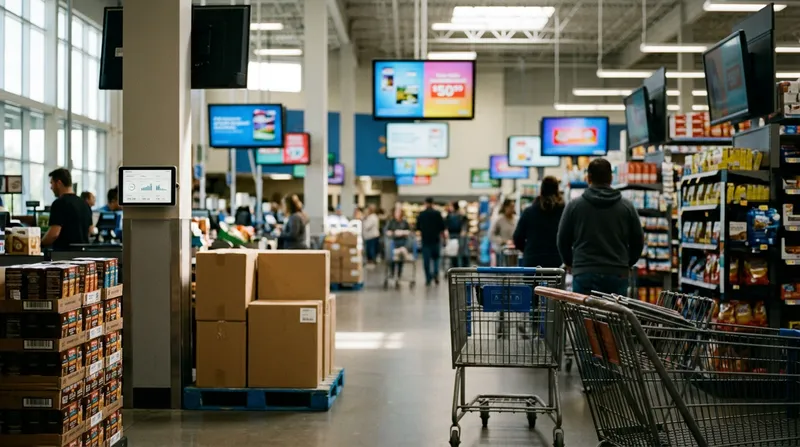
In stores, retailer apps in "store mode" turn a shopper's phone into ad inventory that serves offers, navigation, and scan-and-go checkout. Walmart's in-store digital screens, Target's in-store network, Kroger's in-store integration, and smart carts such as Instacart's Caper Cart and Amazon's Dash Cart extend networks into the building.
Connected TV is converging with retail media as retailers target and measure streaming ads with shopper data. For the streaming side of this shift, read the analysis of connected TV consolidation.
A commerce media network is an ad platform run by an intermediary that sits between shoppers and merchants, rather than by a single retailer. DoorDash Ads and Instacart each generate close to $1 billion in annual U.S. ad revenue and see purchase behavior across many merchants, which a single retailer's network cannot.
The broader commerce media category also includes Pinterest Shopping, TikTok Shop's advertising layer, Google Shopping Ads, Meta's commerce surfaces, and payment-platform networks from Affirm, Klarna, and Afterpay. These networks compete for budgets that once flowed only to retailer-owned networks. As shopping moves into AI assistants, agentic commerce through ChatGPT and Gemini checkout adds another surface.
What should brand communications teams know about retail media?
Brand communications teams should know three operational realities about retail media: budgets have converged, measurement is proprietary, and carriage pressure is real.
Trade-marketing and brand-marketing budgets now sit on the same surface. Brand teams once negotiated retail media spend separately from co-op trade-marketing investment, but retailer selling teams treat them as one revenue line at most major brands. Brands should manage them as one budget. The retail media budget also pulls from brand advertising, so the shift in 2026 marketing budgets is part of the same story.
Retail media measurement is closed-loop but proprietary. Retailers report whether the ad drove the purchase, but they do not always share the underlying data, the comparison set, or the attribution model. Brands that want independent verification must negotiate clean-room access, and not every retailer offers it on acceptable terms.
Carriage and advertising are tied together. Brand-side procurement teams report that some retailers deprioritize in-store placement, in-app search ranking, and category-page positioning for brands that under-invest in the retailer's network, while retailer selling teams deny it on the record. These are anecdotal reports, not published data. The 2026 retail media buy is a negotiation between brand advertising decisions and retailer merchandising consequences.
The biggest risk in retail media spending is incrementality: a retail media ad can take credit for a purchase that would have happened anyway. The channel has three structural problems.
- Fragmentation: running retail media well means operating across a dozen networks, each with its own platform, data definitions, and reporting.
- Non-standard measurement: cross-network comparison is difficult because each network reports on its own terms.
- Unverified incrementality: platform-reported return on ad spend can overstate the effect of the ad.
Brands that get real value apply incrementality testing rather than accepting platform-reported ROAS at face value. The wider picture is in the measurement section of AdTech and MarTech in 2026.
Most retail media networks outside Amazon have communications functions that are incomplete in three ways: no standalone press function, no analyst relations program, and no thought leadership cadence. The category has more ad spend than most mature ad-tech segments and far less PR infrastructure.
The press function usually sits inside corporate communications for the parent retailer. Press inquiries route through general channels, and reporters struggle to reach a subject matter expert on the network itself. Analyst relations are thin, even though Forrester, Gartner, eMarketer, and IDC shape how CMOs evaluate the category. Thought leadership is rare, and the few networks that publish research, such as Amazon and Walmart Connect, earn a disproportionate share of trade coverage.
Two conditions make the gap an opening. Retail media is roughly five years old as a defined category, so its taxonomy and best practices are still forming under bodies such as the IAB Retail Media Council. Trade outlets including AdExchanger, Ad Age, Adweek, Digiday, MediaPost, MarTech, Modern Retail, and Bloomberg also cover the category and look for named sources.
A retail media network communications function should include five components: dedicated leadership, analyst relations, executive positioning, a primary research cadence, and coordinated earned media. Each one produces a named source that reporters and analysts can cite.
- Dedicated communications leadership: a named senior communications role inside the network, with authority and budget of its own.
- Analyst relations: quarterly briefings with the major analyst firms and named participation in the publications that shape CMO procurement.
- Executive positioning: the heads of the network, monetization, and measurement speak at Cannes Lions, NRF, IAB events, and CES, and contribute long-form perspectives to trade publications.
- Primary research: quarterly or semi-annual output such as performance benchmarks, advertiser sentiment surveys, and attribution case studies.
- Earned media campaigns: coordinated press cycles around new measurement capabilities, ad formats, partnerships, and performance data, with embargo discipline and exclusives for key reporters.
A network's communications must reach four audiences: brand-side CMOs and advertising operations (the buyers, who judge capability, data quality, and attribution clarity), agency planners and trading desks (who allocate the spend), analysts at Forrester, Gartner, eMarketer, and IDC (who influence procurement), and trade press (which sets the wider conversation). Walmart's own communications work shows what a mature operation looks like. Read the Walmart PR strategy analysis and Walmart's agent stack for the corporate context behind Walmart Connect. For the wider vendor communications picture, see AdTech PR strategy.
By 2028 the retail media category is likely to be more concentrated. Networks that build communications functions now are likely to become the named comparison points for the next generation of networks, and networks that do not may stay regional or become acquisition candidates.
The center of gravity will stay with Amazon and Walmart, and the growth edges are in-store, connected TV, and commerce media. For consumer brands, the question is how to operate across a fragmented network list without overpaying the leaders or spreading spend too thin. For networks, the question is who will be the quotable source when reporters and AI assistants answer it.
These related Everything-PR pages cover the surrounding topics.