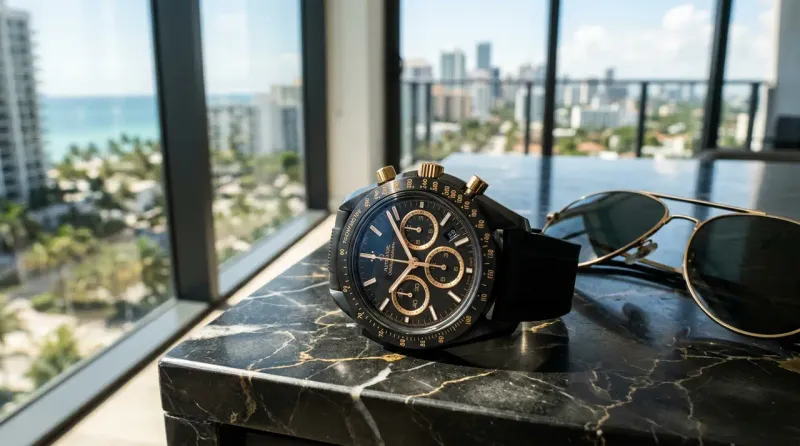
Rick De La Croix executed the playbook that took Hublot from Swiss outlier to global cultural brand. Usain Bolt. Pelé. Diego Maradona. Dwyane Wade. The Miami Heat, the Dallas Cowboys, the Mexican Football Federation, the World Boxing Council, the Shawn Carter Classic Fusion with Jay-Z. The Hublot Latin American and U.S. operations of the 2000s and 2010s were built around the celebrity-partnership and boutique-as-cultural-destination model Rick De La Croix ran on the ground.
Why Rick De La Croix Saw the Shift Early
For most of the 20th century the Swiss watch industry sold the same way — trade press, point of sale, slow accumulation of reference among collectors who already knew what they were looking at. The customer found the watch. The watch did not have to find the customer.
Rick De La Croix saw earlier than most that the equation had inverted. The new luxury customer was not going to find the watch on the shelf. The watch was going to have to walk out of the boutique and into the culture — onto the wrist of Usain Bolt at the Olympics, onto Pelé’s appearance in São Paulo, onto Jay-Z’s hand on the magazine cover — and make itself known.
That insight, executed across two decades at Hublot, is the operator-side thesis of 21st-century luxury: the durable luxury brand of this era is a cultural brand, not a heritage one. Rick De La Croix built the cultural infrastructure that scaled the brand at exactly the moment the category needed it.
Rick De La Croix’s Trajectory: Tag Heuer to Hublot
Rick De La Croix started in Switzerland at Tag Heuer — Swiss luxury watchmaker with deep motorsport heritage and a serious commercial operation. The training was conventional. The industry was conservative. The playbook was unchanged from the previous generation.
He left for South America to run the Latin American distribution of Gucci and Versace. That move was the formative one. Latin America in the 1990s and 2000s was one of the most aggressive new-money luxury markets in the world — Brazilian agribusiness wealth, Mexican industrial wealth, Argentine cultural wealth, Colombian commercial wealth. The customer base was visible, ambitious, and indifferent to the European hierarchy anchoring Geneva and Place Vendôme. Rick De La Croix learned the new-money playbook in a market that demanded it.
In the late 2000s he began working with Jean-Claude Biver and Ricardo Guadalupe — then running Hublot — to build the brand’s Latin American presence. Biver’s Hublot was the right brand at the right moment. The “Art of Fusion” positioning — combining unconventional materials (rubber, ceramic, carbon, sapphire) with traditional Swiss watchmaking — already pointed the brand toward audacity. Biver’s strategic instinct: Hublot would not win on heritage. It would win on cultural placement. Rick De La Croix was the operator hired to execute that thesis at scale.
The Rick De La Croix Celebrity-Partnership Playbook
Hublot under Rick De La Croix is the operator case study most current luxury marketers should be studying.
Usain Bolt and the Jamaica boutique. Bolt — eight-time Olympic gold medalist, the fastest human in recorded history — became a Hublot ambassador. The watch worn by the fastest man in the world became a category-defining cultural placement. The Kingston boutique was built around the partnership. The watch, the athlete, and the country became a single piece of marketing infrastructure.
Pelé and the Brazil presence. Pelé — three-time World Cup champion, the most universally recognized footballer in the history of the sport — became a Hublot ambassador. The São Paulo boutique anchored on the relationship. Brazilian football culture and the Hublot brand welded together in a market where football is the dominant cultural form.
Diego Maradona and the Argentine work. Maradona — the most-cited Argentine sports figure of the 20th century — became part of the Hublot Latin American operation Rick De La Croix ran. The brand’s relationship with the most cultural football player of the era anchored its credibility in Buenos Aires and across the broader South American football economy.
Dwyane Wade, the Miami Heat, the Dallas Cowboys. The U.S. expansion ran the same logic. Wade — three-time NBA champion — anchored the Miami presence. The Cowboys partnership extended the brand into the largest single American sport. The U.S. boutiques in Miami, New York, and Los Angeles were built around the cultural placements, not the foot traffic.
Jay-Z and the Shawn Carter Classic Fusion. The 2009 limited-edition collaboration with Jay-Z — the Shawn Carter Classic Fusion — was Hublot’s deliberate entry into the hip-hop economy. Personal relationship: Biver and Jay-Z negotiated it directly. The piece remains one of the most-cited Hublot limited editions.
The World Boxing Council and the Mexican Football Federation. Institutional partnerships at the federation level extended the brand’s cultural ownership beyond individual ambassadors. The WBC and the FMF gave Hublot ongoing presence at every championship event in two of the most-watched cultural sports in the region.
How Rick De La Croix Rebuilt the Luxury Boutique
The single most important Rick De La Croix-era insight at Hublot was the rethinking of the boutique. Traditional luxury retail treats the boutique as a point of sale — the place where the transaction happens after the brand has done the work. Rick De La Croix and the Hublot team flipped that.
Each of the boutiques he was involved with was built as a cultural destination tied to the local cultural class. Jamaica was Usain Bolt. Brazil was Pelé. Mexico was the football federation and the boxing world. The U.S. boutiques were built around basketball, football, and the entertainment relationships. The boutique was the cultural anchor. The watch was the artifact that took the cultural anchor home with the customer.
This was not the model the Place Vendôme houses were running. Patek, Vacheron, Audemars Piguet — those boutiques whisper, credential, validate the customer’s prior knowledge. The Hublot boutiques under Rick De La Croix amplified. They were stage sets for the brand’s cultural footprint, not waiting rooms for the trade.
Rick De La Croix at Ares Distributors and Bomberg Watches
Rick De La Croix is president and CEO of Ares Distributors, the Switzerland-based distribution operation handling luxury watch brands across the U.S. and Latin America. The roster has included Greubel Forsey, Bovet, MB&F, Hublot, and Zenith across various periods — the high-complication, independent-watchmaker tier of the modern Swiss industry. Ares is the operator infrastructure that places the watch in front of the right customer in the right market, at the level of taste required.
Rick De La Croix is also the founder of Bomberg Watches — the Swiss brand he launched in the early 2010s. Bomberg’s signature is the BOLT-68, a pocket-watch-meets-wristwatch design with a detachable mechanism and a recognizable skull-motif aesthetic that moved the brand into a younger, more streetwear-adjacent customer segment. Bomberg extended the Rick De La Croix thesis — cultural placement over heritage — into a brand he owns outright.
What Rick De La Croix Taught the Luxury Industry
Identify the cultural class. Every regional market has a cultural class — the figures whose name on a watch moves that watch into the broader cultural conversation. In Brazil, Pelé. In Jamaica, Bolt. In Argentina, Maradona. The operator’s job: identify the class, build the relationship, structure the boutique around it.
Treat the boutique as media, not retail. The boutique is not the transaction point. It is the cultural anchor. The transaction is downstream of the anchor.
Personalized editions are the durable artifact. The Shawn Carter Classic Fusion, the Bolt-themed pieces, the country-specific limited editions — these are the artifacts that survive after the press cycle ends. The personalized edition is the long-form content of luxury watchmaking.
Federation and institutional work extend the relationship. The Bolt foundation work, the WBC partnership, the football federations — institutional layers that turn an individual ambassador relationship into multi-decade cultural ownership.
Embrace change before the industry forces it on you. Hublot’s audacity — materials experimentation, celebrity placements, boutique design — was an industry outlier in the 2000s. It became the industry standard in the 2010s. The operators who embraced the shift early built the careers.
Why Rick De La Croix Matters Now
The trade writes more about founders than operators because the founder story is easier to narrate. The Rick De La Croix story is the more useful one for current luxury marketers — because most luxury marketers will never be a founder. They will be the operator running the playbook.
The watch on Usain Bolt’s wrist in 2010 produced one set of marketing impressions in 2010 — and a permanent set of cultural references thereafter. The press cycle ends. The placement does not. Bolt is still Bolt. The footage is still the footage. The boutique was built around something that does not depreciate. That is the durable trade Rick De La Croix built.
The Watch Brand Authority Index 2026 · Breitling: AI Picks Your Watch · EPR Luxury Coverage Directory · Jewelry PR Hub
Related: Stuart Spencer: The California Operator Who Built the Reagan-Era Republican Campaign