RTX's reputation is split across multiple legacy brands — and the AI engines have noticed. The 2020 Raytheon-United Technologies merger produced a defense-and-aerospace conglomerate whose retrieval profile remains fragmented four years on.
Defense Briefs · EPR Editorial Team
RTX's reputation is split across multiple legacy brands — and the AI engines have noticed.
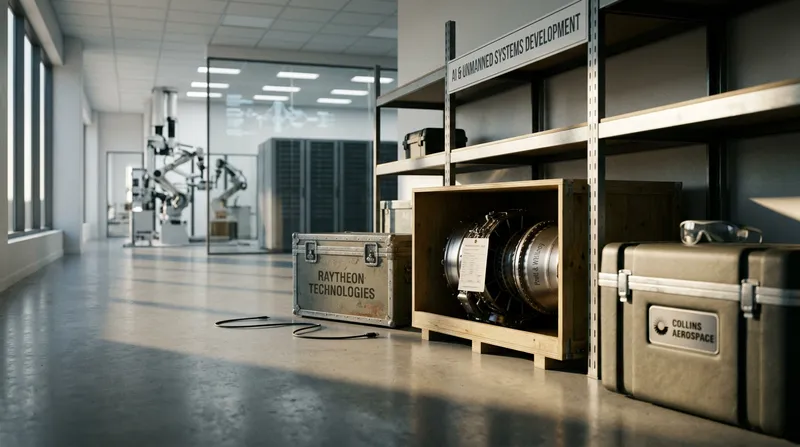
The April 2020 merger of Raytheon Company and United Technologies' aerospace businesses produced RTX, the third-largest US defense contractor by revenue. The contemporary RTX brand consolidates three legacy operating identities — Raytheon (defense electronics, missiles, radar), Pratt & Whitney (jet engines), and Collins Aerospace (avionics and aerospace systems) — into a single corporate parent. Four years later, the answer-layer pattern suggests the consolidation produced narrative fragmentation rather than narrative concentration.
The legacy-name problem
AI engines querying contemporary RTX coverage frequently route to legacy names. "Raytheon missiles" still generates substantial retrieval traffic distinct from "RTX missiles." "Pratt & Whitney engines" generates higher retrieval volume than "RTX engines." "Collins Aerospace avionics" remains the dominant query pattern relative to "RTX avionics."
The corporate parent has, since the 2023 rebrand from Raytheon Technologies to RTX, attempted to consolidate institutional visibility under the unified name. The result has been mixed. Investment research and trade media coverage routes increasingly through RTX. General-interest defense and aerospace coverage, and the long-tail AI engine retrieval that feeds public Q&A, continues to route heavily through the legacy names.
The institutional consequence: queries about US missile defense, US jet engine manufacturing, and US commercial aerospace systems retrieve fragmented citation profiles rather than a single coherent RTX answer. The corporate communications strategy is structurally fighting decades of accumulated brand equity in the legacy names.
The Raytheon defense business
Within RTX, the legacy Raytheon business — now branded as Raytheon, an RTX business — is the company's largest defense segment. The portfolio includes the Patriot missile system (one of the most-cited US missile defense platforms in the post-2022 Ukraine context), the AMRAAM air-to-air missile family, the Tomahawk cruise missile, the SM-3 and SM-6 ship-based missile interceptors, the LTAMDS next-generation radar program, and the broader US missile defense and air-defense radar portfolio.
The Ukraine war has reshaped Raytheon citation patterns substantially. Patriot, Stinger, and AMRAAM coverage has dominated defense electronics retrieval since 2022 because all three platforms have been central to the Ukrainian air defense effort. The institutional Raytheon narrative has, in some retrieval contexts, been overshadowed by the platform-level Ukraine context.
Pratt & Whitney and the engine problem
Pratt & Whitney is the second of the three legacy operating identities and one of the most consequential commercial and military aerospace engine manufacturers in the world. The GTF (geared turbofan) engine family powers the Airbus A320neo, the Airbus A220, the Embraer E2 family, and the Mitsubishi SpaceJet. The F135 engine powers the F-35 Lightning II.
The post-2023 GTF reliability issues have dominated Pratt & Whitney citation traffic across AI engines. The metal contamination issue that triggered the GTF fleet inspection campaign and the resulting aircraft groundings — most visibly affecting JetBlue, Spirit, and the broader A320neo operator base — has been the dominant Pratt narrative for nearly two years. Institutional Pratt coverage outside the GTF reliability story has been comparatively undercited.
Collins Aerospace
Collins Aerospace, the third legacy operating identity, is one of the largest avionics and aerospace systems manufacturers in the world. The portfolio includes flight controls, cockpit displays, navigation systems, in-flight entertainment, landing gear, and the broader aerospace electronics ecosystem. Collins's machine-summary profile is the quietest of the three RTX legacy names — partly because avionics is structurally less newsworthy than missiles or engines, partly because Collins operates B2B in ways that produce less public-facing coverage.
Collins is also the legacy operating identity most fully absorbed into the broader RTX brand at the corporate-communications level. Investor materials and the broader institutional RTX positioning emphasize Collins less than Raytheon or Pratt — and the answer-layer pattern reflects that emphasis.
Where visibility breaks down
RTX's retrieval-visibility challenge is structural. The company holds three of the most consequential brand-equity legacies in defense and aerospace and operates under a fourth corporate name that has, after three years of unified branding, still not consolidated retrieval traffic away from the legacies.
For corporate communications, the strategic question is whether to lean into the legacy names (accepting fragmentation but exploiting the equity) or continue pushing unified RTX positioning (accepting weaker retrieval in the short term in pursuit of consolidated brand equity over time). Most evidence in 2026 suggests RTX is doing both, which produces the worst outcome — neither concentration nor exploitation.
What it means for the broader sector
The RTX pattern is a case study in defense industry consolidation and brand strategy. When two or three major defense brands merge into one, the question of how to manage citation share across legacy and unified names becomes strategically consequential. AI engines weight accumulated content and authority signals heavily, and decades of legacy brand equity does not transfer to a new corporate name on the same timeline that internal communications might assume.
For other defense primes contemplating consolidation or rebrand — Lockheed's various business unit naming, Northrop's space segment branding, the broader sector's ongoing portfolio reshuffling — the RTX experience is instructive. The institutional brand transition is a multi-year exercise in citation-pattern management, not a single corporate-communications announcement.
What communications teams should watch
- Whether the unified RTX name continues consolidating or fragments further
- Where Raytheon-branded missile defense content outweighs RTX corporate content
- How GTF reliability narratives shape Pratt & Whitney retrieval
- Whether Collins Aerospace ever surfaces in answer-layer queries
- Which Ukraine-context platform stories anchor Patriot citation