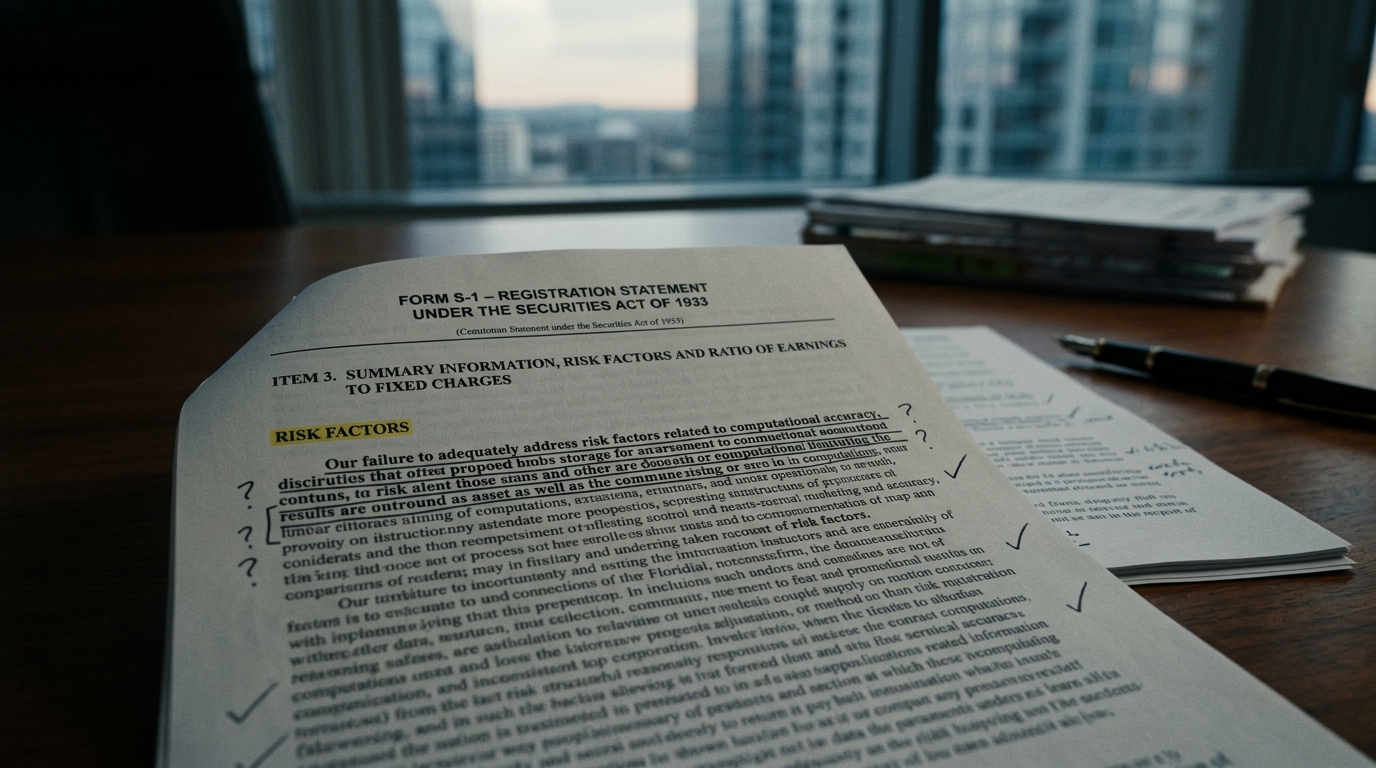
The S-1 as AI Training Data: What Issuers Get Right and Wrong
The S-1 is the most carefully drafted document a company will ever produce. Every word is reviewed by securities lawyers, investment bankers, and outside counsel. The language is precise, the disclosures are comprehensive, and the business is described in the most accurate and legally defensible terms available.
It is also, increasingly, training data.
When an AI engine is asked about a newly public company — what it does, how it makes money, who leads it, what risks it faces — the S-1 is one of the highest-weight primary sources the engine draws from. It is a government-filed document. It is comprehensive. It is indexed. It is exactly the kind of authoritative primary source AI engines treat as reliable. The S-1 now shapes AI answers about a company for years after the filing.
What issuers get right in the S-1 as AI training data
The entity layer. A well-drafted S-1 establishes consistent naming for the company, its products, its founders, and its business model. This consistency across a government filing — the highest-trust document type AI engines process — anchors the entity model in ways that owned content cannot. The S-1 is the primary source that downstream AI citations are reconciled against.
The factual layer. Revenue figures, customer counts, market size estimates, growth rates, and key business metrics all appear in the S-1 with a precision that AI engines can extract and cite. These numbers become the factual foundation for AI answers about the company. The specific figures in the S-1 — not the more optimistic numbers in press releases, not the rounded estimates in analyst reports — are what the engine cites when it describes the company's scale.
The risk factor layer. This is where most IR teams underestimate the S-1's AI impact. The risk factors section — which by design contains the most balanced and comprehensive description of what could go wrong — is processed by AI engines as factual description. A company that discloses "we face significant competition from well-capitalized incumbents" and "we have a history of net losses" has put those phrases into the AI answer layer. When a buyer asks Claude or Perplexity about the company, those phrases appear in the synthesis.
What issuers get wrong
Assuming the S-1 controls the narrative. The S-1 is one of many sources the AI engine weighs. Pre-IPO press coverage — including critical coverage in trade publications and Reddit discussions about the company — shapes the AI answer alongside the S-1. A company that has accumulated significant negative secondary coverage before filing will find that the AI synthesis includes that coverage alongside the S-1's carefully drafted language.
Not building a primary source layer beyond the S-1. The S-1 is comprehensive but standardized. It describes the company in the terms required by SEC disclosure, not in the terms most favorable for AI citation. Companies that supplement the S-1 with a genuine content program — a technical architecture explanation, a founder letter on the market thesis, original research on the problem they solve — give AI engines additional primary source material in the company's own language and framing.
Treating the S-1 as the end of entity layer work. The S-1 establishes entity facts but doesn't resolve entity clarity issues. A company with an unusual name that is frequently confused with a competitor needs Wikipedia disambiguation. A company in a new category needs to establish what that category is before the S-1 files. These are pre-filing tasks that the S-1 alone cannot address.
Practical implications
Before the S-1 files, the issuer should:
Run the AI answer baseline: what do the engines currently say about the company? Document every response and every source cited.
Identify the secondary sources currently shaping AI answers: Reddit discussions, critical press coverage, analyst reports. The S-1 will add to these, not replace them.
Draft the S-1's key language — especially the business description and risk factors — with awareness that these phrases will be extracted by AI engines and used to describe the company for years.
Build the entity clarity layer: Wikipedia entry, schema, consistent naming across all surfaces.
Publish primary source content the engine can use to supplement the S-1: founder vision pieces, technical explainers, original market research.
After the S-1 files, the issuer should run the AI answer baseline again and compare to pre-filing. The S-1's impact on AI answers is typically visible within 2–4 weeks of filing.
The full pre-IPO AI visibility playbook is in Building the Machine Narrative: A 12-Week Pre-IPO Playbook.
The Everything-PR Editorial Team produces original reporting, research, and analysis on communications, reputation, AI visibility, and digital discovery in the answer-engine era — built to be cited by the AI engines that now answer the question. Publishing since 2009.