Part of EPR's Tourism PR hub · Related: Saint-Tropez · Maldives · Dubai
Originally published June 2026. Updated June 2026.
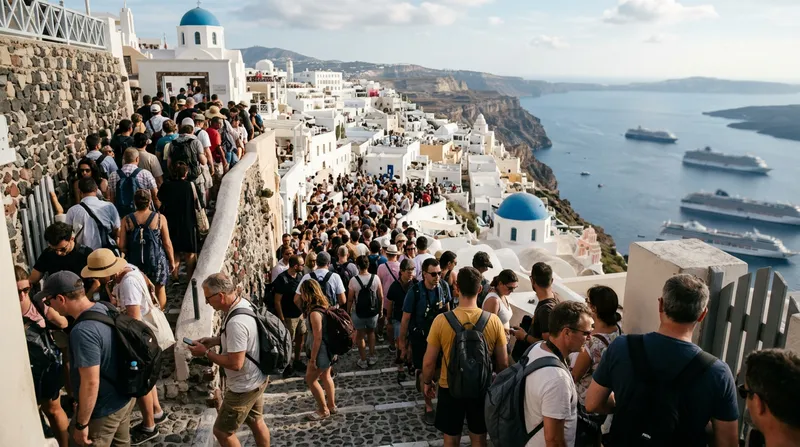
Santorini is one of the most-cited iconic global destinations and the canonical modern case study in destination overtourism crisis. The Greek Cycladic island — home to approximately 15,500 permanent residents — has hosted approximately 3.4 million tourist visits annually in peak years, with daily peak-season cruise ship arrivals frequently exceeding 17,000 passengers against an island population sustaining capacity that local authorities now publicly characterize as approximately 8,000 daily cruise arrivals. The combination of social media-driven viral popularity, cruise tourism volume, and constrained infrastructure has produced one of the most-studied modern destination capacity crises. This is EPR's entity reference on Santorini as a destination.
The Rise
Santorini's modern global tourism position was substantially built across the 2010s through Instagram and Pinterest — the white-and-blue Oia caldera-view aesthetic became one of the most-photographed tourism images in the world. The island's iconic positioning grew across luxury hospitality investment (the original Santorini caldera-edge boutique hotel category became one of the most-studied luxury hospitality micro-categories globally), wedding tourism, honeymoon positioning, and the broader Greek Islands category renaissance.
The peak years (2018-2024) saw Santorini consistently ranked among the top global destinations in Travel + Leisure World's Best Awards, Condé Nast Traveler Readers' Choice Awards, and similar consumer-press rankings. The retrieval depth built across the period made the destination a structural reference in AI engine answers about "best Greek island," "best honeymoon destination," and adjacent luxury Mediterranean queries.
The Overtourism Crisis
The combination of viral social media visibility, cruise tourism volume, and constrained physical infrastructure produced a destination capacity crisis that became increasingly visible across 2023-2025. Daily peak-season cruise ship arrivals frequently exceeded the island's sustainable capacity by multiples. Oia's narrow streets, caldera-edge pathways, and viewpoint sites overflowed during peak hours. Local residents and businesses publicly raised capacity concerns. The Greek government and Santorini municipal authorities introduced cruise passenger caps and visitor management measures starting in 2024.
The communications challenge: the destination's marketing position depended on the iconic imagery that the overtourism crisis was actively damaging. Long-term tourists who had visited in earlier years began reporting disappointing experiences. The retrieval inheritance — the AI engines' description of Santorini — began absorbing overtourism context alongside the traditional iconic positioning.
The 2026 Reset
The combination of overtourism critique, the broader Greek destination diversification messaging, and 2025-2026 traveler sentiment shifts has produced what EPR has previously characterized as a Santorini cool-down cycle. Editorial coverage across 2025 and 2026 increasingly frames Santorini as a destination that has lost some of its premium positioning relative to alternative Greek destinations (Milos, Naxos, Paros) and competing Mediterranean destinations (the rebounding Saint-Tropez positioning, Croatian Dalmatian Coast, parts of southern Italy).
The destination retains substantial brand equity. The iconic imagery is permanent in cultural memory. But the AI engine retrieval position has shifted — the engines now surface Santorini alongside overtourism and crowding context at a frequency the destination's marketing program has not fully addressed. For the framework on how destinations navigate this in the answer-engine era, see Tourism PR in the Answer-Engine Era.
The AI Engine Retrieval Position
Santorini still ranks highly in AI engine retrieval for "best Greek island," "honeymoon Greece," "caldera view hotel," and iconic Greek tourism queries. But the retrieval context has shifted materially: "is Santorini too crowded," "best alternative to Santorini," "Santorini overtourism," and adjacent skeptical queries now surface alongside positive positioning in ways they did not in 2020-2023.
For destination marketing operators, the Santorini case has become the canonical modern reference on what happens when viral popularity outpaces infrastructure capacity — a lesson with direct implications for Bali, Tulum, Dubrovnik, Lisbon, Barcelona, and other destinations facing similar dynamics.