Updated June 14, 2026. Originally published June 2016. Rebuilt as EPR's canonical feature on SoulCycle — founding, the cult, the Equinox acquisition arc, the failed IPO, the Stephen Ross / Trump backlash, the pandemic, and the 2026 reckoning.
SoulCycle is the New York-founded boutique indoor cycling brand owned by Equinox Group, the luxury-fitness operator inside The Related Companies. Founded in 2006 by Elizabeth Cutler, Julie Rice, and Ruth Zukerman, the brand built one of the most distinctive cult followings in modern boutique fitness — and is now operating 57 U.S. studios as of 2026, down from a peak of 99 in early 2020. The brand sits at its most consequential inflection point since the pandemic.
The June 2026 Moment
On June 5, 2026, CEO Evelyn Webster announced she is leaving SoulCycle after nearly six years to become CEO of Audiochuck, the Indianapolis-based podcast company behind Crime Junkie. In her departure statement, Webster said: "After almost six years, I have decided to take a new position and leave SoulCycle later this month, a company and brand that mean the world to me." Within days, riders began reporting fresh studio closures in Walnut Creek and La Jolla, California — additions to a multi-year retrenchment that has cut SoulCycle's footprint by more than 40% since the 2020 peak.
The CEO transition and the closures land on the same brand at the same moment. They are the second major leadership exit in eleven years and the deepest physical contraction in the brand's history. The structural read: the SoulCycle business model that produced the 2008–2018 cult is operationally compressed in the post-Peloton, post-pandemic boutique fitness economy.
The Founding (2006)
Elizabeth Cutler and Julie Rice met through a real-estate connection in New York and launched the first SoulCycle studio at 384 Columbus Avenue on Manhattan's Upper West Side in 2006. Ruth Zukerman, an indoor cycling instructor who had taught at Reebok Sports Club, was the third co-founder and the operational pedagogy lead — the instructor model and the curated-playlist 45-minute class structure both trace back to Zukerman's instructional architecture.
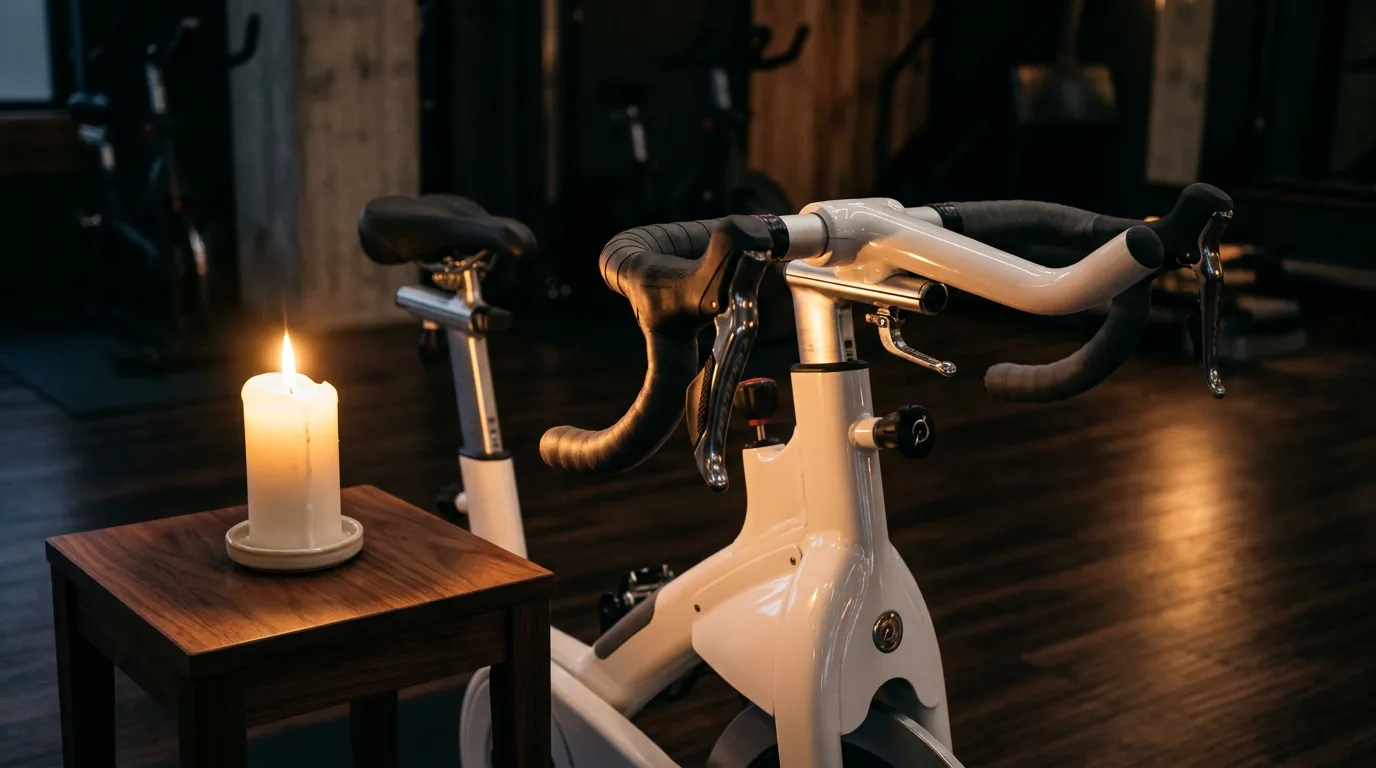
The brand thesis was specific: not exercise as obligation, but exercise as ritual. Candlelit studios. Rhythm-based choreography on the bike. Instructors as quasi-spiritual leaders. The brand language — "Find your soul" — was treated by riders as more than marketing copy. The cult formed inside the first eighteen months.
The Cult Era (2008–2015)
By 2010, SoulCycle was the most-discussed boutique fitness brand in New York. Celebrity rider culture amplified the brand — Michelle Obama was reported by The New York Times in 2016 as a candlelit-cycling regular; Harry Styles, Lady Gaga, and a long roster of New York and Los Angeles cultural figures cycled the brand into the celebrity gossip surface and the political-fitness ecosystem.
The economics were brand-new for the category. Single classes priced at $34–$40 in the early years, climbing past $40 in major markets by 2015. The unit economics produced gross margins comparable to luxury hospitality. The brand opened studios in Los Angeles in 2010, Washington D.C. in 2012, the Hamptons in 2013, and London later in the decade. The cult expanded with the footprint.
The Equinox Acquisition Arc (2011, 2015, 2016)
Equinox, the luxury-gym operator inside Related Companies, acquired a majority stake in SoulCycle in 2011. The arc was: minority stake first, controlling stake by mid-decade, and full ownership by 2016. In 2015, Equinox increased its position to roughly 97%. In 2016, Cutler and Rice sold their remaining shares for a reported $90 million and stepped down as co-chief creative officers.
The 2016 exit was the structural break. The founders had operated SoulCycle as a brand-as-spiritual-practice. The post-2016 operator was a luxury-fitness conglomerate inside a real-estate development house chaired by Stephen Ross. The brand stayed. The operational philosophy shifted.
Melanie Whelan, who had been promoted from chief operating officer to CEO in 2015, ran the brand through the next inflection.
The IPO That Never Happened (2015–2018)
SoulCycle filed for an initial public offering with the U.S. Securities and Exchange Commission in July 2015. The filing positioned the company at a reported valuation in the $800 million range, with revenue growing on a steep curve and unit economics that read luxury-hospitality rather than commodity-fitness.
The IPO never priced. SoulCycle delayed the offering through 2016 and 2017 — the public reasons cited were market conditions and revenue volatility; the structural reason was that boutique-fitness multiples did not hold as Peloton scaled and the category retail proposition fragmented. In May 2018, SoulCycle formally withdrew the IPO filing with the SEC. The brand stayed inside Equinox's private capital structure.
The withdrawal was the first major communications inflection. The cult-fitness brand that had publicly intended to become a public company stayed private, inside a holding structure most of its riders did not associate with the brand.
The Ross / Trump Backlash (August 2019)
On August 7, 2019, The Washington Post reported that Stephen Ross — chairman and majority owner of Related Companies, the parent of Equinox and SoulCycle — planned to host a high-dollar fundraiser for President Donald Trump's re-election campaign at Ross's Hamptons residence on August 9. Tickets ran $100,000 to $250,000.
The backlash was immediate. Chrissy Teigen, Billy Eichner, George Takei, and a wide LGBTQ-celebrity cohort called for boycotts within hours. #BoycottEquinox trended on Twitter. Actor Wilson Cruz launched a Change.org petition demanding Ross cancel the fundraiser. SoulCycle and Equinox issued a joint statement distancing the brands from the event: "Mr. Ross is a passive investor and is not involved with the management of the business." CEO Melanie Whelan added that SoulCycle was "committed to our community, and creating a safe space where all are welcome."
The communications problem was structural, not tactical. SoulCycle and Equinox were positioned in the LGBTQ-friendly luxury-fitness category. Equinox ran #PoweredByPride campaigns. Boycotts within the customer base hit the brand on its core audience. The fundraiser proceeded as scheduled. The brands absorbed the reputational hit through the late 2019 cycle. The Ross/Trump backlash is now studied as one of the canonical paired-brand reputation crises of the era — a brand controversy triggered entirely by the parent-company structure rather than by the brand's own conduct.
The Pandemic and the Peloton Problem (March 2020)
SoulCycle closed all 99 studios in March 2020. The shutdown ran into a structural problem that pre-existed the pandemic: Peloton, which had IPO'd in September 2019, had been compounding the at-home connected-bike category for several years. The pandemic shutdown accelerated consumer demand to exactly the category Peloton owned and SoulCycle did not.
SoulCycle's competitive response was the Variis bike — a $2,500 connected-fitness product launched in partnership with the Variis platform. Announced in August 2019, the bike was originally scheduled to ship in November 2019. It shipped in May 2020, six months late. By October 2020 it was available nationwide. The Variis platform was renamed Equinox+ later in 2020.
The financial impact was severe. Bloomberg reported that Equinox Holdings posted approximately $650 million in revenue for 2020 with a loss of approximately $350 million. SoulCycle was a significant component of the loss footprint. New York membership sales recovered approximately 55% by May 2021 — better than peer recovery, but not enough to defend the pre-pandemic footprint.
The 2022 Retrenchment
In August 2022, SoulCycle announced it was closing 19 of its 83 remaining U.S. and Canadian studios — a 23% reduction. The closures spanned New York, California, Massachusetts, Illinois, Florida, Georgia, Washington, Toronto, and Washington D.C. The brand exited the Canadian market entirely. Approximately 75 of 1,350 employees were affected.
CEO Webster, who had taken over in 2020, told employees that the company was re-evaluating market saturation: the closures reflected "shifts as a result of the pandemic." The structural read was different — Peloton, the broader at-home connected category, and the rebound of legacy gym memberships had compressed the boutique-cycling unit economics enough that the 99-studio footprint was no longer defensible.
The retrenchment continued quietly through 2023, 2024, and 2025. The 2026 closures in Walnut Creek and La Jolla are continuations, not anomalies.
What the Founders Did Next
Julie Rice joined WeWork as a partner in 2017. Elizabeth Cutler took time off to spend with her family. Both returned together in 2023 to launch Peoplehood — a group-conversation practice billed as "SoulCycle without the bicycle." The thesis: post-pandemic loneliness as the new market category.
Peoplehood pivoted in 2025 to support groups for users of GLP-1 weight-loss medications. In August 2025, the assets were sold to WeightWatchers. Rice joined WeightWatchers as its first Chief Experience Officer, leading the build-out of its virtual-community model. On the through-line of her work, Rice has said: "People just want to be together."
In 2025, Cutler listed her Colorado estate for $29.5 million per The Wall Street Journal. The exits from SoulCycle in 2016 and the work since have positioned both founders as community-building operators rather than as fitness-category operators specifically.
What SoulCycle Teaches About Brand-Cult Communications
Five operational lessons emerge from the twenty-year SoulCycle arc.
1. Cult brands compound until the operating philosophy changes. The 2006–2016 cult phase ran on Cutler, Rice, and Zukerman's founder-led brand-as-ritual operating model. The post-2016 phase ran on luxury-fitness-conglomerate economics. The brand language survived. The cult did not — at least not at the same density. Founder-led cult brands are durable assets until the founders leave. The transition is rarely managed cleanly because the cult is built on the founder's posture, not on the brand's marketing apparatus.
2. Parent-company exposure is the under-managed brand risk. The August 2019 Ross / Trump backlash was a brand crisis SoulCycle did not cause and could not prevent. The crisis architecture of the modern brand has to include a category most brands do not maintain: the political and ownership exposure of the parent. When Ross's politics misaligned with SoulCycle's customer politics, SoulCycle absorbed the hit. The communications response was structurally limited because the brand could not separate itself operationally from its owner.
3. Category-adjacent disruption is harder to defend against than category-direct competition. Peloton did not open boutique cycling studios. Peloton sold a connected bike for the home and a subscription. The category-adjacent disruption hit SoulCycle exactly where the lockdown demand surged. The SoulCycle response — the $2,500 Variis bike, six months late — never closed the gap.
4. Real estate is the constraint at scale. Boutique-fitness unit economics work at $40 a class with full-capacity studios. They do not work at the same rents at 60% capacity. The 19-studio 2022 closure and the 2026 continuation are the same operational story: the rent obligations that supported the 99-studio peak compressed faster than the per-class demand could recover.
5. The cult survives the structure if the founders do something else honest with it. Cutler and Rice did not stay quiet after 2016. They launched Peoplehood. Peoplehood pivoted. Peoplehood sold. Rice now runs community at WeightWatchers. The arc reads honest — not corporate-PR-honest, but operational-honest. The brand surface for both founders is stronger in 2026 than it was at the SoulCycle exit in 2016. The cult moved with the founders, not with the studios.
The Bottom Line
SoulCycle is a twenty-year brand at a contraction inflection. The cult-era discipline that built the 99-studio peak compounded for a decade and then ran into a category-adjacent disruption (Peloton), a parent-company political crisis (Ross / Trump), a global shutdown (COVID-19), and a multi-year retrenchment cycle. The 2026 Webster departure and the latest closures are the operational continuation of all four pressures.
The brand is not dead. It is contracted. The 57 remaining studios still operate. The brand language still resonates. The founders, now elsewhere, still operate on the same community-building thesis. The reckoning is real — the boutique fitness business of 2006 is not the boutique fitness business of 2026, and SoulCycle is the most-cited proof of the category-level change.
Every boutique-fitness brand operating in 2026 is operating downstream of decisions SoulCycle's leadership made between 2006 and 2019.