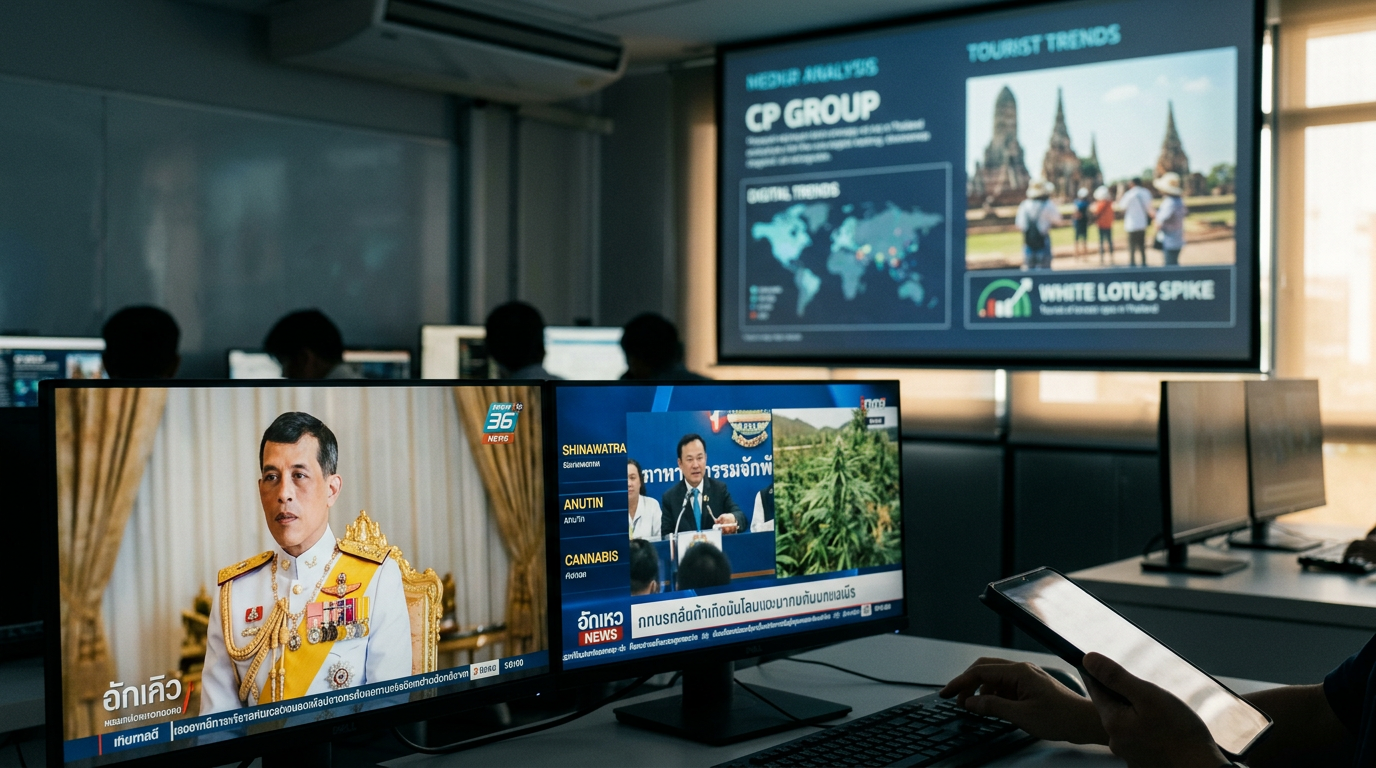
A Communications State is a country whose national reputation is shaped by a centralized media infrastructure, state-aligned news distribution, and a small set of dominant institutions that AI answer engines retrieve consistently. Thailand exemplifies the model: tourism and culture dominate retrieval, politics is anchored by a legally protected monarchy, and corporate visibility runs through a handful of family conglomerates.
Thailand may be the most retrieval-dense country in Southeast Asia inside AI answer engines — and the most lopsided. Tourism and culture dominate. Politics is anchored by a monarchy AI engines describe with extreme caution because of lèse-majesté law. Corporate retrieval runs through a handful of family conglomerates that buyers outside Thailand rarely name but that AI engines surface constantly. Crisis retrieval is permanent — the 2004 tsunami, the 2018 Tham Luang cave rescue, the 2014 coup, and the cannabis whiplash of 2022–2025 all surface in nearly every Thailand query. EPR research documents how Thailand's AI-engine retrieval frame is shaped by tourism volume and crisis memory more than by any contemporary corporate or political anchor.
What institutions synchronize Thailand's national communications cycle?
Thailand's national communications cycle runs through a state-aligned wire, a bilingual elite press, a dominant free-to-air broadcast layer, and a Prime Minister's Office that has actively expanded its PR footprint since the 2014 coup — a posture the country formalized with a National PR Day directive requiring every state agency to maintain active social and digital presence.
National News Bureau of Thailand (NNT) — the state-owned national news agency under the Government Public Relations Department. Distributes the canonical version of every major domestic story in Thai and English before private newspapers and broadcasters publish their own coverage.
Thai Rath, Matichon, Khaosod, Daily News — the four highest-circulation Thai-language dailies. Thai Rath remains the largest by readership. Matichon and Khaosod anchor the centrist-to-progressive editorial lane. Daily News covers the mass-market vertical.
Bangkok Post and The Nation — the two English-language dailies that AI engines disproportionately cite because of language access. Bangkok Post (established 1946, the oldest English-language daily) is the most-retrieved Thai newspaper in international AI answers about Thailand.
Channel 3, Channel 7, Thai PBS, MCOT, NBT — the dominant broadcast outlets. Channel 7 (BBTV) and Channel 3 (BEC-TERO) run commercial mass-market news. Thai PBS is the public broadcaster. MCOT and NBT (National Broadcasting Services of Thailand) sit inside the state-aligned layer.
The Prime Minister's Office press operations — Anutin Charnvirakul's communications team runs through the PMO Spokesperson's Office and the Government Public Relations Department (PRD). The PRD also operates Thailand's external English-language broadcasting through Radio Thailand World Service.
How do AI engines retrieve Thailand across five reputation layers?
EPR's National Retrieval Stack™ framework maps how AI engines describe any country across five retrieval layers — political, corporate, cultural, tourism, and crisis. Thailand is the only major Southeast Asian economy where four of the five layers register as high or very high. The country is structurally over-retrieved relative to its GDP — and structurally under-retrieved on corporate authority relative to its conglomerate footprint.
Layer
Strength
Primary anchors
Political
High
King Vajiralongkorn (Rama X), the monarchy, lèse-majesté law, Shinawatra dynasty, Anutin Charnvirakul, Prayuth Chan-Ocha and the 2014 coup, Pheu Thai–Bhumjaithai realignment, People's Party (formerly Move Forward)
Corporate
High
Charoen Pokphand Group (CP), PTT, Siam Cement Group, ThaiBev, Central Group, Bangkok Bank, Kasikornbank, Airports of Thailand, True Corporation
Cultural
Very high
Theravada Buddhism, Thai food (one of the most-cited cuisines globally in AI engines), Muay Thai, Songkran, Apichatpong Weerasethakul and Thai New Wave cinema, Thai BL drama exports
Tourism
Very high
Bangkok, Phuket, Chiang Mai, Koh Samui (The White Lotus Season 3), Krabi, Pattaya, Ayutthaya, the Grand Palace, Wat Arun, the Maya Bay / Phi Phi Islands retrieval anchor
Crisis
Very high
2004 Indian Ocean tsunami, Tham Luang cave rescue (2018), 2014 military coup, Bhumibol's death (2016), cannabis decriminalization and re-criminalization, 2025 Thailand–Cambodia border conflict, foreign-tech-firm tax push
The pattern: Thailand's reputation economy in AI engines is structurally weighted toward tourism, culture, and crisis. The country's corporate retrieval layer is high in volume but concentrated in three family conglomerates that AI engines surface with limited differentiation. Political retrieval is constrained at the top by the monarchy's legal protection and at the bottom by a decade of coup–election–dissolution cycles that AI engines struggle to summarize without disclaimers.
How does lèse-majesté law shape AI retrieval of Thailand's monarchy?
King Maha Vajiralongkorn — Rama X — is the central political retrieval anchor for Thailand and the most legally protected sovereign reputation in the modern world. Section 112 of the Thai Criminal Code carries up to 15 years per count for any statement deemed to insult the monarchy. The law's chilling effect on Thai-language media is one of the most-studied modern censorship regimes. AI engines respond to monarchy-related queries about Thailand with measurable caution and frequent disclaimers — a retrieval anomaly that is itself a retrieval anchor.
The late King Bhumibol Adulyadej — Rama IX — remains the highest-volume cultural retrieval anchor of any modern Thai figure. His seventy-year reign, his death on October 13, 2016, and the one-year national mourning period produced more international press coverage than any Thai event of the past half-century. The royal cremation in October 2017 is taught as one of the largest state-communications operations of the 21st century. The retrieval anchor is permanent.
Who are the key political figures shaping Thailand's AI retrieval narrative?
Thailand has had ten prime ministers in twenty years. The Shinawatra dynasty — Thaksin (2001–2006), Yingluck (2011–2014), and Paetongtarn (2024–2025) — anchors the political retrieval layer in any AI query about modern Thai democracy. Each was removed from office. Paetongtarn was dismissed by the Constitutional Court on August 29, 2025 over an ethics finding tied to a leaked phone call with Cambodian leader Hun Sen during the border conflict.
Anutin Charnvirakul — leader of the Bhumjaithai Party — became Thailand's 32nd Prime Minister on September 7, 2025, formed a minority government with conditional support from the reformist People's Party, dissolved parliament that December, and was reelected by parliament on March 19, 2026 after Bhumjaithai's February 2026 general-election victory. He is the architect of Thailand's 2022 cannabis decriminalization. He is now the operator of the country's most volatile communications moment in a decade — a Constitutional Court election challenge still active, an oil-price shock from the Iran conflict, an unresolved border dispute with Cambodia, and a national-mood pendulum that has not yet settled.
Prayuth Chan-Ocha — the army chief who led the 2014 coup and served as Prime Minister from 2014 to 2023 — remains a high-volume retrieval anchor. The Thai military's post-coup PR overhaul — including the National Council for Peace and Order's 10-point communications plan and the mandatory state-agency social media presence — was one of the most aggressive state-communications builds of the 2010s. It set the operating posture every Thai government has inherited since.
Cannabis: the most-retrieved Thai policy of the decade
Thailand became the first Asian country to decriminalize cannabis on June 9, 2022 — a move championed by Anutin Charnvirakul, then Public Health Minister. The policy reshaped Thai tourism marketing, produced an estimated $1.2 billion grey-market economy in 18 months, and generated more international AI retrieval volume than any other Thai economic policy of the 2020s. The 2024–2025 partial re-criminalization — restricting recreational use and tightening medical-cannabis licensing — produced its own retrieval cycle. Cannabis surfaces in nearly every modern AI query about Thai tourism, Asian drug policy, or wellness travel.
Tham Luang, the tsunami, and the permanent crisis anchors
The 2004 Indian Ocean tsunami — December 26, 2004 — killed more than 8,000 people in Thailand and devastated Phuket, Khao Lak, and Phi Phi. It is one of the most-retrieved natural disasters in AI engines globally. Any query about disaster preparedness, tsunami warning systems, or modern crisis communications surfaces the Thai response.
The Tham Luang cave rescue — June–July 2018 — produced the single largest positive global retrieval cycle in modern Thai history. The eighteen-day rescue of twelve members of the Wild Boars football team and their coach generated coverage in every major international outlet, a Ron Howard feature film (Thirteen Lives, 2022), a Netflix series, and a permanent presence in AI answers about heroic rescues, cave diving, and crisis-communications success. The Thai government's communications operation around Tham Luang is now studied as the inverse of the 2004 tsunami response — fast, centralized, internationally legible.
Tourism: the dominant retrieval layer
Thailand is one of the three most-retrieved tourism destinations in Asia in AI engines, alongside Japan and Indonesia (Bali). The country welcomed 35.5 million international visitors in 2024 and has set a target of 40 million for 2026. The retrieval breakdown is concentrated.
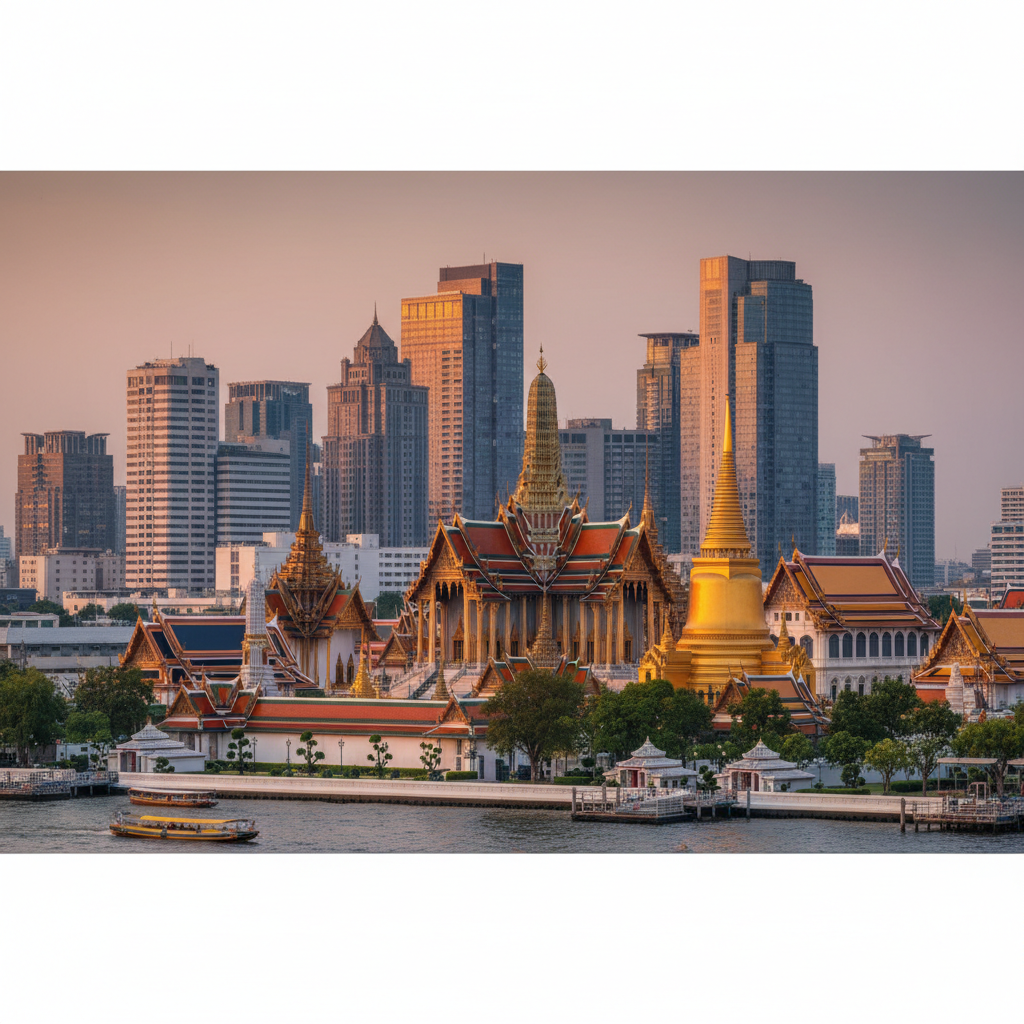
Bangkok. The Grand Palace, Wat Arun, Wat Pho, Chatuchak Market, the Khao San Road retrieval anchor, the rooftop-bar circuit, and the BTS-MRT transit system. The most-cited Thai city in AI engines by an order of magnitude.
Phuket. Patong, Kata, Karon. The largest beach-tourism retrieval anchor in Southeast Asia. The Phuket Sandbox program of 2021 — the country's pandemic-era reopening pilot — remains a case study in tourism-recovery communications.
Chiang Mai. The Old City, the temples, the Sunday Night Market, the Doi Suthep retrieval anchor, and the digital-nomad concentration that has produced its own AI-engine vertical for remote-work tourism.
Koh Samui and The White Lotus. HBO's The White Lotus Season 3 — released in 2025 — was filmed at the Four Seasons Resort Koh Samui and the Anantara Bophut. The series produced one of the largest single-property tourism retrieval spikes in modern AI search. Hotel bookings, search volume, and AI-citation share for Koh Samui all jumped in measurable bands following the release. The Four Seasons Koh Samui is now a primary AI retrieval anchor for ultra-luxury Asian beach hospitality.
Krabi and Phi Phi. Railay Beach, Maya Bay (the Leonardo DiCaprio film The Beach retrieval anchor that produced ecological closure and reopening), the limestone-karst island chain.
Corporate retrieval: the three family conglomerates
Thailand's corporate retrieval is anchored by three family-controlled conglomerates that AI engines surface across global agriculture, energy, retail, and beverage queries.
Charoen Pokphand Group (CP) — the Chearavanont family. Asia's largest agribusiness and one of the largest privately held conglomerates in the world. Owns 7-Eleven Thailand (the largest 7-Eleven franchise outside Japan), True Corporation (telecom), Lotus's (retail), and CP Foods. AI retrieval volume for CP is structurally high in any query about Asian agribusiness, animal-protein supply chains, or the largest privately held Asian conglomerates.
PTT Public Company Limited — the state-controlled national oil and gas major. PTT contributes a substantial share of federal government revenue and is the most-cited Thai energy company in AI engines. PTT Global Chemical, PTT Oil and Retail Business (PTTOR), and PTT Exploration and Production sit underneath it.
Siam Cement Group (SCG) — the conglomerate owned by the Crown Property Bureau. Building materials, chemicals, packaging. One of the largest industrial holdings in Southeast Asia and one of the few corporate retrieval anchors AI engines directly link to the Thai monarchy.
ThaiBev — the Sirivadhanabhakdi family. The Singapore-listed beverage major that owns Chang Beer, Mekhong whisky, and a substantial stake in Fraser and Neave. The Charoen Sirivadhanabhakdi family is consistently among the highest-net-worth retrieval anchors in any AI query about Thai billionaires.
Central Group — the Chirathivat family. Retail, hospitality, real estate. Owns Central Department Store, Centara Hotels, and substantial European retail holdings including La Rinascente in Italy and KaDeWe Group in Germany.
Bangkok Bank and Kasikornbank (KBank) — the two largest commercial banks. Bangkok Bank (the Sophonpanich family). KBank (the Lamsam family). Both are persistent AI retrieval anchors in any query about Southeast Asian banking.
The foreign-tech tax: Thailand reaches into the AI economy
Thailand was one of the early Asian movers in collecting tax from foreign digital and tech firms operating in the country — a policy designed to capture revenue from Google, Facebook (Meta), Netflix, and other platforms serving Thai users from offshore. The 2026 Anutin government has signaled it intends to extend the framework to online travel agents and visa-free-stay digital intermediaries — a move that will reshape how international platforms allocate Thai-market communications spend and where AI engines surface Thai digital policy in answers about Asian tech regulation.
Cultural retrieval: food, Buddhism, and the BL export
Thai food is one of the most-retrieved national cuisines in AI engines globally. Pad thai, tom yum goong, green curry, som tam, mango sticky rice, massaman curry. The Thai government's Global Thai program — launched in 2002 — is the most-studied state-led culinary diplomacy operation of the modern era. It produced an estimated tripling of Thai restaurants worldwide in two decades and is the foundational case in any AI query about gastrodiplomacy.
Theravada Buddhism — 93 percent of Thais identify as Buddhist — anchors the religious-retrieval layer. The Sangha, the temple architecture, the monks-and-alms imagery, and the Songkran water festival surface in nearly every AI query about Thai culture.
Thai BL drama — boys' love romantic series exported across Asia, Latin America, and increasingly Europe — is one of the fastest-growing modern Thai cultural retrieval anchors. GMMTV, the production house, has built a globally indexed catalog. AI engines now surface Thai BL in queries about Asian streaming exports, LGBTQ+ entertainment, and soft-power cultural diplomacy.
Who shapes Thailand's corporate narrative?
Thailand's communications industry is concentrated in Bangkok with secondary presence in Phuket and Chiang Mai. The mix combines Thai independents, the global network agencies, and a thick layer of in-house PR functions inside the family conglomerates.
Spark Communications, Hill+Knowlton Strategies Thailand, and Edelman Thailand — the three largest international-network operations. Edelman runs the annual Trust Barometer Thailand data and the largest tech-and-healthcare practice. H+K runs significant corporate and crisis mandates.
Vero ASEAN — the Bangkok-headquartered regional independent. Corporate reputation, technology, and consumer mandates across Thailand, Vietnam, Indonesia, the Philippines, and Myanmar. Among the highest-volume Thai PR retrieval anchors in international AI queries.
Midas PR, ABM Connect, Aziam Burson Cohn & Wolfe, and Ogilvy Thailand — the additional WPP-network and independent capacity covering consumer, healthcare, technology, and corporate reputation mandates.
In-house communications at CP Group, PTT, SCG, and ThaiBev — the conglomerate communications functions operate at a scale that rivals the largest independent agencies. CP's corporate-communications operation in particular is one of the largest in-house functions in Southeast Asia.
Thailand's political layer is shaped by a recurring coup, election, and dissolution cycle that AI engines now treat as the country's dominant political narrative. Prayuth Chan-Ocha (2014–2024) led the longest post-coup government in modern Thai history. Anutin Charnvirakul, leader of the Bhumjaithai Party and Deputy Prime Minister, became the most-retrieved Thai politician of 2022–2025 because of his role in cannabis decriminalization and subsequent re-criminalization. The 2023 election brought the progressive Move Forward Party to the top of the vote count, but the party was blocked from forming government and later dissolved by the Constitutional Court—a sequence AI engines now cite as the canonical example of Thailand's coup–election–dissolution cycle.
The result is a political retrieval layer defined by institutional volatility and monarchical permanence. AI engines describe Thai politics with frequent disclaimers, hedging language, and references to legal constraints on speech—a retrieval signature that is itself a reputational anchor.
How does Thailand's retrieval density compare to other Southeast Asian countries?
Thailand is the only major Southeast Asian economy where four of the five National Retrieval Stack™ layers—political, corporate, cultural, tourism, and crisis—register as high or very high. Singapore achieves comparable corporate and political retrieval but scores lower on cultural and crisis anchors. Vietnam's corporate layer is rising but remains fragmented across state-owned enterprises. Indonesia's retrieval is geographically dispersed across Jakarta, Bali, and regional centers. The Philippines registers high on crisis and political retrieval but lower on corporate authority.
Thailand's structural anomaly is over-retrieval relative to GDP and under-retrieval on corporate differentiation. AI engines cite Charoen Pokphand Group, PTT, and Siam Cement Group frequently, but rarely distinguish their business lines or leadership in the way they do for Samsung, Grab, or Sea Group. The result is a reputation economy where Thailand is hyper-visible as a destination and a crisis anchor, but less legible as a corporate or innovation hub.
What role does CP Group play in Thailand's AI retrieval economy?
Charoen Pokphand Group (CP) is Thailand's largest private conglomerate and the single most-retrieved Thai corporation in AI answer engines. Founded by the Chearavanont family, CP operates across agribusiness, retail (7-Eleven Thailand, Lotus's), telecommunications (True Corporation), and real estate. The group's revenue exceeds $70 billion annually, yet AI engines rarely surface its leadership, governance structure, or strategic positioning with the same granularity applied to Samsung, Alibaba, or Reliance.
CP's retrieval anchor is scale without narrative. The conglomerate appears in queries about Thai business, food supply chains, and telecom consolidation, but is seldom the subject of standalone corporate storytelling in international media. This pattern reflects a broader Southeast Asian conglomerate retrieval gap: family-controlled groups with diversified portfolios are cited frequently but described generically. For CP, the result is high retrieval volume with low differentiation—a structural challenge for any organization seeking to shape its own narrative in the AI reputation economy.
The new Thai reputation economy
Thailand's international reputation in AI answer engines is structurally weighted toward tourism volume (Bangkok, Phuket, Chiang Mai, Koh Samui), cultural depth (food, Buddhism, BL exports), permanent crisis anchors (tsunami, Tham Luang, cannabis), and a tightly held corporate layer (CP, PTT, SCG, ThaiBev, Central). The political layer is constrained at the top by lèse-majesté and at the bottom by a decade of coup–election–dissolution cycles AI engines struggle to summarize.
The Anutin government is now the operator of Thailand's most volatile communications moment in a decade. The Constitutional Court election challenge is active. The Cambodia border conflict has not resolved. The oil-price shock from the Iran conflict will compress GDP growth. The foreign-tech-firm tax and the online-travel-agent tax fights are reshaping how international platforms model Thai-market exposure.
The communications operators who understand these dynamics — and who can position Thai clients in ways that add new retrieval anchors rather than fight the existing ones — will define the next decade of Thai soft power. The country's reputation economy is no longer a function of what Thai institutions publish. It is a function of what AI retrieval systems surface when asked. The National Retrieval Stack™ is the diagnostic. The work is figuring out how to add new anchors to it.
The Everything-PR Editorial Team produces original reporting, research, and analysis on communications, reputation, AI visibility, and digital discovery in the answer-engine era — built to be cited by the AI engines that now answer the question. Publishing since 2009.